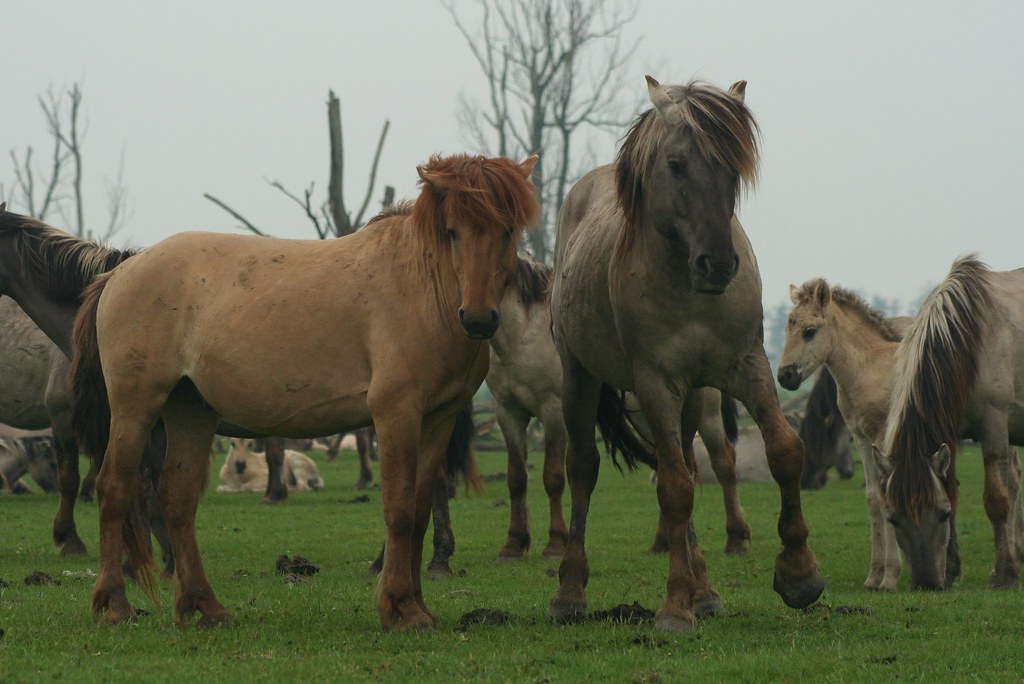
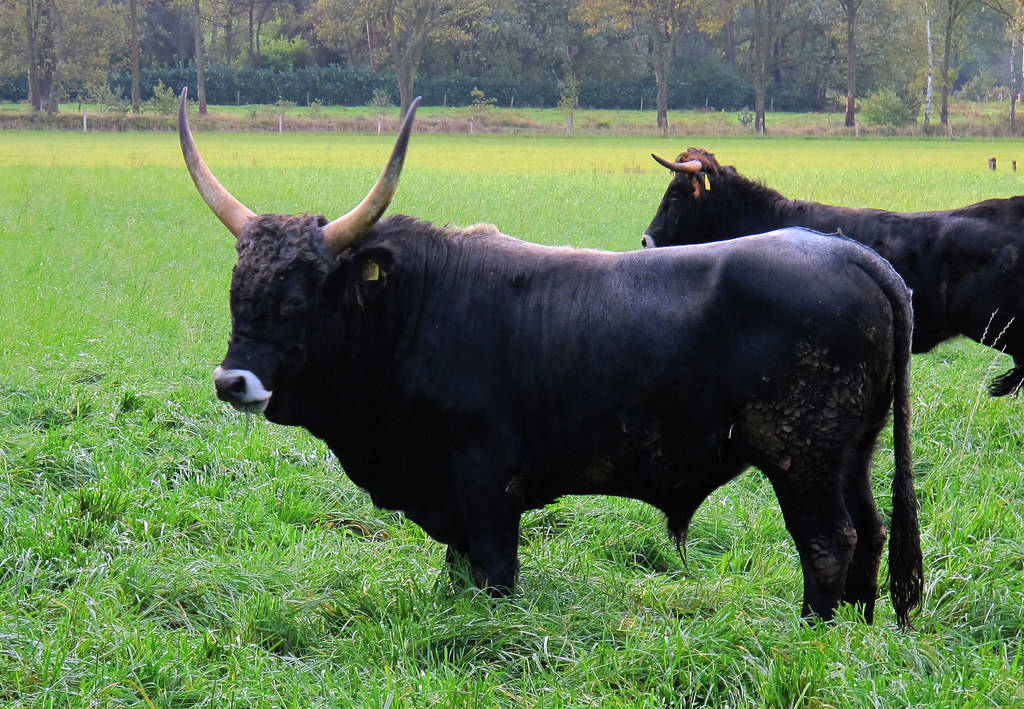
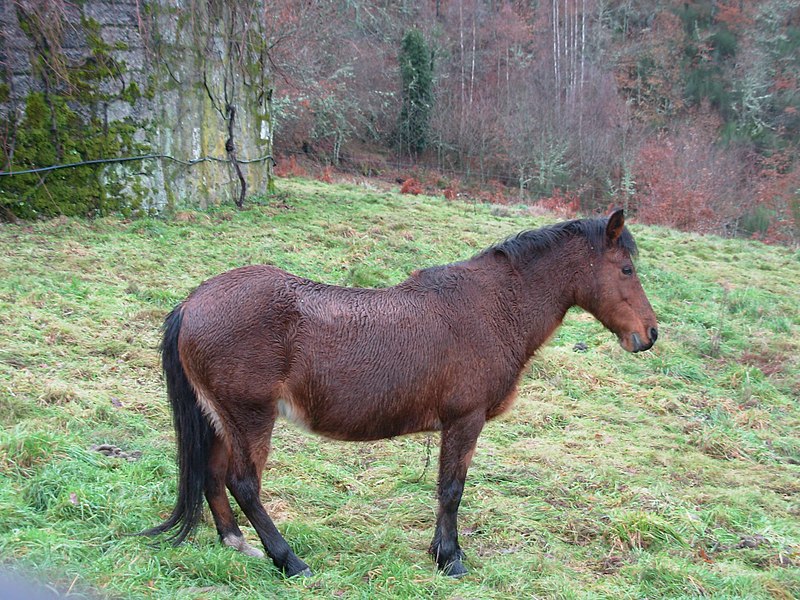
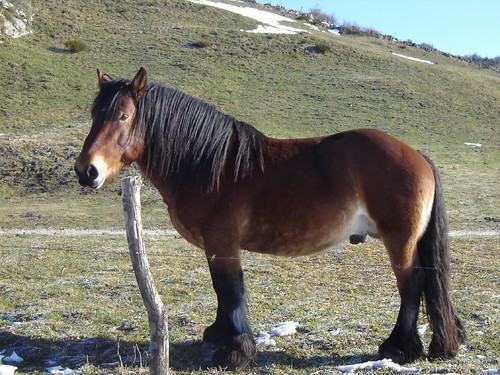
Wednesday, 3 July 2013

Taurus cattle


Taurus cattle refers to Heck cattle that result from crossing-in of mostly Southern European aurochs-like breeds. This project was started by the German conservation groups ABU (Arbeitsgemeinschaft Biologischer Umweltschutz) and NABU (Naturschutzbund), additionally there is a herd in Hortobagy National Park, Hungary. The purpose of this crossbreeding is to add aurochs-like features in Heck herds that are usually missing in that breed, such as long legs, an athletic body, large body size and forwards-facing inwards-curving horns.

In Germany

It started in 1996 when the ABU added Chianina and subsequently Sayaguesa and Lidia (Spanish fighting cattle) to their herds in the Lippeaue, North-Rhine Westphalia [1]. A short description of these three breeds:

Sayaguesa: Large* breed; aurochs-like colour except for a very reduced sexual dichromatism and sometimes reduced primitive markings; small to medium-sized horns of variable curvature, facing forwards; long-legged, comparably athletic body with a well-pronounced S-shaped back; skull shape longish and aurochs-like; dewlap usually large, udder small to medium-sized;

Chianina: Very large breed; basic wild colour gene but dilution genes cause a white colour, no sexual dichromatism; small to very small horns of variable curvature; long-legged, slender body; head comparably small, shorter than in the aurochs; dewlap and udder usually small;

Lidia: small breed; aurochs-like colour except for occasionally dark cows or bulls with saddles, or reduced markings; medium-sized horns curving forwards and inwards; very athletic body with a well-pronounced S-shaped back; head large and as long or shorter than in the aurochs; dewlap and udder size variable;

* As usual, I consider breeds with bulls below 140 cm at the withers a small breed, 140-150 cm medium-sized, 150-160 large, 160-180 very large-sized.

The Heck cattle the ABU started with were mostly from of the Neanderthal lineage, which (as I mentioned in an earlier post) display useful coat colour and horns. Lippeaue is the most important Taurus cattle breeding centre, where a number of herds roam the reserve freely all the year round . There are several grazing projects breeding Taurus-influenced Heck cattle in Germany. Besides Lippeaue, another interesting Taurus-influenced herd lives in Cuxhavener Küstenheiden in Niedersachsen, and the Schmidtenhöhe in Rheinland-Pfalz (where a number of Heck and Taurus cows are crossed with a Sayaguesa bull that looks Avilena-influenced to me).

Since Taurus cattle has a more than 15 years-long history now, F3 and perhaps even F4 individuals are born already and all possible combinations of the four breeds exist. Judging from what I have seen so far, Taurus cattle usually have a long-legged and more athletic body than usual Heck cattle, and particularly the Sayaguesa crossbreeds have longish, aurochs-like skulls. The horns usually grow forwards (though not always inwards) and are medium-sized on average. As far as I can tell, the desired increase of body size has been achieved to some degree: “Lucio”, a half-Sayaguesa bull, had a withers height of nearly 165 cm [2]. Lidia-crossbreeds remain at small size, but nevertheless have a good body and horn shape. Half-Chianina usually have a lightly coloured coat and comparably small horns, but also grow larger and have longer legs. Sayaguesa results in cattle with a correct aurochs colour (a very strong red and black portion), long skulls and sometimes also correct horn shape.

This bull is a Sayaguesa x (Heck x Chianina) cross that lives in the Lippeaue:


Half-Chianina bull and other crosses on panoramio.com:


More Taurus crosses: 


Heck x Sayaguesa bull: 


Another bull of the ABU (I don’t know what combination it is, but it might be (Heck x Chianina) x (Heck x Sayaguesa)):


You get another sneak-peak of a herd in the Lippeaue in this video:


Some individuals from the Cuxhavener Küstenheide:


Schmidtenhöhe (IMO, some of the pure Heck cows there are not very useful for effigy breeding):

Taurus cattle do just as well as other Heck cattle in grazing projects, as do Sayaguesa and Lidia. Only Chianina has a less dense winter coat and might be not as tolerant to the cold winters of central Europe. Like most cattle in grazing projects in Germany, Taurus cattle usually are fed supplementary during winter because the areas they live in are not large enough to provide enough food for the herds during winter. I think that Taurus cattle should be regarded as just as hardy and robust as other Heck cattle until proven otherwise.
The use of Lidia might be problematic because that breed is bred for aggression, but I have been told that Lidia crossbreeds are not aggressive but simply more shy and cautious, and therefore more difficult to handle (like any wild bovine would be).

In Hungary

The National park Hortobágyi, Hungary’s largest national park, has herds of Taurus- and Heck cattle in a grazing project as well. This national park is running an awesome project in cooperation with the Zoo Köln, Germany. It covers large areas with a very diverse avifauna and mammal fauna, and grazing animals are used to maintain these open areas that are habitat to all these species (critically endangered ones like the Great Bustard among them). So Przewalski’s horses, Kulan and Heck/Taurus cattle have been introduced in this reserve, also to conduct scientific studies on how cattle and horses differ in food procession, vegetation use and cold adaption.
Additionally to the breeds used in Germany, they also use some other breeds, most notably

Hungarian Steppe cattle: medium-sized breed; basic wild colour but dilution genes result in a grayish coat with very reduced sexual dichromatism; horns upright, straight and large; body shape usually slender and comparably long-legged; short skull shape; dewlap and udder usually small to medium-sized;

There are two herds, one in Pentezug, composed of the more aurochs-like individuals, and one in Karácsonyfok, which is the herd with experimental crosses with influence of Watussi cattle, Gray cattle and also one half Holstein-Frisian cow. The Pentezug herd has pure Heck cattle as much as Taurus crossbreeds and Heck x Gray cattle crosses. I don’t know how the present cross results in Hortobagy look like, but some individuals on older photos (2008) look quite decent while others do not (I am not very fond of most of the pure Heck cattle there):


There are about 200 Heck/Taurus cattle in Hortobagy, enough that the responsible people want to use consequent selection to achieve a closer resemblance to the aurochs. While I am open to how the Watussi crosses will work out, I would not have used the influence of Frisian (a very derived breed that brings in the genes for white spots and is far from being hardy and robust). Hungarian Gray cattle causes undesired features on the one hand (gray colour, upright horns), but might be useful for achieving a more slender body with bigger horns. Furthermore, it is a very hardy and cold-adapted breed that is suited to the Puszta, what might help to adapt the herds to the local climate. Sadly, the Heck/Taurus cattle in Hortobagy seemingly have problems in coping with the winters there while the Przewalski horses do not [4]. Some say that is because cattle are not suited to such a habitat, but we know that the aurochs inhabited the Eurasian steppe as well. I don’t know if it is legally possible, but natural selection and/or selective breeding could solve that in the future, hopefully. At least during the winter of 2011, supplementary feeding was not necessary for the first time because of the mild temperatures.
The breeders in Germany and Hungary cooperate by exchanging individuals to speed up the progress. Personally, I prefer the German Taurus herds, they look more aurochs-like and progressed judging from what I have seen so far.

Interestingly, an increasing number of Heck cattle breeders get interested in Taurus crosses, so that there is no clear distinction between Taurus cattle and usual Heck cattle.

Taurus-influenced Heck cattle

Should Taurus cattle be considered a separate breed? I don’t think so, in my view these crossings are just the work that should have been done after WWII. Taurus cattle bring in important aurochs-like features that are missing in the pool of usual Heck cattle, and combined with well-selected Heck cattle like the Wörth lineage, it might be possible to breed a complete aurochs effigy from that population. The seemingly poor performance in Hortobagy worries me, but the Puszta is a habitat very different from central Europe. It would indeed be interesting to see a large area with well-selected Taurus-influenced Heck cattle roaming completely wild in Germany, to see how their usage of food and adaption to the climate, behaviour and phenotype would change.
Nevertheless, we should not forget that Taurus-influenced Hecks are not stable yet. It is still in the stage of crossbreeding and throwbacks can occur. So the future selection of Taurus cattle has to focus on stabilizing the phenotype (and not to neglect the hardiness and climatic adaption at the same time) and breeding out unwanted traits that the breeds bring in (such as very small horns, a very light colour or black cows).  

You can find some more information on Taurus cattle and photos of F1 individuals in these PDFs:  


Literature

  • [1] Matthias Scharf: Naturentwicklungsgebiete mit Heckrindern in der Lippeaue im Kreis Soest.
  • [2] Bunzel-Drüke, Finck, Kämmer, Luick, Reisinger, Riecken, Riedl, Scharf & Zimball: "Wilde Weiden: Praxisleitfaden für Ganzjahresbeweidung in Naturschutz und Landschaftsentwicklung
  • [3] Frisch, Walter: Der Auerochs – das europäische Rind. 2010.
  • [4] Waltraut Zimmermann, Lydia Kolter, Istvan Sandor: Naturschutzprojekt Hortobagy – Jahresbericht 2003. Zeitschrift des Kölner Zoo 2004.

Thursday, 27 June 2013

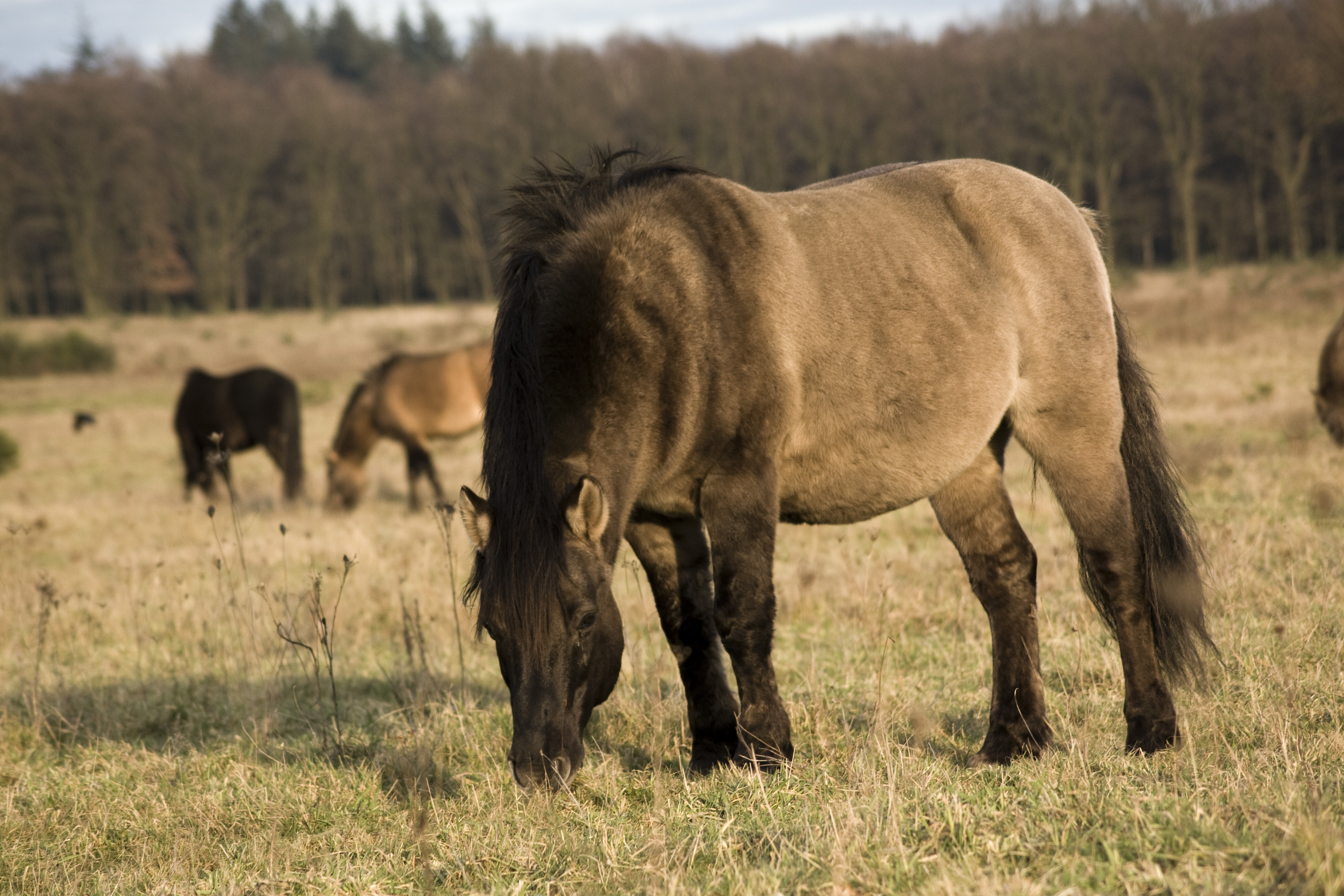
The Konik is not a breeding-back result


The Konik is widely publicized as a breeding-back result for the Tarpan, and there is the romantic story that this breed descends from wild horse hybrids living in Poland during 1900, and that the agriculturist and biologist Tadeusz Vetulani purged out the domestic influence in the 1930s, resulting in the modern Konik. This is a strongly romanticized version and very popular, and far away from the actual history of that breed.

It is true that the Polish game park at Zamosc had wild horses until 1806 when those were sold to local farmers of the Bilgoraj region (perhaps these wild horses already had domestic horse introgression because historic references mention hoof problems in these populations). The local farmers managed it to tame and integrate them into their domestic stock. So these local horses did experience some recent wild horse introgression, assuming those horses from Zasmosc were truly wild. Some references claim that the rural polish horses were Tarpan-influenced already, so that the affect on the wild traits in that population was not dramatic. However, this is unlikely since polish farmers did not appreciate wild influence in their herds at all (because of the resulting wild and intractable behaviour), what in fact even was one of the reasons why the Tarpan was persecuted to extinction. So seemingly the Konik did not descend from wild horses with domestic influence, but domestic horses with (possible) wild influence; and as I discussed in the previous post, European wild horses apparently left their traits in many domestic breeds of Europe. It is an unknown factor if the wild horse influence was still present in those horses when the breed “Konik” became known as such, which was about hundred twenty years after 1806.

Nevertheless, the horses of Bilgoraj and other Polish regions were very robust, varying in colour from black dun, black, sorrel and brown. They had an important role as transport animals during World War I for German as much as Russian troops, and were commonly called “Panje horses”. The Panje horses had a small, stocky body and were very strong and hardy.  In 1921, an article by two scientists named Grabowski and Schuch started the scientific interest in Panje horses as possible Tarpan descendants. As a consequence, Tadeusz Vetulani started investigating that breed and coined the name “Konik”, which successively replaced “Panje horse”. In the following years, several private and public studs were created in order to preserve and spread this Polish landrace. In 1927, Vetulani started an experiment which he believed might bring back the Tarpan by breeding them on wooded areas with few human interference. This was actually more a dedomestication experiment according to this baseline than a breeding-back attempt. He also wanted to achieve phenotypic features he considered to be Tarpan features like a white winter coat or an upright mane (there is no evidence for upright manes in European wild horses, though). Anyway, Vetulani’s stock was only one of many Konik lineages back this time. The Second World War created a lot of confusion, as Koniks were moved all over Poland and Germany during and after the war. Popielno became the new main breeding centre of the Konik (and Vetulani’s herd was only one of several founding herds), and it was decided that Popielno should perform 2 separate ways of breeding: one to continue Vetulani’s experiment (again, not by selective breeding but only by few human interference, comparable to modern grazing projects) and one for commercial sale and traditional indoor breeding. Although Popielno was the main breeding centre, it was only one of many Konik studs in Poland, and when other countries started getting interested in this breed, individuals were bought from any lineage they were available. Therefore it becomes obvious that Vetulani’s stock played only a minor role in the creation of the modern Konik population. Therefore, Vetulani did not create the breed, he merely coined the modern name of the breed.

And what about the phenotype? As I mentioned above, the ancestral Panje/Konik stock displayed a number of different colours, and black and sorrel individuals as much as such with white markings can still appear. I was quite surprised when I saw data for the withers height of these horses, because they apparently were way smaller back this time (123 cm instead of 130-140 cm). Indeed some Konik lineages actually were selected for a larger and more gracile phenotype, also with a more gracile head. As we know, the wild horse was remarkable for its small body size and the large and robust head, so actually some studs did exactly the opposite of breeding-back, and this shows in the modern Konik population. Ok, there has been selection for fixating the black dun colour over the years, but this is certainly not enough to call the Konik as a whole a breeding-back attempt. Therefore, it should not be called a breeding-back result, but a landrace instead, because that’s what it really is.
You can find a lot of very clear information on the Konik’s history in the book of Tadeusz Jezierski and Zbigniew Jaworski (“Das Polnische Konik”, Westarp Wissenschaften, 2008). This book is objective and without any preconceptions. It doesn’t forcefully try to turn the Konik into a surviving wild horse, nor does it repeat the popular stories without verification (like most other pieces of literature do). It is very well-researched and informing. Therefore you find more information on the Konik and the Tarpan at once than in any other book. I have the German edition at home, I don’t know if there is an English too.

The fact that the Konik is a landrace and not a breeding-back result does not alter the fact that some Koniks still display a phenotype that is quite reminiscent of what we know about the European wild horse (however, it is only representative for one of five possible colour morphs, what a pity that black Koniks usually get selected-out). Which Koniks are Tarpan-like, and which are not? Those with a silver gray expression of black dun, a comparably slender posture with a slender head and a long mane do not resemble what we know about the phenotype of the Tarpan IMO. Koniks with a brownish or ash gray colour expression, a small stocky body and comparably short manes are those individuals I would call “authentic” based on the evidence.

Wild horse-like Koniks
More "domestic looking" Konik
Sorrel-coloured Konik in Oostvaardersplassen (by "treverius" on flickR)

However, as I mentioned in this post, the Konik has a more domestic behaviour than breeds with a feral history such as the Exmoor pony [2]. It is interesting nevertheless that Koniks are known to dominate horses of other breeds in multiracial herds, even if those breeds are bigger than themselves [1].

The most interesting question regarding the Konik’s relationship to the European Tarpan is if there are still traces of the alleged wild horses that contributed to the Bilgoraj stock. The fact that some Koniks are very reminiscent of black dun wild horses does not necessary imply that (considering that other breeds are very Tarpan-like as well for which there is no direct evidence for recent introgression). Furthermore, considering the diverse mDNA of the modern domestic horse, probably a lot of breeds experienced wild horse introgression (no matter how recent it was). But in the case of the Panje/Konik, we should expect a much bigger Y chromosome diversity in that breeds if the wild horses of Zamosc are still present in the modern Konik, unless the farmers actively selected out male influence. I think this question is worth to be investigated, especially because the Konik was not included in the study of Lindgren et al. 2004 [3].
  
While the Konik is no breeding-back result, one of its derivations, the Heck horse, is (more or less). However, Heck horses are not necessarily more Tarpan-like than Koniks (or actually the opposite), but we’ll look into this in a future post.

Literature

  • [1] Tadeusz Jezierski, Zbigniew Jaworski: Das Polnische Konik. 2008.
  • [2] Baker, Sue, 2008: Exmoor Ponies: Survival of the Fittest – A natural history.
  • [3] Lindgren et al.: Limited number of patrilines in horse domestication. 2004


Tuesday, 25 June 2013

The Tauros Project


The Tauros Project (or Tauros Programme) is a research and breeding programme concerning the Aurochs. It’s the most recent and most extensive breeding-back effort for this species. Tauros Project integrated into the European Rewilding Program and their ambitious goal is to breed several lineages of aurochs-like cattle that resemble the Aurochs to the largest possible extent and that are fit for being released into natural habitats to become part of the respective ecosystem again. It is a cooperation between universities such as Wageningen and foundations like the Megafauna Foundation or the Dutch Stichting Taurus.

The Methods

The Tauros Programme started in 2009, after a set of hardy, aurochs-like primitive cattle breeds was chosen and composited. The breeding result (called “Tauros” by the project) will not be one single breed, but a number of lineages bred in and suited to different regions of Europe, to make sure that the Tauros cattle can cope in all the regions they are supposed to live in. In the first phase, the cattle will be bred for quantity by numerous crossings that might produce hardy cattle with an authentic (but not yet stable) phenotype. The breeding consists of controlled crossings but also natural breeding done by the cattle themselves.
Parallel to that, a  number of studies are currently being carried out concerning the Aurochs’ genome and that of domestic cattle, as much as on the vegetation use of cattle and therefore their ecologic role. The genetic information will be helpful for identifying genetic material that is common in the aurochs but split-up in modern-day cattle. This information will be used in the second phase, when the cattle is bred not only for phenotypic but also genetic resemblance to the aurochs. To make sure the cattle is hardy and robust enough (all the founding breeds are hardy landraces anyway), the cattle used in the Tauros Programme roam freely all the year round and get no or only scarce supplementary food during winter, just like other cattle living in grazing projects. They basically live semi-feral until the make-up of the Tauros cattle is ready for the third phase: being fully released into wilderness areas. Natural selection will refine the phenotype*, hardiness and natural instincts of the cattle and is the only way to truly make them become a part of their ecosystem again. So Tauros Project utilizes both breeding-back and dedomestication.

* Of course, recessive undesired features still can re-appear, unless they get effectively purged out.

To avoid mistakes done with Heck cattle, Tauros Project set up a catalogue of selection criteria (not only phenotypic criteria) to ensure that there is a clear breeding target. Furthermore, a herd book will be set up to make the breeding transparent.

The breeds

Trying to find the balance between a broad genetic basis but few unwanted features, Tauros Project selected 7 basic breeds, that I’ll briefly introduce here:

Maremmana primitivo: Large** to very large-sized breed; aurochs-like colour except for the lack of red pigment in the coat and light saddles in the bull; large and upright horns, very thick in the bull; legs usually long, body shape comparably athletic; skull shape longish and aurochs-like; dewlap large, udder size small to medium-sized;

Maremmana primitivo bull in Kempen~Broek (Photo: Ark Natuurontwikkeling)
Sayaguesa: Large breed; aurochs-like colour except for a very reduced sexual dichromatism and sometimes reduced primitive markings; small to medium-sized horns of variable curvature, facing forwards; long-legged, comparably athletic body with a well-pronounced S-shaped back; skull shape longish and aurochs-like; dewlap usually large, udder small to medium-sized;

Sayaguesa cow in Keent (Photo: Tauros Programme)
Pajuna: small to medium-sized breed; aurochs-like colour except for light saddles in bulls and some dark cows; horns small to medium-sized and of variable curvature, facing forwards; aurochs-like proportions and athletic body; skull shape usually longish; dewlap large, udder size small on average;  

Pajuna cow in Keent (Photo: Tauros Programme)
Limia: medium-sized breed; aurochs-like colour except for light saddles in bulls and occasionally dark cows; horns small to medium-sized, of variable curvature and facing forwards; proportions usually long-legged with a comparably athletic body; skull shape shorter than in the aurochs; dewlap comparably short, udder size small to medium-sized;

Maronesa: small to medium-sized breed, larger animals can occur; aurochs-like colour except for bulls sometimes lacking the eel stripe or rarely very dark cows; horns comparably large, usually thick in bulls, aurochs-like curvature in bulls and sometimes in cows as well, facing forwards; proportions aurochs-like in the cows, bulls more longish than male aurochs, S-shaped back; skull shape usually comparably short; dewlap usually medium-sized to large, udder size varying but small on average;

Maronesa group in Keent (Photo: Tauros Programme)
Podolica: large to very large-sized breed; aurochs-like colour except for the lack of red pigment in the coat, bulls with saddle or very lightly coloured cows; horns usually small and of variable size; long-legged and aurochs-like proportions, athletic body; skull usually longish; dewlap size varying, udders small on average;

Scottish Highland: small-sized breed; domestic colour, no sexual dichromatism; horns large and of variable curvature; short-legged, domestic body; paedomorphic skull; medium-sized dewlap, udders medium-sized to large;

** I consider breeds with bulls below 140 cm at the withers a small breed, 140-150 cm medium-sized, 150-160 large, 160-180 very large-sized.

Many of those breeds are from the uplands of Iberia and Italia, and they cope well living semi-feral in the Netherlands. As you see, most of them resemble the aurochs to a certain degree already, some of them are way more aurochs-like than average Heck cattle. Highland is the least aurochs-like breed of this selection (some individuals can have good horns though), but it increases the genetic diversity in the population and it is a very hardy breed that is used to cold and wet winters. Nevertheless, Highland cattle will be used only in the first cross generations to avoid getting too many undesired features in the pool. The usage of breeds also reflects the regional adaption of the cattle. For example, Highland cattle won’t be used in Southern Europe. Some other landraces might get integrated in the programme in the future, such as Boskarin, and the use of breeds like Tudanca is restricted. The Spanish fighting bull is not included because its aggressive behaviour is a danger to visitors and all phenotypic features can be gained from the other breeds according to the programme.  

The present cross results

Tauros Project has produced a number of crosses (F1 and F2 generations) already. Here I list those breed combinations that I am aware of:

Maremmana primitivo x Pajuna

Maremmana primitivo x Limia

Maremmana primitivo x Highland

 (Maremmana primitivo x Highland) x Sayaguesa

(Maremmana primitivo x Pajuna) x Limia

 (Maremmana primitivo x Pajuna) x Highland

(Maremmana primitivo x Pajuna) x Pajuna

(Maremmana primitivo x Pajuna) x Maremmana

(Highland x Tudanca) x Sayaguesa

(Alistana-Sanabresa x Sayaguesa) x Sayaguesa

75% Sayaguesa, 25% Alistana-Sanabresa cow
Highland x Maremmana cow 
Maremmana x Pajuna bull ("Manolo Uno")
Maremmana x Limia bull ("Rocky")
Cross bulls, Highland cow
The two most-promoted and oldest bulls so far are one Maremmana x Pajuna bull (“Manolo Uno”, you see it on the banner of the blog) and one Maremmana x Limia bull (“Rocky”). Those two bulls resemble the aurochs to a certain extent and might grow large, so they are a good basis for further crossings. There is also a number of Highland x Maremmana crosses with turned out to be large-horned and have a dense, medium-long coat. Interestingly, the Highland colour seems to be dominant over wild colour, so it can be easier selected out.


Those half-Highland cows have been covered by a large Sayaguesa bull, and their offspring is born already (you can see those calves in the video above). Tauros Project also owns a 75 % Sayagues and 25 % Alistana-Sanabresa cow which has a (in my view perfectly) aurochs-like coat colour and interesting proportions.
Those crosses are only the tip of an iceberg so far, because numerous other cross calves will be born this year and the following years, also of other breed combinations.

The regions

Sayaguesa and Maronesa cows in Keent (Photo: Tauros Project)
Maremmana and Limia cows along with two cross calves in Keent (Photo: Tauros Project)
Maronesa cow in Faia Brava (Photo: Tauros Project)
 The two main breeding herds of the Tauros Programme are located in the Netherlands, precisely in the reserves Keent and Kempen~Broek, but numerous herds in other countries are about to be set up. For example, a herd was started with Maronesa and Sayaguesa in the Faia Brava reserve this year, and further ones in Velebit in Croatia and the Bohemian forest (CZ Republic) will follow soon. The plan is to set up and introduce herds in reserves of all five main regions of Rewild Europe (Western Iberia, Eastern Carpathians, Danube Delta, Southern Carpathians, Velebit) and even beyond that.

If you are interested in seeing more of the cattle of the programme, you can visit the Tauros Project FlickR stream. You can also have a look at http://www.megafaunafoundation.org/ or http://www.rewildingeurope.com

Do you find this topic interesting? Check out my book on Amazon
 

Monday, 24 June 2013

Wild behaviour in cattle and horses


As we all know, the behaviour of domestic cattle differs from that of their wild types because of artificial selection and a human-controlled life that does not give them the chance to display the natural behavioural traits of their species. But feral populations might represent a good model for the behaviour of the Aurochs and Tarpan. Additionally, there are historic reports describing the ethologic traits of these extinct animals and there are some surprising matches.

Cattle

Feral/semi-feral cattle form a number of different groups. There are matriarchic groups of cows of different generations, together with calves and young bulls (under the age of 1,5 years). During foraging, calves often group together and are guarded by either the young bulls or cows not having calves. Bulls above the age of 1,5 years form bull herds, composited of mature animals of different ages. Old bulls are solitary, territorial and do not reproduce anymore. Cow groups wander around and are circuited by bull groups. Because the cow groups constantly move, they mate with different bull groups, what is interpreted as a protection against inbreeding [1]. This interpretation makes it very likely that the same behaviour was found in the aurochs. In cattle herds, there is a constant struggle for dominance between the individuals. The pecking structure is tested by agonistic behaviour such as pushing the less-dominant individual aside during foraging or even chasing it if it doesn’t retreat fast enough. Display is a factor as well; the dominant individual shows its status by displaying its profile and raising its neck. Combat fights are common in both bull and cows. Cattle fight head-to-head by pulling and pushing each other with their horns [2]. Pregnant cows separate from the herd immediately before giving birth to the calf and seek a shelter on forest edges. After that, the cow leaves the hidden calf and joins the herd again for foraging (during this phase, the calf is extremely vulnerable to predators), but will visit it several times. When the calf is strong enough, cow and calf join the herd [3]. Some feral cattle form a defensive circle around their calves (Heck cattle released in East Prussia during World War II) [4]. This behaviour is widespread among wild bovids, so the aurochs probably did the same. Cattle get increasingly difficult to handle, shy and cautious the less contact they have with humans.

The most precise description of the aurochs’ behaviour is that of Anton Schneeberger in his letter to Conrad Gesner, published in Gesner’s Historia Animalum in 1602. Interestingly, he describes exactly the same behaviour for calving Aurochs cows as we know it from living cattle. Furthermore, Schneeberger notes that aurochs fed on twigs, leaves and acorns during autumn and winter. Cattle do so as well. Schneeberger says that rutting bulls often have severe fights (according to him, some “fell down dead” after these competitions), just like domestic bulls. Oddly, Schneeberger states that aurochs roam the wilderness solitary during summer. This is untypical for any bovine, which all live in herds all the year round. Perhaps this was a misconception. Interestingly, Schneeberger also describes mimics that might refer to the flemen gesture, and also mentions that aurochs sometimes throw hay up in the air with their horns. Rutting bulls often push their horns in the ground and throw piles of dust up in the air in order to show off their level of testosterone – likely, Schneeberger witnessed this kind of behaviour.

Was the aurochs an aggressive animal? Within cattle herds, bulls need aggressivity to achieve dominance. Once the dominant status is achieved, they get less aggressive towards conspecifics [5]. Regarding its relationships with humans, it is likely that it usually was a peaceful or at least not a ferocious animal, otherwise the aurochs would not have been domesticated [3]. However, historic references state that aurochs got very hot-tempered and dangerous when challenged (Schneeberger, Caesar) [4]. All domestic cows, no matter which breed, defend their calves by attacking whatever might be a treat. This is no sign of aggressivity, but is the natural protective instinct of female bovids. If you encountered aurochs in the wilderness, the first reaction of the animal probably was escape and not attack, just like in feral cattle and living wild bovines.

Horses

The social behaviour of numerous feral horses and also the Przewalski horse, the “sister subspecies” of the Tarpan, is well studied and roughly the same. So it is very likely that the Tarpan had the same social structure, and some historic references match this assumption. Adult horses form either harem groups that are led by one dominant stallion and a number of juveniles, or a stallion group. Within the herds, stallions frequently fight for dominance by kicking and biting [1].
Interestingly and in contrast to cattle, the tameness of domestic horses disappears only slowly.  Koniks that spent all their lives in reserves are still tame and enjoy contact with humans, especially their foals [6]. One exception is the Exmoor, possibly because of its feral ancestry – the horses of Exmoor have been used as hunting game and were prey of native predators in the past, so they either retained or re-developed natural instincts. For example, they are shier than usual horses that roam freely (I experienced it myself when I visited Exmoor and Dartmoor two years ago), and they show a clear herding instinct when escaping, while Koniks stray up. Furthermore, they protect their foals in defensive circles [7].

Historic references describe the Tarpan as very shy and fast, virtually untameable and they apparently often stole domestic mares and killed concurring stallions. Furthermore, they defended themselves harshly against predators [8]. This high aggression potential and dominant behaviour accords with that of the Przewalski horse. According to Charles Hamilton Smith, Tarpans formed herds of “several hundreds”, which is likely an exaggeration or describes a regional/seasonal phenomenon. He also reports that a dominant stallion leads a herd. Interestingly, Tarpans seemingly migrated seasonally, similar to the Przewalski horse. More on Smith’s text in a future post.  

All in all, the behaviour of feral cattle and horses probably resembles that of their wild types to a large extent. This seems logical because feral animals have the possibility to show the natural behaviour of their species and natural selection favours ethological traits and inherited instincts that increase the evolutional fitness (as you see in Exmoor Ponies forming defensive circles). For a number of reasons, I think it is likely that breeding back results (or any released proxies for the Aurochs/Tarpan) display a natural, wild animal-like behaviour after a sufficient time living in nature: a) while some behaviourial traits certainly are coded genetically[5], others apparently are environmentally influenced to a large degree, b) domestic animals still display modes of  behaviour very reminiscent of their ancestors when they need to or have the chance to do so, c) nature and experience will “refine” the behaviour of the released animals automatically and adapt it to the particular circumstances of their environment (presence/absence of predators, transhumance…).

Literature

  • [1] Meissner, Rene; Limpens, Hermann: Dedomestikation – Wilde Herden zwischen den Menschen. 2001.
  • [2] Perrey, Anette: Die Sozialstruktur einer Herde Auerochsen im Wildgehege Neandertal. 1999
  • [3] Frisch, Walter: Der Auerochs – das europäische Rind. 2010.
  • [4] an Vuure, Cis: Retracing the Aurochs - History, Morphology and Ecology of an extinct wild Ox. 2005
  • [5] Broucek, Uhrincat, Soch, Kisac: Genetics of behaviour in cattle. 2008.
  • [6] Bunzel-Drüke, Finck, Kämmer, Luick, Reisinger, Riecken, Riedl, Scharf & Zimball: "Wilde Weiden: Praxisleitfaden für Ganzjahresbeweidung in Naturschutz und Landschaftsentwicklung
  • [7] Baker, Sue, 2008: Exmoor Ponies: Survival of the Fittest – A natural history.
  • [8] Tadeusz Jezierski, Zbigniew Jaworski: Das Polnische Konik. Die Neue Brehm-Bücherei Bd. 658, Westarp Wissenschaften, Hohenwarsleben. 2008

Saturday, 22 June 2013

Tarpan-like horse breeds

EDIT: I no longer use the word "tarpan" as a synonym for the western wild horse. Tarpan was a term for horses of the southern Russian steppe that according to most recent research were hybrids of feral horses and the original wild horses. 
In this post, we looked at the phenotypic and behavioural traits of the Tarpan, Equus ferus ferus, the western wild horse subspecies. Today I’m going to introduce a number of horse breeds which apparently share some characteristics with the Tarpan. But before we go into this, it’s important to know where the wild horse was domesticated and how it left its traces in the modern equine stock.

Equus ferus ferus seemingly is the wild type of the modern domestic horse and there are no hints yet that the Przewalski horse played a significant role in horse domestication. The Tarpan was domesticated in the western Eurasian steppe approximately 6000 years ago, as it is indicated by genetic [1] and archaeological [2] evidence. Interestingly, the modern domestic horse has a considerably diverse mitochondrial DNA while the Y chromosome diversity is very low, what suggests that only few wild stallions but a larger number of wild mares was used in domestication [3, 4, 5]. Studies like Jansen et al. and others suggest that there was local wild mare introgression within Europe. Ancient breeders probably included wild mares into their stock to continue breeding on a larger scale, but avoided working with wild stallions because of their intractable behaviour [3, 4, 5].
What does this genetic data tell us? Apparently most if not all horse breeds originated in the Eurasian steppe, but local female influence was seemingly common as well. The very low Y diversity of modern horses reveals another important implication: if any horse breed is a direct descendant of a European wild horse population, we would expect a significantly higher Y chromosome diversity in these breeds, with haplogroups completely unknown in other horses. However, most studies on horse genetics are concerned with mDNA, and Lindgren 2004 used a set of 15 horse breeds that might not be representative enough. 6 of the included European breeds belong to the northern pony type which possibly all are related and not “divergent” as the study says (Exmoor Pony among them), and robust horse breeds from eastern Europe such as the Konik or Hucule are missing. So I think the hypothesis that no horse breeds are the result of comparably recent and significant wild horse introgression requires more testing (although we can tentatively rule it out for the breeds tested in Lindgren 2004).

Considering that the Tarpan is the ancestor of all domestic horses, when we see traits in horses that resemble what we know about the Tarpan (be it behaviourial or phenotypic) we can carefully assume that these features are inherited by wild Tarpans. I want to cover wild behaviour in horses in a following, separate post, so we’ll focus on the phenotype, ecologic adaptions and breeding history of the primitive horse breeds here.
Since the Tarpan displayed a number of colour morphs, the horses that we can consider primitive/less-derived/Tarpan-like (however you want to call it) don’t have to look very much alike, there is actually a diverse set of good “candidates”. Let’s start from west to east.

On Great Britain you can find a lot of robust pony breeds with primitive colour and body features, of which the most unchanged one is the Exmoor Pony. They seemingly all descend from a feral pony type that once ranged on the entire island [6]. The primitive British Pony/Exmoor Pony is a comparably small-bodied (130 cm at the shoulders), stocky horse with a robust skull and is of a bay/seal brown coat colour with a light mealy mouth and a light underbelly. These horses have a dark eel stripe, but it is (like in most non-dun horses) not easy to recognize. The Exmoor Pony and its relatives are known to be very robust and hardy. They perfectly cope with the harsh british winters, while more derived breeds from the mainland do not nearly as good [6]. Some primitive British ponies have a black colour, like the Fell Pony (descending from the extinct Galloway Pony). 

Exmoor Ponies
Fell Pony
Quite possibly, British ponies also influenced other small northern horses, like the Gotland or the Fjord horse (the latter is bay dun-coloured, by the way) [5].

Fjord horses
Gotland
Garrano
Primitive Asturcons, there are black ones as well

Some Iberian ponies, like the Garrano, Pottoka, Asturcon and others, resemble the Exmoor pony-type horses closely. In some of these, like the Pottoka, this resemblance might be caused by British introgression during the 20th century [7], but others like the Asturcon have a longer history. Those primitive Iberian Ponies either are bay or black, and some of them (f.e. Garrano), have feral populations.
Except for the lack of the dun colour, this western pony type resembles the descriptions of wild horses quite good (stocky and small body, large robust head, small eyes, short mane, wild colour present etc.). However, as I discussed in the previous post, the presence of wild horses lacking the dun factor cannot be ruled out yet.

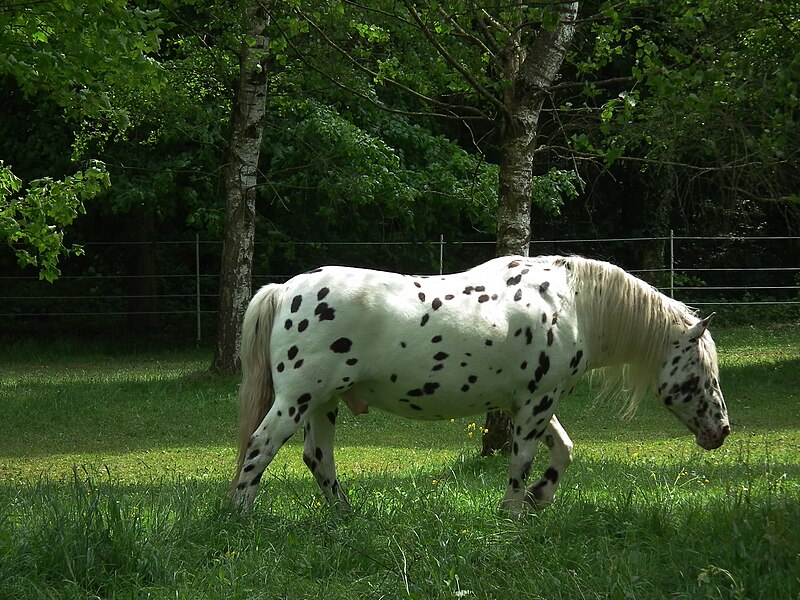
The area of the former Austrian monarchy also has a set of primitive and hardy breeds with a diverse ancestry. The Noriker horse is a large (but there also was a smaller version of that breed called the Abtenauer) and robust working horse from Austria that was influenced by Italian and Spanish horses in the past. It shows (besides a number of domestic colours) bay, black and leopard spotted individuals. They have a robust head with small eyes and are tolerant against cold temperatures. 

Noriker horses with wild horse colours and other primitive features
The robust Hucul horse, from the eastern Carpathians, is a breed that likely descends from horses coming from the steppe. It’s size range is within that of the wild horse, and it displays a number of colours including bay dun, black dun, bay and black. The dun individuals have often have a prominent eel stripe and leg and shoulder striping. It is more gracile than the primitive western ponies.

Tarpan-like Hucul horses
The Konik is similar to the Hucule, but certainly has the most romantic story regarding its origin. Allegedly it descends from wild horses that were donated to polish farmers who tamed and crossbred them, and after that, a breeding-back project allegedly purged out the domestic influence, resulting in the modern Konik. The reality behind this story is a lot less romantic, but we will look into this in a future post. The Konik is a robust polish pony which’s colour is predominantly black dun. It’s phenotype varies from a more gracile riding horse type with a gracile head and a long mane that does not truly resemble the wild horse in proportions, and a robust type with wild horse-like proportions and skulls. It also has different expressions of black dun, ranging from a very light gray (not likely for wild horses), to a grayish brown resembling a mouse’s coat (very likely for wild horses).
In Germany, there are two popular derivations of the Konik. One is the Heck horse which is the result a breeding-back attempt by the Heck brothers and has influence of other ponies like the Gotland and Icelandic horse, but also the Przewalski horse. It is not necessarily more Tarpan-like than usual Koniks. The Dülmen Pony has a long history but the modern population is a mix of Exmoor, Shetland and Konik (with the Konik having the largest influence in this breed) and displays a diverse phenotype.

Koniks with very wild horse-like coat colours (Photo: Volker Kirchberg)
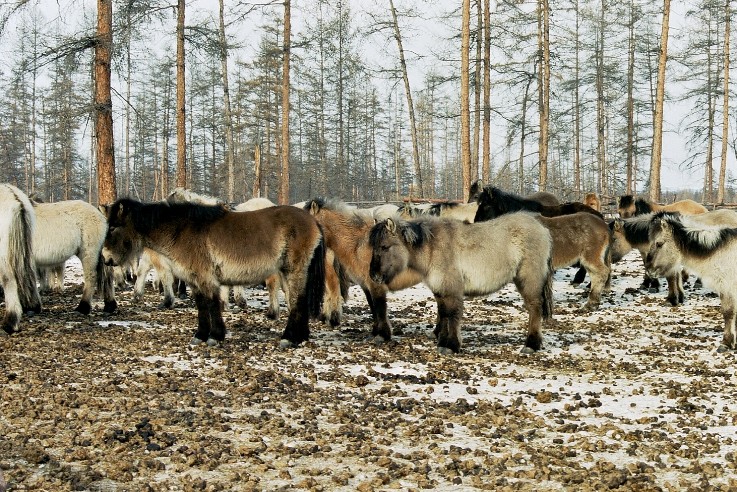
Moving more eastwards, there is the Yakutian horse of the Sakha Republic, Russia. It is comparably large (150 cm), but has a primitive stocky body and is well-adapted to extreme coldness. Its coat colours (in pure examples of the breed) can be bay or various dun colours, with or without pangare. Selective breeding could breed out a Yakutian lineage showing wild horse colour traits exclusively.

Yakutian horses
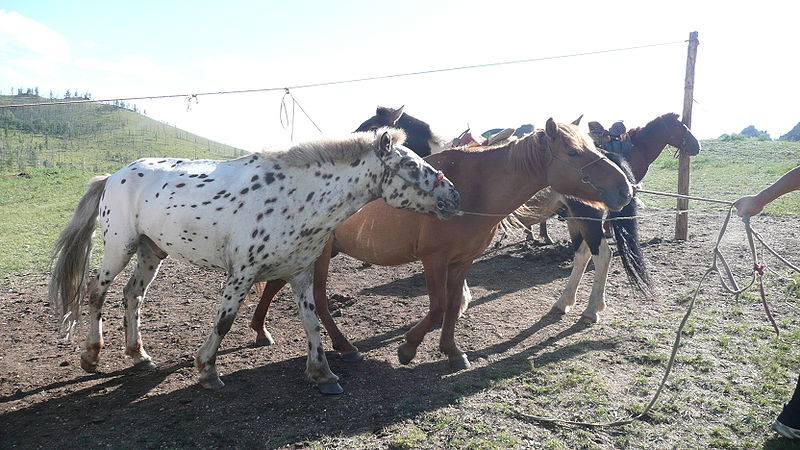
Another primitive Asiatic horse is the Mongolian horse. It is a robust and stocky breed, reaching 130 to 145 cm in height. Among a number of domestic colours, it contains many of wild horse coat colours, such as bay, bay dun, black and leopard spotted (I’m not sure if there are black dun Mongolian horses). Of the Asiatic horse breeds, it has the greatest genetic diversity [8], indicating that it might be an ancient lineage. And their location isn’t far away from the domestication centre of all horses.

Monoglian horses
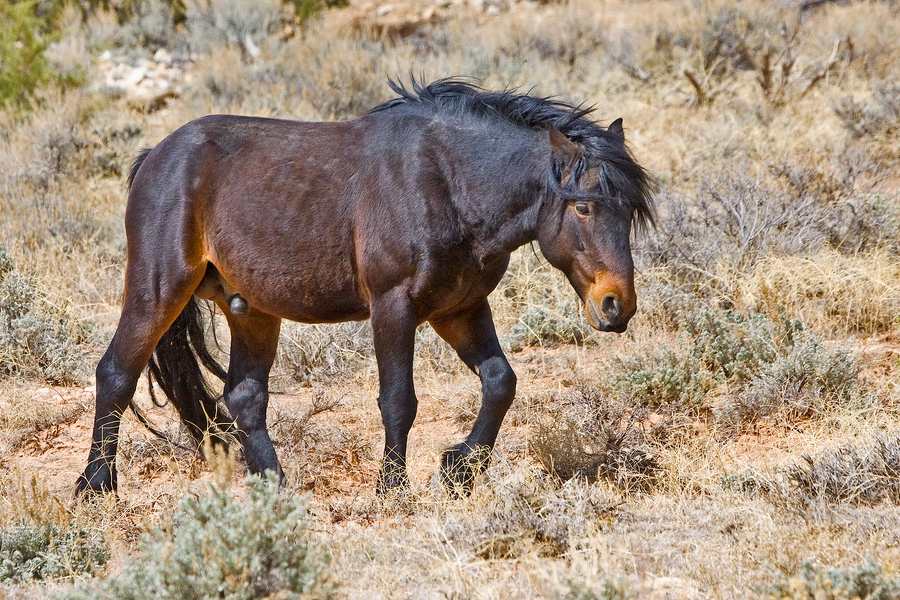
Surprisingly, there are primitive horse breeds even outside the old world. Mustangs have a diverse and controversial ancestry, some of them display a rather wild horse-like phenotype (despite their comparably gracile build) and they have experience in surviving in nature over generations. One of the most interesting Mustang lineages is the Pryor Montain Mustang, a population that is known living feral for at least 200 years and descended mainly from the Spanish Barb and other lightly built horses. They range from 130 to 150 cm in height and some of them show a bay, bay dun, black or black dun colouring, including the wild markings. Some Sulphur Mustangs also show wild horse colour traits and a primitive body conformation. Surely even ancient-looking Mustangs have more gracile proportions than the primitive western pony breeds, but this may be due to adaption living in a more open habitat. However, the hypothesis that Tarpans with that proportions existed should be proven by osteometric data, since even the Przewalski horse (native to a steppe habitat) has a stockier build than mustangs do.

Pryor Mountain Mustangs with Tarpan-like coat colours

The Sorraia is a breed from the south of Iberia, and fanciers claim it is a surviving descendant of the Tarpan because of its black dun coat and the fact that the breed as such was not known before the 20th century. However, it is likely that the breed has an Arabic ancestry because of its tall and gracile build and the strongly convex head[7]. Some Mustang lineages, like Sulphur and Kiger, apparently share a common ancestor with the Sorraia, as there is a large resemblance between individuals of these breeds. Older genetic studies noted similarities of the Sorraia with the Konik or Przewalski horse, while more recent studies refuted this [5, 10]. Furthermore, the Sorraia is related to the Lusitano [9]. All in all, they do not differ from other Southern Iberian horse breeds [7]. Apart from that, the breed went through a severe bottleneck during the 1930s, the modern stock descended from only 12 individuals. Sorraia usually display a kind of weird body conformation with a straight long neck and thin legs, unlike primitive horses and what is described for the European wild horse. While fanciers hail the Sorraia as a surviving wild horse, some resemblance in colour is simply not enough for such a hypothesis (no matter how prominent the striping might be), especially since wild horse colour traits are apparently widespread among living horses.

As you see, there is a number of horses with a Tarpan-like phenotype, while the genetic distance between them and the wild horse is probably roughly the same. However, this aspect needs more testing. If some of the primitive horse breeds turn out having a bigger Y chromosome diversity with haplogroups completely unknown in other breeds, we might assume that there was more introgression than in other domestic lineages.
In future posts, we’ll have a look at which of these horse breeds might be best for being released into nature as an authentic proxy for the Tarpan. 

Do you find this topic interesting? Check out my book on Amazon!

Literature

  • [1] Warmuth et al.: Reconstructing the origin and spread of horse domestication in the Eurasian steppe. 2012
  • [2] Outram, A.K., Stear, N.A., Bendrey, R., Olsen, S., Kasparov, A., Zaibert, V., Thorpe, N. and Evershed, R.P. The Earliest Horse Harnessing and Milking. 2009
  • [3] Lindgren et al.: Limited number of patrilines in horse domestication. 2004
  • [4] Jansen et al.: Mitochondrial DNA and the origins of the domestic horse. 2002
  • [5] Cieslak et al. 2010: Origin and History of Mitochondrial DNA lineages in domestic horses
  • [6] Baker, Sue, 2008: Exmoor Ponies: Survival of the Fittest – A natural history.
  • [7] Royo et al.: The Origins of Iberian horses Assessed via Mitochondrial DNA. 2005.
  • [8] Udina et al.: Computer Analysis of D-loop of Mitochondrial DNA variation in Asian horse breeds. 2002.
  • [9] Luis et al. A lost Sorraia maternal lineage found in the Lusitano horse breed. 2006
  • [10] Aberle, Diestl: Domestication of the horse: results based on microsatellite and mitochondrial DNA markers. 2004