Tuesday, 14 January 2014

Founding breeds of Heck cattle, once again

… but this time as a picture. I picked photos of all the (known) founding breeds of Heck cattle, and composed them on a single table. They are not shown to same scale, but the size of each cattle represents the possible importance of its contribution to Heck cattle. 


Image sources: 
Highland: http://www.eigenheer.ch/thomas/reisen/2006_schottland/hochlandrind.JPG
Braunvieh: http://www.ulis-photowelt.de/wp-content/uploads/2010/08/
Old Frisian: http://www.vieh-ev.de/bilder/gross/schwarzbuntes_niederungsrind_01.jpg
Corsicana: https://blogger.googleusercontent.com/img/b/R29vZ2xl/AVvXsEhXmN7WX3WlhDSupPBa7y6ucLA9i4IRJY0b4h4oOJMMc90KO5VhitbOD2mgw5O7iDAhepC19OtLo5q0kE2YK-naGJR1ZZgzFgTmwL-hIr71nJqIqFkUTB1UlwNSijAOKaULOHTUk678lc29/s1600/Corse+618+.JPG
Angeln cattle: http://www.fitmenue-haustier.de/assets/images/angler-rind.jpg
Hungarian Gray: http://www.herz-fuer-tiere.de/typo3temp/pics/771669e1af.jpg
Murnau-Werdenfelser: http://www.lbr.bayern.de/zv-weilheim/Bilder/Anita_JaisEschenlohe_2011.jpg
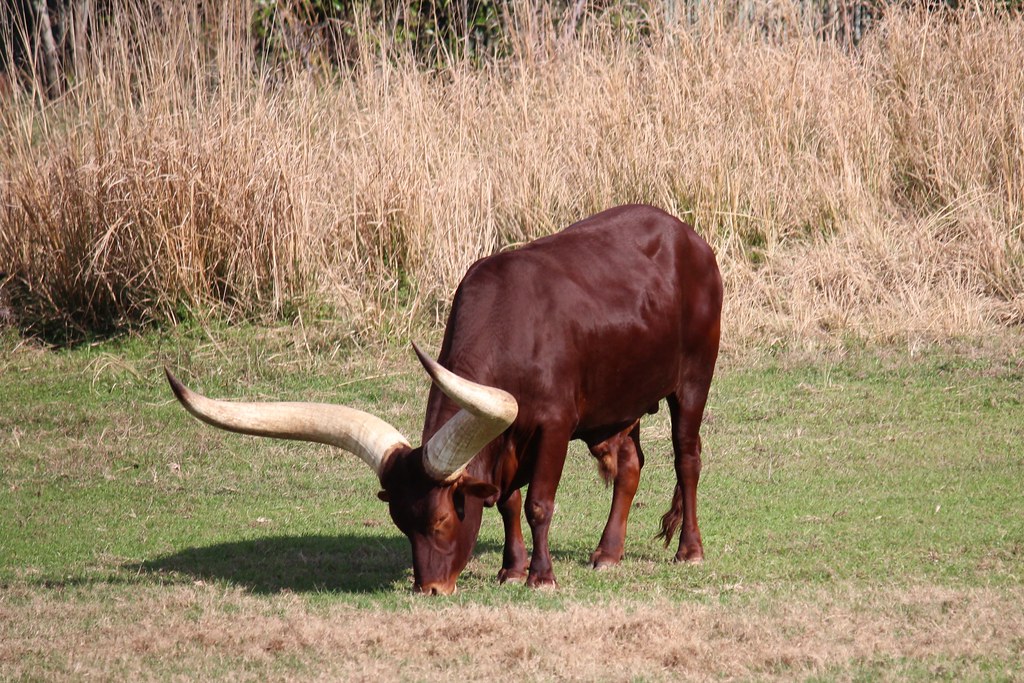
Watussi: http://upload.wikimedia.org/wikipedia/commons/thumb/0/02/Watusi_Cattle.JPG/1280px-Watusi_Cattle.JPG

Examining a Pleistocene Wild horse's body conformation

The Pleistocene Wild horse skeleton from Denmark displayed at Kopenhagen is perhaps the only complete specimen of Equus ferus from that epoch that is available on the web. I always suspected that it was a member of the przewalskii subspecies that far more widespread during the Würm glacial and also present in Europe, as cave paintings show. However, on sorraia.org there is the claim that this skeleton is practically identical to that of a Sorraia. In the lack of a complete Sorraia skeleton to compare with, we have to take the other way to verify this statement and do an anatomically correct reconstruction of the skeleton and compare both animals in flesh. This is less precise than working with the skeletons, but better than nothing. Note that the skeleton is mounted incorrectly, like most museum mounts (the post of the legs is unnatural, the neck should have an S-curvature). This how the animal should roughly look like in life: 


I chose a bay dun colour because this is seemingly the most common wild type colour of Equus ferus, and there is no genetic evidence for black dun during the glacial yet. I restored it with a standing mane because it seemed advantageous to me in a dry environment. But a falling mane is possible as well, as it is a good protection from heat loss and snow, and mummified Pleistocene horses from Siberia show a falling mane as well. In this case, it probably would be a member of the ferus subspecies. The snout in this reconstruction probably is a bit too long, you see the more precise head reconstruction of the specimen here

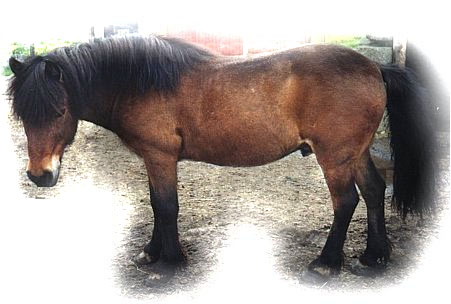
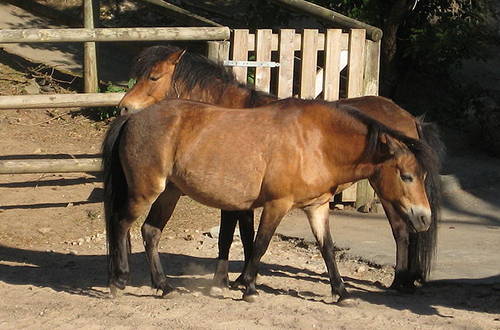
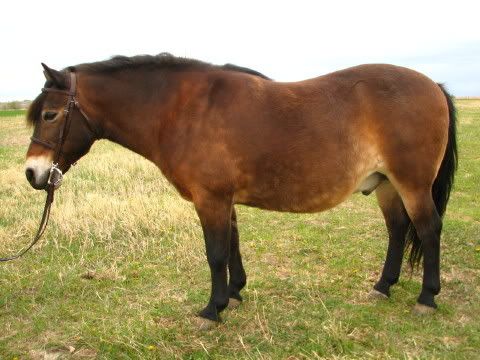
After doing the reconstruction, I superimposed three primitive horse breeds over the image to get an idea of which body conformation comes closer to this wild horse. These three breeds I chose are a Przewalski-influenced Heck horse, an Exmoor, and a Sorraia-type Kiger mustang. 


Image sources: 
Heck: http://cdn.fotocommunity.com/Tiere/Tier-und-Mensch/Przewalski-Pferde-a20563865.jpg
Exmoor: http://i68.photobucket.com/albums/i40/VickiE_87/Conformation%20Clinic/Banjo_2.jpg
Kiger Mustang: Wikimedia Commons

The trunk length is the benchmark. The Heck horse and the reconstructed wild horse have almost no proportional differences (if you think the Heck horse has a shorter neck, keep in mind that it has its neck in a more upright position), but the head is slightly shorter. The Exmoor pony has legs shorter by about 7%, but apart from that, the proportions are similar. Again, the snout is shorter. The Kiger Mustang, which's phenotype is identical to that of a Sorraia, has legs longer than those of the wild horse by about 9%. The neck and skull might be slightly longer as well, but this is not measurable because the animal does show them in a lateral position. 
But metric proportions are not the only important aspect of the body conformation. All historic wild horses are described having strong legs, and primitive ponies like the Exmoor and kin or the Konik do so as well. I reconstructed the thickness of the legs with the aid of this superb drawing of a Przewalski's horse: 


As you see, the lim bones of this Przewalski's horse are about as thick/slender as in the fossil horse, therefore I made the legs in my reconstruction as robust. Of the living horses I compared it with, the Heck horse comes closer regarding the thickness of the legs. The Exmoor's are a bit thinner, and those of the Sorraia-type Mustang are way thinner. 

Mind that this comparison is, enforcedly, based on a very small sample - just one skeleton, and pleistocene Equus ferus seemingly were quite variable. Furthermore, horses from that epoch probably are not a prime comparison for what European wild horses would look like if they hadn't been exterminated by man. The increased forestation during the Holocene might have caused a change in body conformation, probably leading to a smaller and stockier type - but as I always say, trustable osteologic data is needed. 
But what I can say based on that comparison is that the skeleton of this Pleistocene wild horse is very likely not identical to that of a Sorraia.  

Sunday, 12 January 2014

A second gene pool for the British primitive horse

UPDATE: I fear that the concept of a "British primitive horse" is outdated and not well-supported by evidence. See here

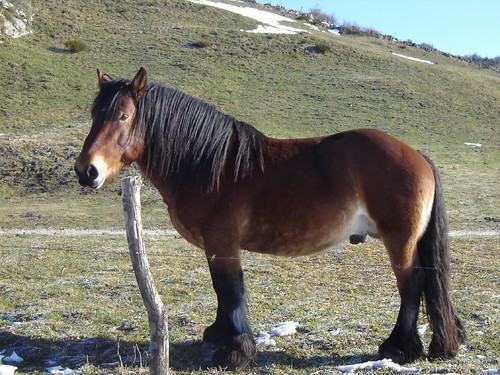
The Exmoor pony is the only remaining pure member of what I like to call the British primitive horse, a native type feral horses that once probably was present on a large part of Great Britain whose historic records date back at least to the 850s AD and that evidently forms the ancestral base of all native British landraces (see here).[1] I still have not figured out how the Exmoor-colour (dark brown without dun) fits the puzzle of what the European wild horse actually looks like (this question is more complex than “breed A vs B” like it is approached by some people), but nevertheless the Exmoor/British primitive horse is a very precious breed and its nature should be preserved. Why? Because that population is the oldest feral horse population that still exists – although the majority of the Exmoor horses lives a domestic life today, they still have their instincts for surviving in the wild even among predators and necessary physical adaptions. And of course, beside their feral ancestry and their ecologic capacities, their phenotype is very primitive as well: small, stocky body, strong legs, large thick head, short frizzy mane and bushy tail; whether or not their lack of dun fits the European wild horse.
Unfortunately, the feral population at Exmoor went through several bottlenecks during the late 19th and early 20th century, but the most severe one was during the Second World War. The numbers dropped down to 50, only 7 of them being stallions (of which one was a crossbred with a thoroughbred). [1] As a result, the genetic diversity of the breed is not very large and the breed tends to be prone to getting horse mange, at least on the mainland.[2] With 800 Exmoor ponies worldwide, the breed is not very numerous as well.

Therefore I came up with an idea how to get more quantity and genetic diversity into the remnant stock of the British primitive horse by some kind of breeding-back or effigy breeding. The basic idea is to collect Exmoor-like horses from numerous less-derived British landraces and to purge out the domestic influence brought in by derived horses from the mainland by selecting them on phenotype and hardiness. Interestingly, there is something similar for the seriously inbred Sorraia, where mustangs (predominantly Kiger) displaying an identical phenotype are bred into the population to gain more genetic diversity. I don’t propagate that the new British primitive horse breed should be crossed into the Exmoor population right from the beginning, but if it turns out to be as stable and as original as the Exmoor, merging the two populations together in the future could in my opinion be considered.

Suitable landraces

When the British primitive ponies where increasingly used for agricultural purposes instead of left free for being hunted, they were crossed and selected for certain purposes. Particularly horses from the Iberian peninsular played a role in this, as you can see in breeds like the Connemara. Many of the so-called mountain and moorland ponies that have a native British ancestry luckily have very wide selection criteria, leading to a great variability that allowed the persistence of original features within them. Human migrations spread the Exmoor-type horses outside Great Britain; on Iceland, they constituted the base of the Icelandic pony (obviously many horses contributed to that breed); it is also the ancestral type of the Faroe pony. They even left a track in Scandinavian horses. Genetic studies showed that British and Scandinavian horses have genetic similarities that endorse their common ancestry, forming a “north pony group”.[2] In the south, the Exmoor evidently influenced some Iberian breeds, such as the Pottoka,[3] maybe also others. I am not sure if the inclusion of such Iberian breeds in such a breeding program would be wise because they might be less cold-adapted (unless they regularly live on high latitudes).

Dartmoor Pony

The Dartmoor Pony ranges free in large numbers in the Dartmoor National Park. It was, just like the Exmoor, another remnant population of the BPH before constant releasing of derived breeds into the moor brought in a lot of domestic features, many Dartmoor ponies do not look primitive anymore, they are actually a rampant cross population. However, there still are some very Exmoor-like individuals in the breed, and they live under the same circumstances as the free-ranging Exmoors.

New Forest Pony


The New forest Pony has a similar history as the Dartmoor, but the Exmoor-like animals are more common and more “complete”.

Fell Pony


The Fell Pony is a descendant of the extinct Galloway Pony, which also resembled the Exmoor closely. It has a black (for black in such a program, read on) or dark brown colour, and some have a useful body conformation.

Shetland Pony


The Shetland is the smallest and stockiest breed in this selection, which is good because the light frame of some of the other breeds needs to be compensated. Some Shetlands have a good colour.

Welsh Pony

The Welsh is more gracile and more derived than the other breeds here, but some of them still have a good colour and a short mane.

Highland Pony


The Highland Pony is very variable, it has individuals with a small stocky body and the right colour.

Icelandic Pony


The Icelandic Pony is a breed displaying many different colours, including bay, dark brown and black (there are even black dun individuals, but those are not interesting for a program for the British primitive horse). Some Icelandic ponies are optically almost identical to the Exmoor.

Faroe Pony


The Faroe was taken to the islands between the 7th and 9th century, and some of them also display a phenotype meeting all criteria desired. Counting only about 50 individuals in number, they are extremely rare.

Gotland Pony


The Gotland has several lineages, including small and stocky ones that are virtually identical to the Exmoor on the looks.

Dales Pony


The Dale Pony has some very nicely coloured dark brown and black individuals with the right body conformation.

Kerry Bog Pony


This Irish breed has, as you see, some very useful individuals as well.


To get a genetic diversity as high as possible, as many suited breeds as available should be used. I, personally, would include all those breeds. This increases the unwanted traits of course, but that could be counteracted by keeping a careful eye on the founding individuals and the herds they are from. Especially the stallions should be of high quality. Another question is how large the founding population should be to create a large and diverse gene pool. If between five and ten individuals of each of these 11 breeds are chosen, 55 between 110 individuals would form the base of the population. If that is feasible would depend on the financial capacity of the program of course, but I’m just thinking about a theoretical guideline here. A breeding book should be set up right from the beginning to not repeat the mistakes the Heck brothers did with their cattle and horses we do not know today what cross animals these are actually based on.

The breeding criteria to consolidate the original phenotypic features of the British primitive horse in a kind of “Exmoor Pony 2.0” should be:
  • Size between 115-135 cm
  • Stocky body with strong legs
  • Large, thick head with strong jaws
  • Short, frizzy mane
  • Coat colour either bay or brown with prominent pangare/mealy mouth or black
  • Ability to thrive on natural forage and sustain cold temperatures, surviving winters without supplementary feeding if they are present at an appropriate density
  • Shy and cautious behaviour
I included the last point because it is known that horses living semi-feral do not easily loose their tameness what can provoke situations dangerous for horses and people.[2] I am confident that all of those 11 breeds I chose here are hardy and robust, but to further select on this trait cannot be a mistake. I think that this new breed does not have to be totally phenotypically identical to the Exmoor, f.e. some variation regarding the skull shape could be permitted if it increases its primitiveness (as I explained in the previous post, the Exmoor has domestic skull features such as enlarged eyes and a shortened snout). Now let me explain why I would permit black colour in this population if it is obviously not present in the modern Exmoor. Actually, black horses seemingly always were present within the Exmoor/British primitive horse; they were reported as recently as the 19th century, but the bottleneck events purged them out of the modern population.[1] Black colour is not only a colour of the original Exmoor, but also one of the two basic wild type colours in horses (among bay, which probably was more common based on genetic evidence) [4,5] and it is very useful for camouflage. So this colour should be reintroduced in any case if such a project to re-unite the original features of the British primitive horse is ever to become put into practise.

I already contacted Mr. David Brewer, Chairman of the Exmoor Pony Society, regarding my idea, and he told me that my idea was already looked into and that they keep a careful watch on the blood lines of the Exmoor with the aid of genetic testing, I guess to avoid too much inbreeding.

Literature

[1] Baker, Sue, 2008: Exmoor Ponies: Survival of the Fittest – A natural history.
[2] Bunzel-Drüke, Finck, Kämmer, Luick, Reisinger, Riecken, Riedl, Scharf & Zimball: Wilde Weiden: Praxisleitfaden für Ganzjahresbeweidung in Naturschutz und Landschaftsentwicklung. Arbeitsgemeinschaft Biologischer Umweltschutz
[3] Royo et al.: The Origins of Iberian horses Assessed via Mitochondrial DNA. 2005.
[4] Ludwig et al.: Coat colour variation at the beginning of horse domestication. 2009
[5] Pruvost et al.: Genotypes of predomstic horses match phenotypes painted in paleolithic works of cave art. 2011


Saturday, 11 January 2014

Exmoor, Przewalski and Konik skulls

I was wondering how similar the skulls of these three horses are on an osteometric basis. I got an Exmoor skull scanned from Sue Baker's book on the Exmoor pony and laid the skull of a Przewalski's horse upon it. 


The Exmoor skull fits that of living Exmoor so there is no reason to dismiss it as a crossbred or more derived animal. Interestingly, although it has a deep dental on the cheek area to attach large jaw muscles, the more anterior part of the dental is much more massive in the Przewalski skull, probably it its teeth are very deep-ruted. As you see, the eye postorbital area in the Exmoor skull take up a larger proportion of the length than in the Przewalski skull, what means that the snout in the Exmoor is shortened and the eyes are enlarged, a typical domestication effect. That probably also causes the nasal opening to look shorter and the muscle attachment area in the Exmoor's lower jaw to look enlarged relative to the tooth-carrying part of the jaw bone. It also appears to me that the occiput is turned more downwards in the Exmoor, causing the neck vertebrae to be attached more vertically relative to the skull than in the Przewalski. This might be the reason why the Przewalski carries its head less elevated than domestic caballine horses, although I don't regard that necessarily as influenced by domestication. 


Having looked at the differences between Exmoor and Przewalski, now let's have a look at the Konik. There is no Konik skull visible on the web, so I laid the Exmoor skull over a Konik from Oostvaardersplassen. 


They line up quite well, except that the Konik skull is slightly deeper. That makes the comparison Konik-Przewalski less necessary because the differences will be roughly the same as with the Exmoor. 

Now which type of skull did the western subspecies of the wild horse, Equus ferus ferus, the Tarpan if you want, have? The domestication features in the Exmoor and Konik skulls (enlarged eyes, shortened snout) make it unlikely for me that European wild horses had exactly the same skull shape. Historic references of wild horse from the pyrenees, central Europe, eastern Europe and even Russia uniformly describe the heads of wild horses as large, thick and small-eyed. Although that certainly is a useful description for doing a life restoration, it's not precise enough to see if the western wild horse was more like the Prewalski or these two primitive landraces. To get hand of true wild horse skulls from the Holocene of Europe would be needed, but there are no such on the web, at least I didn't find any (if you have, I'd be grateful for a link!), and possibly there are not many confirmed wild horse skulls in the sub-fossil record of Europe because it is hard to distinguish them from domestic horses without genetic testing. 
Looking for other primitive caballine landraces that might be interesting for this question, I came up with the Asturcon. Some of these Iberian ponies have a skull basically similar in shape to the Exmoor/Konik, but with smaller eyes and a longer snout, therefore less domestic to my eye (UPDATE: This is in fact a Breton horse, not an Asturcon)


But keep in mind that I'm basing myself here on a very small sample and without having confirmed European wild horse skulls at hand, we can never be sure. 

Friday, 10 January 2014

Complete Genome of an Aurochs sequenced! Finally!

A paper presenting the fully-resolved nuclear genome of an aurochs individual from Britain is finally about to get published. They used an exceptionally well-preserved humerus from about 7.000 years BP.  Here you have the abstract: 


"The extinct wild Eurasian aurochs (Bos primigenius) was the progenitor of domestic taurine cattle (B. taurus). Although genetic and archaeological studies pinpoint the Near East as the centre of origin for Bos taurus, recent genetic evidence suggests that historical admixture may have occurred between domestic taurine cattle and wild aurochsen. Here, we present analyses of the first complete nuclear genome from an archaeologically-verified and exceptionally well-preserved aurochs humerus bone sample recovered from a cave site in Derbyshire, England and radiocarbon-dated to 6,738 ± 68 calibrated years before present (laboratory sample code: CPC98). Previous work in our laboratory has shown that this aurochs possessed a haplogroup P mitochondrial sequence, which predominates in Northern European aurochs samples examined to-date. For the present study, DNA extracts from the CPC98 humerus bone were prepared for Illumina® short read, high-throughput DNA sequencing. A consensus CPC98 B. primigenius nuclear genome was assembled, using the complete B. taurus genome. A mean read depth of 6.2× was generated from 470 million reads aligned to unique locations in the template genome, yielding a genome coverage of 2.37 Gb. Phylogenetic analyses using Illumina® BovineSNP50 BeadChip genotype data from modern B. taurus and B. indicus cattle place the CPC98 sample as an outgroup to all modern taurine cattle, consistent with common ancestry of taurine cattle from Near-Eastern aurochs. We have performed comparative analyses of coding sequences or candidate regulatory regions associated with genes using high-throughput DNA sequencing data from modern B. taurus and B. indicus cattle to identify over 300 genes in which CPC98 and indicine cattle share potentially functional SNP or indel alleles not seen in taurine cattle. Selection at these genes throughout the history of domestication and selective breeding may have played a key role in shaping the genome of modern taurine cattle."

Before you get too euphoric, this individual cannot be cloned yet. It is a reconstructed sequence, for cloning this aurochs you need a functioning set of chromosomes. One method to reconstruct this individual using the genome is to modify the genome of a domestic cattle step-by-step to achieve a 100% aurochs, but this is a long-term process. Another possibility is de novo synthesis of the chromosome set, which is technically not possible yet but might be in the near future. 
Nevertheless, this is more-ground braking than it sounds at first. The fact that it was possible to sequence the full genome from this early Holocene bone might indicate that this is possible with a large number of individuals - maybe close to 100, based on the large number of aurochs remains that we know. It might not only be possible to do that with the aurochs alone - it might be possible with the Holocene wild horses of Europe as well - and a whole set of other early Holocene and late Pleistocene extinct species. And if the gained genetic diversity to low, it can always be improved by crossing-in similar domestic counterparts. We know that these species serve a function in the european ecosystems and that they were exterminated by man, so the answer to the question "Should be do this?" is "yes, definitely we should". And even if the animals don't serve a function in modern ecosystems like saber-toothed cats, it's still a huge progress in studying these animals, so it is desirable in any case. The "ethical problems" related to genetic reconstructions provoked by people who have hardly an idea what they are talking about are quite a non-issue, so let's not concern us with that. 

Although technique is not ready yet, the possibility is good that we see several true aurochs in flesh again in a not too distant future!

Thursday, 9 January 2014

Watussi cattle - an underrated breed

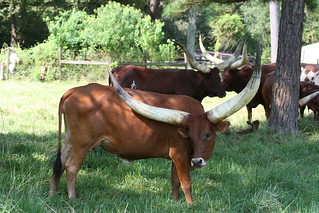
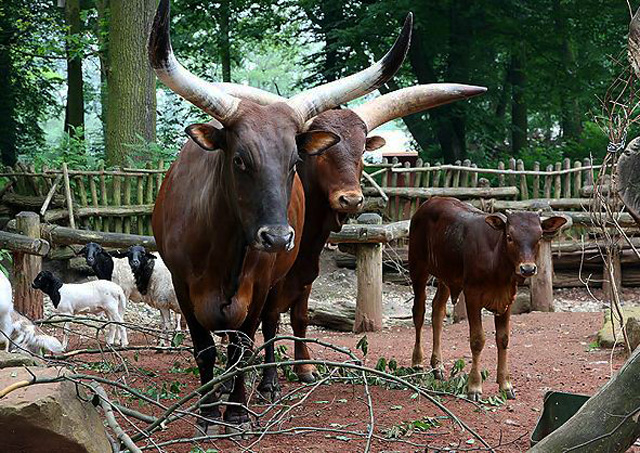
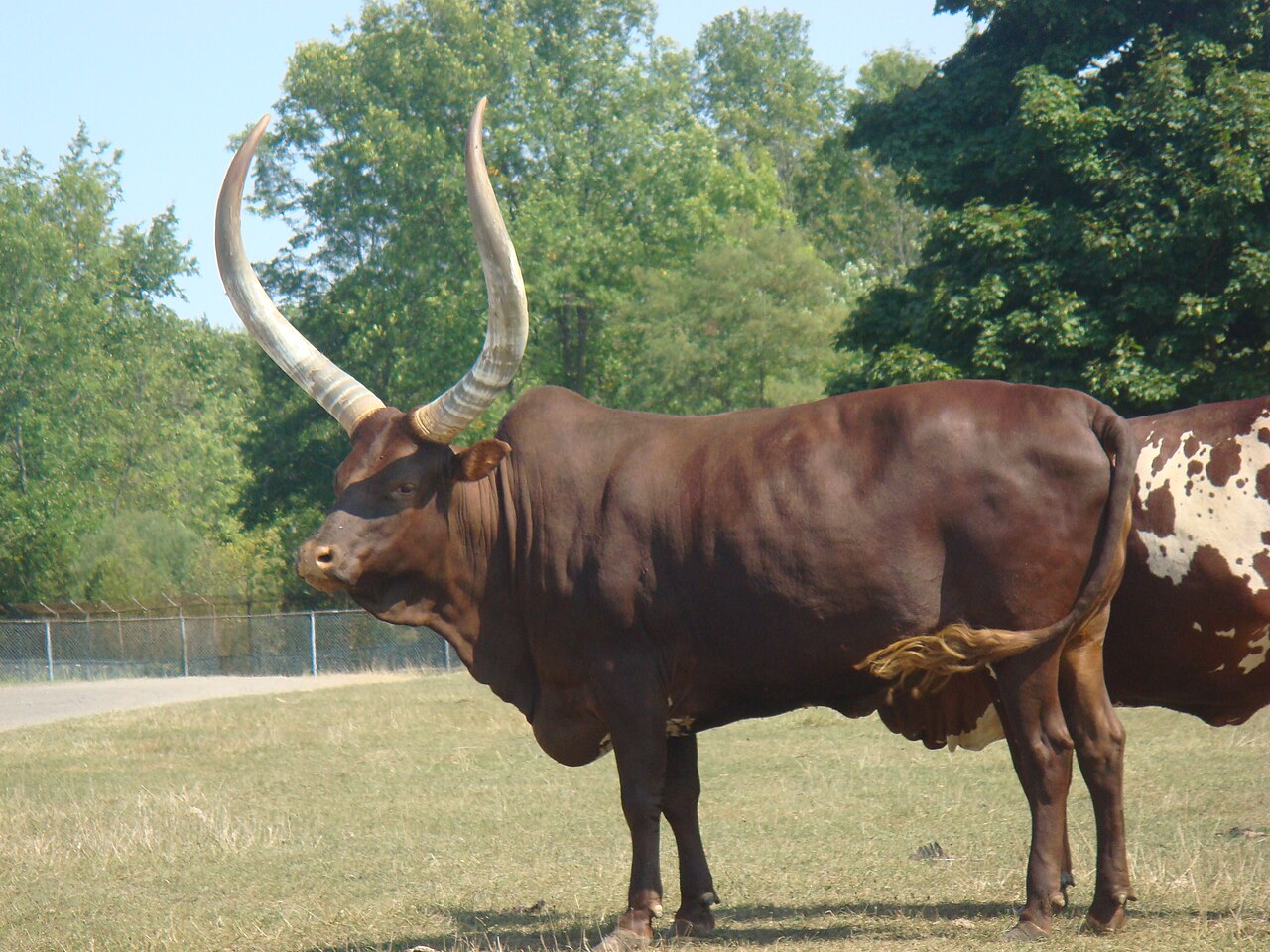
Watussi cattle is a hybrid of taurine and zebuine cattle and are known mostly for their huge horns. It is a variable breed, especially concerning the horn shapes and coat colours. It has not been used extensively in breeding-back yet, possible because of the zebuine influence (which isn't necessarily bad, subspecies purism makes not much sense in a case where so much of the original DNA is lost) and some "weird" features caused by this influence. However, with this post I'd like to outline why I think that this breed is useful and maybe even very desirable in creating an effigy breed of the aurochs, mainly because of its horns. 

Watussi cattle is, like most African breeds, a very hardy landrace that is able to live on poor forage. Of course it is adapted to much higher temperatures than European landraces and have a quite thin coat, but we know that they can low temperatures being kept outside all the year round, and crossbreeding with more cold-adapted breeds and selection will further improve that ability. 


Watussis standing in the snow; the coat is insulating enough
that the snow does not melt (forget the colour)
Watussi are reported to have a herding instinct since they lived alongside large predators in their native range - ok, I think all cattle show herding behaviour when living in nature under disturbance from man or predators, but this is certainly a good fact. So behaviour and ecology are no arguments against using that breed, quite the contrary is the case. Concerning genetics: Zebuine influence is often dammed by people doing breeding-back, because they think zebus are genetically very different from the Eurasian aurochs. However, both taurine and zebuine cattle descend from the aurochs, merely different subspecies with - as far as we can say - only subtle differences. Both zebus and taurine cattle probably lost so much of the original diversity of their ancestral subspecies that it is, in my opinion, no crime to use a half-zebuine breed in a breeding-back project working with taurine cattle. Probably the weird zebu-typical features including the fleshy hump, hanging ears, long skin flap near the praeputium and the long dewlap are what alienates many people off, but these can be bred out just like any undesired phenotypic features. 

Despite extensive internet research, I haven't found any data on Watussi size. I think the size of that breed might be heterogeneous, but probably numerous Watussi are larger than Heck cattle, so I'd categorize it as a medium-sized breed in my size categorization scheme. The leg length of Watussi isn't that bad either, quite a lot actually have long and slender legs


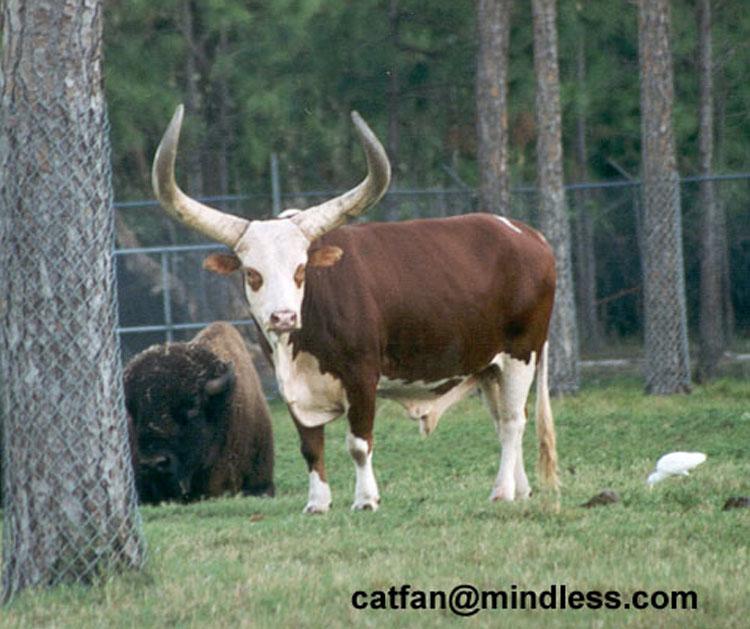
The body is floppy and massive in most Watussis, but this problem should be familiar from other breeds. The zebuine hump should not be all that difficult to breed out, it left no track in Heck cattle. The colour in Watussi is variable, but most have a weird, homogeneously reddish coat. I think this wild type colour plus some unidentified zebuine modifier,  since some Watussi clearly display dark mucosa, a mealy mouth and in some cases even sexual dichromatism - sure signs of wild type colour. 


Vestiges of sexual dichromatism in Watussi
Aurochs-coloured Watussi cows (lower one: © ribarn on flickr)

Other members of that breed might have the black allele, and spots are very common - some have the hereford pattern, but the colour-sized pattern is very common in American Watussi, due to the mutual intermixing with Texas Longhorn. In fact, there are many Watussi x Longhorn crosses, and some of them do look good. And since Longhorns are a very hardy breed as well, their ecologic capacity can be nothing but useful. Some Watussis also are quite long-snouted:
Now lets move to their most interesting and obvious phenotypic aspect: the horns. The horn shape is very variable in this breed. Their dimensions are awesome, and since horn size is a quantitative feature that is very difficult to increase just by selection, the use of such a large-horned breed is advantageous in any case. Of course some Watussi have really exaggerated horns, like Schwarzenegger arms, but I wouldn't say that most members of the breed have horns larger than those of (predominantly pleistocene) aurochs. Many of them have rather upright, straight horns or very outwards-facing horns. However, numerous Watussi have the basic "primigenius spiral", just less extreme and more upwards-outwards. Some individuals even have decently inwards-facing or forwards-pointing horns. 
Here are some examples of Watussis with really useful horns: 


Watussi cattle has not been extensively used in breeding-back yet. But the use of one half Watussi cross cow in the Neandertal Heck cattle lineage has helped greatly to increase the horn size in Heck cattle, most notable in the Wörth Heck herd. The Hungarian Taurus cattle project in the national park also uses Watussi, with some very decent results, like this cross bull ((Heck x Sayaguesa) x (Hungarian Gray x Watussi)): 


I think that Watussi would also be very advantageous for the Lippeaue herd to increase the horn size and maybe also to modify the horn curvature. 
The Tauros Programme might need that breed as well, to get rid of very small horn dimension contributed by many of the used breeds and to achieve a satisfying aurochs-like horn size. 

If a breeding-back program, or any breeder, takes the time to find a Watussi cow that is large and long-legged, does not have too much undesired colour genes and has a long snout, I'd opt for using that cow at any time. I think that German zoos have a number of useful individuals. 
So, my today recommendation for breeding-back is: More Watussi, please! 


Tuesday, 7 January 2014

Sorraia skulls - robust or gracile?

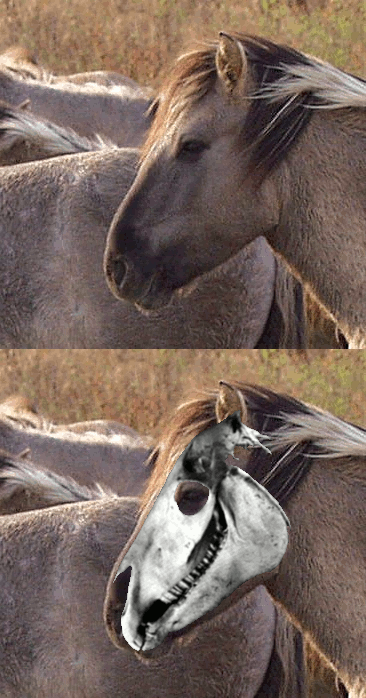
In my previous post on the Sorraia, I claimed that these horses are slim-jawed. To either verify or justify this statement, I did a life reconstruction of the skull of the wild horse skeleton found in Denmark, using this excellent anatomic drawing as reference. I then superimposed it with the heads of two Sorraia (first head ©Lynne Gerard, second head from Wikipedia commons). This is the result:


 They do not match completely, and it is difficult to decide which parameters to take as anchors, such as the snout length or the depth of the postorbital head etc. To get a more precise idea I then decided to do it the other way round by taking photos of Sorraia heads and trying to infer what the skull of this animal must look like. This is quite easy when having good anatomical guidelines. I chose the photos of four individuals; two which appeared to be on the robust side, and two which looked gracile to me. This is a small sample but considering that the Sorraia is seriously inbreed, it might be sufficient.

As a comparison, I used the Denmark skull again, additionally to a skull of E. lambei in the lack of Holocene wild horse skulls. The two “Tarpan” skulls are useless as they most likely represent feral or mixed horses. I added the skull of an Exmoor pony which I scanned from a Sue Baker’s book (The Exmoor Pony: Survival of the fittest) and the derived domestic skull (I have no clue which breed it might represent, but its shape is obviously very different from wild Equus ferus).
To compare how deep, short or pinned the skulls are and how weak or deep the lower jaw is, I related several arithmetic features of the skull against each other. I measured the length from the tip of the upper incisors and the Squama occipitalis ("length/depth"), the relative depth of the lower jaw by measuring the depth of the snout at half of its length (lower jaw and upper teeth not included) and the depth of the lower jaw (teeth excluded). The "pinned ratio" is my attempt to quantify how conical/pinned the skulls are by relating the depth of the skull at where the nasal bone ends and at the end of the jaw bone. 


Length/depth
Snout/dental depth
“pinned-ratio”
Sorraia 1
2,43
2,18
2,33
Sorraia 2
2,52
2,38
2,29
Sorraia 3
2,44
1,33
2,41
Sorraia 4
2,28
2,38
2,09
Sorraia average
2,42
2,07
2,28
Denmark skull
2,33
1,45
1,8
E. lambei skull
2,37
1,27
2,06
Exmoor skull
2,33
1,45
2,1
D. Domestic skull
3,29
2,17
2,2

Sorraia skulls less deep than those of the other skulls observed. The lower jaws of the Sorraia are less deep than the other skulls by about one third. The Sorraia skulls are more pinned than the other skulls. The Sorraia skulls, however, are one third deeper than the derived domestic skull, the jaw bones are deeper as well, but not very significantly. The Sorraia skulls (except No. 4) are considerably more conical than the derived domestic skull. Interestingly, the Exmoor skull is very similar to the Denmark cow, just less pinned. Remember though that these are just arithmetical figures, there are other differences between the Exmoor and Denmark skulls.


So, to prove whether the skull of the Sorraia resembles that of Holocene wild horses from Iberia or not, a sample as large as possible of such skulls of the local predomestic horses has to be collected and compared on osteometric basis. Actually that should be done with the whole body.