Here are the articles:
With the articles I intended to do a comprehensive summary on what we know about these two animals. Long-term readers of my blog will be familiar with the knowledge presented in the articles.

The ecologic niche of the aurochs and where it differed from that of the wisent is hard to ascertain as the aurochs is extinct. Right? Not exactly. There actually a lot of things on the ecology of the aurochs and its interplay with other European herbivores that we can infer from various sources.

The aurochs and other European herbivores of the Holocene
1. The aurochs was a grazer and probably much like cattle ecologically
The aurochs had the hypsodont denture of a grazer, like cattle today [1]. Anton Schneeberger writes that aurochs fed on acorns, mown grain and hay they were provided, and on branches of shrubs and trees during winter [2]. It has been reported that aurochs grazed in the same places as cattle and horses [2]. Since cattle descend from aurochs, and domestication probably did influence the basic diet in cattle [2], it can be assumed that aurochs and cattle were very much alike in food choice. There are differences within cattle, but that is mainly between highly derived breeds and landraces, since the former do not consume plants that are less digestible while the latter do [3].
Isotope analyses suggest that aurochs were found in more forested and wetter habitats than cattle, which mainly grazed on pastures [1]. It is of course possible that this is a difference between the wildtype and the domestic form, but it is more likely that the aurochs was pushed into these less accessible regions because open habitats were reserved as pastures for domestic cattle. Also, free-roaming cattle have been found to prefer wet habitats as well [5]. The continuous habitat loss was one of the driving factors for the aurochs’ extinction [2].
2. The aurochs preferred lowlands and wetter habitat than the wisent
The distribution of fossil and subfossil remains of aurochs and wisent have shown that aurochs preferred plain habitat and lowlands while wisent were found much more often in mountainous habitat [4]. This is also in line with what is known of the historic distribution of both species [2]. While it is true that both the wisent and the aurochs have been limited to hideaway regions due to habitat loss because of the human civilization and hunting, it probably has a reason why the hideaway regions of aurochs were marshes and lowlands and that of the wisent was mountainous habitat, and this region were the ecologic adaptions of the respective species. The wisent avoids areas which are too wet [4], which is why a replacement of the cattle at Oostvaardersplassen with wisent, as it has been discussed on occasion, is not feasible (Bunzel-Drüke, pers. comm.)
Nevertheless, both bovines must have met each other [2].
3. There was niche partitioning among Europe’s large herbivores
According to the competitive exclusion principle in ecology, two or more species cannot exist in one and the same ecologic niche. Therefore, there must have been niche partitioning among Europe’s large herbivores and apparently this was the case. Cattle consume more wooden material than horses, which are strict grazers. However, cattle do not include as much wooden material in their diet as the wisent, which is a so-called semi-intermediate feeder. So there is a graduation on how much the respective herbivore relies on either grasses or wooden material, with horses relying the most on grasses and wisents consuming the most wooden material, and cattle being intermediate [4]. Since this niche partitioning is the result of evolutionary adaptions of these species, it is likely that this would also be the niche partitioning between wild horse, aurochs and wisent.
Therefore, considering the differing habitat and food preferences, cattle and wisent would concur only to a limited extent in Europe’s nature systems. So the fear that wisent and cattle cannot be kept in the same reserve is baseless as long as the reserve provides habitats for both species. Another reason why some people have objections against (re)introducing cattle into European nature systems is that they are concerned that wisent and cattle would hybridize. However, a work by Frans Vera has concluded that cattle and wisent do not hybridize spontaneously and only under artificial conditions, which also often lead to the assault of the domestic individual by the wisent [6]. Furthermore, parturition does not occur in those hybrid pregnancies [6], what makes human assistance necessary. Thus, cattle and wisent would not produce hybrid populations in the wild even if mating between both species would occur.
[1] Lynch et al.: Where the wild things are: aurochs and cattle in England. 2008.
[2] van Vuure: Retracing the aurochs – history, morphology and ecology of an extinct wild ox. 2005
[3] Poettinger, J.: Vergleichende Studie zur Haltung und zum Verhalten des Wisents und des Heckrinds. 2011.
[4] Bunzel-Drüke, Finck, Kämmer, Luick, Reisinger, Riecken, Riedl, Scharf & Zimball: „Wilde Weiden: Praxisleitfaden für Ganzjahresbeweidung in Naturschutz und Landschaftsentwicklung“. 2011
[5] Gander et al.: Habitat use of Scottish Highland cattle in a lakeshore wetland. 2003.
[6] Vera: Do European bison and domestic cattle hybridize spontaneously? 2002.

 |
| A Heck horse mare in the Tierpark Hellabrunn. The Heck horse is a well-known "breeding-back" result with horses. |
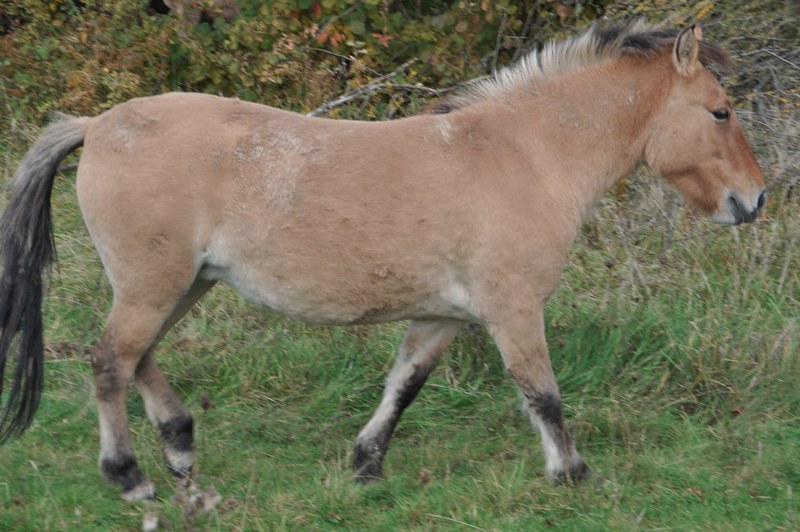 |
| A Przewalksi x Konik mare in the Lippeaue |
 |
| A reconstruction of the Holocene wild horse as suggested by recent evidence (the mane is still speculative). |
 |
| Lerida, a Heck x Sayaguesa, in young years © Matthias Scharf |
 |
| Lerida a little bit older © Matthias Scharf |
 |
| Photographed in the Lippeaue 2013, all rights reserved. |
 |
| © Claus Kropp |
 |
| © Claus Kropp |
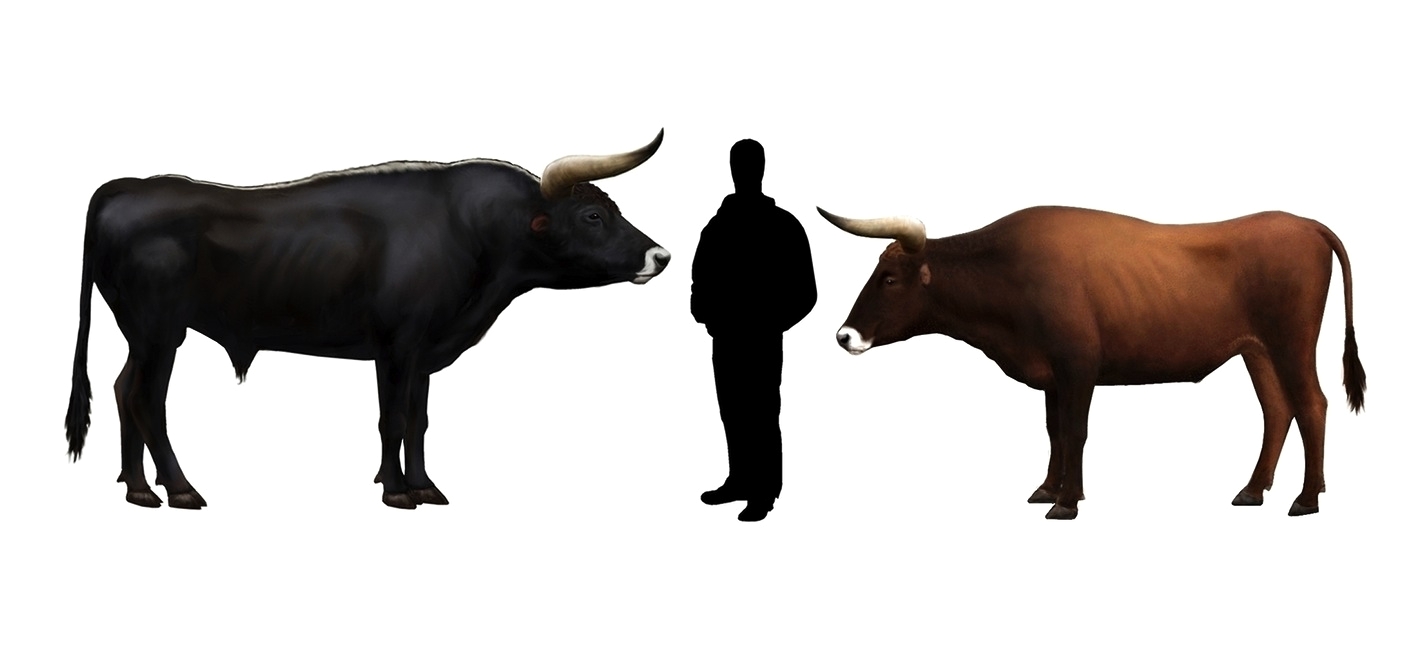 |
| Aurochs bull and cow. Based on the Lund bull and the Cambridge specimen. It is a rather old reconstruction of mine, I still consider it accurate except for the raised pelvis in the bull and that the horn tips do not face inwards enough |
 |
| All rights reserved. |
 |
| All rights reserved. |
 |
| © Markus Bühler |
 |
| All rights reserved. |
 |
| Skeleton, muscle reconstruction and life reconstruction of the Sassenberg cow specimen © All rights reserved, please do not use without permission. |

 |
| The Sassenberg cow with a shagger coat during fall. Please do not use without permission. |
 |
| Apollo (Watussi x Maremmana) © Claus Kropp |
 |
| Benito (Maremmana x Sayaguesa) © Claus Kropp |
While the genetics of coat colour of domestic animals are comparably well-studied, the genetic background of other aspects, such as the horn shape and size of cattle, remains nebulous. Only the genes for the polled and scurred conditions are resolved, while the genes that determinate the shape of the horns as well as the size are unresolved.
Horn size is a quantitative trait. That means it is influenced by a larger quantity of genes and shows a continuum. The identity and influence of those individual genes is probably largely unknown, but crossbreeding results can provide a clue for speculations.
The idea for this post came to my mind when I saw photos of the Taurus cow “Lippe”, which is an F2 (Sayaguesa x Heck) individual.

F2 Heck x Sayaguesa cow Lippe in the Lippeaue © Matthias Scharf
It is notable that the cow has very small horns like a Chianina. Yet it has no Chianina in its ancestry, only Heck and Sayaguesa. Two breeds that have horns that can be described as at least medium sized – the horns of the Heck cattle used in the Lippeaue are actually comparably large. So it is possible to breed individuals with tiny horns from two breeds that have at least medium-sized horns within only two generations.
How is that possible? One possibility is that the gene or genes for this tiny horn size is or are recessive, and that the F2 carries two of the recessive alleles and is thus homozygous. However, in this case we would also see tiny-horned Sayaguesa and Heck cattle on occasion. The other explanation, which is much more plausible to me, is that this tiny horn size is the result of a cumulative effect. Sayaguesa may have alleles for small horn size one the one locus, and Heck cattle on another locus. In the F1 generation these loci would be heterozygous, thus the horn size would still be medium-sized. But in the F2 generation, coincidentally, the cow might be homozygous for the alleles causing small horn size on both loci, resulting in the very small horns not seen in the parental breeds or F1 animals. It might involve even more loci, two would be the minimum.
The horn size we see in Chianina might be caused by different loci or alleles, we cannot know without resolving the alleles and testing it. Crossbreeds suggest that at least some of the alleles causing the small horn size in Chianina are recessive. The crossbred Taurus bull 01 856 was the son of the bull Laokoon and the cow Larissa, two individuals with medium-sized horns. However, both parents were part Chianina (25% respectively 62,5%). 01 856 happened to have rather small horns, not larger than in Chianina. This suggests that at least some of the alleles causing the horn size in Chianina are recessive. It would also explain why many half-Chianina individuals had horns of medium size (such as the bull Luca or the cow Larissa).
If the small horn size of Chianina is indeed recessive, this is bad news. Recessive alleles are difficult to purge effectively from the population.

The bull 01 856
If it is possible to breed horns smaller than in both parental breeds within two generations, as the cow Lippe demonstrates, it might also be possible to breed large horns out of two breeds with medium-sized horns in few generations. This would depend on which alleles the parental breeds have.

 |
| The Vig specimen at the National museum of Denmark, © Markus Bühler |
 |
| Life reconstruction of the Vig bull |