Thursday, 30 June 2022

Video of a Steinberg/Wörth bull and Tauros cattle


The video above shows the bull Azrael, which is currently the breeding bull at the Neandertal Heck cattle herd. The Neandertal herd was important for improving the quality of non-crossed Heck cattle in the 20th century, as they included a half-Watussi cow in the 1960s and used her 25% Watussi son as a breeding bull. This created good horns in the herd. The Neandertal Heck herd was also important for the Steinberg/Wörth lineage, as many of its founding individuals were from that herd. The Steinberg/Wörth lineage is the Heck lineage with the most aurochs-like horns among the breed, due to consequent selective breeding. Now (at least in 2020) the Neandertal herd has a breeding bull from the Steinberg/Wörth lineage, what is certainly useful for maintaining the good horns in the herd or even improving them. Azrael has large and thick horns, matching those of many aurochs skulls in dimensions. 

This video shows a group of individuals of the Tauros cattle herd at Keent, the Netherlands. The bull is certainly part Maremmana, as the horns, diluted coat colour and large dewlap reveal. I like the body morphology of the bull, as the trunk is not too long and the body not too heavy. Also, the hump is large. If it had good horns and the right colour, it would make a good breeding bull. The sexual dichromatism seems to be completely absent in the herd, as the cows are dark while the bull has a saddle (the opposite of what should be the case). The individuals are called "Taurus cattle" in the video title, which is wrong as they are Tauros cattle. Those two names will be confused forever, and many even think Taurus and Tauros cattle are one and the same because the names are so similar. I wonder why the TaurOs Programme picked a name that is so similar to an already existing project/breed. 

Tuesday, 21 June 2022

My trip to the Lippeaue in 2022 (Taurus cattle)

Last week I visited the Lippeaue reserve again, which is the main Taurus cattle breeding site in Germany. As usual, it was a very enjoyable trip, and it was great to see the animals again and how the herds progressed since 2017. 

It has been five years since my last trip to the reserve in 2017. Some of the older individuals have died or had to be slaughtered in the meantime, including Lerida, Dona-Urraca (the Sayaguesa cow with the great horn curvature), Linnet and the huge Laokoon’s brother. Others, like Lamarck, are still in the herd. The other current breeding bulls are new. I counted 98 individuals in the stock list, including the calves. As long-term readers of my blog will know, the Lippeaue population is divided into five herds: Hellinghauser Mersch, Klostermersch-Nord, Klostermersch-Süd, Disselmersch and Kleiberg. There is one breeding bull per herd, selection takes place by picking a breeding bull with desired traits and selecting out individuals. 


Hellinghauser Mersch 


The current breeding bull at Hellinghauser Mersch is a nameless bull with the number 47 938, which is the son of Laniel and Larissa. Therefore, both its parents are crossbred themselves – this is good, because it’s where the real selective breeding starts. 47 938, as a result of two crossbred individuals that both are very useful, looks good itself. He has a flawless wildtype colour, horns facing forwards in a 60° angle to the snout, the hump is more or less large, and he has a short dewlap. He is three years old, thus not fully grown. 


The cow 42 604 is one of my favourite cows. I saw her as a young cow in 2013, and her horns developed considerably since then. Her colour is a flawless aurochs cow colour, and bears striking resemblance to some of the depictions at the Lascaux cave. She is a daughter of Lamarck (Sayaguesa x (Heck x Chianina)), and Julia, a red Sayaguesa cow, thus she is 75% Sayaguesa. In general, Sayaguesa is by far the dominating breed in the Lippeaue gene pool. This is because Sayaguesa simply is a very useful breed that results in good-looking animals. 


Another good cow of the same combination but with a different Sayaguesa mother (named Zamora) is 42 630. Like 42 604, she has a perfect wildtype colour and her horns are good as well. 


Apart from the wildtype-coloured individuals, there are some other colours as well. There is the cow 55 443, which is one of those with a pink nose and a light coat colour. I think that it is possible that it is the e mutation on the Extension locus, a colour variant that is found in breeds like Highland and Simmental, but I am not sure. This mutation disables the production of black pigment in the mucosa, horn tips and coat colour and is recessive under the wildtype allele. I wonder which breed contributed the colour variant displayed by 55 443, perhaps Heck cattle (Highland is one of the founding breeds of Heck). Basically, it is tried to avoid this colour variant, but 55 443 has good horns and is comparably large, so she is kept in the herd. She is the daughter of Laokoon’s brother (Sayaguesa x (Heck x Chianina)) and Loren, a daughter of Luca and Lirgit. 


Another cow with a deviant colour variant is 47 988. Her nose is pink too, therefore she might have the e mutation too, but she also seems to have dilution alleles contributed by Chianina. She will be selected out. 


One of the Lidia-influenced individuals is 79 813. She is the daughter of Lamarck and Lepisma, a half-Lidia cow. She is a little bit more nervous than other cows, which is very likely due to the Lidia influence. Her horns are good, the colour is alright as well, and she is from good parents. 


Most of the bulls that are born in the Lippeaue are black with a dorsal stripe. Some, however, have a saddle. And a young bull in the Hellinghauser Mersch this year is kind of cow-coloured. He is a son of Laokoon’s brother. I suspect that this is the case because Laokoon’s brother had a saddle, so that the sexual dichromatism is less pronounced in some of the individuals in this herd. 


55 444 is another cow with a flawless aurochs cow colour. 


Klostermersch-Nord


Lamarck is an old boy now, he is 15 years old. He still looks good, he did not grow a massive body. I think his horns even grew a little bit. I still consider Lamarck the best Taurus bull to date, and therefore the best “breeding-back” bull that was born yet, although he is not as huge as Laokoon’s brother. Due to his age, he has become slow and tired, often he is found outside the herd. It’s probably his last year. 


Linea is of the same combination as Larissa, namely Chianina x (Sayaguesa x (Heck x Chianina)). She is the daughter of the Chianina cow Eloisa and Lombritz. As she came rather close, we tried to measure her withers height, and the result was 156 cm. For a cow that’s a very good size, most aurochs cows were not much larger. 


01 896 is a daughter of Laokoon’s brother and Dunja, so it is an F2 of the combination Sayaguesa x (Heck x Chianina). I think true F2 are very interesting, as they have a higher chance to be homozygous than usual crossbreeds.  


55 441 is the daughter of Lamarck and Nadia, the Heck cow from the Steinberg/Wörth lineage, so she is half Heck half Sayaguesa x (Heck x Chianina). 


Nadia herself is old now and doesn’t calf anymore. She bore two bull calves which were slaughtered and 55 441. 


Klostermersch-Süd


Most of the individuals on this photo have the right colour for their sex, so there is good dichromatism in the herd


The breeding bull at Klostermersch-Nord is Laniel. He is the son of the Sayaguesa cow named Augustina and Laokoon’s brother. The horn curvature is really nice and also the hump is comparably large, what compensates the fact that he has a faint saddle. 


01 870 is a daughter of Laokoon and Laniana, therefore she has a little bit Lidia in her blood. The colour is flawlessly aurochs-like, and also the horns are good. 


Larissa next to a wildtype coloured cow

Larissa is the largest cow in the Lippeaue and the same breed combination as Linea, with the Chianina mother Laura. 


Disselmersch


The breeding bull at Disselmersch is Darth Vader III, who became famous as the “jumping bull” on Youtube. He is the son of Londo, who was an F2 Sayaguesa x (Heck x Chianina) and the son of Lamarck, and the cow Laniana. He is 1/32 Lidia. 


Guessing by eye, the body size and horn size of the animals at Disselmersch is slightly smaller than in the other herds. 


Kleiberg 


Linnet was replaced as a breeding bull this year, the new breeding bull is Dominator. He is the son of Laniel and a Sayaguesa cow, therefore mostly Sayaguesa. The horns of this bull are great. The curvature is very aurochs-like, and if they continue growing with this curve they will be perfect. The angle between the horns and snout is rather narrow, but that will be compensated by the horn orientation of other individuals. The horns also have a nice size. He will continue to grow for a couple of years, I am looking forward to see how large he is going to get. 


Bionade, the Sayaguesa x Chianina cow, is alive and well. Back in 2017, I measured her at 155 cm at the withers, and she must have grown since then, because she is huge. She came rather close, and I was impressed by how large she is. I am looking forward to the offspring with Dominator, his great horns coupled with her large size surely has a lot of potential. 


Another very large cow is Kasmerodia. She has the same deviant colour as 55 443 which might be the recessive mutation, but her large size and the large horns make her a useful individual. She is the daughter of Loren and Laokoon’s brother, therefore she is more Heck than Sayaguesa yet still she is huge. That shows that genetics work by chance, which is always interesting to see. 


Kalandra is a daughter of Linnet and Kalidis, a daughter of Bionade. Her horns are comparably large and the colour is aurochs-like. 


The most important question is: did the average quality of the individuals increase over the last few years? I think it did, as cows with inwards-facing horns are now much more common than in 2017, 2015 or 2013. Looking at the horns of most of the individuals, the first impression may be that the tips should face more inwards, but actually the curvature is alright, it is just that they should be oriented a bit more diagonal when viewed in frontal view. To explain what I mean, have a look at the photomanipulation of Lerida. I elevated the horns laterally by a few degrees in the "aurochs picture". Maybe it is best to call this the “lateral horn orientation”, in contrast to the horn orientation relative to the snout. I haven’t realized that this is a factor previously. Once the horns are a bit more laterally elevated, the curvature automatically looks more aurochs-like because the tips face more inwards, although the shape of the horns is actually the same. That way, the horns would resemble those of a lot of aurochs skulls, such as the one from the Gramsberger Museum or that at Asti, Italy. I don’t know how to fix that by breeding in future generations, as many aurochs-like landraces have a horizontal lateral horn orientation. All in all I think the horn curvature of most of the individuals is good and has improved over the last years. 

Regarding the sexual dichromatism, most individuals are coloured correctly. Bulls tend to be black with a dorsal stripe, cows tend to be reddish brown. However, there are also black cows and rarely also cow-coloured bulls, so that the dichromatism is often present but not always. 

Concerning the general colour, most individuals have the right colour phenotype. Half-Chianina individuals have a diluted colour of course, as Chianina has several dilution alleles, some of which are recessive. Selective breeding has to purge these alleles from the population in the long run, but considering that colour is regulated only by a few genes, that’s not all too difficult. 

Regarding the morphology, I think the trunk of the cattle is longer than in the aurochs. This is a general problem for “breeding-back”, no matter which project, as in most taurine cattle the trunk is longer than in the aurochs. Only some zebu landraces have a truly aurochs-like short trunk. This is why I included trunk length in my list of the challenges for “breeding-back”. But in general, Taurus cattle are of course more long-legged than Heck cattle, and also slenderer. 


All in all, I think the herds are on a pretty good way. I like all of the current breeding bulls and I am looking forward to see how large they will get and what the horns of Dominator are going to look like when he is fully grown in a few years. I was very impressed by the size of Bionade, Kasmerodia, Linea and Larissa. The horn size of many individuals is within the range of the Holocene European aurochs when skeletons like the Himmelev bull are considered. Of course, hypothetically, crossing-in Watussi for example would increase the horn size but it would also introduce a lot of unwanted traits like a large dewlap, the indicine hump, or a small body size. Backcrossing with Chianina would help to increase the body size, but also increase the frequency of alleles for small horns and colour dilutions – therefore, it is always about finding the right balance and prioritizing certain traits. Otherwise, it would be too easy. 

So far, no individual has been born that comprises all of the desired traits (that goes for all the other “breeding-back” projects as well of course). But I think that basically all of the aurochs traits that are achievable with domestic cattle are present in the gene pool, therefore the first of the milestones for “breeding-back” that I have defined years ago has been accomplished in the Lippeaue.


The horses 


The Lippeaue reserve is also home to the Konik-Przewalski crosses. These are either bay dun with a standing mane as a Przewalski’s horse, bay dun with a falling mane and rarely also black dun with a standing mane. Most individuals are bay dun in colour because they are most likely heterozygous and the allele on the Agouti locus (resulting in black dun) is recessive under the A allele (resulting in bay dun), therefore bay dun is the dominant phenotype of most of the crosses. So far, no concrete breeding goal for the phenotype of the crossbreeds has been defined. They are wilder in behaviour than Koniks, which are domestic horses, since Przewalski’s horses, being wild horses, are more difficult to handle than the domesticates. The remaining pure Koniks are sometimes sold as riding horses, which is impossible with the Przewalski’s hybrids because of their wild behaviour. Interestingly, I was told that the legal protection status of the Przewalski’s horse in Germany also goes for the hybrids, what surprised me. Some of the hybrids have already been sold to other grazing projects. This could increase the Przewalski’s influence in the Konik in Germany (the Konik already has introgression from the Przewalski’s horse) in the long run, which I consider a good thing. A haplotype typical for Przewalski’s horses has been found in an ancient DNA sample from a European wild horse stallion, what suggests that the range of the two subspecies was continuous. Therefore, Przewalski’s influence in European landraces is not “unnatural”, and also beneficial because the Przewalski’s horse is a genuine wild horse. In the end, the Przewalski’s horse would likely have recolonized Europe from Asia after the extinction of the European wild horse if it had not been for the anthropogenic obstacles. 


All in all, I think the Taurus cattle in the Lippeaue represent the top-level of current "breeding-back", and also the Przewalski's hybrids are very interesting and have potential. Therefore, it is always great to visit the herds and see the breeding progress. 

Wednesday, 1 June 2022

New Auerrind breeding herds assembled

The Auerrind project assembled new breeding herds in Lorsch, Wildpark Schwarzach and Bielefeld and published photos on Facebook: 
© Lauresham on Facebook

© Lauresham on Facebook

© Lauresham on Facebook
The upper two photos show a herd composed of the three adult Sayaguesa x Chianina cows, the Chianina x Watussi cow, two heifers (I don't know their combination but maybe they are Sayaguesa x Chianina too) and one young bull. The bull is, according to its ear tag number, the (Sayaguesa x Grey) x (Sayaguesa x Watussi) bull, a fullblood brother of Doro. I am looking forward to see how his horns will develop; it is impossible to judge the curvature at that young age, but the massive horn bases suggest that the horns will grow large. The Chianina x Watussi cow (on the second photo, far left) developed good as well, her horns are slightly reminiscent of that of the Vig bull. 
The third photo shows a Sayaguesa x Chianina bull and two cows, which, I guess, could be Sayaguesa x Maremmana cows. 
It is great to see the project progressing and trying all those combinations. These two new herds are composed of crossbreeds exclusively, what means that the offspring will descend from crossbreeds on both parental sides - this is where the real breeding starts, as the quality of the offspring will depend on which alleles get passed on by the crossbred parents. 


Tuesday, 31 May 2022

Two zebus with traits of the Indian aurochs

At first glance, zebus seem to be rather different from the aurochs. But there are certain traits found in many zebus that are very reminiscent of the wildtype. For example, many zebu landraces from South Asia have a very short trunk with long legs (more so than most taurine breeds on this world) and small udders. Many also have a comparably long snout. Surely, their often hanging ears, the fleshy hump (which is less likely to be a wildtype trait than a trait that appeared after domestication) and the often rather derived horn shapes give them an unusual appearance that creates the impression they are more removed from the aurochs than taurine breeds, but the huge udders, the piebald colour and tiny horns of Holstein-Frisian, for example, are not wildtype traits either. And not to forget, zebus have been found to share alleles with the European aurochs that taurine cattle have lost [1]. It is most parsimonious to assume that these alleles were also present in the Indian aurochs. Thus, zebus are actually more "primitive" than their looks suggest at first glance. 

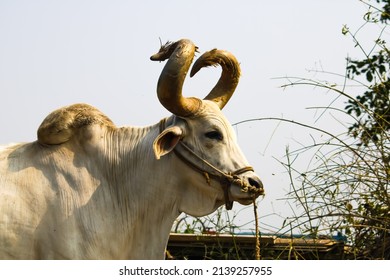
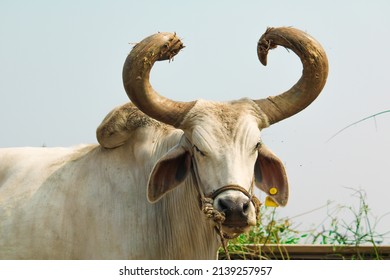
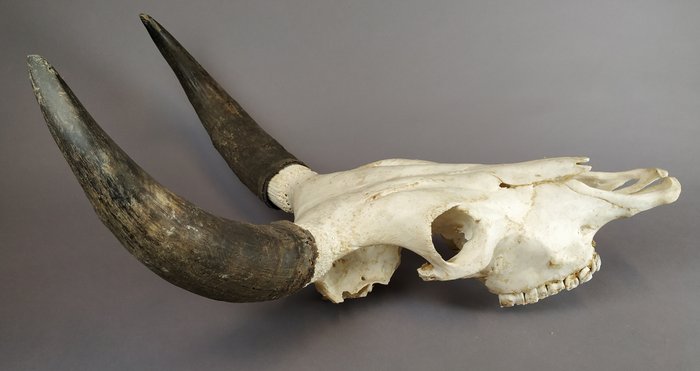
While searching for zebus with wildtype traits I found photos of one living zebu and one skull that both respectively share traits with Bos primigenius namadicus
For the living individual, go here and here. It has a crazily extreme primigenius spiral. And as so often when a domestic cattle individual has a perfect primigenius spiral, it is a steer (the picture description on shutterstock says it is an ox, thus castrated). Nevertheless, the horns are interesting. Not only because of their curvature, but also because they are antero-posteriorly compressed on the proximal half and thus oval in cross section, which was a trait of B. p. namadicus. In the African aurochs, B. p. mauretanicus, and also some European aurochs, B. p. primigenius (particularly those from the Pleistocene), we see the opposite, namely dorsoventrally compressed horns at the base. Thus, the horns of this zebu steer resemble the Indian aurochs in this respect, thus they can be considered "primitive". I would love to see the bony horn cores of this individual, to see if they have keels. A bony keel on the dorsal and ventral ridge of the horn core was a trait of Indian aurochs, particularly in early individuals [2], that later was lost in zebus again. Whether or not these keels were visible in the living animals is unknown, as no keratinous horn sheaths of this subspecies have been preserved. Therefore it would be interesting to see the bony horn cores of that steer. 
The zebu skull that is interesting can be seen here and here. What makes the skull interesting is that it can be seen that the forehead is slightly convex, which is a trait inherited from B. p. namadicus and the opposite of what is seen in the other aurochs subspecies and taurine cattle (a planar or slightly concave forehead). Also, the profile of the snout is completely straight, while European aurochs and taurine cattle have a slightly convex bulge at the base of the snout. The profile of the zebu skull, and that of many other zebus, thus resembles that of wild B. p. namadicus in these two respects: 
The skull of the Indian aurochs in profile view is at the bottom right; a cross section of the horn with the keels can be seen at fig. 6

Too bad that there is no complete skeleton of the Indian aurochs available. Plentiful of remains of B. p. namadicus have been found, but always only fragmentary specimen consisting of few elements and never a complete skeleton. My suggestion would be to create a composite skeleton in order to get a more complete picture of the morphology of this aurochs subspecies by taking well-preserved remains of individuals of the same sex and size and create a (more or less) complete skeleton. The same has been done for the neanderthal, from which no complete skeleton is known either.  

Literature 

[1] Orlando et al.: The first aurochs genome reveals the breeding history of British and European cattle. 2015. 
[2] Bökönyi: Zebus and Indian wild cattle. 1997.  

Monday, 23 May 2022

Bos primigenius trochoceros?

The species of the aurochs, Bos primigenius, has many synonyms – last time I counted it was 8, counting only those that are based on wildtype material and there might be more (with those based on cattle there would be much more). One of those synonyms is Bos trochoceros, a species which was described for Pleistocene European aurochs. However, as the differences between Pleistocene European aurochs and Holocene European aurochs is not dramatic enough to justify a split on species level, it has been synonymized decades ago. But what about subspecies level? Might it be justified to classify Pleistocene European aurochs as Bos primigenius trochoceros

There were differences in the morphology of Pleistocene and Holocene European aurochs. First of all, the former reached very large sizes of 200 cm withers height or more, while individuals from the Middle and Late Holocene were smaller (what was most likely due to anthropogenic factors). It also had – on average – considerably larger and more wide-ranging horns as the horn size of Holocene aurochs was decreasing and also the curvature was narrower (with large-horned Holocene individuals such as the Sassenberg bull being exceptions) throughout this period. The coat colour, however, was seemingly identical between Pleistocene and Holocene European aurochs, as a comparison between cave paintings and historic texts suggest. The question if the differences in body size and horn size are enough for a split on subspecies level is not easy to answer, as taxonomy is rather subjective – what is distinct enough for one worker is not distinct enough for the other. 

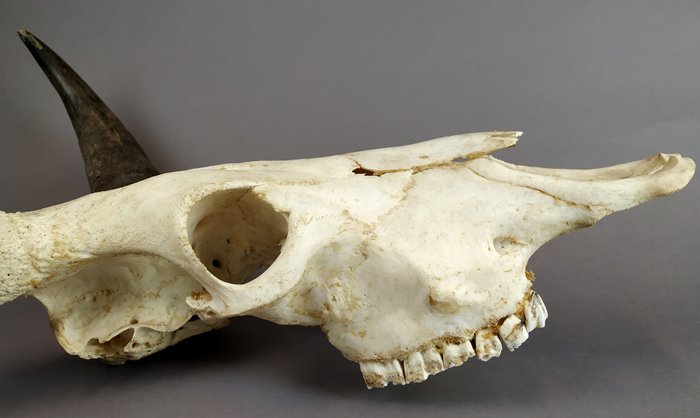
A Pleistocene aurochs skull from Germany with massive and wide-ranging horns - Bos primigenius trochoceros?
However, genetic information might endorse a split on subspecies level. Southern European aurochs (at least Italian ones) have the mitochondrial haplotype T which is also found in taurine cattle (hence the “T”), while those from the Northern half of Europe have the haplotype P (from “primigenius”). Southern Europe was a refuge for the aurochs during the last glacial, when the mammoth steppe covered most of its former range in Europe. The different haplotype of northern aurochs suggest that Europe was recolonized from the East rather than from the South after the last glacial [1]. So, there is a genetic difference between Southern and Northern European aurochs, and it must be noted that during the Pleistocene the range was restricted to Southern Europe. 

As it happens, Bos trochoceros is based on a Pleistocene skull from Siena, Italy [2]. And Bos primigenius is based on a Holocene skeleton from Haßleben in Germany, thus the northern half of Europe. Doesn’t that fit nicely? So, can we say that Bos primigenius primigenius represents only the Central and Northern European aurochs from the Holocene, that migrated from the East to Europe after the last glacial and have the P haplotpye, and that Bos primigenius trochocerosrepresents the Southern European aurochs that were slightly larger, had larger and more wide-ranging horns, were present in Europe during the last glacial and all had the T haplotype? I don’t consider this assumption all too absurd. We also have to consider that there likely was a continuum between both forms, as their range was continuous during the Holocene (similar as in the case of Canis lupus lupus and Canis lupus italicus). Not all Holocene aurochs with the P haplotype had smaller horns (see the Sassenberg specimen) and not all of them were smaller than Pleistocene Southern European ones (see the Prejlerup specimen which might have been around 195 cm tall in life). 

It seems that I am not the only one who considers the use of the trinominal name Bos primigenius trochoceros legitimate. The name has been used in a 2020 paper and a 1995 work for Middle Pleistocene aurochs remains in France [3,4].

If a split on subspecies level within the European aurochs was legitimate, this also would have consequences for the evolution of cattle. Since Southern European aurochs have the T haplotype, Near Eastern aurochs in the fertile crescent from 10.000 years ago that were the ancestors of taurine cattle, likely had the same haplotype. Quite possibly, the populations were connected at some point, and most likely the aurochs entered Southern Europe via Anatolia. Therefore, it is likely that Near Eastern aurochs from that time can be or must be considered Bos primigenius trochoceros too. That means taurine cattle were not domesticated from the nominate subspecies, Bos primigenius primigenius. Nevertheless, B. p. primigenius in this strict sense left a lot of living descendants because of secondary introgression into cattle in Europe (go here). 


I consider this split on subspecies level at least possible – I am very open for the possibility that trochoceros rises from the grave of the junior synonyms thanks to genetic and morphological information. We would have five mainland subspecies of the aurochs in this case: the Northern European aurochs Bos primigenius primigenius, the Southern European (and possibly Near Eastern) aurochs Bos primigenius trochoceros, the North African aurochs Bos primigenius mauretanicus, the Indian aurochs Bos primigenius namadicus, and the East-Asian aurochs Bos primigenius suxianensis. I am also convinced that this would not be over-splitting as other bovines with a large geographical range such as the cape buffalo which is divided into two to three subspecies (depending on the status of Syncerus nanus), and this includes only those that live today in the late Holocene. The aurochs simply was a species with a large geographical range over a comparably long period of time, which goes hand in hand with the evolution of several subtypes. 


Literature


[1] Mona et al.: Population dynamic of the extinct European aurochs: genetic evidence from a north-south differentiation pattern and no evidence of post-glacial expansion. 2010. 

[2] Rütimeyer: Überreste von Büffeln (Bubalus) aus den quaternären Ablagerungen von Europa. 1870.  

[3] Uzunidis: Dental wear analyses of Middle Pleistocene site of Lunel-Viel (Herault, France): did Equus and Bos live in a wetland? 2020. 

[4] Tuffreau et al.: Le gisement acheuleen de cagny-l’epinette (somme). 1995. 

Thursday, 19 May 2022

Genome editing for "breeding-back" the aurochs

Traditional “breeding-back” takes a long time until satisfying results are achieved, also because cattle are a comparably slow-reproducing species. Also, “breeding-back” cannot revive the aurochs for several reasons, it can merely produce an imitation of the wildtype. That is why many dream of using genome-editing in modern “breeding-back” projects. Genome editing using the CRISPR-Cas9 method enables to cut and modify the genome of an organism, and to insert or exchange alleles in the genome. The now-dead Uruz Project (which now only exists on Wikipedia) started with the claim that they want to use genome editing for “breeding-back” in order to speed up the process. It sounded great, but there are some obstacles. 

First of all, only a handful of genes responsible for the phenotypic characters of interest in cattle have been resolved. For example, we know that a brindle coat colour is caused by a dominant allele on the Agouti locus, that the polled condition is caused by a dominant allele on the Polled locus, and the three alleles on the Extension locus and aggression in cattle is probably influenced by the MAOA locus (go here). But we have no clue which alleles are responsible for horn size or curvature, the various colour dilutions we see in Podolian cattle and Chianina (which are used in “breeding-back”), the size of the hump, the sexual dichromatism and many other traits. And some traits, such as body size, proportions and other morphological traits (which make up the most important differences between cattle and aurochs) are likely controlled by hundreds of genes or even more (cattle have 22.000 genes). Therefore, a lot of research would have to be done in order to use genome editing efficiently for “breeding-back” an imitation of the aurochs. 

Genetic linkage is kind of an argument pro and contra genome editing in “breeding-back” at the same time. It is possible that some morphological/optical aurochs-like traits are linked to wildtype traits with other functions (for example immunological, developmental, physiological). If the wildtype allele(s) for a certain morphological trait is inserted into another genome with genome editing instead of being introduced with traditional breeding, the wildtype allele for non-visible characteristics would not be transferred to the new genome. This is a scenario where genome editing would not be beneficial for the goal (to have as much wildtype alleles as possible) and where traditional breeding would be more effective. However, the opposite scenario would be equally as likely, that some wildtype alleles are genetically linked with domestic alleles on the same chromosome. If the wildtype allele and the domestic allele lie close together on the chromosome, it is not only impossible to get rid of the domestic allele without also losing the wildtype allele but it is also very unlikely that the linkage is ended by recombination. In this case, genome editing would be beneficial: the domestic allele could be cut out and replaced with a wildtype allele from the same locus from another cattle breed that still has the wildtype allele. This is the scenario where genome editing would be highly beneficial for “breeding-back”, and I believe this is what the Uruz Project was referring to when they said they want to use this technique. However, as outlined above, as long as the alleles responsible for the phenotypic traits of relevance, it is not possible to use genome editing for “breeding-back” effectively. 

This is where the fully resolved aurochs genome that was resolved in 2015 from a British Neolithic aurochs bull comes into play. So far, no particular gene has been identified that played a considerable role in the domestication of the aurochs. In horses, two such genes have been identified: one influencing the ability of the animals to bear weight on their back, and one influencing fear response and docility (here). If the same work was done for the aurochs, one could take these genes in the genome of modern cattle (preferably cattle that are already aurochs-like, not Holstein-Frisian) and replace their domestic alleles on these important loci and replace them with alleles taken from the aurochs individual. It has also been found that zebus have some wildtype alleles that were replaced by domestic alleles in domestic cattle (here). These could also be replaced by aurochs alleles in an aurochs-like cattle individual. This modification of the genotype of an already aurochs-like taurine cattle individual would be a reintroduction of organismic wildtype traits that could be very beneficial for the cattle’s survival in nature under natural selection (be it immunological, developmental, physiological, genomic by the removal of deleterious domestic alleles, morphological or behavioural). 

I think it might be possible (though more effortful) to go one step further: replacing all the domestic allele of an aurochs-like taurine cattle individual with those of the aurochs. The result would basically be a recreated aurochs. It would not be a recreation of the original genetic diversity of the wildtype, but at least one individual. As an aurochs enthusiast, I would of course love this scenario. But if that is not possible for technical reasons, even the reintroduction of single wildtype alleles that are lost in modern cattle would already be a success. I really hope that someone one day is going to try it (what would require the “the aurochs can be bred back anyway” mentality to finally disappear). 

Wednesday, 11 May 2022

The Vig bull and its horns

The Vig bull is one of the two almost complete aurochs skeletons from Zealand, Denmark. It's from the early Holocene and shows several injuries to the bone caused by arrows. The skeleton is likely a male because of its size, robust postcranial skeleton and long skull shape. However, compared to other finds from males like the London skull, the eye sockets are not nearly as prominent and the overall build of the skull not very robust. 
The horns are not as strongly curved as those of many other aurochs bulls, and also the angle between horns and snout is larger than average (about 80°). On Wikimedia Commons there is a nice photo of the skeleton in frontal view (here). I could not resist to track the skull out with a pencil and do a life reconstruction of the head and horns: 
Perhaps I made the snout look too feminine for a bull, but the skull is very slender. There is no general rule how much keratine to add to the length and thickness to the horn cores because apparently there was much individual variation in the aurochs. 

Friday, 29 April 2022

Video of a great Lidia bull

Repeatedly I wrote on my blog that I consider the Spanish fighting bull (Lidia) the most aurochs-like or least-derived taurine cattle breed that is left on this world. In the youtube video linked down below there is yet another example for a very aurochs-like Lidia bull. 

The bull appears at 0:22. Look at its horns, its morphology, its skull shape. Simply wonderful. All in all it is a very aurochs-like individual. The colour is not wildtype colour (which would be an E+//E+ genotype), but colour is an easy fix as it is controlled by only a few genes. The morphology, however, is controlled by most likely a very large number of genes and thus a bull that has the right morphology but not the right colour is much more useful for "breeding-back" than a bull with the right colour but not the right morphology. And considering that most "breeding-back" cattle so far have a morphology that is not quite there yet, this Lidia bull would help to boost their aurochs-likeness considerably.

However, this breed has to be used wisely due to its problematic behaviour. What I would do if I had the chance would be to create a herd of about 30 Chianina cows and let them be covered by this Lidia bull. The results will be F1 Lidia x Chianina that have both a full set of Lidia chromosomes and Chianina chromosomes. Then I would pick one of the F1 bulls (either the best-looking or least aggressive one), and let them cover all of the F1 cows. The resulting (roughly) 15 F2 will display a wide phenotypic variation spectrum. Some individuals might have the Lidia size and Chianina horns (not desired), or Chianina size and the horns of the Lidia P individual. It requires luck to get an individual with horns and morphology like the Lidia bull, Chianina size and Chianina leg length and an E+ phenotype without visible dilution factors et cetera. I would pick the best bull of the F2, also taking the behaviour into account for pragmatic reasons, and let him cover all of the F2 cows. Maybe the F3 individuals will be pretty good already and also more or less homozygous for the desired traits due to the consequent line breeding. If not, one could repeat the process endlessly (that way, highly inbreed and genetically homozygous laboratory mice lines have been produced that are used for genetic research. The so-called purging of deleterious alleles produces genetically homogeneous lines that do not suffer from an inbreeding depression), but I would expect that the F3 would be pretty good already. It would maybe lack horn volume for an average aurochs, but it would likely be within the variation of the European aurochs (compare with, for example, the Prejlerup bull). The genetic diversity would be narrow, but my goal would not be a large, genetically diverse population but rather a couple of high-quality, genetically comparably homogeneous individuals that are suitable for improving the aurochs-likeness of other herds. Bulls from such a line could be used as sires on other "breeding-back" herds. That way the potential of this Lidia bull would be used for the breeding of aurochs-like cattle. 
Unfortunately this is all a phantasy scenario of mine, but it is always great to see that there are such great Lidia bulls around. 

Monday, 11 April 2022

Bos primigenius or Bos taurus?

There is some confusion about which name is the proper scientific name for the aurochs, Bos primigenius or Bos taurus. In this post, I am going to investigate the question which of those names is the legitimate scientific name for the aurochs. 

If one considers domestic cattle and aurochs different species because the former has been domesticated, the case is clear which scientific names they should have: the aurochs would be Bos primigenius, described by Bojanus in 1827, and domestic taurine cattle would be Bos taurus, described by Linnaeus in 1758. But there is no scientific consensus on whether domestic animals and their wildtypes should be regarded as one species or separate species. I tend to not regard domestic animals as taxa that need a proper scientific name at all (go here for my post on that). 

So, if aurochs and domestic cattle would be one species, with the aurochs being the wildtype and domestic cattle man-made modified versions of the aurochs created by artificial selection, what is the proper scientific name for that species? This is now where it becomes tricky. 

Due to the rule of priority of the ICZN, the first name used to describe a species has priority. In this case, Bos taurus would be the proper scientific name of the species containing aurochs and domestic cattle because it is the earlier name. However, in 2003 the ICZN decided that 17 names of wildtypes that are pre-dated by names for domestic forms should be conserved, including Bos primigenius (opinion 2027). However, to complicate the issue, Linnaeus actually referred to the aurochs in his description of Bos taurus from 1758. He mentioned the aurochs as “ferus urus” (= “wild aurochs”) living in Poland. Apparently, he was not aware of the fact that the aurochs probably already had died out when he described the species (go here for the youngest aurochs remains currently known). This is taxonomically not relevant however, Linnaeus definitely described the aurochs and domestic cattle as one species in 1758. 

Referring to the aurochs as Bos taurus is therefore definitely legitimate. However, I prefer to follow opinion 2027, also because Bos primigenius at least has a holotype (the Haßleben specimen), while Bos taurus does not. Therefore, it is up to ones’ preference whether to use Bos primigenius or Bos taurus for the species that contains the aurochs, and also depending on your opinion on the taxonomic status of domestic animals in general.


Wednesday, 16 March 2022

The horns of the African aurochs and its evolutionary implications

I did a post on the African aurochs, Bos primigenius mauretanicus, a few years ago. The African aurochs is said to be morphologically very similar if not identical to the European aurochs, so that van Vuure (2005) concludes it might be exclusively geographical [1]. The only difference to the European aurochs mentioned in my old article is the fact that bulls likely had a colour saddle. However, there might be morphological differences in the horns of the African aurochs, which have previously not been recognized in the literature. 


In 2015, the oldest aurochs skull found so far was described [2]. It is from Tunisia and is very large-horned. But what was interesting to me about the horns was not their size, but their shape and orientation relative to the skull. They have an angle of 40° relative to the snout, which is narrower than in the European aurochs, where the range of angles of the horns relative to the snout is between 50 and 80° on average, and larger in single exceptions (such as in the skull exhibited at Horsholm). Also, the horns seem to be dorsoventrally compressed at the base or proximal half, while the distal end of the horn seems to be round in cross section. 

Due to the age of the skull (700.000 years), I was unsure whether to classify it as a member of B. p. mauretanicus, or maybe as a basal aurochs that lived before subspecies differentiation. 

However, I recently found a depiction of another African aurochs skull, that, because of its geologically younger age, certainly is a member of B. p. mauretanicus. The anatomical drawing is from a work from 1931 and is labelled as Bos opisthonomus, which is a junior synonym of B. p. mauretanicus. It shows the same anatomy as the 700.000 years old skull from Tunisia: horns facing forwards in a narrow angle (35°) and dorsoventrally compressed at the base or proximal half. The image is from Duerst (1931) [3]. 

An anatomical drawing of an African aurochs skull, from Duerst 1931

Thus, it seems that these two traits (dorsoventrally compressed horns at the base, horns facing forwards in an angle sharper than in the European aurochs), were general anatomical traits of the African aurochs. That the horns of the African aurochs faced forwards in a sharp angle also fits historic descriptions, because Herodotos describes that in North Africa there were bovines with horns so long and forwards-facing that they had to graze backwards [1]. Likely this referred to the African aurochs. Also ancient depictions of African aurochs show horns growing parallel to the snout, what suggests that the horns were facing forwards in a narrow angle. In European aurochs, and sometimes also domestic cattle, the horns were/are oval in cross section at the base as well (in Pleistocene European aurochs more so than in Holocene ones) [1], but this trait is definitely more expressed in the African aurochs. 


Apparently, the aurochs varied in horn orientation from subspecies to subspecies. While the African aurochs had the narrowest angle, the Indian aurochs and possibly B. p. suxianensis had the largest angle, and the European aurochs was in between. Whether the difference in horn orientation has a functional purpose or if the variation was merely a result of genetic drift is unclear to me. 


It is interesting to speculate about the evolutionary implications of the horn anatomy of B. p. mauretanicus. There are two conflicting hypotheses on the origin of Bos and the aurochs. One of the hypotheses postulates that Bos and the aurochs in particular evolved in Africa from Pelorovis oldowayensis, the other one suggests that Bos originated from Leptobos in Asia, and the aurochs from the very large-horned Bos acutifrons in India. The fact that the horns of the Indian aurochs are more upright than those of the other aurochs subspecies seems to support the latter hypothesis, as the horns of Leptobos are rather upright. However, the fact that the horns of the African aurochs have such a narrow angle between horns and snout and the dorsoventrally compressed horn bases support the origin from Pelorovis oldowayensis, as this species has horns with a very narrow angle relative to the snout and dorsoventrally compressed horns. Other cranial traits seem to support an origin from Leptobos, on the other hand. The origin of Bos probably can only be resolved by finding more fossils of relevant taxa. 


Literature


[1] van Vuure: Retracing the aurochs – history, morphology and ecology of an extinct wild ox. 2005. 

[2] Martinez-Navarro et al.: The early middle Pleistocene archaeopaleontological site of Wadi Sarrat (Tunisia) and the earliest record of Bos primigenius. 2014. 

[3] Duerst: Grundlagen der Rinderzucht – eine Darstellung der wichtigsten für die Entwicklung der Leistungen und der Körperformen des Rindes ursächlichen, physiologisch-anatomischen, zoologisch-paläontologischen, entwicklungsmechanischen und kulturhistorischen Tatsachen und Lehre. 1931. 


Friday, 4 March 2022

Differences between the Quagga Project zebras and the quagga

The Quagga Project likes to call their zebras “Rau quagga”, after the founder of the project Reinhold Rau. That is why I made the post Please don’t call it quagga. The advocates of the name “Rau quagga” state that it is O.K. to call the zebras that way because the “Rau” in “Rau quagga” underlines that they are different animals from the quagga. I, however, think it is not legitimate to call something that is not a quagga a “quagga”, with or without the “Rau” in front of it. Calling those zebras “Rau zebra” would be more adequate if the zebras of the Quagga Project need a name, because they are zebras in any case. 


Names aside, I made a post on the differences between the quagga and other zebras not so long ago. I think it is time to have a look at the differences between the zebras of the Quagga Project and the quagga. 

The Quagga Project focuses only on the pelage colour characteristics. The coat colour of the Quagga was variable to a certain degree. I tried to capture this diversity in a drawing, using the preserved quagga skins as a reference: 


The quagga was variable in the extent of the striping, but there are some general differences between the quagga and the zebras of the Quagga Project. 

The striping is supposed to link the zebras of the QP with the quagga, and indeed the amount of reduction of the striping that has been achieved is impressive, but there are some clear differences in the stripe pattern of the quagga and the zebras of the QP. 

1) In many of the zebras of the QP the stripes on the neck alternate between broad, solid black stripes and faint, narrow stripes. This was not the case in the quagga. All quagga skins show that the quagga had exclusively broad, solid black stripes on the neck. 

2) The stripes on the face of the zebras of the QP are very narrow, producing a broad white space between them. In the case of the quagga, the stripes on the face are rather broad, with only a narrow quite area in between them. 

The second clear difference in coat colour between the zebras of the QP and the quagga is the base colour, i.e., the colour between the stripes on the trunk. In the quagga the base colour of the trunk was brown, sometimes more intense sometimes less intense, but always brown. The base colour of the trunk on the zebras of the QP has some brownish shade but is not nearly intense as in the quagga specimen documented. The QP is aware of that and hopes they will achieve that brown base colour in the future. 

Another possible difference is the length of the mane. I have the suspicion that the quagga had a shorter mane than other plains zebras, based on the photographs and the preserved skins. The zebras of the QP have rather long manes compared to the documented specimen of quagga. This is only my suspicion; it would have to be verified by measuring the manes of the preserved quagga skins. 


Another very important difference between the quagga and the zebras of the quagga project is the fact that the quagga does not share any mitochondrial haplotypes with the living plains zebra subspecies (see my article linked above). There is no reason to assume the case is any different in the zebras of the QP, so therefore the animals are also genetically different. 


The quagga and the zebras of the QP are superficially similar because an amount of stripe reduction on leg and trunk has been achieved in the latter, but that is it. There is no justification for calling the zebras of the QP quagga or “Rau quagga”, they are simply plains zebras with a reduced stripe pattern. General differences, such as in the striping on the anterior part of the body or the lack of a brown base colour on the trunk will remain. The project hopes to achieve the brown base colour one day, but I wonder if this is possible without new mutations enabling an increased production of pigment on the trunk area.


I am writing this not in order to criticize the QP, not at all. I just think that we should always stay objective and should not declare the revival of an extinct animal that is still dead as a dodo based on superficial similarity. I am happy that there is the QP, because their zebras could be very useful for outbreeding with quaggas if one individual or a few individuals could be genetically resurrected using genome editing one day.