Showing posts with label Quagga. Show all posts

Wednesday, 25 June 2025

A sneak peek into my book

Today I want to give you a little sneak peek into my book so that you can see what you can expect from my book "Breeding-back wild beasts: aurochs, wild horse and quagga". Now available on Amazon. 
Life reconstructions, anatomical drawings of all types of aurochs 

 
Lots and lots of photos of "breeding-back" cattle, including brand new previously unreleased photos of the Hortobagyi animals

Previously unpublished reconstructions of wild horses
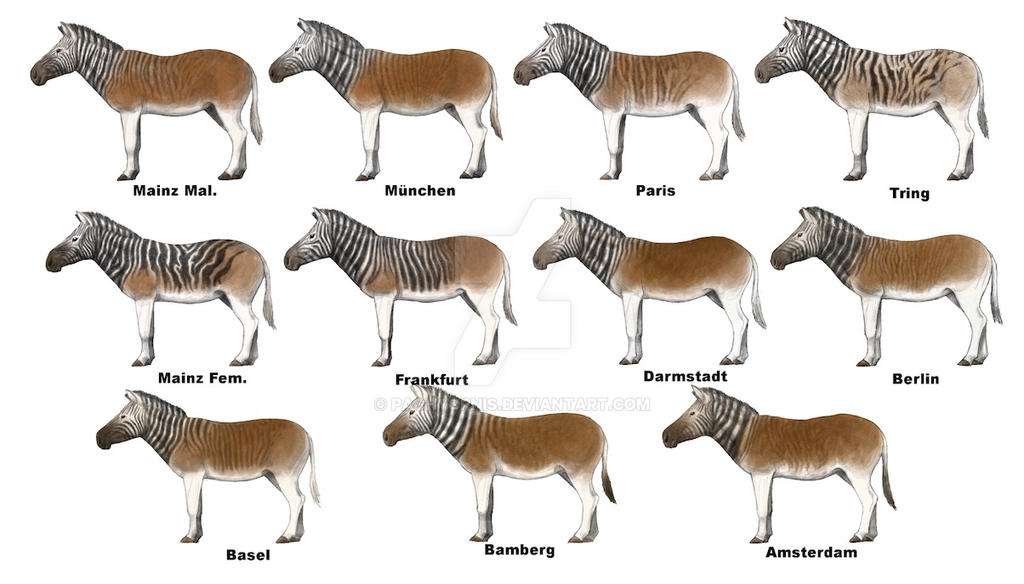
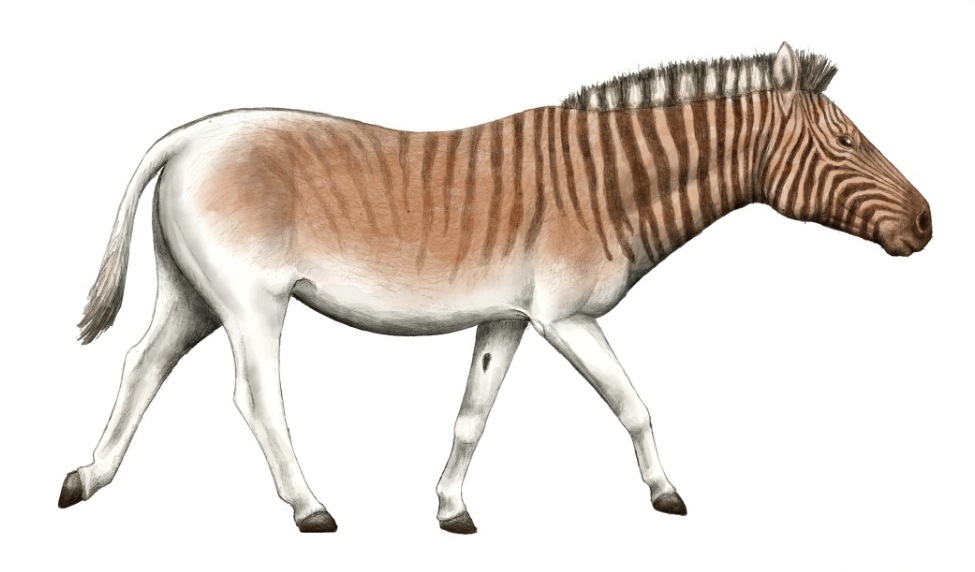
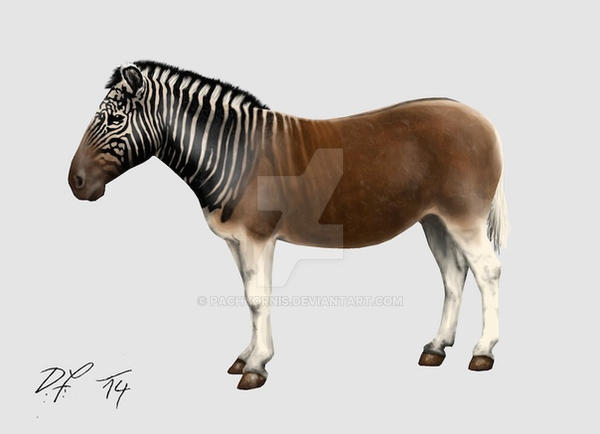
Reconstructions showing the variation within the quagga
The cover; I'll reveal the bull on the cover in an upcoming post

Thursday, 19 January 2023

Extinct megafauna that could be revived using genome editing

Humans wiped out countless species of animals. Some of those species, particularly those that died out comparably recently, might actually be retrievable. Usually, cloning comes to mind when talking about reviving extinct animals. However, somatic nucleus transfer for reproductive cloning requires an intact cell and not just the DNA of the animal, which is why it is not available for most species wiped out by man. However, there are a few megafaunal species that have been wiped off from which we have at least one and in some cases several complete genomes. If there is a still extant species that is closely related and would make a suitable surrogate, it would be possible to exchange the alleles specific for species A with those for species B and thus creating a viable cell with the genome of the extinct species in question with genome editing. This limits the number of extinct animals that could be revived. For example, I would imagine it to be pretty difficult if not impossible for a species like the thylacine, which has been evolutionary separated for 30 million years from its closest living relatives. In some cases, it could be easy and much less effortful because of the lower number of genes that differ and the suitability of the surrogate because the animal has a very close living relative. In this post, I present a number of megafaunal species from which full genomes either have been acquired or at least could potentially be acquired and which have a more or less closely related relative that can be used for genome editing and as a surrogate. The mitochondrial DNA of the resulting animal would be that of the donor cell, which would be from the related species. However, as mitochondrial genes are highly conserved among mammals this would not have much of an influence. Using closely related species also has the advantage that the behaviour will be rather similar, especially among the large herbivore species that I am going to list. This makes the rearing by a surrogate mother and socialization of the result less problematic or maybe not even an issue at all. 

I see reviving an extinct animal that has been wiped out by man as a contribution to species conservation just as breeding an endangered species or subspecies. One might ask, particularly in the case of wiped-out subspecies, why doing that at all if there are suitable ecological proxies. Occasionally some even question the need to conserve endangered subspecies such as the Northern White rhino because their conspecifics from other subspecies would function ecologically the same or very similar. Personally, I cannot relate to that mindset. Conservation is about preserving biodiversity and the preservation of evolutionary more or less distinct subspecies is a vital part of that. The same goes for reviving extinct species or subspecies – it would greatly increase the biodiversity again, after it has been depleted by man when the species or subspecies was wiped out. 


Bubal hartebeest, Alcelaphus buselaphus  

This animal is sometimes also considered a subspecies, but that question is merely taxonomical and not relevant for “de-extincting” the animal. In any case, other members of Alcelaphus could be used for genome editing and as a surrogate. Many individuals must have been preserved as trophies, and it is potentially possible to acquire full nuclear genomes from them. 


Bluebuck, Hippotragus leucophaeus  

Other members of Hippotragus could be used as a surrogate and for genome editing. It can be tried to acquire a fully nuclear genome from taxidermies.  


European aurochs, Bos primigenius primigenius

One full nuclear genome has been resolved in 2015 from a well-preserved Neolithic bone. Considering the richness of recent aurochs material, it could be possible to obtain quite a few more complete genomes. And there is a very close living relative, modern cattle. The number of genes that would have to be exchanged would probably be lower than in most of the other cases I am listing here, and also the surrogate and the procedure of implanting an embryo would be completely unproblematic. And considering the similarities in behaviour between cattle and aurochs, socialization will not be problematic either. For these reasons, I consider the aurochs one of the most realistic candidates for a revival through genome editing. Even if the resolved genome remains the only one to be fully resolved, one revived aurochs individual still can be outbred using aurochs-like cattle. I wrote a post on that a few years ago. 


Several types of wild horses 

There are well-preserved mummies of Siberian wild horses, Equus caballus lenensis, and one of the Yukon wild horse, Equus caballus lambei, so it could be possible to obtain fully resolved nuclear genomes from that. A domestic horse could be used for genome editing and as a surrogate. Even if only one genome can be obtained, the revived horses can be outbred with Przewalski’s horses and/or robust landraces in the same manner as I suggested for revived aurochs. 


Kouprey, Bos sauveli  

Numerous kouprey specimen have been preserved as trophies and one skin. It could be possible to obtain full nuclear genomes from that very recent material. The closest living relative is the Cambodian banteng which hybridized with the kouprey in the past. It can be used for genome editing, as a surrogate and even for outbreeding if necessary. 


Quagga, Equus quagga quagga  

The quagga is not and cannot be bred-back from extinction with living Plains zebras, which is why it would be desirable to try to acquire full genomes from the numerous preserved skins and the few skeletal material that is preserved of this zebra. The zebras of the Quagga Project can be used for genome editing, as a surrogate and outbreeding if necessary. 


Pyrenean ibex, Capra pyrenaica pyrenaica  

This is the only extinct animal that has been cloned so far, unfortunately the clone died shortly after birth. Genome editing with individuals from other subspecies of Capra pyrenaica could be more successful, they can be used as surrogates and for outbreeding. 


Steppe bison, Bos (Bison) priscus  

There are plentiful of remains from steppe bison, including soft tissue. Perhaps it would be possible to obtain full nuclear genomes from that. Needless to say, that still existing bison, be it European or American, can be used for genome editing, as a surrogate and outbreeding. 


? Woolly mammoth, Mammuthus primigenius  

Currently, there is no de-extinction project in the strict sense focusing on the woolly mammoth. There is the attempt to create a “mammophant” by introducing mammoth alleles for certain traits into the genome of an Asian elephant, what is not what I would consider de-extinction in the strict sense. If doing that is possible, it might also be possible even if more effortful, to exchange all alleles of genes where Asian elephant and woolly mammoth differ. However, since implanting an embryo into an elephant is very complicated, and those who want to create plan to use an artificial womb, a technique which does not exist hitherto, I wonder if it is feasible to recreate the woolly mammoth for practical reasons. 


Caucasian Wisent, Bos (Bison) bonasus caucasicus  

Several skins and trophies of this wiped-out subspecies (or species or variety, there is no consensus on its taxonomic status) exist, so it could be possible to obtain full nuclear genomes from it. European bison of the Lowland-Caucasus line, which partly descend from the last Caucasian wisent bull, could be used for genome editing, as a surrogate and for outbreeding. Obtaining genomes from remains of wisent prior to the bottleneck in the 20th century could also help to greatly increase the very limited genetic diversity of this endangered bovine. 


Cave lion, Panthera spelaea  

Several very well-preserved pubs of this feline have been found. It might be possible to acquire full nuclear genomes from that, and the closely related actual lion would be suitable for genome editing and as a surrogate. 


Schomburgk’s deer, Rucervus schomburgki  

Some remains of this deer species exist, a sister species from the Rucervus clade could be used for genome editing and as a surrogate. 


Japanese sea lion, Zalophus japonicus

There are taxidermied specimens of this sea lion, related species of the Zalophus clade can be used for genome editing, as a surrogate and possibly outbreeding if necessary. 


Caribbean monk seal, Neomonachus tropicalis

There should be some remains of this recently extinct species, the related Hawaiian monk seal can be used for genome editing, as a surrogate and possibly outbreeding if necessary. 


One common objection against the revival of extinct animals is “one individual is not enough to build a population”. Apart from the fact that even one individual could tell us a lot about the extinct animal species/subspecies, it could be possible to get several genomes of those recently extinct species. Getting the full genome of five or ten individuals from different regions and times would probably enable to get a genetic diversity comparable to that of the modern wisent population, which descends from only twelve founding individuals from the same population. Some wisent individuals show inbreeding-related problems, but not to the extent that it threatens the survival of the species. An even more extreme example would be the Mauritius kestrel. Apart from that, related species/subspecies can always be used for outbreeding to add genetic diversity. Hybridization among related species with neighboring or overlapping distributions is very common in the animal kingdom. 


Friday, 4 March 2022

Differences between the Quagga Project zebras and the quagga

The Quagga Project likes to call their zebras “Rau quagga”, after the founder of the project Reinhold Rau. That is why I made the post Please don’t call it quagga. The advocates of the name “Rau quagga” state that it is O.K. to call the zebras that way because the “Rau” in “Rau quagga” underlines that they are different animals from the quagga. I, however, think it is not legitimate to call something that is not a quagga a “quagga”, with or without the “Rau” in front of it. Calling those zebras “Rau zebra” would be more adequate if the zebras of the Quagga Project need a name, because they are zebras in any case. 


Names aside, I made a post on the differences between the quagga and other zebras not so long ago. I think it is time to have a look at the differences between the zebras of the Quagga Project and the quagga. 

The Quagga Project focuses only on the pelage colour characteristics. The coat colour of the Quagga was variable to a certain degree. I tried to capture this diversity in a drawing, using the preserved quagga skins as a reference: 


The quagga was variable in the extent of the striping, but there are some general differences between the quagga and the zebras of the Quagga Project. 

The striping is supposed to link the zebras of the QP with the quagga, and indeed the amount of reduction of the striping that has been achieved is impressive, but there are some clear differences in the stripe pattern of the quagga and the zebras of the QP. 

1) In many of the zebras of the QP the stripes on the neck alternate between broad, solid black stripes and faint, narrow stripes. This was not the case in the quagga. All quagga skins show that the quagga had exclusively broad, solid black stripes on the neck. 

2) The stripes on the face of the zebras of the QP are very narrow, producing a broad white space between them. In the case of the quagga, the stripes on the face are rather broad, with only a narrow quite area in between them. 

The second clear difference in coat colour between the zebras of the QP and the quagga is the base colour, i.e., the colour between the stripes on the trunk. In the quagga the base colour of the trunk was brown, sometimes more intense sometimes less intense, but always brown. The base colour of the trunk on the zebras of the QP has some brownish shade but is not nearly intense as in the quagga specimen documented. The QP is aware of that and hopes they will achieve that brown base colour in the future. 

Another possible difference is the length of the mane. I have the suspicion that the quagga had a shorter mane than other plains zebras, based on the photographs and the preserved skins. The zebras of the QP have rather long manes compared to the documented specimen of quagga. This is only my suspicion; it would have to be verified by measuring the manes of the preserved quagga skins. 


Another very important difference between the quagga and the zebras of the quagga project is the fact that the quagga does not share any mitochondrial haplotypes with the living plains zebra subspecies (see my article linked above). There is no reason to assume the case is any different in the zebras of the QP, so therefore the animals are also genetically different. 


The quagga and the zebras of the QP are superficially similar because an amount of stripe reduction on leg and trunk has been achieved in the latter, but that is it. There is no justification for calling the zebras of the QP quagga or “Rau quagga”, they are simply plains zebras with a reduced stripe pattern. General differences, such as in the striping on the anterior part of the body or the lack of a brown base colour on the trunk will remain. The project hopes to achieve the brown base colour one day, but I wonder if this is possible without new mutations enabling an increased production of pigment on the trunk area.


I am writing this not in order to criticize the QP, not at all. I just think that we should always stay objective and should not declare the revival of an extinct animal that is still dead as a dodo based on superficial similarity. I am happy that there is the QP, because their zebras could be very useful for outbreeding with quaggas if one individual or a few individuals could be genetically resurrected using genome editing one day. 

Wednesday, 25 August 2021

Differences between the quagga and other zebras

It has been established that the quagga is a subspecies of the plains zebra because it clusters genetically within this clade. This, however, does not imply that it does not differ considerably from other zebra species or subspecies. It diverged from the other plains zebra subspecies between 290 000 or 120 000 years ago [1], what is considerably longer ago than the differentiation between the lineage leading to domestic horses and Przewalski’s horse and definitely long enough to develop its own distinct traits. 

The most obvious difference between the quagga and other zebras is the fact that only the anterior part of the body was striped, while the posterior half was stripeless and of a brownish colour. The coat colour, or rather the extent of the striping, varies considerably in the 24 individuals of which the skin was preserved. I illustrated and described this variation in this post. Alas, the locality of the specimen has not been documented, so that the claim that the stripe reduction of the quagga represented a cline cannot be verified for at least within the quagga itself. 

Also, the quagga apparently had an idiosyncratic call (sounding like “kwa-ha-ha”, other variations are documented as well), of which the name of the animal is said to be an onomatopoeic derivation (Wikipedia). EDIT: It is possible that the quagga's call was identical with that of other plains zebras. 

Another very important distinct trait of the quagga is its sexual dimorphism. Preserved quagga skins suggest that the mares were longer and taller and thus larger than the males, which is the opposite of what we see in other zebras, including the plains zebra, where the males are larger than the females [2]. This is unique among extant equines. 

Another possible difference between the quagga and other plains zebra subspecies is the mane length. Looking at photographs of the 24 quagga skins preserved plus the photos of the only living mare to be photographed in the 19th century, it appears to me that the mane is shorter than in other plains zebras. Of course this has to be verified by actually measuring the mane hair and comparing it to the other subspecies, but it seems rather apparent to me. 


My coloured version of the photo of the only quagga to be photographed, drawn with GIMP

Thus, it has to be concluded that the quagga was, despite being nested genetically within the plains zebra species, a distinct type of zebra with unique autapomorphies. This has consequences for the guideline of the Quagga Project. The quagga is evidently more than a colour variant, even though its range might have been continuous with that of other plains zebra subspecies (we find this also in species that form a hybrid zone, such as species within BombinaCorvus, or Loxodonta to name a few). The similarity between the quagga and the zebras of the Quagga Project will merely be superficial. But, so claims the Quagga Project, the quagga was defined only based on external features, thus making that argument invalid. However, the overwhelming majority of animal (and plant) species on this planet is described on a phenotypic basis, it’s part of the requirements of the ICZN for a valid species description. Furthermore, the differences in the fur colour are not the only defining quagga characters, as outlined above. The zebras of the Quagga Project do not exhibit the idiosyncratic call of the quagga, they do not have the reverse sexual dimorphism and the (possibly) shorter mane. Apart from the phenotype, there are genetic differences as well. The quagga has unique mitochondrial haplotypes and does not share any haplotypes with the plains zebra [1], indicating reproductive isolation for a considerable time span. Thus, the quagga was also genetically distinct and the zebras of the Quagga Project will necessarily differ also genetically. 

Another problem is that the zebras of the quagga project only have a raw similarity to the quagga based on the coat colouration. While the amount of stripe reduction that was achieved is impressive, the animals lack the deep brown base colour on the trunk and also the stripe pattern is different: the white space between the stripes on the face and neck is rather white because the stripes are comparably thin, sometimes with faint brown stripes between the black stripes, while in all the preserved quagga skins the stripes on face and neck are rather broad, with a narrow white space between them and no faint stripes between the solid stripes. Therefore, the only similarity between the zebras of the quagga project is that the stripes are reduced on trunk and legs. Everything else is different. That is why I wrote the article Please don’t call it quagga in 2015, suggesting that these zebras should neither be called “quagga” nor “Rau quagga”. 

Perhaps the quagga project is not even a “breeding-back” project in the strict sense, since it does not work with living descendants of the quagga but merely more or less related animals of a completely different subspecies. 

Nevertheless, I am happy that there is the Quagga Project. While they cannot recreate the quagga, they have produced animals that could be useful for outbreeding a genetically resurrected quagga, for the case that the quagga one day will be recreated by using genome editing. 


Literature 


[1] Hofreiter et al.: A rapid loss of stripes: the evolutionary history of the extinct quagga. 2005. 

[2] Heywood: Sexual dimorphism of body size in taxidermy specimens of Equus quagga quagga Boddeart (Equidae).2019. 


Wednesday, 24 June 2020

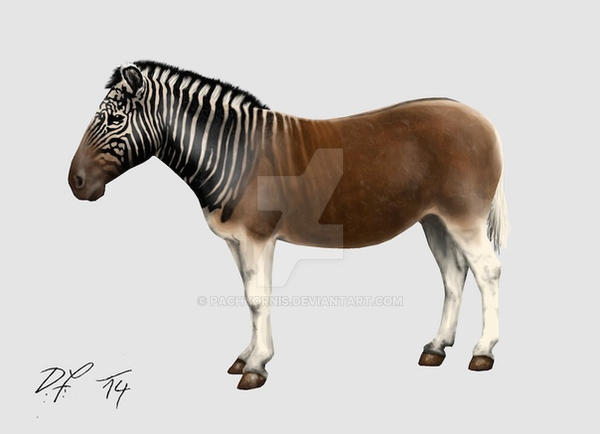
Quagga life restoration

Today I did another Quagga life restoration, based on the Amsterdam skin

I drew it in the same posture as this zebra of the Quagga Project so that both can be easily compared. 

The stripe pattern on the Quagga is different from those of the zebras of the project. The stripes are broader, with a much smaller space in between, especially on the head. Also, the brownish background colour of the trunk is not quite achieved yet. Furthermore, I suspect that there are more differences between Quaggas and Burchell's zebras. For example, the mane seems to be shorter in each of the skins and the photos of the London mare. Also, it might be that the ears are smaller. Although being nested within the Burchell's zebra, the quagga has unique haplotypes identifying the subspecies. 
The zebras of the Quagga project, on the other hand, are simply Burchell's zebras with a reduced stripe pattern, not more than that. This is why I wrote Please don't call it Quagga

Saturday, 26 September 2015

The quaggas' coat colour variation

The 23 preserved quagga skins tell us that there was quite considerable variation regarding stripe reduction in this animal. This is not only an interesting fact for itself but also of importance for the Quagga Project. So I tried to capture this colour diversity in one picture, so that we can see it at one glance.
I decided only to use the skins as a reference. There are plenty of old drawings depicting quaggas, but most of them are from a time after its extinction. And those that might be contemporaneous are, just as many the others, mostly just copies of the widely used photo of the mare at London zoo (by the way,  I decided not to include the London mare, which is identical with the Edinburgh skin, because I already did an illustration of that specimen and it does not differ substantially from the other quagga individuals). The webpage of the QP project provides a nice overview over all preserved skins with background information. A quick google research will result in more pictures of the respective specimen. 
However, I did not include all of the skins in my drawing. For the simple reason that many of them do look much alike and I did not want the image to become all too large. Therefore the relation of the individuals with the weaker stripe pattern and the stronger stripe pattern is not exactly the same as in the preserved skins, because the excluded individuals are mostly of the weakly-striped type. So the latter was the prevailing one, probably by far.

While the skins give a very good idea of the colour pattern, telling the exact tone was difficult because none of those is younger than 132 years (today). Therefore, all of them must be bleached today (I consider it very likely that the Berlin specimen is bleached as well, eventhough the QP webpage speculates it is not). So it is not easy to say when stripes were deep black or just dark brown, and if the neck and head region was always black-white or maybe striped in a dark brown and light brown pattern. So I used the hair on the legs as reference, which were probably always white in life. So if the hair of the space between the stripes was the same colour as those on the legs, they probably where white. And for black, I used the colour of the dark stripes on the mane as reference. I had to speculate about the shade of the background colour in the Frankfurt, Tring and Mainz (female) specimen. I am not sure if it really was that light on the trunk. But mostly the skins were sufficient to get an overall idea of the colour. But for the brown regions, it was not easy to tell which tone they had - chestnut, dark brown, orangish? So I had to guess and preferred a chestnut-like colour (note that I use that word in its universal meaning, not its meaning as a horse colour). 

It was tempting to arrange the specimen as a kind of colour pannel and therefore suggesting the stripe pattern reflects an ecological cline within the quagga, as it is hypothized by some. But unfortunately, it seems that the actual localities where the animals have been obtained have not been noted or are not known in most cases. That makes it impossible to test this hypothesis, as long as no research has been done to find out the respective origins of the skins. It would be a small sample size anyway. 

Doing these drawings confirmed my notion I have done several times already. While the reduced stripe pattern on the trunk of the quagga and the Rau zebras of the QP sometimes looks much alike, the reduction of stripes follows a different pattern on the anterior part of the body. The stripes on neck and face are almost always thicker than the space between them, sometimes more than twice as much. In most of the Rau zebras, the stripes on the neck region seem not to be thicker than in other Burchell's zebras and often have "shaddow stripes" (as some quagga did), which are not counted in the QP's scoring system. The stripes on the head of some Rau zebras are very reduced, creating much white space, while the stripe pattern on a quagga's had is actually to be called intensified.

The way of stripe reduction in Rau zebras resembles that of specimens like Darmstadt, Mainz (male) and Munich. In other cases, such as the Tring specimen, the Rau zebras have a similar pattern but it is not that "squiggely". The stripes of the specimen from Berlin and Amsterdam seem to be numerous but they get smaller and their contours smoother, and their colour continues to merge with the background towards the end of the trunk. Some quaggas, on the other hand, have stripe patterns that I think do not occur neither within Rau zebras or other living Plains zebra populations, such as the Basel and Frankfurt specimen, which have these broad, horizontal and smooth stripes, regularly arranged along the trunk. Other cases, such as the female Mainz specimen or that at Vienna (not included in the drawing) show striping to an extreme extent in a way that I have not seen it in living P. zebras yet. Again in a kind of "squiggled", or irregular somehow. 

The explanation for that is simply that the quagga had some unique traits, which would be the result of population genetics in any way if the quagga was just the end of a cline or a separate population. Nothing would hinder new traits to evolve.

I also have the suspicion that the mane of the quagga was a few centimetres shorter than in other P. zebras. It looks like this is the case in all skins. That might be due to preservation, but the photos of the alive mare at London zoo also show an animal with a comparably short mane. Measurements of the mane length in the specimen might provide some insight, it would be interesting to have this suspicion confirmed.

Tuesday, 22 September 2015

A quagga herd

During the last weeks, my motivation for writing was not that high. But instead, my spent some time doing my artistic activities. Dinosaur models and drawings, which are not quite of interest for that blog, but also some others. Today I want to share a little illustration of a quagga herd in their native environment somewhere in South Africa. 
I rarely do life scenaries because I prefer to do my rather technical drawings, therefore the results are not very elaborated. So mostly I leave it to those who are better at it. But this time I tried it again, also because I feel that the quagga is rarely illustrated as a herd animal in its natural enviroment. The coat pattern of these individuals is based on the 23 preserved skins.

A more precise illustration of the coat pattern variation in the quagga population is going to come soon.


Thursday, 20 August 2015

Another video on the Quagga Project

ABC News made a short reportage on "De-extinction" of extinct species, focusing mainly on the quagga from 0:58 onwards. I think that most of my long-term readers will be familiar with the information provided, but there are nice shots of the Rau zebras. Should I ever be to South Africa, my goal would be certainly to visit one of the QP herds. 
By the way, I really agree with what Dr. Robert Fleischer (geneticist, one of the autors of "A rapid loss of stripes: the evolutionary history of the extinct quagga) says in the video about the extinct-ness of the quagga, for reasons I outlined in previous posts (see here). However, I am not agreeing with the "we can do it but should we do it?" quote.

Saturday, 28 March 2015

Please don't call it quagga


Don’t get me wrong, I am happy that there is something like the Quagga Project, and I like their current breeding results. But they make a number of claims that I simply cannot agree with. The Quagga Project pretends that they are able to – or even did already – recreate the quagga by selective breeding with extant Plains zebras.
They argue that since the quagga nowadays is classified as a subspecies of the Plains zebra it might even be only a colour variety with the only features making it distinct being the coat pattern. Furthermore, they say that since it was not a species on its own, the genes responsible for their colour scheme might still be present in extant Plains zebras just have to be united. And since the quagga displayed individual variation regarding the intensity of their stripe pattern, a rough overlap with the original and not necessarily a total match is required to call their results “quagga”.

However, the extinct quagga was not a zebra species of its own but one of several subspecies or local forms of the Plains Zebra. This fact makes a big difference - the quagga’s extinction may not be forever!
[The Quagga was]A variety of zebra […]
However, since the coat -pattern characteristics are the only criteria by which the Quagga is identified, re-bred animals that demonstrate these coat-pattern characteristics could justifiably be called quaggas.
[…] Therefore the Quagga and other Plains Zebras belong to the same species and consequently the Quagga should be considered merely a different population (or deme), of the Plains Zebra.
[…]There are a few Zebras which qualify - not as true quaggas, but as Rau Quaggas in the project. From our point of view they are "real" quaggas, but since there has always been the possibility that there might have been other features of the original quagga that we have not selected for (because we do not know what those features, if any, might have been), we have chosen the term "Rau quagga" to describe our recovered phenotype. Rau quagga is the name we chose to apply to animals which meet the criteria of no scorable stripes on the hind body and effectively none on the legs (Darwin recorded occasional stripes on the hocks in some quaggas, so we allow that in the hind legs). More will doubtless come along as time goes by...”

The project claims that the quagga was merely a colour variant of the plains zebra as they see no differences between the existing subspecies other than the colour. However, there never was an osteologic study comparing the morphological similarity between the plains zebra subspecies including the quagga. There were craniometric measurements with conflicting results (I assume that the authors of these studies took care of whether the skulls were from quaggas indeed or from horses and donkeys for taxidermies) – some studies suggested that the skulls of the quagga were nearly identical to that of other plains zebras, while others suggested they differed from those of horses, donkeys and zebras to the same extent. I learned from a skull gallery by Vera Eisenmann that there is quite some variation regarding skull shape within an equine species, so that factor might not be that important.
As to genetics, the quagga is nested within the plains zebra. That means, it is either a member of the species, or, if you consider it a separate species, descended from the plains zebra at least. It seems that the quagga diverged from the other subspecies in the middle Pleistocene [1], which is about the same time distance as between domestic horses and Przewalski’s horses. The quagga does not share any mitochondrial haplotypes with other plains zebras [1], but the sample size is probably too small to ascertain whether it indicates that it was a reproductively isolated clade on its own or did indeed represent the end of a cline as the coat patterns within the species suggest.
Nevertheless, I think that the divergence of about 200.000 years is too long to regard the quagga merely as a colour variant. Genetic drift inevitably leads to changes. Apart from that, you could argue in the same way that the hooded crow is “just a colour variant” – we have exactly the same situation here. Furthermore, the sparce molecular data does not give us any clue on the karyotype of the quagga – it might have one or more chromosomes more or less than other plains zebras, as it is the case in the Przewalski’s horse compared with the domestic horse.
We cannot say whether the quagga had any ecological differences to other plains zebras, but I don’t think it was necessarily the case. Not much is reported on their behaviour, apart from that they had an idiosyncratic call was an inspiration for the animal’s name (f.e. “kwahaa”), remotely resembling a donkey’s. 

My belief is that there is also a certain misunderstanding of the concept of a subspecies when they say: “the extinct quagga was not a zebra species of its own but one of several subspecies or local forms of the Plains Zebra. This fact makes a big difference”. A subspecies is, as the term implies, a less-marked form of a species, or as Darwin called it, an incoming species. Everyone who has basic biological knowledge will know that giving a clear, unambiguous definition of a species and therefore also a subspecies is highly problematic. But what can be said is that a subspecies is not just a result of taxonomical boredom or nit-picking, but an actual clade and defined by biologic criteria, and this is clearly the case in the quagga. As outlined above, there are more differences between the quagga and the remaining subspecies than pelage characteristics, such as genetic distinctions that inevitably must have arisen during about 200.000 years of separation, and its distinct call. Currently there is not evidence for more as far as I know (as if it was not enough). But the project argues that if there is no further evidence, no further defining characters should be assumed and therefore something that shows all traits that we know is automatically a quagga. In my opinion, the assumption that only those distinct features that we know of through our limited access were the only ones is ultimately destined to fail. However, the QP does not deny that the quagga was different (and it was certainly the most distinct of the plains zebra subspecies), but their assumption is that mimicking those traits that were unique to it and eradicating those that differed should lead to a true quagga.
Different genetics and different descent, different animals. No living herd of plains zebras do descend from the quagga in any way. The QP’s point is that all the traits that defined the quagga might still be present in the extant population thanks to the fact that they belonged to the same species and it likely represented one end of a cline. I see problems in this guideline: We have no clue on the factors that control the pelage characteristics in the plains zebra, which is the only trait the QP is focusing on. Is it polygenetic, or regulated by one gene only? Which characters is it connected with? No extant plains zebra has a stripe pattern that is as reduced as in most of the quaggas, not to speak of the brown background colour, so the selective breeding program is not working on a fixation of a trait but on trying to achieve it in the first place from what is not there yet. It’s like selecting for cattle with 100 cm horn length when starting with horn lengths of 50 and 70 cm. But if I interpret the QP’s argumentation correctly, they assume the amount of striping in a zebra’s coat is regulated by a number of genes, and that those alleles that worked in the quagga are split up among those we see among other subspecies, present somewhere towards the middle of the cline.  That’s a legit hypothesis, although a speculative one.

This provides a good opportunity to test the guideline of the QP. One could take some strongly striped zebras from Etosha and select them for a stronger stripe pattern. Would anybody claim that, if after some decades of breeding such a herd is as strongly striped as possible, a Grant’s zebra (E. q. boehmi) comes out? Or taking wolves, would picking a bunch of white or crème-coloured Northwestern wolves (C. l. occidentalis) result in a polar wolf? I think these examples show how simplified this concept is.  

However, let’s take the QP’s argumentation for granted for a moment and say that a Plains zebra that looks like the quagga automatically is a quagga, and that there are no external differences other than the pelage characteristics. Do the most advanced current results of the project look like quaggas in this respect?  
Judging from the remaining quagga skins and those individuals of the QP that I know, it is true that indeed a number of those zebras show a stripe pattern that is as reduced as in the quagga (apart from the legs, which are not yet totally stripeless). However, I noticed a not negligible difference regarding the stripes on head and neck. In the quagga, they are packed closely together, being broad while the white space between them is thin. And there are no thin stripes between broad stripes as we see it in many extant zebras. In the zebras of the QP, the exact opposite is usually the case. I even get the impression that as stronger reduced the striping on the rear is, the more it is on the face as well. The facial stripes in the quagga on the other hand were very broad and intense, giving the head a dark aspect overall.
The QP admits that there has been only little progress in achieving a brown background colour on the trunk. This might change in future generations, but maybe not. Maybe the last few stripes on the leg will disappear, but maybe not. Perhaps the climax is reached already, only future will tell. But I see no trend towards the quagga regarding the neck and facial stripes. And it brings us to an empirical problem: when is the breeding program progressed enough to say: “ok, this and that trait have not been achieved”? The predictions made have to be falsifiable, otherwise they are of no empiric value. No such timeline has been given, and apart from that, how stable have the characteristics to be in a “recreated quagga population”?

So my conclusion is: Their claim that the quagga was merely a colour variant of “the” plains zebra is likely to be erroneous, their assumption on the genetic background of the stripe pattern is speculative, their guideline that one subspecies can be turned into another by selective breeding on external traits is simplified and probably wrong as my examples have shown, the resemblance of their current results to the quagga are not satisfying yet (contrary to what the QP says) and the resemblance to the quagga is only limitedly falsifiable following their concept.

Perhaps the reason for them considering their results recreated quaggas is just for public relations, but I fear that it is the same kind of self-delusion as it was the case with the Heck brothers. They officially call them Rau quaggas to appreciate that there “might” have been further differences, just as some people call Heck cattle a “model” of the aurochs. But this is not legitimate in my view: There can be no man-made alternative versions of wild animals by definition. Heck cattle is not a model of true wild-type aurochs (not more than any domestic cattle breed is), and the zebras of the QP are not more of a quagga than other Burchell’s zebras are, despite some resemblance in the coat pattern.

This is why I call those zebras “Rau zebras” instead of “Rau quaggas”, as you might have already noticed.


Literature 

[1] Hofreiter et al.: A rapid loss of stripes: the evolutionary history of the extinct quagga. 2005. 

Saturday, 28 February 2015

First fifth-generation Rau zebra

A little bit delayed news. It was born on 10th of december 2013. See here.
It has a clear brownish tint, but I am not sure if one could say that it is significantly more prominent than in non-selected plains zebras. What is interesting is that the stripes seem to fuse to a dark brown colour on the upper arms in this individual; I have noticed that in several other Rau zebras as well. 
I think I'm going to draw another prediction of how Rau zebras might look like by 2025, additionally to my first one.

Saturday, 21 June 2014

New Quagga reconstruction, based on the mare at London Zoo

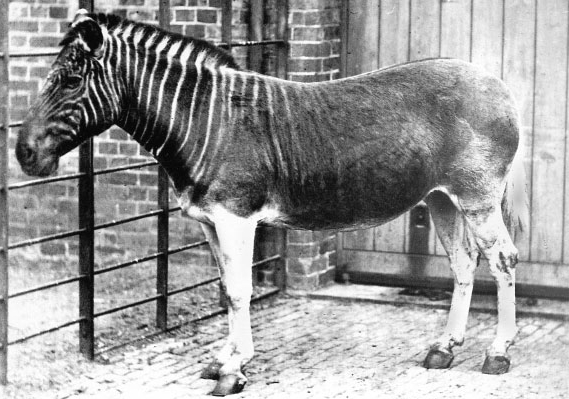
The only Quagga that was ever photographed was a mare at the London Zoo in 1870. I don't know the subsequent history of that specimen and whether its skeleton or skin was preserved. The fact that this photo down below is, among others that were shot at the same time, the only photo that shows a living and healthy Quagga inspired me to use this for a life restoration. 

I did it by painting it directly on the photograph using GIMP, to be as accurate as possible. I am really happy with the outcome, I think it might provide a lively picture of what this particular animal looked like in life. 
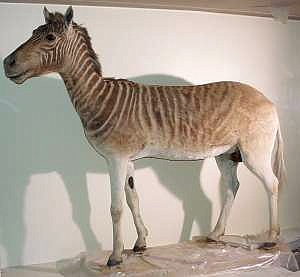
Another good basis for a life restoration is the specimen down below: 
It is the skin of the alleged last Quagga and is the least discoloured as far as I know. 
Most Quagga reconstructions only show single individuals, so I plan to do a coloured drawing of a whole herd in their natural environment as well, showing them doing what they normally did. 

Thursday, 17 April 2014

Quagga Project video channel

Today I came across the Quagga Project's video channel on youtube.

There are some videos showing nice shots of the Rau zebras, like this one:


In another video, you see a Rau zebra foal with its mother among other herd members. I like the brownish tint in their coat, and the fact that both the videos are not of recent origin means that there are more advanced animals than these ones, and I would like to see a video of those too. If I'll ever be to South Africa, I would definitely visit the Rau Zebra herd.

Thursday, 5 December 2013

The Quagga Project Stud book

The Quagga Project now has an online studbook where all their current animals can be viewed. Looking through all those photos gives you a nice overview on their preliminary results, and some of their more progressed animals are indeed pleasant to look at - not only is the striping greatly reduced, but some individuals also developed a quite decently brown background colour. 

Check out these individuals (the uppermost, "Freddy", is the most Quagga-like in my opinion): 


Saturday, 2 November 2013

Another Quagga reconstruction

As you might or might not know, virtually all preserved Quagga skins have patterns that differ from each other. So I decided not to reconstruct what I consider the average within the population but one single specific individual for my latest Quagga life restoration. I chose the Wiesbaden skin: 


Quaggas actually have, contrary to the current Rau zebras, usually quite broad stripes with less space between them as far as I can see. I assume that most skins, like that one, are bleached and do not represent the original colour of the fur. For that, I used contemporaneous paintings such as the one below as a model. 


Painting based on a living Quagga by Nicolas Marechal from 1793
This is what came out of it: 


For comparison, that's my prognosis of how the Rau zebra of 2025 might look like based on the trend I see in the current animals of the Quagga Project: 


One noticeable difference between Quaggas and Rau zebras might be that the latter have broad stripes that fuse with the brown background while the Rau zebras tend to have continuously finer stripes that disappear towards the end of the trunk. But this is just my personal impression and we don 't know what future Rau zebras will look like yet. 

Thursday, 31 October 2013

The Quagga specimen


There are 23 preserved skins, 7 complete skeletons and few skulls of the Quagga left on this world. It is not surprising that some of the skeletons belong to the same individual of some skins, perhaps even all. Most stuffed Quaggas can be found in Germany, others in the Netherlands, France, Great Britain, South Africa, USA, Sweden and Russia. Looking at all the different Quagga specimen, which include complete adult individuals as much as foals and only a part of a leg, gives you a fairly good idea of the degree of variation within the Quagga subspecies.

Skins

Amsterdam

The skin of the last living Quagga, well-preserved colour (Photo: ©Artis Museum)
Bamberg


Basel

Berlin


Cape Town

Darmstadt


Edinburgh


Exeter


Frankfurt


Kazan


Leiden


London


Lyon


Mainz


Milan

Munich


New Haven

No photo found. Probably not on display. 

Paris


Philadelphia

No photo found.

Pretoria

No photo found. 

Stockholm


Stuttgart

No photo found. 

Tring


Tübingen

No photo found.

Turin


Vienna


Wiesbaden


Skeletons

The only skeleton on display that I am aware of is that of the Grant Museum:


You might be wondering what happened to the Quagga mare that was photographed in 1870 and died in 1872 and if she is among the stuffed skins or skeletons that are preserved till today. The stripe patterns of the two specimens in London do not fit the animal, nor does any other specimen. Therefore she’s probably not among the skins. It would be helpful to have more accessible information on the skeletons. UPDATE: I was addressed that the London mare probably is the specimen now held at the museum of Edinburgh, since the stripe pattern do line up. For a better photo of this specimen, go here.

For more information on the Quagga skins you can have a look at this very useful list on the Quagga Project's homepage.

Call me crazy, but the stuffed skins give me hope that the real Quagga might return some day. A 2009 paper [1] reports that mitochondrial DNA has been successfully extracted from stuffed specimens of the Thylacine, Thylacinus cynocephalus, so there is the reasonable chance that some of all those Quagga skins still preserve certain amounts of DNA. Theoretically, those almost thirty individuals might be enough to recover a healthy population, but I think it is much too optimistic to expect that all of them contain enough genetic material to be cloned. It probably would be a challenge already to gain enough material for at least one individual. However, if one - or even two or three - Quaggas could be cloned one day, it would be a huge sensation. Those Quaggas could be constantly bred into the Rau zebra population which would provide a genetic base for a new near-Quagga population. 

[1] Miller, Drautz, Janecka et al. The mitochondrial genome sequence of the Tasmanian Tiger (Thylacinus cynocephalus). 2009.