Sunday, 25 August 2013

5 myths about Heck cattle


There are quite a lot “myths” (common misconceptions or wrong statements) about Heck cattle around that are constantly repeated in media articles and other sources. One of these myths (the S. fighting bull as an ancestral breed of Heck cattle) has already been dismantled in this post. Today I want to list some other examples of common misconceptions about this cattle breed that usually lead to the picture of Heck cattle being the best or only aurochs substitute. It is not my intention to badmouth Heck cattle nor to discredit fanciers of the breed, but simply to bring this subject to a more objective and open level in order to give other aurochs-like breeds a better chance to get involved in breeding back and rewilding.

"Heck cattle is the most aurochs-like cattle and resembles the aurochs to a large extent"

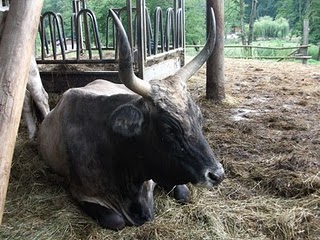
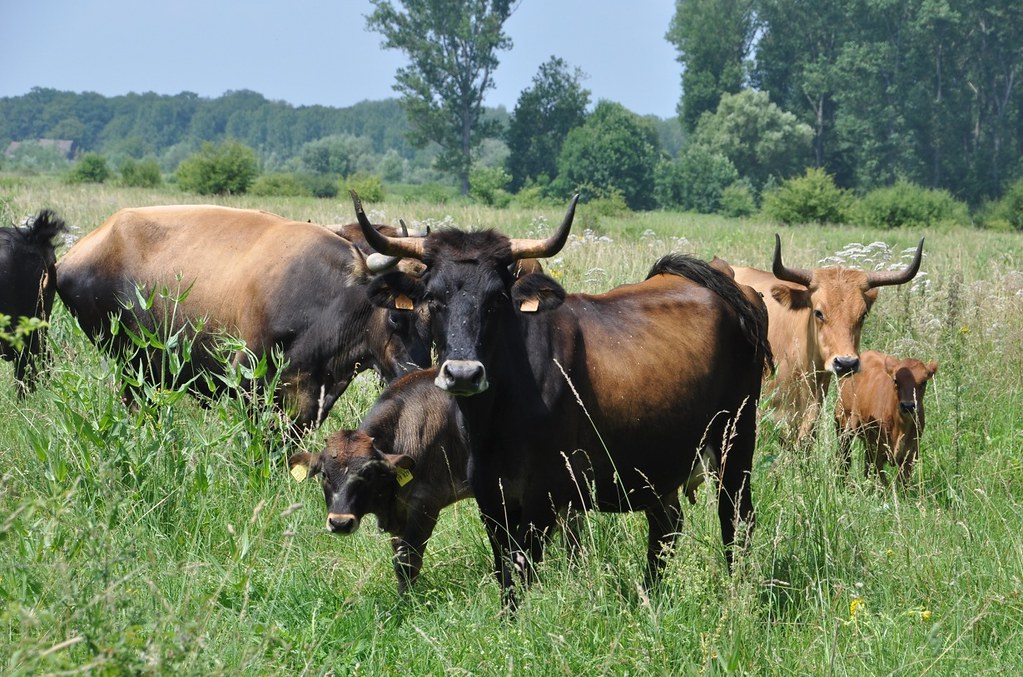
Well, where should I start? As I discussed in this post, Heck cattle is a very heterogeneous population and therefore the authenticity of the animals depends on the herd you are looking at. But as a whole, there are some considerable phenotypic differences between this breed and the aurochs. First of all, Heck cattle in general have a way smaller but longer body than the aurochs, are less athletic and have a domestic body, the head is smaller and shorter and so on. Horn shape and colour are very variable, in some individuals they match up very well with the aurochs, in others not.
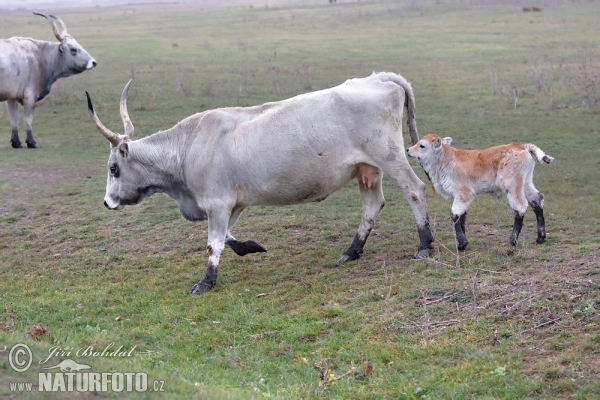
There is a large number of “primitive” breeds from Southern Europe and other regions which resemble the aurochs just as well as many Heck herds, or even better. Usually they are more stable, so it’s easier to judge which features are present and which are not. Most of them have a better body shape and better proportions than Heck, but also many of them lack the large horn dimensions (but those aren’t that big in many Heck cattle too). Many primitive breeds have a very aurochs-like colour with minor differences like bulls having a saddle, black cows or lacking eel stripes, but the colour rarely is perfect in Heck cattle as well.
So I would say again that Heck cattle is surely different from the aurochs in appearance, often to a large extent, and it is surely not the most-aurochs like cattle breed of all because there are many breeds that are about as aurochs like. Check this post for some examples.

"Heck cattle itself is a breeding-back project"

While modern Heck cattle obviously is the result of a breeding-back attempt, it is no project on its own. It should be seen as a “normal” cattle breed that is found on farms, in zoos and grazing projects – like some other breeds. However, it is true that many breeders select for certain features to a certain extent, but there is no centralized and coordinated guideline for the breed as a whole in neither country, therefore the quality of an Heck herd as an effigy breed depends on the work of the individual breeder. Some breeders tolerate many undesired features and/or do not care about the size or proportions of the cattle et cetera. That’s the reason why some Heck cattle herds can look quite good but others may bear almost no real resemblance to the aurochs.

"Heck cattle is more resistant to diseases than other cattle"

This is clearly a myth. It is true that Heck cattle is robust and resistant to many diseases found in very-derived dairy breeds, but so are other landraces. After all, Heck cattle is a mix of several landraces, therefore it is not surprising that it is just as robust to diseases as Highland cattle or Hungarian steppe cattle from which it descended. And, more importantly, Heck cattle do get infected by diseases that all cattle have, such as Bovine herpesvirus 1 and Mucosal disease.

"Heck cattle behave wilder than usual cattle"

Cattle that live under natural or semi-natural conditions for a considerable time get less docile and shier and therefore more difficult to handle. This is true of Heck cattle in grazing projects just like of other breeds under such conditions. In a zoo, you will encounter mostly tame and friendly Heck cattle. But of course cows having a calf have a strong protective instinct and will get aggressive when they think their calf is in danger; there are many incidents that show that is true of all cattle breeds. All in all, the behaviour of Heck cattle is like that of any other domestic breed and therefore also dependent of their environment.

"Heck cattle live under wild conditions and have proven to be robust and hardy "

In fact Heck cattle live nowhere truly in the wild. The only environment with barely any human influence is Oostvaardersplassen in the Netherlands. We do not need to discuss that farms and zoos are not natural environments that lead to natural selection or require animals that are exceptionally hardy and robust. Grazing projects, where the animals live on a large area freely all the year round can be called semi-natural, but the cattle always have medical care and supplementary food if the area is not large enough. Actually Heck cattle live under very similar conditions as thousands of cattle in less industrialized regions, f.e. on the Iberian peninsular. The primitive Iberian landraces (and those from other parts of the world) have been living under these conditions for centuries and probably even longer, so the claim that Heck cattle is the only breed dealing with harsh conditions is absolutely baseless (especially when considering feral cattle from around the world). And, not to forget, other robust landraces do just as well in grazing projects (I intended to list them here but the list of cattle living under semi-natural conditions in Germany, Austria, the Netherlands and other European countries is quite long). One should not underestimate the surviving capacities of modern cattle. 

Wednesday, 21 August 2013

The Indian Aurochs: breeding-back with Zebus?


UPDATE: I consider my life reconstruction of the Indian aurochs a bit outdated. For my current opinion, see my 2017 post

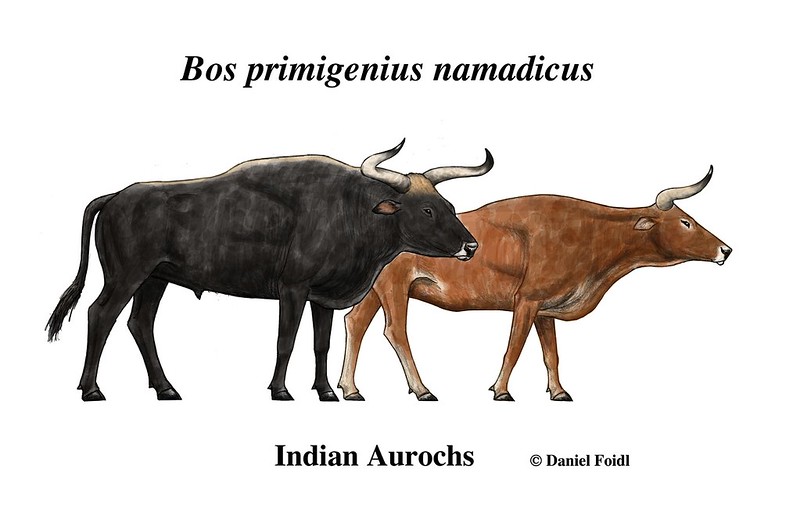
When we speak about the aurochs, we mostly refer to the Eurasian subspecies, B. p. primigenius, the wild type of taurine cattle. The two other subspecies, the African and Indian aurochs, are almost forgotten because they died out way earlier, there are no written accounts of them and there is much less skeletal material to work on. The distinct Indian subspecies, Bos primigenius namadicus, is in the focus of this post. This subspecies has a number of living descendants too, the zebuine cattle or zebus, arising from a different domestication event. Zebus usually are avoided, even banned, from effigy breeding because their ancestors separated from those of taurine cattle during the middle or late Pleistocene. Also their phenotype is rather awkward and derived, and they are adapted to very arid habitats and none of them has the same cold-tolerance or thick winter coat as European cattle. So they are considered to serve no good for creating a proxy for the European aurochs. But how about using less-derived Zebus for breeding a suitable stand-in for the Indian aurochs in its native range? Before going further into this idea, we have to see what we do know about Bos primigenius namadicus.
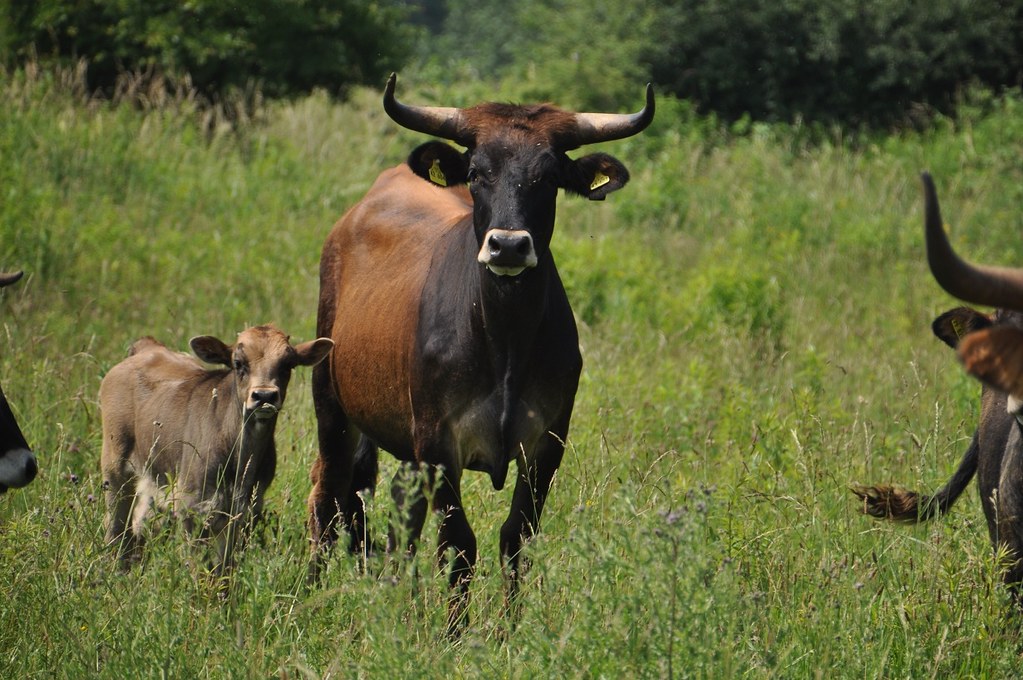
Skeletal remains of the Indian aurochs are scarce, only fragmentary postcranial material and few skulls are known. These tell us that the Indian aurochs probably was smaller than the Eurasian subspecies (I don’t know how much smaller, but 150-160 cm for bulls might be realistic) and had proportionally larger and more wide-ranging horns [1]. There are no unambiguous depictions that show the Indian aurochs, nor are there historic accounts describing them [1]. Therefore, much of its phenotype is actually unknown.
But phylogenetic bracketing which is based on parsimony is a useful tool to infer some traits of its appearance because features present in both zebus and sister clades such as taurine cattle, the banteng, kouprey and gaur must have been present in the Indian aurochs as well. I think it is very likely that the Indian aurochs too had a long-legged and athletic body like the Eurasian aurochs, and also Koupreys had similar proportions. The dorsal spines of the 1st - 13th dorsal vertebrae are elongated in Eurasian Aurochs, Bantengs, Gaurs, Koupreys and Bison (also in primitive cattle such as Lidia), forming the typical “hump” of wild cattle. Therefore it is very likely that the Indian aurochs also had this feature. The colour of the Eurasian aurochs displaying black bulls with an eel stripe and reddish or brownish cows and a mealy mouth in both sexes is also present in some Bantengs (except for the light eel stripe in bulls) and is indicated in some gaurs as well. It is even displayed by some primitive zebu cattle. Therefore the same basic colour must have been present in the wild Indian aurochs as well. The so-called “zebu tipping gene” causes a lightly coloured area between the legs cows and (some) bulls of zebus, and apparently the same gene is present in the Banteng, so the I. aurochs must have had it as well. The hair of the area between the horns is lightly-coloured in many primitive taurine cattle bulls and also in Gaur bulls, therefore some Aurochs populations must have had this feature. Because the same is found in some zebu, I apply it to namadicus as well. The hair between the horns in the Eurasian aurochs were said to be curly and frizzy, but this isn’t the case in any zebu or Gaur/Banteng, so I assume this feature to be absent in the I. subspecies. The pelvis in zebus is oriented more vertically than in taurine cattle, resulting in a more horse-like rear. When taking a closer look at wild cattle, it becomes obvious that actually all of them have the same feature – Bantengs, Gaurs and Bisons. So it must be a plesiomorphy (a “primitive” feature) and must have been present in the Indian aurochs as well.
Putting everything together, it turns out that although we actually do not know much about this subspecies’ appearance directly, we can infer a lot of things when approaching it systematically. Based on this, I created this reconstruction:


I also gave my Indian aurochs a slightly longer dewlap, because bovids tend to have long dewlaps for display and cooling in warmer habitats (and hairy appendages like beards in colder ones). There is the possibility that the Indian aurochs also had a kind of hump that is visible in its zebuine descendants, it could have served as an additional tool for cooling down and also for storing fat (the Indian aurochs probably dwelled more arid environments than the Gaur or Eurasian aurochs). But the zebuine hump mainly consists of a hypertrophied rhomboideus muscle that actually serves no visible purpose and has no effect on thermoregulation or food reserve [2]. Unambiguous depictions of the Indian aurochs might help solving that question. I think the zebuine hump is too speculative for me to include it in my drawing and I am not convinced of its presence, but I cannot rule it completely out yet. There is an engraving in the Bhimbetka rock shelters from the Pleistocene which may show the aurochs and has no zebu hump. The depicted animal definitely has an eel stripe, but because this eel stripe is dark it could also show a Banteng, or a Kouprey (the horn tips look a bit bristled).

The phenotype of modern zebuine cattle is very derived and gives them a quite weird appearance. Apart from the fleshy hump and the long dewlap, they have hanging ears, a floppy body and horns of various shapes and sizes. Clearly there is no known zebuine breed that resembles their wild type as much as some southern European taurine breeds resemble their respective wild type. The first depictions of zebu-like cattle were date back 6000 years ago, but it is possible that more-primitive zebuine cattle still were around at that time. I have no likely explanation for why there are no truly primitive zebus left; they were not domesticated significantly earlier than taurine cattle. Perhaps the disappearance of primitive zebus was due to conscious selection or simply coincidence. However, there still are some zebuine breeds that preserve some aurochs-like features.

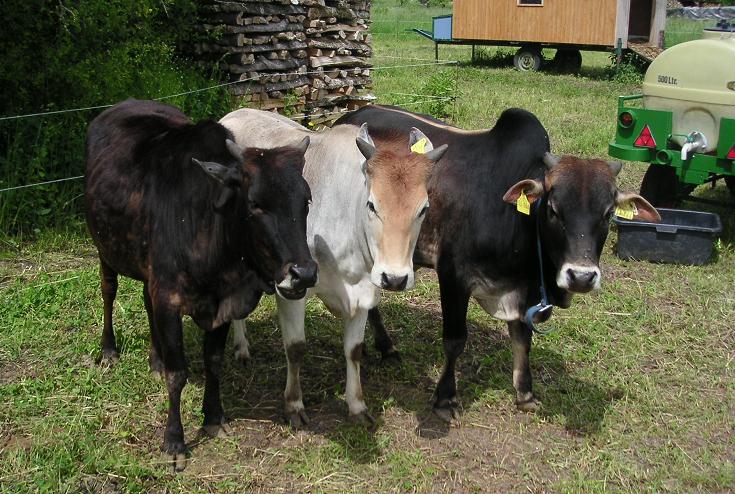
Miniature zebus with aurochs-like coat colours (photo: Markus Bühler) 

Some miniature zebus have a coat colour very reminiscent of the aurochs, even displaying sexual dichromatism. But this breed is quite small, stubby, has tiny horns with a deviant curvature and many of them have taurine introgression.

 
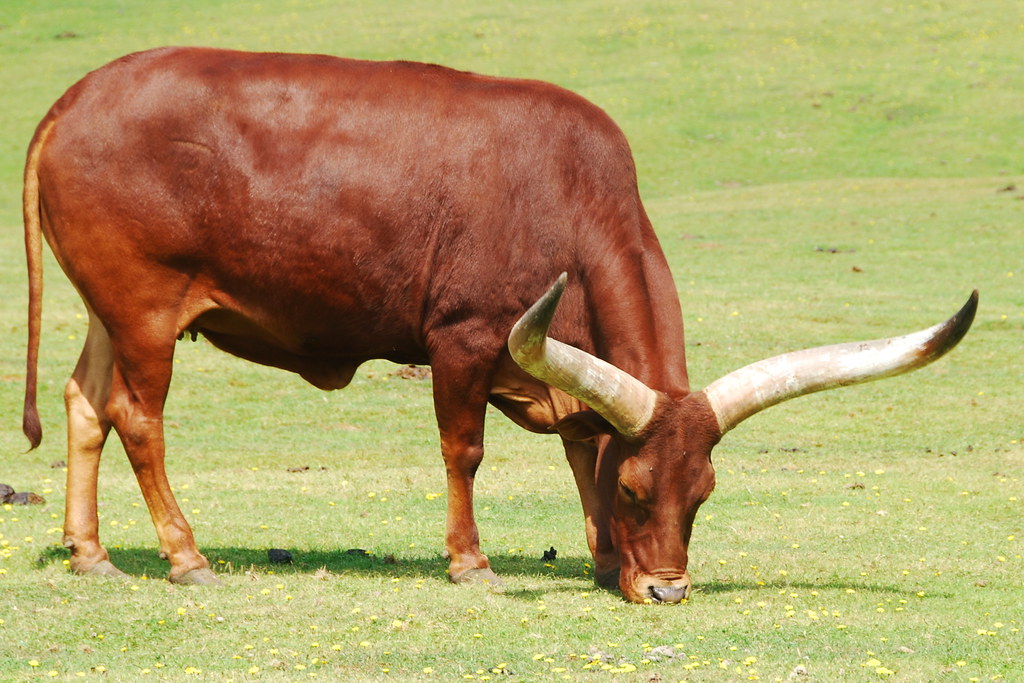
Watussi cow with remotely aurochs-like horns (Photo: Marc Thevenard)
Watussi cattle are taller and slenderer, but do not have the wild colour. Their horns sometimes have an excellent curvature, and their huge dimensions are useful for compensating the small horns of other breeds. Very likely Watussi is no purely zebuine breed as well.

Gudzerat zebu (Photo: Marleen Felius)
Kankrej zebu
The Gudzerat/Kankrej (both breeds are nearly identical) have a grayish wild colour with a reduced sexual dimorphism (much like Steppe cattle). Their horns are very upright, but apart from that, have a useful curvature and also decent dimensions. This breed has no taurine introgression as far as I know.

Although quite satisfying results might be achieved by crossing and selective breeding with breeds like these three, it is clear that the most suitable animals for effigy breeding with zebus are yet to be found. What such a “Wild zebu project” needs before actual breeding starts is: research!
In fact, we don’t know much more about the Indian aurochs and primitive zebus than the Heck brothers knew about the European aurochs and primitive taurine cattle ninety years ago. To ensure that such a project is a success, one has to

1. Collect more material of Bos primigenius namadicus
Be it bone material that tells us more about the morphology, habitat preference and extinction of this subspecies or artistic depictions that could provide clues about its external appearance.

2. Research on zebuine breeds, locating the most primitive breeds
While those three breeds I took as an example may provide some useful features, most zebus outside India are mixed with taurine cattle and looking for good Indian breeds that are hardly known in Europe may uncover not only pure (I am no fan of the purity cult anyway) but also more primitive zebus than those we usually see.

I think that only after such research is done the actual breeding should be started. I am sure that virtually all Indian zebus are hardy, robust and heat-tolerant landraces, but it would be best if such a “Wild zebu project” would also be carried out in India, in order to keep the animals in a semi-feral state in the habitats they are supposed to be living later on.
Although some native Indian zebu breeds may be more primitive and aurochs-like than those breeds usually known in Europe, it may turn out that zebus do not preserve enough phenotypic features to reconstruct the appearance of their wild type completely. I consider that likely because all zebus we know of lack the athletic body that is displayed by at least some taurine cattle, most have very derived horns and almost none of them have a long, aurochs-like skull. Also all zebuine breeds that we know of have a the typical, hypertrophied rhomboideus muscle. However, not all zebus have a really huge hump, actually the hump is quite small in some Indian and south-east Asian zebus. Another idea which is worth considering that some breeds which previously were considered taurine cattle or taurine hybrids in southern Asia might actually represent primitive, humpless zebus. This would need to be genetically tested and would be the third task of the research that yet has to be done.
 
This is what the "wild zebu" could look like
This photographic reconstruction by Jochen Ackermann on Wikipedia illustrates what I think is achievable with selective breeding with zebus. It would be interesting to see how these “Wild zebus” would look like after living several generations in the wild, perhaps even with pressure from predators. They’d certainly get more swift and athletic, their zebu hump might get smaller until it disappears while the neck and shoulder region gets developed stronger and the horn shape would also be refined.

Actually there are Zebu populations living feral, such as in the Kuno Wildlife Sanctionary. These cattle have been reintroduced recently, are a mix of several zebus and serve as “buffer prey” for the big cats until viable populations of genuine large herbivores are available for them, making them the only domestic descendants of the aurochs that are exposed to large felines. Let’s hope they are not short-sightedly removed after that stage because they will develop into a fascinating dedomestication example and one of the few (or even only?) feral zebus to date.
 
Feral zebu in the Kuno wildlife sanctuary 
But what is the point of creating an aurochs-like zebu breed at all? Well, it’s the same reason why authentic proxies for the European aurochs are desirable. The aurochs was a native large herbivore in India and fulfilled a niche that others do not (f.e. it likely inhabited dryer and more open habitats than the Gaur). The Kuno Wildlife Sanctuary, Gir Forest or the Rhanthambore National Park are suited wildlife refuges which might be a good place to reintroduce and dedomesticate the “Wild zebu”.


Literature

[1] Cis van Vuure: Retracing the Aurochs - History, Morphology and Ecology of an extinct wild Ox.
[2] McDowell, McDaniel, Hooven: Relation of the rhomboideus (hump) muscle in zebu and European type cattle. 1958. 

Friday, 16 August 2013

The Liebenthaler horse


Another horse breed, besides the Heck horse, which is actually the result of a breeding-back attempt is the Liebenthaler horse, also from Germany. I haven’t mentioned this breed before yet because I considered it just another dilution of the Konik like the Dülmen Pony (nope, the Dülmen Pony is not a remnant of the wild horse). But seemingly this doesn’t appreciate it enough.

The breed originated in 1960, when Jürgen Zutz wanted to rebreed the European wild horse. For this purpose, he crossed Fjord horses with Koniks and a Heck horse mare. Today there is a herd of more than 100 individuals living freely all year round in a zoo in Liebenthal, Brandenburg.

Apparently the Konik left its strongest mark in the breed. The Liebenthaler is no sensation, it is yet another Tarpan-like breed with the usual appearance, size, behaviour and probably also ecologic capacities. But what I find interesting is the combination Fjord x Konik, because it results in a population of black and bay dun horses (apparently there are also some Sorrel and isabelline horses in the herd). The animals look nice overall, add some Exmoor and perhaps a bit of Przewalski and you get a decently Tarpan-like horse herd.


Tuesday, 13 August 2013

History lesson Pt.II: The founding breeds of Heck cattle


To know what we are dealing with, it’s important to have a look at the breeds that were used to create modern Heck cattle. This post discusses which breeds might have the largest influence on modern-day Heck cattle, and not to be a critical review of the Heck brother’s experiment. For this, you can have a look at Cis van Vuure’s book Retracingthe Aurochs – History, Morphology and Ecology of an extinct wild Ox, 2005.
One problem is that the Hecks did not keep track of their breeding after the early 30s, so that the pedigree of particular Heck cattle individuals was actually unknown until an international breeding book as created in 1980. Therefore, we have to guess which breed left the strongest mark in Heck cattle by looking at the history of the breed and the phenotype displayed by contemporary individuals.

As the Berlin lineage bred by Lutz Heck died out during WWII and probably did not
contribute to the remaining Heck cattle, the breeds used by Heinz Heck are in the focus of our interest, which are:

Angeln cattle* No wild colour, dairy breed, small horns of variable curvature
Black-pied lowland cattle (old lineage of the Frisian) no wild colour, dairy breed, small horns of variable curvature
Braunvieh grayish-brown wild colour with strongly reduced sexual dimorphism, dairy breed but comparably slender, small horns of variable curvature
Murnau-Werdenfelser wild colour with reduced sexual dimorphism, dairy breed, small horns of variable curvature
Hungarian/Podolian Steppe cattle** whitish wild colour with greatly reduced dimorphism, usually slender body, large but upright horns
Highland cattle no wild colour, small and stubby body, long horns of variable curvature
Corsican cattle wild colour, body slender but not athletic, small horns of vaguely aurochs-like curvature

* as an interesting side note, the Angeln cattle were smaller and slenderer back these days: http://www.anglerrind-az.de/img/geschichte-head.jpg
** These are almost identical breeds, therefore I will refer to them only as Steppe cattle

For whatever reason, Heinz Heck relied more on central-European dairy breeds with little resemblance to the aurochs than his brother did, who used southern breeds to a large extent. The “first Heck cattle” was a bull born in 1932, which was an F4 individual that consisted of 75% Corsican cattle and 25% a mix of Steppe cattle, Angeln cattle, Highland and Lowland cattle. After that bull was born, Heinz Heck added Braunvieh and Murnau-Werdenfelser. If he also included English Park cattle and crosses from his brother is dubious, because the documents of the Hecks are unclear about this. Interestingly, H. Heck remarks he learned that using Steppe cattle, Highland cattle, Fighting cattle and Texas longhorn is the fastest combination to gain an aurochs look-alike (although neither he nor his brother used Texas longhorn, by the way).
Although the Hecks themselves did not continue their experiment after WWII, some further crosses took place in other zoos. For example, Hungarian steppe cattle were crossed-in in some herds again. Also a Watussi cow was crossed-in in a German zoo in 1952, resulting in a crossbred cow that left its trace in the Neandertal lineage and their descendants.

That’s how far the history of the breed goes. Now let’s look at the phenotype of modern Heck cattle in order to see the influence of the respective breeds.
Black-pied lowland cattle and Angeln cattle have little diagnostic features in this selection of breeds, probably you’d only recognize their influence by their colour genes. Angeln cattle lack, as far as I know, the wild type allele (E+) but carry the e mutation instead, resulting in a red coat without any dark pigmentation. This colour pops out in some Heck cattle, but is not very common. Black-pied lowland cattle carry the ED mutation instead, resulting in a uniformly black coat in both sexes and also calves. I am not sure if this occurs in modern Heck cattle. But black-pied cattle also carry alleles for white spotting on the S locus. Unfortunately, Heck cattle with white spots keep showing up in various lineages, therefore the influence of the one black-pied bull is still there. Most Heck cattle have the wild colour gene E+, and display a large degree of variation concerning the expression of this feature. Within this diverse pool, the colours of all the wild type coloured founding breeds show up (Steppe cattle, Murnau-Werdenfelser, Braunvieh, Corsican). Grayish, beige or whitish individuals are common “throwbacks”, indicating a strong presence of Steppe cattle. Although the colours of Highland cattle is rarely seen among Heck cattle (which in fact include the same colour genes as in Angeln and black-pied cattle, or the Simmental dilution gene that results in a lighter coat), other features, such as the body shape (if you imagine it without the long coat) or horn shape of many Heck cattle, can resemble Highlands to a large extent. Some even show a longish coat all the year around. The horn shapes and dimensions among Heck cattle are extremely variable, but the lyre-shaped horns, present both in Highland and Steppe cattle, are common among Heck cows, and the long, straight and upright horns of Steppe cattle bulls are common among bulls as well. Heck cattle display nearly all types of body shapes and proportions among their founding breeds, but many resemble Steppe cattle, Corsican cattle, Murnau-Werdenfelser and Braunvieh. Looking at the overall appearance, some Heck cattle really look like nearly-aurochs-coloured Steppe cattle or Corsican cattle with larger horns. There are not many photos of Corsican cattle in the web (and many of them are influenced by other breeds already), but those that I have seen show a clear resemblance with Heck cattle. The Corsican seems to show almost every colour variation present in Heck cattle (except very lightly coloured ones), and the horn curvature also is very alike. Some Corsican cows are virtually indistinguishable from some Heck cows, except that the latter tends to have longer horns. The Heck cattle’s history also implicates that both Corsican and Steppe cattle left a strong mark in the breed, because the former was used by H. Heck to a large extent and Steppe cattle played an important role in the experiment as well and was crossed in subsequently again. Also Watussi might not have been unimportant, although only one crossbred cow was used. Its influence probably enabled the breed to gain large and well-curved horns that are seen among several German Heck lineages today, although it is likely that not all Heck cattle have that half-Watussi in their ancestry. ThisHeck bull from Germany also resembles Watussi in having a slightly downwards-facing pelvis, giving it a more rounded rear, and also the horns of this individual remind me of Watussi.

All in all, I came to the conclusion that the most important founding breeds of Heck cattle probably are Corsican cattle and Steppe cattle, followed by Highland cattle and Murnau-Werdenfelser/Braunvieh. A cross of 75% Corsican and 25% Steppe cattle probably results in an animal that is very alike some Heck cattle. And single individuals or even herds of that breed, on the other hand, resemble these four breeds to such an extent that it probably would be possible to breed an effigy of these out of the modern Heck population. But, due to inconsequent selection, features of virtually all founding breeds are still recognizable in single within the total of the modern Heck cattle population.
What follows now is a selection of individuals of the founding breeds that show a decent similarity with Heck cattle (I own none of these photos):

Corsican cattle greatly resembling Heck cattle
(nevermind the white spots, these are the result of crossbreeding)

Steppe cattle resembling some Heck cattle
Murnau-Werdenfelser resembling Hecks
Braunvieh cow resembling some Hecks


Literature


Saturday, 10 August 2013

Sayaguesa are awesome


Sayaguesa is a breed from the Spanish province of Zamora in the northwest of Spain, and it preserves a number of features that make it very useful for breeding back. There are about 640 individuals of this endangered breed. It’s a large breed with cows reaching 145-150 and bulls reaching 150-165 cm at the shoulders (these numbers are based on several measurements I found in the web, and also personal information). One of the Sayaguesa cows I saw at the Lippeaue, Germany, was a really large one. Her head alone might have been 50 cm long.

Besides the size, the long-legged body of Sayaguesa, especially in the cows, produces useful crosses. Although the body is not as athletic as in the Spanish Fighting bull, many Sayaguesa still have a comparably muscular and slender body and also a decent hump at the shoulders (this feature is very prominent in some individuals).


Sayaguesa cow of the Tauros Program with a very large hump
Typical Sayaguesa cow in the Lippeaue
Sayaguesa is one of the few breeds that retained a really long skull, especially in cows. In the Lippeaue, I saw a skull of a Sayaguesa cow, and although there’s still some decaying flesh on it, you can see the basic shape of that skull on the photo. It matches up quite well with some aurochs skulls, except that the frontal bones are not as elongated (probably because it is not as large-horned).

Sayaguesa cow skull in the Lippeaue 
Sayaguesa basically have a correct Aurochs colour, but the sexual dimorphism sadly is very reduced because the Spanish breeders select against it. Consequently, many Sayaguesa cows have a bull coat colour. And selection for a totally black colour also reduced the wild markings in some bulls, such as the mealy mouth and eel stripe. But luckily there are still examples of “correctly” coloured Sayaguesa, even very reddish cows that display the typical sexual dimorphism of wild cattle.

Aurochs-coloured bull of Tauros Project
Red Sayaguesa cows in the Lippeaue (those with red ear marks)
The colour of Sayaguesa has proven to be very useful in crossbreeding. In bulls, Sayaguesa results in a beautiful deep black colour with an eel stripe, even if the father was lightly coloured. Female offspring, on the other hand, usually is coloured reddish brown when crossed with lightly coloured cattle, as the crosses with Alistana-Sanabresa (Tauros Programme) and half-Chianina (Taurus cattle) have shown. Unfortunately, some Sayaguesa have white spots on the belly because of the crossing with more-derived breeds in order to improve it as economic cattle.

75% Sayaguesa, 25% Alistana-Sanabresa (Tauros Project)

75% Sayaguesa, 12,5% Heck, 12,5% Chianina (Taurus cattle)

The horns of Sayaguesa can either be useful or problematic for breeding-back. They are usually medium-sized, and oriented forwards. Many cows have horn tips curving outwards, like in many Iberian breeds. Some individuals, on the other hand, have horns curving inwards as in the Aurochs, f.e. one of the cows I photographed at the Lippeaue. Others are intermediate.

Sayaguesa cow with well-shaped horns (Lippeaue)
And of course Sayaguesa is hardy, used to poor forage and does very well in the winters of Germany and the Netherlands. So do all other hardy Iberian breeds, there is no reason to assume that southern-European primitive breeds would not do well in Central and Northern Europe.

All in all, Sayaguesa is a very useful breed for breeding-back. It’s large, has long legs, a well-pronounced S-curved back, a long and straight skull and a colour that isn’t perfect but can result in correct offspring when crossed properly. The quality of that breed has been proven by many crosses of Taurus and also Tauros. That’s why this breed is used in Taurus cattle and Tauros Programme to a large extent, it certainly is a very aurochs-like breed. Sayaguesa also is used in grazing projects in the Netherlands independently from Tauros Project, in areas such as Planken Wambuis and in the Veluwe (alongside Tudanca).
The sad aspect is that many breeders in Spain select against wild type features, what means that breeding-back should collect the remaining good individuals of that breed. In my opinion, starting herds with some very good Sayaguesa and supplementing them with individuals from other breeds could result in a very aurochs-like improved Sayaguesa lineages that are fit for being released as Aurochs proxies. The Tauros Programme wants to set up a herd of Sayaguesa cows in Spain that will be covered by a good Maremmana primitivo bull. After adding further breeds and some selection, the results might resemble the aurochs very well already.

Here is a video of Sayaguesa in the Netherlands, part of the Tauros Project:


Friday, 9 August 2013

Britain's primitive ponies


Great Britain is home to a number of primitive, Tarpan-like ponies of which the purest and most remarkable ones is the Exmoor Pony. This breed is the most unchanged representative of a feral pony type that once ranged all over Great Britain and is the ancestor of many native British horse breeds. In this post I am going to go a little bit into the history of these ponies and explain why they are precious for the restitution of the European wild horse.

Exmoor Pony from Wikimedia Commons
The earliest document mentioning this pony type living in Exmoor is found in the Domesday Book in 1086, but remarks of “wild” horses in Great Britain date back even earlier and confirm that these ponies were found even as northwards as Scotland. Being the largest game species on the island, feral horses were an important food source for ordinary people. That is why the Columban church prohibited the consummation of horse meat in order to suppress the Celtic culture in 850. This forced Scottish farmers to leave and colonize Iceland.  With the ongoing civilization of Great Britain, the space for feral ponies became smaller, and many of them were tamed and became livestock, giving rise to the native British pony breeds of today. There is good reason to believe that these “wild” ponies were not merely a bunch of mixed animals, but a homogenous population with certain defining traits and very well-adapted to their habitat. In 1796, it was reported that free roaming ponies, often referred to as the “native ponies”, that are still seen living in mountain lands in west England, resembled Welsh and Highland breeds of that time closely. Also, the naturalist Charles Hamilton Smith makes an interesting note on free-roaming horses in Great Britain in The Natural History of Horses, with Memoir of Gesner (1866):

All seem to refer to a sturdy form of mountain-forest ponies, still found in the province of Cordova, in the Pyrenees, the Vogesian range, the Camargue, the Ardennes, Great Britain, and in the Scandinavian highlands: all remarkable for an intelligent but malicious character, broad forheads, strong lower jaws, heavy manes, great forelocks, long bushy tails, robust bodies, and strong limbs; with a livery in general pale dun, yellowish brown and a streack along the spine and cross bars on the limbs, or the limbs entirely black, as well as all the long hair and mostly havng a tendency to achy and gray, often dappled on the quarter and shoulders. They prefer the cover, delight in rocky situations, are dainty in picking their food, do mischief in plantations and their cunning, artifice, and endurance is far greater of that of large horses.

In the middle of 19th century, the native, free-roaming pony type was represented by many of the British breeds, such as the Galloway Pony, Shetland, Welsh, Highland and others (even the Icelandic and Faroe pony partly descend from these horses), and still roamed freely in New Forest, Dartmoor and Exmoor. These primitive British horses all were of a small and very strong build, had large heads, a short but opulent and frizzy mane. The colour was described as “true brown with mealy nose and belly so often seen in native ponies of all breeds” in a book on the Highland pony from 1899, and photographs of these breeds from around 1900 show exactly such animals. To put it more technically, these ponies had a bay/seal brown coat with a light underbelly and mealy mouth. This is the same colour found in many of the recent wild equines, except that the dun factor is lacking (what might or might not be an adaption to living in more closed habitats). There were black animals among these primitive ponies as well, and we know that black also was present in wild horses (albeit rarer than bay). Small, dark bay horses with are perfectly camouflaged in forested environments: 

Exmoors in the forest, from Wikimedia Commons
Also the hardiness of these primitive ponies was very much appreciated, as they survive harsh winters without any human help. But during the 20th century, the trend towards breed separation and “improvement” through interbreeding with more derived breeds became so strong that many of these original lineages disappeared or were diluted. Many of the breeds mentioned above do not resemble their 19th century counterparts anymore, or look much more domestic at least. Many of the free-roaming populations diminished, and also the Dartmoor population was crossed with a lot of more-derived breeds around 1900. Only on Exmoor the original type of the once feral British pony was preserved to a large extent, although the Exmoor pony is not completely free of “foreign” influence as well, especially of the English Thoroughbred. During WWII the number of Exmoor ponies dropped to 50, with only 6 remaining stallions. One of them certainly looked as if it had a Thoroughbred in its pedigree. Although most attempts to “improve” the Exmoor were abandoned because the resulting animals were far less hardy, white markings still can occur in living Exmoor ponies (but those are not permitted and consequently selected out).
Exmoors are very well adapted to the biotic and abiotic circumstances of their home range because they have been feral there for at least one millennium. During harsh winters, they are capable of slowing down their metabolism just like Przewalskies do, they grow a very dense winter coat with a prominent beard that is also present in the Przewalski’s horse and is mentioned for the Tarpan in several sources. They are known to be shier than other horses living semi-feral (like Koniks) because they have been hunted for centuries. When a herd feels threatened, Exmoor Ponies form a defensive circle around their foals. This behaviour is seen in many herbivores and obviously shows that these horses know how to deal with predators. They had to because wolves were still present on Great Britain during the Middle ages.  

Although the Exmoor is the only un-derived representative of the British primitive horse, there are breeds which still display some features of their original type. The Dartmoor pony is a very good example, although it has been quite diluted during the last century by crossing with more-derived breeds. The New Forest Pony has a similar history, and some representatives of that breed still display many primitive characters. Even some Shetland Ponys, like that one I photographed at Haag (Austria), show some resemblance to their original type. The Fell Pony is a descendant of the extinct Galloway pony and a primitive representative of the black variety.

Less-derived Dartmoor Pony that I came across in Dartmoor
Very ancient New Forest Pony from Wikimedia Commons
Less-derived Shetland that I saw in Haag, Austria
Fell Pony, resembling black wild horses; from Wkikimedia Commons
Selective breeding with these more-derived British ponies for a small, sturdy body and robust head with wild colour characteristics and great winter tolerance without crossing in any Exmoors might result in lineages that are as original as the Exmoor. These could be merged together in one gene pool (although the Exmoor society likely would be against that) in order to add more genetic diversity into the pool and overcome the problems that have resulted from the genetic bottleneck of the Exmoor after WWII, and also brings the black colour into this primitive horse population again.

So with the Exmoor Pony and its relatives we seemingly have a very precious breed. They have a small, strong wild horse-like body with a large and robust head that resembles the descriptions of the Tarpan, and they share colour features with the wild horse. Apart from the phenotype, they are seemingly well-adapted to its habitat where its ancestors lived feral for more than 1000 years. That means that they descend from the oldest feral horse strain in the world. And during this time, they either retained or redeveloped natural instincts, such as herding and defence. In my opinion, the Exmoor pony is just as useful and just as authentic for a wild horse restoration as the Konik and should be equally “worshipped”.

As we discussed in this and this post, the Konik is not a direct descendant of Europe’s last wild horses (at least, not anymore than other European horses), but is the Exmoor and its cousins?
Wild horses have been present on Great Britain since the middle Pleistocene, and obviously they were important hunting game for stone age hunters. Probably a bit “too important”, because the wild horse seemingly disappeared at the end of the Mesolithic period. It is hard to distinguish between wild and domestic horses in the bone record, but there is a Neolithic equine gap where there are no horse remains found (yet? I am basing myself on a quite old reference here, I’d be glad to be proven wrong). Later horses were reintroduced as domestic animals, probably by the Celts. However, this does not rule out that these celtic landraces were very primitive and maybe also influenced by local wild horses. Y-chromosome diversity suggests that the Exmoor is not strikingly different from other domestic horses, therefore most of its ancestors must have been domestic horses stemming from the same domestication event as other breeds. Apparently a part of the stock introduced to Great Britain during the antiquity or earlier escaped or was left free-roaming, resulting in the ancestral population of the modern Exmoor and other native British pony breeds.

Literature

  • Baker, Sue, 2008: Exmoor Ponies: Survival of the Fittest – A natural history.
  • Lindgren et al.: Limited number of patrilines in horse domestication. 2004
  • Jansen et al.: Mitochondrial DNA and the origins of the domestic horse. 2002
  • Cieslak et al. 2010: Origin and History of Mitochondrial DNA lineages in domestic horses
  • Smith, Charles Hamilton: The Natural history of Horses, with Memoir of Gesner. (1814/1866)

Sunday, 4 August 2013

History lesson Pt.I: Please stop claiming Heck cattle was bred using the Spanish fighting bull


I call this a “history lesson” because it actually has little relevance for the potential of modern-day Heck cattle, but is still worth to be explored. Often it is stated in news articles and videos that Heck cattle partly descends from Spanish Fighting cattle, Lidia. Lidia is the first breed that comes to many people’s mind when thinking of a “primitive cattle breed”, it is known for its wild nature and many of them look like small versions of the aurochs. But in fact it is very unlikely that the Spanish fighting bull had any significant influence on Heck cattle.  
Honestly, nobody can tell how many and which breeds exactly contributed to the Heck cattle population. Probably not even the Heck brothers themselves could if they were still alive because they did not keep track of their crosses sufficiently. But we must assume that no individual from the Berlin lineage bred by Lutz Heck survived beyond 1945, so that modern Heck cattle are exclusively the result of Heinz Heck’s work. This narrows the number of founding breeds, and the Spanish fighting bull was not among them. In fact, Heinz Heck did not use that breed. While Lutz Heck relied on southern-European breeds to a large degree (many of his crosses were exclusively from Camargue, Lidia and Corsican cattle), Heinz Heck did not use Camargue and Lidia, for whatever reason. He used more derived breeds like Angeln instead, what can be considered a mistake from the modern view point.
But the case is not closed yet. Heinz Heck remarked in 1933 that he was planning to exchange individuals with those of his brother, therefore it is possible that some Lidia-crossbreeds found their way into Heinz’s breed. However, there are no later remarks on whether this exchange was executed and if so, which individuals were used. So the possibility of Lidia being one of the founding breeds of Heck cattle remains very small. Photos of historic Heck cattle might provide a further clue. There are only very few such photos in the web, but in Walter Frisch’s book Der Auerochs – Das europäische Rind, 2010, you can see some of them. Apparently the earliest Heck cattle during the 1940s and 1950s were very bulky animals (like some still are today) with no indication that they might be related to the Spanish fighting bull. But there was a bull called “Schultheiß”, born in 1956, that looked a bit Lidia-influenced; it had a more athletic body than the other individuals, also with a hump at the shoulders. However, the photo shows the animal running, so its body shape is not easy to judge correctly and might have been more bulky than it appeared on the photo. All in all, I don’t know of any Heck cattle, living or historic, that display features present in Lidia and not present in the breeds used by Heinz Heck (what would imply the presence of Lidia in the gene pool), such as clearly forwards-facing horns or an athletic body shape with a large hump. If there was indeed Lidia influence in historic Heck cattle, it is likely that breeders selected against individuals that were too difficult to handle, so that there would be barely anything left today. To put it in a nutshell, there is no conclusive reason to assume that Heck cattle have any influence from the Spanish fighting bull.
So where did Heck cattle get the wild colour and (remotely) aurochs-like horns from? Well, it consequently must have been mostly the influence of Corsican cattle and selective breeding.

I think the reason for many people claiming that Heck cattle partly descend from the Spanish fighting bull is either sloppy research (some might even not distinguish between Corsican cattle and Fighting cattle because they are both Southern European breeds and look similar) or because the Spanish fighting bull is the only “primitive” Southern European cattle most people in Central and Northern Europe have an idea of, and it is a very aurochs-like one, while Corsican cattle is comparably unknown.

But, not to forget, there now is a number of Heck cattle which do have Lidia influence due to mixing with Taurus cattle, but most representatives of the breed do not.

There also is the myth of Heck cattle being particularly aggressive towards humans because of the Lidia influence. But since most Heck cattle do not have influence from that breed, this cannot be the reason for the allegedly aggressive behaviour. In fact Heck cattle is no aggressive breed at all. Most breeders will confirm to you that they are tame and docile. If they are kept semi-feral on large areas and have few contact with humans, it is only natural that their behaviour gets more difficult to handle, but that’s true for any cattle breed. And of course Heck cows defend their calves just as feisty as other cattle breeds.