Thursday, 19 September 2013

News from the Quagga Project 2013


According to their report of August 2013, the Quagga Project has 89 animals on 10 locations. Two foals have been born this year, which seemingly are of good quality:


One of the foals born in 2013 (photo by Quagga Project)

Another foal born in 2013 (photo by Quagga Project)
In their report they also show a genealogical tree of one of their F4 individuals called Mary, which has almost completely stripeless legs. According to the project, HN12 (F4 individual) is the most Quagga-like animal they have so far. As far as I can see, most Rau zebras born between 2010 and now are about as good as these two individuals. Zebras mature later than domestic horses (mares at about the age of 2, stallions 4 years), so we’ll have to wait a bit until we see the offspring of the animals linked down below. I’m really looking forward to see the Rau zebras of 2020!


HN12 (photo by Quagga Project)

"Mary", another F4 Rau zebra (photo by Quagga Project)
I’ll do some Quagga artwork soon, meanwhile here are photos of the Quagga specimen that I took at the Senkenberg museum, Germany (I have one from Berlin too, but that one is too dark):


Tuesday, 17 September 2013

Heck cattle at Oostvaardersplassen - A special population


In 1983, 32 Heck cattle were released in the Dutch reserve Oostvaardersplassen, an area of 5600 hectares. Oostvaardersplassen is the only place where Heck cattle live under natural conditions without much influence of man, such as no supplementary food during the first decades and no artificial selection. The cattle grew to 350 individuals in 2011 and evolved into a very heterogeneous population, making it a very interesting dedomestication experiment. It is cool to see some individuals with broken horn tips, split ears or even scars; that shows that they have a rough life and those which do best pass on their genes.
Keep in mind though that Heck cattle in Oostvaardersplassen are by far not the only free-ranging cattle population in Europe. Chillingham cattle and Betizu cattle have been living freely since centuries, and especially the last one is way more dedomesticated than the Oostvaardersplassen cattle. Sadly though, feral cattle (or feral domestic animals in general) are an ashamedly understudied field. Their social behaviour, reproduction cycle, habitat choice, food selection, species interaction and so on could tell us so much about their ancestral wild type, the aurochs. And if it is a very variable population (what makes the Oostvaardersplassen cattle so interesting here), a statistic evaluation of the changing frequency of certain phenotypic features over the time would provide a lucid example of evolution at work

Most of the Heck cattle at Oostvaardersplassen do barely resemble the aurochs. When people in the Netherlands started to buy Heck cattle from other countries in the 1980s, the breeders mostly sold their less good cattle (this is understandable, I would have done the same), and some individuals were bought as calves, so that their quality was not yet discernable. Therefore, most Dutch Heck herds, and the Oostvaardersplassen herd in particular because no artificial selection takes place, are less aurochs-like than many German herds, but there are also some good animals among them (more on other Dutch herds in a future post).

Nevertheless, the population at Oostvaardersplassen is very valuable because it has been exposed to intense natural selection over the past 30 years. Predators are still absent in the reserve, so the selective pressure mainly concerns the ability to survive harsh winters, resistance against injuries and competition for food, social dominance and breeding rights. I am not aware of any diseases in this population.
The ability to survive harsh winters and to live on poor forage is dependent on saving as much energy as possible. This requires a thick and insulating winter coat (Heck cattle, like other cold-resistant cattle breeds, have such a winter coat), but also a small, hairy udder, short dewlap and short scrotum in order to reduce the heath loss. Those individuals which loose too much energy during winter cannot keep up sufficient strength or fall ill and die, what favours the cattle that are more effective in saving energy and resist diseases. Storing fat during autumn is another factor that is important for cattle to survive strong winters. Also, seasonal adaption of the reproduction cycle is important for the cow and calf’s survival, because cows having calves during the cold season have difficulties in subsisting themselves and their offspring. Therefore, cattle should mate during August/September and give birth during spring, like it seemingly was the case in the aurochs [3], and is the case in Highland cattle under natural conditions [3][2]. Heck cattle usually give birth all the year round like most domestic cattle, unfortunately there is no information on the reproductive cycle of the Oostvaardersplassen population that I am aware of.
The competition for social dominance (which has advantages such as better feeding places and less stress) and breeding rights is directly connected to the animal’s superiority in intraspecific fights, which is dependent on the weight/size, horns and also the psyche of the individual [1][2]. Long-legged and agile animals also have a higher chance in succeeding in a fight. Intraspecific fights occur in both sexes, but especially the mating competition of bulls has a direct influence on the evolution within the population. High shoulder spines that allow large neck and shoulder muscles to develop provide another important advantage in combat; that’s the kind of “hump” that’s present in all wild bovines, aurochs included. Also the horns of the aurochs were shaped for a purpose: their curvature had a functional advantage in competitions, because large, forwards and inwards-facing horns made it possible for the animal to pull and push the opponent more effectively than other horn shapes would do. This is the reason why bovine species fighting in a similar manner also have very similar horns (Kouprey, Yak) and why the aurochs’ horns were relatively uniform, no matter which respective time and region.

© treverius on flickr
Having tried to make predictions on how the functional phenotype (among other aspects) of a released cattle population might change under such conditions, now lets have a look at how the present Oostvaardersplassen Heck cattle look like.
The body shape of many cows is still domestic in having a bulky rear, visible pelvic bones and no hump (thus, comparable to usual Heck cattle). However, single cows seem to develop a slight hump and a slender waist. This trend is even more apparent in bulls, some of which do really have an athletic body shape with a clear hump and a slender waist, resembling Spanish fighting bulls and wild bovines. Also, many bulls and cows have long legs as in the aurochs. Therefore, the prediction that body shape and proportions in a feral variable cattle population re-develops to an athletic, aurochs-like body seems to be confirmed, because such a body conformation is found in no other Heck cattle population. Down below you see screenshots of an Oostvaardersplassen bull (sadly with the wrong colour and horns) that has perfectly aurochs-like body shape and proportions. However, there are still some quite bulky and dachshund-proportioned Hecks in this reserve.

Slender, long-legged bulls
Perfectly "wild" proportions and body shape (Screenshot from youtube)
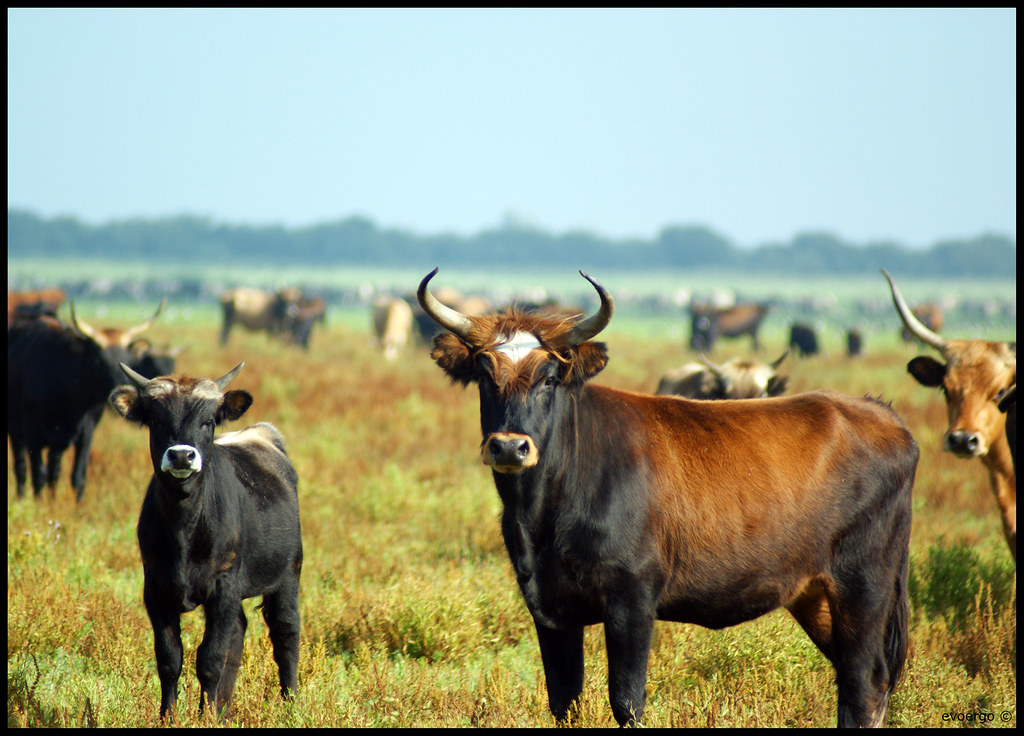
The horns within this population are mostly steppe cattle-like and thin, the length is varying and they are oriented very upright both in bulls and cows. However, I was surprised to discover cows with horns facing more forwards and inwards than in any other Heck cows. This is a strong hint that this horn shape developed in Oostvaardersplassen and therefore is a product of natural selection instead of artificial selection. In essence, the curvature of the horns in these two individuals is nearly perfect, except that they are oriented to vertical. I see the same tendency several in other cows and also bulls in Oostvaardersplassen.

(© evoergo on flickr)
(© Frits van Hout) Cows with aurochs-like inwards-facing horns, 
very likely a product of natural selection
The skull of the Oostvaardersplassen Heck cattle is short and paedomorphic like in most other representatives of the breed. However, surprisingly some cows show an elongated skull, similar to Sayaguesa. I wonder what causes this development and if a longer snout perhaps provides an advantage for grazing, or if it is influenced by environmental factors.
The colour of those cattle is extremely variable. Dark brown bulls with a kind of saddle and either dark or reddish-beige cows are most common, but black cows and black bulls, as much as reddish brown or beige bulls do appear. Gray individuals exist in both sexes and are a relatively common sight. The portion of spotted animals seems to be higher than in usual Heck herds, unfortunately. These spots either are limited to the forehead or cover the whole body.
Spotted bull calf (©Jaap Rouwenhorst)
There is no size data for the Heck cattle at Oostvaardersplassen, and also no useful photos from which the size of the animals could be extracted, so we can only speculate how large they are. Do the conditions in the reserve favour a size increase or decrease against the 140 cm shoulder height in bulls and 130 cm in cows? As discussed above, the natural selection created by the physical competition of the animals likely favours larger animals. But considering the small size of the reserve, the high density of herbivores and the limited amount of food, as much as the absence of predators, makes Oostvaardersplassen a kind of island. These island conditions favour a size decrease in larger animals, as numerous examples of insular tetrapod evolution have shown. After all, the aurochs itself “dwarfed” slightly on Sicily after it became isolated from the mainland. It makes sense that a smaller animal needs less energy than a larger one, and a healthy and strong small bull might succeed over a larger but emaciated one in a competition. Therefore, we have to assume that the Heck cattle at Oostvaardersplassen are as large/small as the average of the breed given above, or even slightly smaller.

If the conditions like they are now remain unchanged, how will the population in Oostvaardersplassen develop in future decades? I think that on a middle- and long-term sight, the portion of animals with an athletic body and aurochs-like proportions and horns will increase, while the bulky and domestic looking ones will get constantly fewer because these factors have a considerable impact on the fitness of the animals. Also, if the food situation does not change (f.e. by increasing the supplementary food that already is provided during winter), those with the smalles udders and shortest dewlaps and scrota, and most effective winter coat and resistance to diseases will become more common.  The island situation of the reserve will favour a size decrease more than a size increase. The colour of the animals has, as far as we know and in the absence of predators, no direct influence on the fitness of the cattle, so it will remain heterogeneous for a very, very long time. Perhaps sexual selection favours dark bulls and lightly coloured cows, but only on a very long term.
In essence, future Heck cattle in Oostvaardersplassen will be more adapted to their habitat and living as a wild animal than they are now. They probably will evolve into a population with aurochs-like horns and proportions/body shape, but varying colours and a small size. Probably it would also take a considerable time span until these alleles are fixed, and I am speaking perhaps of centuries. But what if man would “help” natural selection to speed up the process? Individuals with undesired features, such as grayish coat colour and steppe cattle-like horns, or many of the spotted individuals, could be culled, and a wild type colour with the right sexual dimorphism could be fixated. To compensate the loss of individuals, cows of herds that add what is lacking in the population can be added, such as from the Wörth herd (for the horn dimensions and curvature) and the Taurus cattle at Lippeaue (for the size, proportions/body shape and horn curvature). Later culling should focus on the bulls in order not to decrease the population too much, and because single bulls have a greater influence on the evolution within the population than single cows.
This plan could lead to a dedomesticated, wild cattle population that is adapted to their habitat and resembles the aurochs very well. However, it is up to the responsible people if this is turning into reality or not.

It seems that the next step in Oostvaardersplassen will be expanding the reserve. The plan of Oostvaardersland, a new 150 square kilometres large nature area that would be formed by the connection of Oostvaardersplassen to the reserve Hosterwold by a corridor named Oostvaarderswold, ran into political trouble. This is a shame, as Oostvaardersland would be one of the most precious nature areas in western Europe. Not only because of its rich avifauna and the wet zones which are very important for the amphibian fauna, but also because it is the only place in western Europe where large populations of cattle, deer and horses live side by side. Also, the cattle would have the chance to chose between forests and open grassland, what would tell us more about the habitat preference of this species. However, let’s stay tuned and see if Oostvaardersland is going to happen.


Literature

[1] Frisch, Walter: Der Auerochs – das europäische Rind. 2010.
[2] Julia Poettinger: Vergleichende Studie zur Haltung und zum Verhalten des Wisents und des Heckrinds. 2011.
[3] van Vuure, Cis: Retracing the Aurochs - History, Morphology and Ecology of an extinct wild Ox.

Saturday, 14 September 2013

Over-purity as a danger for the Wisent?

EDIT: For an update on my take on to this subject, go here

Ok, this is a little bit off-topic, but it is bovine-related and certainly a very important issue that I don’t want to miss here.

It is well-known that the Wisent went through a dramatic bottleneck in the 1920s; only 54 individuals remained, and these descend from only 12 ancestors [1]. The contribution of these ancestral individuals to the modern population is uneven and dominated by one pair in particular, so that the modern gene pool is even smaller [1].

The small genetic diversity and the high degree of inbreeding is regarded as one of the main dangers to the global wisent population. Inbreeding affects the skeletal growth, leads to skull asymmetry, deformation of the male gonads, increases the rate of stillbirths, decreases female fertility and the resistance against diseases and parasites [1]. Wisents are vulnerable to diseases such as posthitis and balanoposthitis, foot-and-mouth disease, cattle tuberculosis, bluetongue disease and others. Epidemics are an acute danger to wisent populations, even in captivity. In the Bialowieza Primeval Forest, about 20% of the mortalities are caused by diseases [1].

The modern Wisent population is separated into two genetic lines. One is of pure bonasus individuals, and the other one has introgression of one single caucasicus bull. Curiously, the inbreeding effects are more severe in the LC-line. In the Lowland line the inbreeding coefficient is equal to 44%, in the Lowland-Caucasian line 26% [1].

"Kaukasus", the last pure Caucasian wisent
Line breeding separates the very small gene pool into two even smaller sub-pools and is something that usually would be avoided in the conservation of a species that is highly inbreed and homozygoteous. The reason behind this is to preserve the pure members of the lowland line, although the introgression of only one bull of a different subspecies eighty years ago probably would have little effect on the global wisent population, except that the genetic diversity would increase (what is, in fact, necessary to preserve the species). While the L line is a closed pool, the LC line is “open” and therefore pure lowland bison are constantly mixed in. This leads to a further decrease of genetic diversity, because the Caucasian influence gets increasingly diminished [1]. Therefore, line breeding increases the problem of inbreeding and homozygosity.
Therefore, one way to prevent the further loss of genetic diversity that I propose is to stop the line breeding by “opening” the L line, so that the two very small gene pools could fuse into a larger one and to prevent that the Caucasian influence disappears altogether. The affect of this influence of only one bull on “pure” Lowland wisents would probably be very small, as both bonasus and caucasicus belong to the same species and show only slight phenotypic and ecologic differences. It confuses me that there are efforts to separate subspecies and subspecies hybrids (with hardly any recognizable difference except inbreeding-related issues) in an endangered species with a critically small gene pool like the Wisent, while there is no such action in a genetically diverse, healthy and not endangered species like the American Bison, of which the two subspecies also intermixed in some populations (f.e. Wood Buffalo National Park) or not even to purge out the influence of domestic cattle in the American bison.

Another but certainly controversial step to increase the genetic diversity of the wisent is to cross-in single American bison and mate the results with pure Wisents again until the American influence isn’t recognizable anymore. This way of breeding is called absorptive breeding. The mere existence of such hybrids, or individuals with “unproven pedigree” are regarded as a threat for the Wisent in the action plan for the conservation of this species by the Polish Academy of Science [1], although it certainly would compensate the larger, immediate danger of the small genetic pool. It is true that uncontrolled and nontransparent hybridization, f.e. in a feral population, is an indirect danger for the Wisent as a species, but controlled introgression of the closely related American species might be helpful in overcoming the severe inbreeding depression of the European bison.
In the early 20th century, hybrids of wisent and Am. Bison, but also domestic cattle hybrids, were not rare at zoos and were in fact a threat for the conservation of the species, because there was the danger that hybrids and pure wisents become all mixed up and indistinguishable. That’s why a pedigree book for the Wisent was set up in 1931 – the first pedigree book for any endangered species – to ensure that the Wisent will survive in its original form, un-altered by uncontrolled hybridization [2]. Therefore, it is understandable why hybridization per se is still regarded as a threat to the Wisent, but today it is also apparent that the high degree of inbreeding and the resulting low resistance to diseases and parasites and other negative consequences are a drastic and immediate danger for the global population. Controlled introgression by few hybridization events would be one way to add genetic diversity to the wisent gene pool, but what other effects would controlled hybridization and back-crossing have on the Wisent?

The European bison and the American bison are closely related and can interbreed without any fertility problems. Because of this, several authors treated them as one species in the past. Phenotypic differences are apparent; the American bison has a more longish and massive body, more opulent fur on the head forelegs and also the horns are not as long but thicker as in the Wisent, among other differences. However, both species are ecologically similar, except that grasses make up a higher portion in the diet of the American bison. The Wood bison, B. b. athabascae, inhabits a similar habitat as the Wisent did in ancient Europe. In 1940, hybrids of American and European bison were released in the Caucasus. After controlled culling and subsequent replacement with pure wisents, the portion of American blood within the Caucasus population is now estimated being only about 5%, although the American influence is still slightly visible in the phenotype of the animals. Allegedly this population has a destructive influence on the local flora because of the hybrid origin. I am not familiar with the facts behind this claim, but I am sceptic about it because according to the food choice of the A. bison, the only difference to be expected is that they eat a higher amount of grasses than pure wisents would do – and originally there were two other species of grazers in the Caucasus that relied on grasses to a large extent (aurochs and wild horse). But of course does the presence of herbivores change the frequency of certain plant species, because herbivores decimate some species more than others. This is to be expected in every ecosystem, and this observed change in the plant community might be interpreted as a “damage” if someone expects the animal to cause damage. It is further claimed that the population released in the Caucasus is less tolerant to cold and less adapted to mountainous habitat because of the influence of the American bison. But the lacking adaption to the mountainous habitat probably isn’t due to the American influence in particular, but the Caucasian Wisent very likely had special adaptions to its habitat that are not present in the Lowland Wisents as well. For example, it was smaller, had shorter higher hooves and a less shaggy coat [3]. The claim that the American influence made them less resistant to cold is very likely incorrect, since American Bison resist temperatures down to - 40° Celsius.

Wisents with American bison introgression in the Caucasus (Photo by Sergej Trepet) 
In order to conserve the Wisent as a species but to increase the genetic diversity by controlled hybridization, not a patchwork of American and European features should be the objective, but a homogenous Wisent population with slight American introgression that is not visible. This is possible, as we know from the fact that many modern American bison populations experienced introgression from domestic cattle in the past, but the cattle apparently left hardly a trace in the phenotype, behaviour or ecology of the bison (however, this isn’t the case for all herds). Controlled hybridization followed by “expulsion breeding” by constant back-crossing with pure wisents can result in a wisent population that looks like the wisent, behaves like the wisent and has the ecology of the wisent, but is more genetically diverse than the highly inbreed “pure” populations. Individuals that show clear traces of the American bison can be selected out. When American bulls are used and only their female offspring is chosen for further breeding, the entrance of “foreign” Y chromosomes is effectively prevented (vice versa for the mitochondrial DNA in cows).
What would be the effect on the genetic structure of the Wisent? As a population geneticist would say, its allele frequency would slightly change. But as we know through modern genetics, populations always change (genetic drift). The modern wisent is necessarily genetically different from the Wisent of the 19th century before the bottleneck event. And the Wisent of the 19th century was genetically different from that of the Bronze Age et cetera.

Surely, uncontrolled and nontransparent hybridization of wisent with American bison or even cattle, be it in the wild or captivity, is a threat for the conservation of the species. But a controlled and transparent breeding plan like described above might be seen as a chance for the Wisent to gain more genetic diversity to overcome the menacing effects of inbreeding in the species. Perhaps the European bison Pedigree book one time will allow a third genetic line with American introgression besides the Lowland line and the Lowland-Caucasian line, where every interspecies mating is transparent and recognizable. In this case it would always be possible to distinguish between wisents with introgression and those without, and the amount of introgression is always transparent as well. If the Pedigree book is against such a step, there is still the possibility to set up a new breeding book for that lineage. Surely this would be controversial and also cause disaffirmation, but if it turns out that Wisents with slight American introgression are healthier and more resistant to diseases than their “pure” counterparts and show no apparent signs of hybridization (neither in their phenotype, behaviour or ecology), maybe there will be shift in looking at this strategy to safe the wisent, for which, as the conservation plan states, “the danger of extinction still remains”. Maybe it will also cause a different look at the 700 wisents that are not registered in the Pedigree book and also the population in the Caucasus. The latter population has been living in the wild for more than 70 years now and grew to magnificently large numbers (though poaching is a serious problem), and therefore is certainly precious. Culling of bulls and replacing them with pure Wisents could further reduce the phenotypic effect of the American bison introgression.

In my opinion, studies comparing the food choice of American bison, European bison and hybrids should be set up. Also it is necessary to investigate the resistance of the hybrids against diseases and other negative effects of inbreeding (the existing population in the Caucasus could serve as a model) and to investigate which of the two subspecies of the American bison is better-suited for such an attempt. This could be a scientific basis for a breeding experiment executing controlled and transparent introgression into the Wisent pool as described above without affecting it as a species in order to overcome the most serious and immediate threat for the conservation of the species.

Here's a video of the wisents in the Caucasus with bison introgression: 


Literature

  • [1] Mammal Research Institute, Polish Academy of Science: European Bison Bison bonasus: Current state of the species and an action plan for its conservation. 2002
  • [2] Jan Raczynski, Malgorzata Bolbot (2009): The European Bison Pedigree Book.
  • [3] Ninell Melkadze, Nargiza Ninua, Izabella Skhirtladze (2009): Catalogue of the type specimens of Caucasian large mammalian fauna in the collection of the National Museum of Georgia


Saturday, 7 September 2013

Maronesa - a relict breed from Portugal


By “relict” I of course do not mean this breed is a surviving aurochs population. But Maronesa is one of the very few remaining cattle breeds that resemble the aurochs overall to a large extent in overall appearance, apart from their size.

Maronesa was and is used as a draft breed and their range is centred around the North of Portugal. This breed usually is raised in the upland regions and live freely most the time of the year. They are used to heavy raining and snowfall, and even are known to fight of wolves and defending their calves.
Some genetic studies find it to be well-differentiated among Iberian breeds [1], but they also show striking phenotypic similarities to Auroquesa, Barrosa/Cachena and some other Northern Portuguese cattle breeds. These similarities concern f.e. horn shape, face shape and overall appearance, but Maronesa has a much more Aurochs-like coat than the other breeds.

Well-marked sexual dimorphism
In fact, Maronesa is one of the very few breeds that still exhibit a nearly correct aurochs coat colour: the bulls are dark brown to black with a lightly coloured eel stripe, the cows are reddish brown and darker on neck, head, tail and anterior side of the legs. Both sexes show a clear mealy mouth and the colour of the very curly hair between the horns of bulls varies between orange, reddish brown to black. However, some Maronesa bulls have a reduced or lacking eel stripe, and some Maronesa cows also are coloured dark brown, in rare cases black; this is an unpleasant effect of breeders selecting against sexual dimorphism in colour. For some reason, many Iberian breeders apparently dislike the original sexual dimorphism of cattle and if this selection process isn’t counteracted by a program to conserve the primitive lineages of this breed, future Maronesa might get as uniformly dark or black as Sayaguesa.

This is what I imagine the curly hair between the aurochs' horns to look like
Bull with perfectly aurochs-like horns, albeit oriented too low
The horns of Maronesa are about the same size as in the aurochs, perhaps slightly smaller. The curvature resembles those of the aurochs almost perfectly in many bulls and also some cows, albeit being some 15-20° (just an estimation of mine) lower than in the average archetype. While some bulls have rather thick horns, the horns of most cows unfortunately are not as thick as in the aurochs, and the tips curve outwards in many cases, similar to a corkscrew. Nevertheless, individuals with inwards-facing horns of the breed surely are very helpful for effigy breeding.

Cow with inwards-facing horn tips
Cow with outwards-facing horn tips
Large bull with thick horns, short skull
Maronesa have, as do the possibly related breeds Barrosa and Arouquesa, a comparably short and concave skull, bulls in particular. Maronesa has a clear hump in many individuals (again, bulls in particular), though this hump is not quite as tall as in the Spanish fighting bull; some cows have a really athletic body, while the bulls tend to be not as high-legged. But in general Maronesa are more athletic than most Heck cattle, especially when kept under semi-natural conditions and when they are not fattened.
This breed is variable in size, but most individuals are not very big. Some are even as small as Highland cattle. Therefore, the size is something that has to be considered when choosing Maronesa for an effigy breeding program. However, some individuals still grow comparably big, and one bull which’s semen is used in Tauros Project allegedly reaches almost 160 cm at the shoulders.

Very aurochs-like cow in Faia Brava: proportions, colour and body shape look perfect to me.
If the horns were larger, more upwards- and inwards-facing and the skull more elongated (and probably the body size larger), that cow would look perfectly like an Aurochs to me
All in all, Maronesa probably is one of the most aurochs-like breeds in Europe thanks to its colour, horn shape (and also horn dimensions) and also proportions (at least in cows, the bulls are not that long-legged). The curly hair between the horns gives them a particularly wild appearance. Disadvantages of this breed are the mostly small size and the short snouts. The fact that their horns are very low is advantageous when crossing with breeds with very upright horns (mostly Steppe cattle).
Maronesa is a breed that has proven to survive well in the wild of Portugal, and is resistant to heavy rainfall and snow. And they are known to fight off wolves. A selection of good In my opinion, Maronesa is at least as desirable for rewilding as good Heck cattle, especially when supplemented with another breed that adds what is lacking in Maronesa. Maremmana for instance would improve the size, head shape and also result in more upright horns within the aurochs’ variation range. Add a bit Chianina and select carefully, and you get a very good stand-in for the aurochs.

Cows in the Netherlands, used in Tauros Project
Tauros Project has a herd of nice Maronesa in the Netherlands and is producing Maremmana x Maronesa crossbreeds at the moment. Let’s see what will come out of it, it will certainly bring interesting results. The Faia Brava reserve also has a herd of slender Maronesa that were released last year, and they will also be combined with other breeds. The herd did very well with the rough conditions in the reserve last year.

Here you have some nice videos of that breed (I would insert the videos themselves, but blogger doesn't find them): 


Literature

[1] Catarina Ginja et a.: Y chromosome haplotype analysis in Portuguese cattle breeds using SNPs and STRs. 2009.

Friday, 6 September 2013

Why doing breeding-back at all?


While my previous posts here focused on the breeding-back projects in general and primitive, suited domestic breeds of cattle and horses in detail, one might ask the question: why doing, or even trying, breeding back at all?

First of all, the loss of every species because of man is tragic. Therefore conservation tries to reduce destructive human influence to a minimum, and thereby preserves and reintroduces endangered species. The Przewalski’s horse, Wisent, Mauritius hawk, the Oryxes or the Milu have been saved in the last second, and big cats and other large game are being reintroduced in areas in which they have been extirpated. It is obvious that it is a very important, if not the goal of zoological conservation to preserve or reintroduce endangered species in their natural habitat, because they belong there and fill a niche in their ecosystem.
The Aurochs, the Tarpan and the Quagga are animals just like these I mentioned above. They have been extirpated by habitat destruction and excessive hunting only centuries ago, but had been integral parts of their respective ecosystems for millennia. Without anthropogenic influence these species still would be around in the wild, and probably in more or less high numbers. The only difference between those animals which are in the focus of modern conservation programmes is that they are already lost. But breeding-back or effigy breeding is a way to create adequate substitutes for these animals in the wild that are also satisfying for interested people; effigy breeding, in my opinion, can be seen as a tool for conservation instead of merely something for fanciers.
The Plains Zebra once was very common in South Africa in form of the Quagga. Regardless of the validity of the megaherbivore hypothesis*, Europe was home to several species of large herbivores. Three of these species are still left (Wisent, Elk, Red deer), and it’s my heart’s desire that these will roam the wilderness on most of the continent again. But these three species are more browsers than grazers (with the exception of the wisent, which seems to be a semi-intermediary grazer [1][2]), so the grazing niche is virtually vacant without wild cattle and horses. We know that Bos primigenius and Equus ferus were present in Europe during the Holocene, and the former was a particularly common animal. Reintroducing them is just as legitimate as reintroducing wisents and elk, although their wild type is lost.

* The controversial megaherbivore hypothesis suggests that large herbivores play a more or less important role in shaping their environment by feeding.

Regardless of the merely nomenclatorial issue if you consider domestic animals as part of the species they derived from or not, domestic cattle and horses very likely are ecologically and behaviourial very similar, if not identical, to their wild types. But certainly not all breeds of these two animals would do well in the wild or present an authentic picture, and that’s where breeding-back comes in.

One way to create a substitute for the aurochs is to choose a number of suitable, hardy landraces for a specific region and to release them and build up a feral population. Natural selection would start to work on this population and certainly you can expect to see phenotypic and behavioural changes after some time. The population would get increasingly adapted to their habitat, but as several examples of feral cattle show, they do not necessarily resemble the aurochs in all known features, and it would take natural selection a very long time to create a homogenous strain of cattle that looks like a genuine wild bovine instead of a bunch of feral domestic animals that is considered a pest in other regions of the world (see Amsterdam Island). Furthermore, it would be much easier to communicate deaths of wild-looking cattle and horses to the public (“they are wild animals, that’s what happens in nature”) than explaining why conservation watches cute dairy cows or ponies starving during winter. Imagine the public outcry to a photo of wolves hunting down an adorable Shetland pony!
Moreover, ancient-looking cattle and horses, or Plains zebras at least resembling the Quagga, are probably more satisfying for zoologists and visitors, who both want to get an authentic impression of what wilderness was like before man started to diminish it. In my opinion, people and nature deserve authenticity. And if there are authentic and very hardy breeds suited to live in the wild, why choosing any other breed for rewilding?
In the case of the Quagga, it is even easier to argue in favour of the selective breeding project. It is not a novelty that a different subspecies is reintroduced into the area where another subspecies has been exterminated earlier, and in this case the Rau zebras are clearly more desirable than “usual” Burchell’s zebras.  

Another reason why breeding back is not pointless is it’s value for zoological education. This was one of the reasons why the Heck brothers started their aurochs experiment and is probably still valid today. Thanks to breeding-back, the aurochs escaped oblivion; people learn about its existence at zoos and several books (it is even listed in an English guide to British mammals), and the constant confusion with the wisent is now quite rare in the German language at least. Effigy breeding, if executed carefully and with the necessary background knowledge, can deliver a good impression of what these extinct animals looked like. They also serve as a reminder against the careless destruction of nature and persecution of species, because it always has to be made clear that an actual return of extinct animals is impossible without having enough viable genetic material of it left and therefore we should take care of the species that are left.

Some people may be sceptical because they think breeding-back or effigy breeding tries to revive an “ancient beast” from lost worlds that has no place in modern times. But this is clearly a wrong impression. As I explained above, effigy breeding focuses on animals that have been wiped out by man and would be still around today without hunting and habitat destruction.
The argument that breeding-back results compete with existing, endangered species also can be discarded because they all occupy different ecologic niches. For example, the aurochs tended to inhabit lower and wetter regions than the wisent did and grasses probably made up a higher percentage of their food than in the wisent. Oostvaardersplassen, for example, would be much to wet to be suitable for the wisent. It must be clear, though, that the conservation of still existing species is clearly more important and must be priority; at least in my opinion.

Literature

[1] van Vuure, Cis: Retracing the Aurochs - History, Morphology and Ecology of an extinct wild Ox. 2005.
[2] Julia Pöttinger: Vergleichende Studie zur Haltung und zum Verhalten des Wisents und des Heckrinds. 2011. 

Wednesday, 4 September 2013

C. H. Smith's description of the Tarpan


Charles Hamilton Smith (1776-1859), an English artist and naturalist, delivered one of the most important and extensive descriptions of the wild horses inhabiting the Russian steppe during the 19th century. He also is the artist of the famous “Augsburg Aurochs”.
In The Natural History of horses, with Memoir of Gesner, published in 1841, Smith describes not only the appearance, but also social behaviour and seasonal migrations of the animals considered to be Tarpans. He also distinguishes between pure Tarpans and mixed feral domestic herds. He apparently obtained his information from local people and soldiers, and also argues against other naturalists saying that all free-roaming horses of western Eurasia are feral and not wild. Moreover, Smith also mentions wild or feral horses in western Europe that seem to be largely similar to those of the steppes. Down below you find the most interesting passages on the Tarpan which I typed from the digitalized version of his work on google, from page 148 to 166:

But doubts may be entertained respecting the real source of the wild horses roaming of the Ukraine, in Europe, eastwards to the northern extremity of Chinese Tahtary: those about the Don, it is asserted, are sprung from domesticated animals sent to grass during the siege of Azof in 1696 (or, as in other authorities, 1657), which could not again be entirely recaptured. Forster was disposed to consider all the wild horses in Asia descendants from strayed animals belonging to the inhabitants; and Pallas, who had likewise travelled in Asiatic Russia, inclined to the same conclusions. He thought the horses from the Volga to the Oural the progeny of domestic animals; and again, that all from the Jaik and Don, and in Bokhara, where of the Kalmuck and Kurguise breed, remarking, that they are mostly fulvous, rufous and Isabella; while, on the Volga, he noticed them as usually brown, dark brown, silver-gray, some having white legs and other signs of intermixture. […] Now, if we examine the extent of the travellers’ own immediate means of judgment, we find that they have occasionally seen troops of wild Equidae at a distance, and been enabled to give one drawing of a living colt recently captured, besides two or three more species from living specimens or stuffed skins: surely a sweeping conclusion upon such scanty data may be convenient, but is scarcely deserving of acquiescence; particularly when we take into account, that, including the collected opinions of those upon the spot, in themselves only of conditional value, the field of obervation explored is scarcely a hundredth part of the surface whereon this zoological problem must be decided. The Russian dominions extend over most level part only: four chains, at least, of enormous mountains, whose direction is even in a measure unknown occur within the great basin of the Thiachan, the Little Altai, the Himalaya mountains, and Hindukoh; and opon them there are table lands of more than 16,000 feet in elevation, not as yet traversed by a European foot, though known to be stocked with wild horses and other animals. […] Over the whole extent of this almost boundless surface several species of Equidae are noticed, and shall we assume that these also are feral descendants of stray animals at the siege of Azof, though neither Forster nor Pallas advanced such an opinion? Surely no: nor can we deny that in the south-eastern mountain frontier of Russia, upon the inclinded plains restingagainst the chain, the original wild Equus caballus is still found; and that in the other regions of the empire stretching westward, they are likewise of the wild stock, but more and more adulterated with domestic races as they approach towards Europe, or have been long peopled by fixed residents.
Even in the south-western steppes to the Ukraine, there have been wild horses, as is attested by the earliest historians, poets and geographers […] and if the horses on the banks of the Don are of feral or of mixed blood, their origin and contamination is surely much older than the siege of Azof. Even at that period, there were still wild horses kept in the parks of Eastern Europe, like other game, for the service of the tables of the great. To admit, therefore, the conclusion, that all the wild horses of the old continent are descended from animals at some period under the dominion of man, appears a gratuitous assumption resting upon no proof, and in opposition to historical records from the time of Herodotus to our own age: it would imply the absorption into domesticity of the whole species, or of several species, in regions where such abounded wildernesses exist, in several parts still maintaining a parent stock of other domestic animals: or involve the total destruction of the original wild horses upon this immeasurable surface, where man subsequently could not prevent their again multiplying to uncountable numbers; while in Europe, the most peopled part of the old world, there were still in existence wild individuals of a race never reclaimed. […]
Now, with regard to wild horses, in the relations of the ancients and in the travels of modern writers, though we have reason occasionally to suspect they mistake the onager and the hemionus for real horses, their still remains sufficient authority for their presence in a state of nature, under one or other of their primaeval forms, as far as the south and west of Europe and their characteristics assuming the same preference for opposite habitations in plains or in woody mountains which we now perceive to be a leading distinction of the zebra and the Dauw; traits of character the more important, as they indicate a different mode of living a choice of plants, not alike both, - adissimilar temperament; and when coupled with different proportions and position of the ears, an arched or plane forhead, a straight or curved nose, a difference of colour in the eyes, of the skin, of the hoofs, the constancy of their liveries, of their marks, in a streak along the back and bars on the limbs, of dappled croups and shoulders, or of dark uniform colours, dense or thin manes and tails, although traits now mixed, feeble and evanescent, they appear to be indications of original difference of forms sufficient to be distinct though osculating species, or at least of races separated at so remote a period that they may claim to have been divided from the earliest times of our present zoology.
Wild horses, by Oppian denominated hippagri and by Pliny equiferi, are the first mentioned by Herodotus as being of a white colour and inhabiting Scythia, about the river Hypanis or Bog, he notices others in Thrace, beyond the Danube, distinguished by a long fur. Aristotle (de Mirab) indicates them in Syria, but with manners that seem to refer them to hemionus or onager. Oppian places his hippagrus in Ethiopia, and denies the presence of wild horses in Syria; an opinion entitled to credit from his local knowledge and his description of the onager, which shows that he was acquainted with both. […]
In Varro, we find that there were wild horses in Spain; the ancients generally admit their existence in Saridina and Corsica; dapper places others in Cyprus; Strabo, in the Alps; and we know that they existed in the British islands. All seem to refer to a sturdy form of mountain-forest ponies, still found in the province of Cordova, in the Pyrenees, the Vogesian range, the Camargue, the Ardennes, Great Britain, and in the Scandinavian highlands: all remarkable for an intelligent but malicious character, broad forheads, strong lower jaws, heavy manes, great forelocks, long bushy tails, robust bodies, and strong limbs; with a livery in general pale dun, yellowish brown and a streack along the spine and cross bars on the limbs, or the limbs entirely black, as well as all the long hair and mostly havng a tendency to achy and gray, often dappled on the quarter and shoulders. They prefer the cover, delight in rocky situations, are dainty in picking their food, do mischief in plantations and their cunning, artifice, and endurance is far greater of that of large horses. From many circumstances, this form of Equus may be deemed indigenous in North-western Europe, and aborigine distinct from the large black race of Northern Gaul, which once ranged wild in the marshy forests of the Netherlands, and was so fears that it was held to be untameable. It was a gaunt, ugly animal, with a large head and bristly mouth, small, pale, often blue eyes, a haggard and abundand mane and tail, which according to Cardanus, when rubbed in the night, emitted sparks of fire; the hips were high, the legs nodose, and the feet broad, flat and hidden in an immense quantity of long bristly hairs about the fetlocks: this form of horse may have extended northward as far as the Hartz […]. It may, indeed, have been a feral branch, only in part wild, and introduced with the first Gallo-Belgic colony that ascended the Danube, […].
But the ancients all agree in their statements concerning wild horses of the north-east of Europe residing, according to their narratives, from Pontus northward into regions unknown to their geography; some we have seen are described as white, and having the hair five or six inches long, characters we find verified at present in Asiatic Russia and in the wild horses of the Pamere table land. In the woods and plains of Poland and Prussia there were wild horses to a late period. Beauplan asserts their existence in the Ukraine, and Erasmus Stella, in his work “De Origine Borussorum”, speaks of the wild horses of Prussia as unnoticed by Greek and Latin authors. “They are”, he writes, “in form nearly like the domestic species, but with soft backs, unfit to be ridden, shy and difficult to capture, but very good venison.” These horses are evidently again referred to by Andr. Schneebergius, who states, that “there were wild horses in the preserves of the prince of Prussia, resembling the domestic, but mouse-coloured, with a dark streak on the spine, and the mane and tail dark; they were not greatly alarmed at the sight of human beings, but inexpressibly violent if any person attempted to mount them. They were reserved for the table like other game.” It may be that in both the above extracts the hemionus or the onager is presumed to be depicted, but the difference of mane and tail is so obvious, that such an objection cannot be entertained; and should it be said that these were merely feral horses, it might be asked in return, what a true wild species must be like to satisfy the dissentient. In our view, this form of horse is the original eelback dun of the west, and allied to the common Median horse of antiquity; the parent, by gradual subjugation and intermixture, of the mouse-coloured and sorrels still common in Lithuania; and particularly those breeds that, with the black streak along the back, have cross bars on the joints, and a black mane, tail, and fetlocks [Footnote: Rzonozynski compares the Polish wild horses (Kondziki) in size to the Samogitian (Zmudzineks), mostly with tan or mouse-colored liveries; but there being other furs, attests they were mixed in his time. He describes the manners of the stallions, and admits that they can be trained, which, indeed, is equally true of the zebra and quagga. He relates their extension over the Ukraine, and gradual decrease]. These were the wild and feral horses of Europe, as far as Bessarabia, from the earliest era to the close of the seventeenth century; and from the facts recorded, we may with some confidence conclude, that farther east, where Europe displays an Asiatic character, becoming more and more, as we adcance in that direction, wild and uncultivable, that the appearance of the wild animals, particularly the horses, have retained their original nature more and more purely as we reced from the haunts of civilization, showing marks of degeneracy only where the old human migrations have passed, but leaving the typical characters everywhere perceptible. This is the cause of which induced authors to derive all the wild horses of Asia from the stray troop-horses at the siege of Azof, then, be it observed, already geldings, yet made to replenish the steppe with a species constantly noticed before and since as abundant in a wild state in the same regions! Within these few years, Moorcroft and the brothers Gerrard, when they penetrated into Independents Tahtary and within the borders of China, met with numerous herds of wild horses, scouring along the table lands, sixteen thousand feet above the sea, and express not the least in of their having been domesticated at any period.
Whatever may be the lucubrations of naturalists in their cabinets, it does not appear that the Tahtar or even the Cossack nations have any doubt upon the subject, for they assert that they can distinguish a feral breed from the wild by many tokens; and naming the former Takja and Muzin, denominate the real wild horse Tarpan and Tarpani. We have had some opportunity of making personal inquiries on wild horses among a considerable number of Cossacks of different parts of Russia, and among Bashkirs, Kirguise, and Kalmucks, and with a sufficient recollection of the statements of Pallas, and Buffon’s information obtained from M. Sanchez, to direct the questions to most of the points at issue. From the answers of Russian officers of this irregular cavalry, who spoke French or German, we drew the general conclusion of their decided belief in a true wild and untamable species of horse, and in herds that were of mixed origin. Those most aquainted with a nomad life, and in particular and orderly Cossacck attached to a Tahtar chief as Russian interpreter, furnished us with the substance of the following notice.
“The Tarpany form herds of several hundreds, subdivided into smaller troops, each headed by a stallion; they are not found unmixed, excepting towards the borders of China; they prefer wide, open, elevated steppes, and always proceed in lines or files, usually with the head to windward, moving slowly forward while grazing,  the stallions leading and occasionally going round their own troop; young stallions are often at some distance, and single, because they are expelled by the older until they can form a troop of young mares of their own; their heads are seldom observed to be down for any length of time; they utter now and then a kind of snort, with a long neigh, somewhat like a horse expecting its oats, but yet distinguishable by the voice from any domestic species, excepting the woolly Kalmuck breed: they have a remarkable piercing sight; the point of a Cossack spear, at a great distance on the horizon, seen behind a bush, being sufficient to make a whole troop halt: but this is not a token of alarm, it soon resumes its march, till some young stallion on the skirts begins to blow with his nostrils, moves his ears in all directions with rapidity, and trots or scampers forward to reconnoitre, bearing the head very high and the tail out: if his curiosity is satisfied, he stops and begins to graze; but if he takes alarm, he flings up his croup, turns around, and with a peculiarly shrill neighing, warns the herd, which immediately turns round and gallops off at an amazing rate, with the stallions in the rear, stopping and locking back repeatedly, while the mares and foals disappear as if by enchantment, because with unerring tact they select the first swell of ground or ravine to conceal them until they reappear at a great distance, generally in a direction to preserve the lee side of the apprehended danger. Although bears and wolves occasionally prowl after a herd, they will not venture to attack it, for the sultan-stallion will instantly meet the enemy,  and, rising on his haunches, strike him down with the fore feet; and should he be worsted, which is seldom the case, another stallion becomes the champion: and in the case of a troop of wolves, the herd forms a close mass, with the foals within, and the stallions charge in a body, which no troop of wolves will venture to encounter. Carnivora, therefore, must be contended with aged or injured stragglers.
“The sultan-stallion” is not, however, suffered to retain the chief authority for more than one season, without opposition from others, rising in the confidence of youthful strength, to try by battle whether the leadership not be confided to them, and the defeated party is driven from the herd in exile.
“These animals are found in the greatest purity on the Karakoum, south of the lake of Aral, and the Syrdaria, near Kusneh, and on the banks of the river Tom, in the territory of the Kalkas, the Mongolian deserts, and the solitudes of the Gobi: within the Russian frontier, there are, however, some adultered herds in the vicinity of the fixed settlements, distinguishable by the variety of their colours and a selection of residence less remote from their human habitations.
Real Tarpans are not larger than ordinary mules, their colour variably tan, Isabella or mouse, being all shades of the same livery, and only varying in depth by the growth or decrease of a whitish surcoath, longer than the hair, increasing from midsummer and shedding in May: during the cold season it is long, heavy, and soft, lying so close as to feel like a bear’s fur, and then is entirely grizzled; in a summer much falls away, leaving only a certain quantity on the back and loins: the head is small, the forehead greatly arched, the ears far back, either long or short, the eyes small and malignant, the chin and muzzle beset with bristles, the neck rather thin, crested with a thick rugged mane, which, like the tail, is black, also the pasterns, which are long: the hoofs are narrow, high and rather pointed; the tail, descending only to the hocks, is furnished with coarse and rather curly or wavy hairs close up to the crupper; the croup as high as the withers: the voice of the Tarpan is loud, and shriller than that of a domestic horse; and their action, standing, and general appearance, resembles somewhat that of vicious mules.”
The feral horses, we were told, form likewise in herds, but have no regular order of proceeding: they take to flight more indiscriminately, and were simply called Muzin. They may be known by their disorderly mode of feeding, their desire to entice domestic horses to join them, by their colours being browner, sometimes having white legs, and being often silvery gray: their heads are larger and the neck shorter; but their winter coat is nearly as heavy as that of the wild, and there is always a number of certain expelled Tarpan stallions among them, but they are more in search of cover and of watery places, and the wild herds being less in want of drink and more unwilling to encounter water, being even said not to be able to swim; while the Muzin will cross considerable rivers. During winter, both resort to elevated ground were the winds have swept away the snow, or dig with their fore feet and break the ice to get at their food.
Their olfactory sense, though not delicate in distinguishing enemies at great distances, is remarkable for judging the nature of swamps, which they often traverse, particularly the south of the Lake Aral: when thus entangled at fault, their scent indicates the passable places, and the snorting of the first that finds one is immediately observed and followed by the others.
The genuine wild species is migratory, proceeding northward in summer to a considerable distance, and returning early in autumn. The mixed races wander rather in the direction of the pastures than to a point of the compass; nearer Europe, they haunt the vicinity of cultivation, and attack the hay-stacks which the farmers make at a distance in the open country. Though in many respects they have similar manners, they want the instinct of the wild: upon being taken young, after severe resistance, they submit to slavery. The Tarpans always die of ennui in a short time, if they do not break their own necks in resisting the will of man: they are moreover, said to attack and destroy domestic horses: they rise on their haunches in fighting, and bite furiously; while the mixed races, though ready to bite, are more willing to strike out with their hind feed, and neither have ever been remarked lying down. In these particulars, the younger Gmelin, who likewise travelled in Eastern Russia, corroborates our account, and he does not appear to have come to the same conclsions as Forster or Pallas; we may therefore infer, from what is here stated, that the foal observed by the last mentioned outhor, when he was on the Samara, opposite Sorothinska, caught at Toskair Krepost, was of the mixed race, or not sufficiently grown to furnish a satisfactory representation.

Everyone is free to interpret it himself, but to me it clearly shows that the Tarpan, also in the steppes, was not a mere Konik-counterpart. His description suggests that the colour was predominantly some kind of bay dun, with some individuals perhaps being black dun, which is accordant to the genetic evidence. The attribute of being mule-like overall seems to confirm that the Tarpan was much like the Przewalski’s horse in appearance (except the apparently falling mane), and thus also resembling certain primitive horse breeds. Here you have Smith’s artistic interpretation of the Tarpans of the steppe:

C. H. Smith's artistic interpretation of the Tarpan (public domain)