Saturday, 2 November 2013

Another Quagga reconstruction

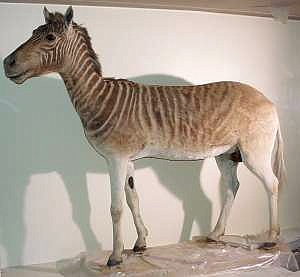
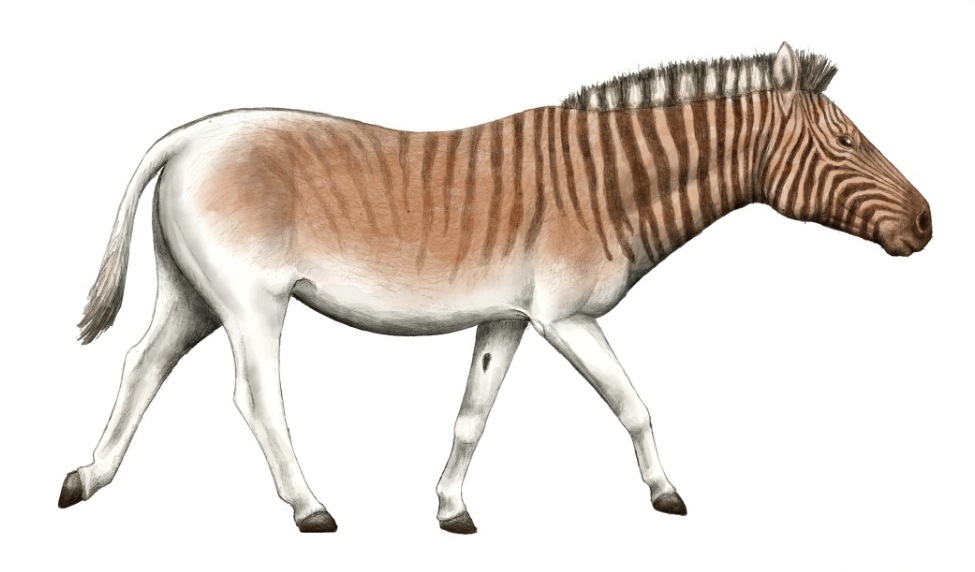
As you might or might not know, virtually all preserved Quagga skins have patterns that differ from each other. So I decided not to reconstruct what I consider the average within the population but one single specific individual for my latest Quagga life restoration. I chose the Wiesbaden skin: 


Quaggas actually have, contrary to the current Rau zebras, usually quite broad stripes with less space between them as far as I can see. I assume that most skins, like that one, are bleached and do not represent the original colour of the fur. For that, I used contemporaneous paintings such as the one below as a model. 


Painting based on a living Quagga by Nicolas Marechal from 1793
This is what came out of it: 


For comparison, that's my prognosis of how the Rau zebra of 2025 might look like based on the trend I see in the current animals of the Quagga Project: 


One noticeable difference between Quaggas and Rau zebras might be that the latter have broad stripes that fuse with the brown background while the Rau zebras tend to have continuously finer stripes that disappear towards the end of the trunk. But this is just my personal impression and we don 't know what future Rau zebras will look like yet. 

Some "horrible" Heck cattle

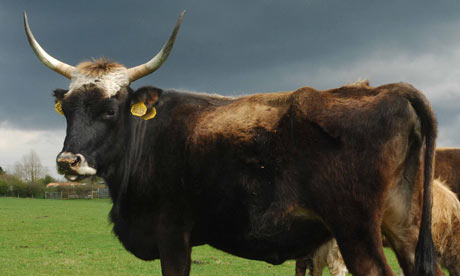
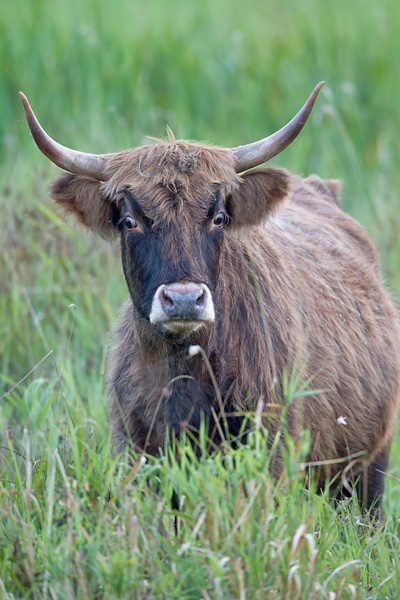
Because I was accused to “support” Heck cattle in an “unfair and biased” way over other breeding-back projects recently, which is absurd, I’ll cover the deficiencies of this breed as an effigy breed this time. During the last months I introduced some of the good and aurochs-like Heck herds, today I am going to portray some of those that have to be considered not aurochs-like at all.


Heck cattle is overall a hardy and robust landrace and high in numbers, so we are allowed to nit-pick with the phenotype. Note that when I criticise the cattle as non aurochs-like that it is not my purpose to criticise the breeders at all – far from it. Everybody is free to breed cattle how he wants, and we are all free to chose those cattle we want for projects and so on. And when I call any Heck cow “horrible” I am just talking about its phenotype in relation to what an aurochs would look like, I would never attack the cattle itself, which would be ridiculous. And surely all Hecks, like all domestic cattle, are cute and adorable animals no matter how much they resemble their ancestor.

Because Heck cattle is a rampant crossbreed of several semi-aurochs-like and some non-aurochs-like cattle breeds that was and is selected only by very loose criteria, all possible phenotypes have arisen in that breed. Besides herds that do resemble the aurochs, many only share one or two features with their wild ancestor and have an otherwise very domestic appearance. F.e. many herds have a very bulky, domestic body or a pretty reduced sexual dimorphism. Often the horn shape does not or only remotely resemble the aurochs. Some individuals even developed quite strange combinations of features, what you are going to see here.
No colour dimorphism, short-legged bulky body, short faces, weakly curved horns
So, where do you find the “worst” Heck cattle? (I exclude the population at Oostvaardersplassen here, because they no longer are subject of breeding-back but of dedomestication) Usually zoos show Heck cattle with a somewhat neglected phenotype, which is understandable because zoos have more important things to do than cattle breeding and worrying about horn orientation and fur colour in cows. The German zoos Wildpark Frankfurt (Oder) and Tierpark Neumünster for example have very short-legged and small Hecks that I call “bovine dachshunds”. Their body is bulky, stubby and short-snouted like in Highland cattle, some also have quite weird horns. The Wildpark Rheingönheim (above) is another example of a very bad and non-aurochs-like herd: no colour dimorphism, very short legs and skulls, wrongly shaped and/or too small horns.
Heck cow at Frankfurt/Oder, a bovine dachshund
Tierpark Neumünster; Very Highland-like in body shape, horns,
naked eyelids, fluffy ears and even brindled colour (Photo: © Ulli J. on flickR)
This cow (Rheinauer Wald) has hardly any useful features either...
This cow above from Wildgehege Rheinauer Wald is nothing special as well. It has short legs, a bulky trunk, short skull, large udder and long dewlap. The fur coat dimorphism is absent and the horns are not any more aurochs-like than those of some Highland cattle. A lot of Heck cattle in zoos look like that, and actually don’t give a better impression of the aurochs than slender Braunvieh or any Murnau-Werdenfelser. 

The Hecks at Lainzer Tiergarten near Vienna, a herd I know very well, have “bad” horns and a reduced sexual dimorphism as well, even spotted individuals appear. Although those animals are quite long-legged, their body is still bulky, especially in the cows.
Lainzer Tiergarten, Austria; weakly curved thin horns, weak colour dimorphism, domestic body
Apart from not very aurochs-like Heck cattle in zoos, there are also quite a lot individuals or herds in private farming or grazing projects that do not fit the requirements of a good effigy breed. Here you have a collection of photos and descriptions what is not aurochs-like in those animals:
Heck cow in Devon; horns are thin and upright, skull small, dewlap large,
body bulky, coat to dark, long trunk
Very Highland-like Heck cow (©Helge Schultz)
Longish and small-headed Heck bull, built like a meat bull
Tierpark Neumünster again
Heck cow lacking wildtyp colour allele, having "red" allele (Highland) instead
Short small head, long trunk, wrongly curved horns, colour saddle
Why am I writing all this? Again, it is not my purpose at all to bash the breed or to accuse breeders of having done something wrong. I’m merely comparing the phenotype of the cattle with what should be the breeding objective in an effigy breed of the aurochs. It is always good to point out that many Heck cattle are far from being a phenotypic aurochs and that this breed needs clear breeding objectives if its quality as aurochs effigy is to be improved. Many Heck cattle actually only resemble the aurochs in colour and only roughly in respect to the horns and are not any more aurochs-like than Iberian landraces. Therefore, rigorous selection within the breed and crossing-in of good other primitive cattle is necessary to improve Heck cattle, and pointing out which Heck herds/individuals are useful and which are not is important. In my opinion, Heck cattle should finally start to increase in quality instead of quantity. 


Thursday, 31 October 2013

The Quagga specimen


There are 23 preserved skins, 7 complete skeletons and few skulls of the Quagga left on this world. It is not surprising that some of the skeletons belong to the same individual of some skins, perhaps even all. Most stuffed Quaggas can be found in Germany, others in the Netherlands, France, Great Britain, South Africa, USA, Sweden and Russia. Looking at all the different Quagga specimen, which include complete adult individuals as much as foals and only a part of a leg, gives you a fairly good idea of the degree of variation within the Quagga subspecies.

Skins

Amsterdam

The skin of the last living Quagga, well-preserved colour (Photo: ©Artis Museum)
Bamberg


Basel

Berlin


Cape Town

Darmstadt


Edinburgh


Exeter


Frankfurt


Kazan


Leiden


London


Lyon


Mainz


Milan

Munich


New Haven

No photo found. Probably not on display. 

Paris


Philadelphia

No photo found.

Pretoria

No photo found. 

Stockholm


Stuttgart

No photo found. 

Tring


Tübingen

No photo found.

Turin


Vienna


Wiesbaden


Skeletons

The only skeleton on display that I am aware of is that of the Grant Museum:


You might be wondering what happened to the Quagga mare that was photographed in 1870 and died in 1872 and if she is among the stuffed skins or skeletons that are preserved till today. The stripe patterns of the two specimens in London do not fit the animal, nor does any other specimen. Therefore she’s probably not among the skins. It would be helpful to have more accessible information on the skeletons. UPDATE: I was addressed that the London mare probably is the specimen now held at the museum of Edinburgh, since the stripe pattern do line up. For a better photo of this specimen, go here.

For more information on the Quagga skins you can have a look at this very useful list on the Quagga Project's homepage.

Call me crazy, but the stuffed skins give me hope that the real Quagga might return some day. A 2009 paper [1] reports that mitochondrial DNA has been successfully extracted from stuffed specimens of the Thylacine, Thylacinus cynocephalus, so there is the reasonable chance that some of all those Quagga skins still preserve certain amounts of DNA. Theoretically, those almost thirty individuals might be enough to recover a healthy population, but I think it is much too optimistic to expect that all of them contain enough genetic material to be cloned. It probably would be a challenge already to gain enough material for at least one individual. However, if one - or even two or three - Quaggas could be cloned one day, it would be a huge sensation. Those Quaggas could be constantly bred into the Rau zebra population which would provide a genetic base for a new near-Quagga population. 

[1] Miller, Drautz, Janecka et al. The mitochondrial genome sequence of the Tasmanian Tiger (Thylacinus cynocephalus). 2009. 

Monday, 28 October 2013

Comming soon: more Quagga posts

This week will see two more posts on our favorite extinct zebra subspecies: one presenting a new Quagga life restoration, in the style of my hypothetical Rau Quagga and based on a well-preserved skin. The other one will given an overview over the two dozen preserved Quagga specimen - loads of pictures. Stay tuned! 

Corsican cattle - the "mother of Heck cattle"

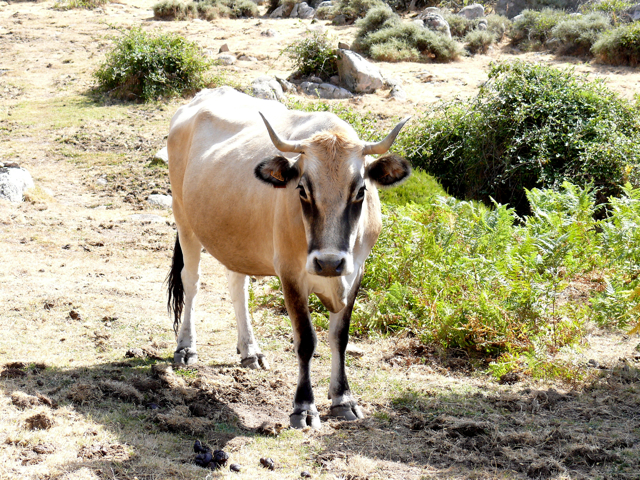
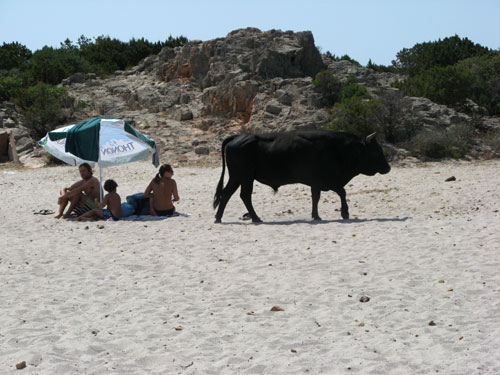
Like I wrote in this post, Corsican cattle (or Corsicana) and Steppe cattle probably are the most important founding breeds of Heck cattle. The two cross animals considered to be the first Heck cattle bred by Heinz Heck both were 75% Corsican cattle. And indeed if you look at members of this breed today, there's still a large and undeniable similarity with many Heck cattle. Bear in mind that the modern Corsicana have been crossed with dairy breeds from the European main land to a large degree during the last century. So the Heck brothers worked Corsican cattle that were more primitive than those we see today, without deviant colours and so on. 
Some examples of Corsican cattle (sources are visible in the URL of the photos): 


Corsican cattle is a rather small breed, and also the horns are much too small to fit the aurochs. The positive phenotypic feature this breed contributed is the very aurochs-like wildtype colour. But it also has grayish or beige variants in cows and bulls with prominent saddles, and we see exactly the same colours in Heck cattle. Also the horn shape greatly resembles that of many Hecks, just smaller. Some Heck cows, like an individual I saw at the zoo Haag in Austria last year, are almost indistinguishable from Corsican cows. 
In my opinion, one could easily breed "Heck cattle 2.0" by simply crossbreeding Corsican cattle and Hungarian steppe cattle. Would be pointless (= not very aurochs-like), but fun. 


Tuesday, 22 October 2013

Aurochs-like cattle breeds: An overview


Of course Heck cattle is not the only aurochs-like cattle breed, not at all. But how many are there? This depends on where you draw the line. Compared with water buffalo, even Austrian Fleckvieh is “aurochs-like”. Therefore, this categorization is purely arbitrary. With the selection down below, I want to present you a list of breeds which have more than just a single aurochs-like feature (like a high-legged slender body in Chianina or huge thick horns in Watussi), but a good representation of several primitive traits. I was also struggling with myself about making a split between “phenotypically aurochs-like”, “ecologically aurochs-like” and “genetically aurochs-like” (also because sometimes I am accused of being too appearance-based), but this turns out to be very complicated. How to define and measure “ecologically aurochs-like”, including traits such as hardiness, heat/cold tolerance and food needs? There are no living aurochs that can be used as a model, and there are certainly regional differences in ecological requirements as well. The same as with genetics: there is simply not enough data (yet) to make such a list. It seems that the appearance of the cattle is the only really quantifiable aspect for such a list. Furthermore, it is questionable if such a split would be useful at all, because most, if not all, of the optically aurochs-like breeds are very hardy and robust and would be on the other list as well.

Curraleiro bull from Brazil

So here it is, my top 32 of the aurochs-like cattle on this world, roughly in alphabetical order (click on the breed if you want to see how they look like):


* I only include advanced Hecks here (like Taurus cattle, the Wörth lineage, or herds at Hellabrunn or Solling-Vogler), because many of the usual Hecks are IMO not really worth mentioning here.

Sykia cattle from Greece
You might be wondering why there are only taurine cattle on the list. Well, I would include zebuine cattle here if I was aware of a breed that bears a good resemblance to the aurochs not only in one aspect like in the miniature zebu (colour) or Watussi (horns).
Very likely there are also some quite aurochs-like cattle in the Near East and North Africa, but those are virtually inaccessible to me except a few photos. Cattle from those regions tend to be small as well.