Thursday, 1 January 2015

Dedomestication series Pt. I: From wild to domestic

About eight months ago, I intended to do a dedomestication series on how domestication works per se, what happens when domestic animals run wild, and how this is relevant for “breeding-back”. But I never got to it, and actually I am happy about that because I gathered much more information in the meantime. Also, the drafts for the articles were unnecessarily long, so I am going to do more succinct versions here, which are easier to read for you and quicker to write for me.

So the subject of the first part is going to be how a wild animal becomes a domestic animal with all its morphologic and behavioural changes. My post from April 2014 covered this question already (http://breedingback.blogspot.co.at/2014/04/breeding-back-and-dedomestication-pt-i.html), but IMO not sufficiently, so I decided to write another, more inclusive and handier one.
Domestication has a strong developmental background. I am an amateur on developmental biology as much as I am not a geneticist, so feel free to point me to conceptual errors in this text if you spot some.

Per definition, domestication is the process that occurs when man shapes wild animals for his purpose by artificial selection. This process always results in similar morphologic and behavioural traits, regardless of which species or domestication event, suggesting that there are universal underling mechanisms that are always the same. These mechanisms are very likely part of these factors:

Genetic drift: This is the very first effect of domestication. Man snatches out a small population out of a larger wild population and and starts breeding with it. But that factor is of minor importance here.  
 
A normal and a hypothyroidic mouse. The latter shows
floppy ears, smaller body size and shorter limbs and
snout. Taken from [2].  
Developmental delay: This is way more important. The famous Farm fox experiment which selected captive silver foxes for tameness over decades, the results are human-friendly foxes with juvenile behavioural and morphological characters, as well as novel traits. The retention of juvenile characters, known as neoteny or paedomorphy, is common to all domestic mammals and is the result of a developmental cascade due to the selection on tameness [1,2]. The reason for that is that behaviour is regulated by hormones, and selection on certain behavioural traits changes the endocrinology. And selection on tameness, or in other words, a reduction of the so-called fight/flight reaction, seemingly has a dramatic effect. Main hormone groups involved are corticosteroids and those produced by the thyroid gland [1,2]. The former play a role in the animals reaction to stress, and indeed the level of corticosteroids in the domestic foxes dropped to a quarter compared to the control group [1]. Also, the surge of this hormone group during postnatal development got delayed, suggesting that the hormonal change that causes the behavioural change also results in neoteny.
The thyroid hormones have an even greater impact. They play a crucial role in postnatal growth, pigmentation, brain development, adrenal gland function and development of the gonads [2]. Hypothyroid rats are smaller than the average, have a shorter snout and floppy ears, which are typical domestic traits [2]. Neoteny in amphibians is the result of hypothyroidism as well, and so is the so-called cretinism in humans. Symptoms of cretinism are shortened extremities, reduced body size and lowered cognitive abilities. I don’t know if we can connect the reduced brain volume we see in domestic animals with these reduced cognitive abilities, but the parallels between typical traits of domestic animals and the effects these hormones have in humans and rats are obvious.
The reduced sexual dimorphism has to have a hormonal cause as well. Probably – and this is now my presumption – the selection for tameness and the change in the endocrinological activity also affected the production of steroids that are responsible for the development of secondary sex characteristics, androgens and oestrogens. Distorted production of these hormones in humans results in syndromes such as virilism. Indeed the farm foxes show reduced sexual dimorphism in cranial morphology.
Another result of the Farm fox experiment and of domestication in general is earlier maturity. The domesticated foxes mature one year earlier and give rise to one more pup. This was achieved by selecting for tameness only, while the efforts by fur breeders by selecting on earlier maturity directly for decades remained fruitless [1].

Pleiotropy: (forgive me that I just recycle this paragraph from my earlier post) Pleiotropy
takes place when genes do not affect one single trait but have a number of functions. This can also be the case in genes for discrete, monofactorial traits like coat colours – these “colour genes” actually have more than one function. A prime example is the KITLG locus that produces the ligand for tyrosine-kinase (coded by the KIT-locus), which has a function in germ cell, neural cell and blood cell development. Mutations on these two loci are either hyperpigmentation or leucisms [3], responsible for many of the spotted patterns we see in domestic animals [4].  KIT mutations are the cause of the typical white streak along or the “star” on the face of many domestic animals, and is also displayed by humans having similar mutations (“piebaldism”). The spots are the result of a disordered migration of the melanoblasts from the neural crest where they are produced. White-faced cattle like Hereford have a greater susceptibility to Cancer Eye or Bovine Squamous Cell Carcinoma [4], and depigmentation in general increases the risk of cancer because melanin is an important barrier for mutagenic UV radiation, which is evident in basically every animal. The Agouti-locus has a role in pigmentation (responsible for colour dilutions in many mammal species), but also in regulating lipid metabolism in adipocytes [5]. The Dun-locus, a dilution locus as well, has functions in the nervous system and metabolism. Mutations on this locus cause neuromuscular disorders which can result f.e. in arched tails (see dogs and pigs) because of myelin degeneration [6]. The phenylalanine metabolism might be disturbed as well [6]. Not all mutations on these loci are necessarily disastrous, otherwise all domestic animals with deviant colours would regularly be born with serious disorders. Pleiotropy certainly is the cause of some other traits displayed in domestic animals as well, perhaps such as over- and under-bite in dogs.

Relaxed Selection: This refers to the loss or reduction of adaptions that are otherwise required by living in nature in its ecological niche. For example resistance to diseases, seasonal mating, climatic adaptions, certain behavioural or morphological traits. 

Phenotypic plasticity: The genotype alone does not determine what an organism will be like. Rather, the actual phenotype is the outcome of the products of the genotype interacting with the environment. Phenotypes of the same genotype can differ under different environmental conditions. This is called phenotypic plasticity. Limited food for example restricts individual growth, or that of horns and antlers. Muscles grow or shrink by being trained or not trained – if an animal is able to live and move freely, it should be well-muscled. If it has to live in a small confined place, it will have a rather hypotrophic musculature. The impact that the environment can have on the phenotype depends on how much is permitted by the genotype. This is called the reaction norm. Muscle size depends on training, yes, but there is a genetic basis for what is possible and what is not (influenced by hormones such as steroids or the protein myostatin and its antagonist follistatin). In the same way, you can’t make a Chianina grow horns as big as in Watussi by supplying them with extra-calcium-rich food, and vice versa. Phenotypic plasticity is not inheritable and therefore not really a part of domestication mechanisms, but determines what these animals look like in the end, and so it is relevant for the subject too, as you will see in the subsequent posts.

To sum it up: artificial selection for behaviour alone alters the hormonal cocktail responsible for development and behaviour, what not only results in tameness but also paedomorphism, shorter limbs and snouts, smaller size, reduced sexual dimorphism and affects brain development and pigmentation. Other domestic traits arise through pleiotropy, when genes that play a role in the nervous system (and therefore also behaviour) are altered, what also affects pigmentation or causes curled tails. Relaxed selection dilutes adaptions of the wildtype to required by living in the wild. Other traits seen in domestic animals might be the result of pleiotropy as well. Phenotypic plasticity influences the phenotype as well, but depends on environment and is not inheritable.

The next part is going to be on what happens when domestic animals run wild. 

Literature

[1] Trut, 1999: Early Canid Domestication: The Farm fox experiment.
[2] Dobney & Larson, 2005: Genetics and animal domestication: new windows on an elusive process. Zoological Society of London. 
[3] http://ghr.nlm.nih.gov/gene/KITLG
[5] https://en.wikipedia.org/wiki/Agouti_signalling_peptide
[6] http://www.informatics.jax.org/wksilvers/frames/frameRST.shtml


Friday, 26 December 2014

News from the Uruz Project

For those who haven't read it on their Facebook page already. 

The True Nature Foundation has now granted rights to set up breeding herds in all the nature reserves of the Dutch municipality of Boxmer along the river Maas, which means a considerable expansion for the project. The Uruz Project now also has access to more Chianina from a large herd in the Netherlands.

One or two bulls of those Chianina will be put on their Watussi cows near Breda. The Watussi at Kloster Lorsch, Germany, is still not mature. Meanwhile the Chianina there will be inseminated with the semen of Lidia bulls. Lidia-Chianina is a interesting combination, and in my opinion could result in really nice individuals in the second or third generation. And Watussi will compensate the small horns.
To make it easer, crossbred embryos will produced and implanted to local cattle in their sites in Romania and the Ukraine. As far as I understand, this saves them the efforts of importing cattle there.

They will move the cattle in early spring, and Exmoor ponies will be introduced into the reserves as well. In Spain, the TNF also plans to build up pure Lidia herds and select them for the desired traits. I am really happy about that, I always considered that a good ideal - imagine a Lidia herd that regularly has the right colour with the right dimorphism and good, aurochs-like horns.


One of their Chianina cows

UPDATE: It's not the Chianina at Kloster Lorsch that will be insemited by Lidia, but those in the Netherlands. 

Wednesday, 24 December 2014

Skeletons, Skulls and horn sheaths: Photos by Markus Bühler

Markus Bühler from the Bestiarium (I highly recommend you this blog - you'll find a loads of info and photos on various fields of zoology there, and also on some extinct animals) kindly provided me with a lot of photos of aurochs material from a number of museums that he visited. Perhaps some of you already know some of these, because a few of them have been published either on the web or Walter Frisch's "Der Auerochs - das europäische Rind". The material includes complete skeletons, (partial) skulls and also horn sheaths. 

One particular interesting skull is this one from museum of natural history of Stuttgart: 

(Before anyone gets confused, the two lower photos show Bison schoetensacki, Bubalus murrensis and once again, I presume, Bison schoetensacki) As you see the horns of this skull are remarkable in their curvature, i.e. because their tips do not really face inwards and they are rather wide-ranging. Their shape resembles that of many Heck and Highland cattle, but do not forget that this is only the bony core - with the keratinous sheath, their curvature would certainly be more pronounced. Because of the comparably gracile eye sockets and preorbital skull I suppose that this aurochs was a female. 
This skull below is located at Stuttgart as well and shows a curvature that is more typical of the aurochs: 
These two skulls are displayed in the Vivarium Karlsruhe: 
The - in my opinion - coolest horns those of that partial cranium that is displayed at the natural history museum of Mainz: 
These horns remind me of those of some individuals of the Wörth/Steinberg lineage and their relatives (f.e. this and this cow). I can't say with certainity whether this individual was a female or a male aurochs, but I think the massiveness of the horns and the frontal portion suggest it was a bull. 
This partial skull from the palaeontological museum of Tübingen: 
I suspect this one was a female, because of the gracile frontal and eye sockets. 

The next photo shows two different specimen. The upper left skull with the darker colour is, according to the sign next to it (not visible) the oldest and largest aurochs skull found in Scandinavia. The other individual is that skeleton that was found on Prejlerup and is displayed at the Zoological Museum of Kopenhagen and, in my opinion, resembles a fighting bull with its strong, energetic stature: 

The knees are flexioned slightly too much, but it is apparent that the processi spinosi are rather long and the "hump" therefore pretty large. Probably the maximum of what is seen in Lidia, or perhaps even a bit more. The skull is more compact overall than is the dark one, and also its horns are smaller and curve more stringently inwards. Both individuals are very likely to be bulls, as the broad frontals, prominent eye-sockets, small eyes and, in the case of the dark one, very elongated snout show. 

These two skulls are on display in the Museum for Hunt in Hørsholm, Denmark. I cannot say much on the upper skull, but the other one is interesting for me because of its - by bull standards, and that one is very likely a male - rather elevated horns. I am sure this one was the reference for this life-sized reconstruction, located at the same Museum:
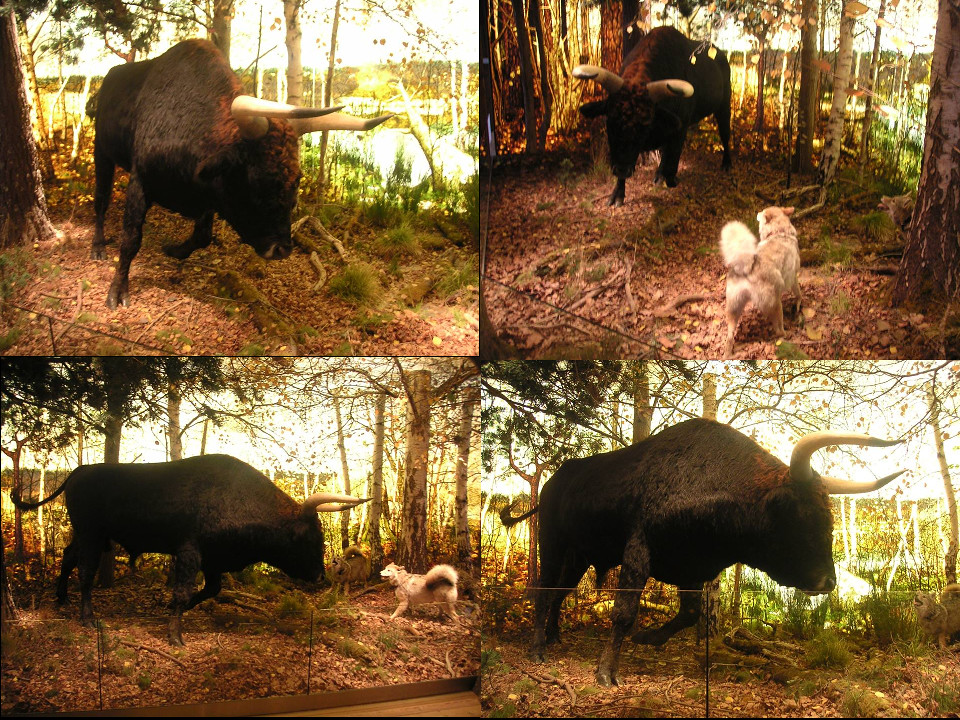
This reconstruction is awesome. The hump could be more pronounced, but still awesome. Its coat is longer and rougher than in typical domestic cattle, the forelocks are prominent, the proportions as much as head and horns are correct. Maybe not easily visible, it has a reddish dorsal stripe. And the posture is dynamic and lively. Someone has done a really, really good job here! I'd love to see this great piece of work in real, it would give a good impression of what an aurochs would look like if you'd encounter it on a forest edge during fall. 

The last skeleton I present here is the famous Vig specimen: 
Markus took more than those four shots of course, and some of them already are on the internet. This specimen is remarkable for 1) its size, 2) the visible spear-caused damages (the Prejlerup bull has such as well). More on that specimen in a later post. I only want to give away that Markus provided me with a photo that enabled me to calculate the size of this specimen by using the platform from which I extrapolated the projection point and used a person with a known size of 192 cm as reference. It resulted that the skeleton should be 182 cm tall at the end of the processi spinosi. 

The last photo shows a number of ornamented horn sheaths at the Livrustkammaren in Stockholm: 
Each royal family in Europe has drinking horns, and some colleges, universities and museums do so as well. Ornamented horns are not necessarily of the aurochs - bison horns were used as well, or those of domestic cattle -, but I think that these horns or at least most of them are of aurochs for sure. Curvature, thickness, size and colour fit. I was told that they are not extremely large, but late aurochs had ever smaller horns due to anthropogenic influence such as environment limitation or trophy hunt. But of course it is possible that some drinking horns out there may actually be from domestic cattle with a very similar horn shape. 

Ecoland cattle

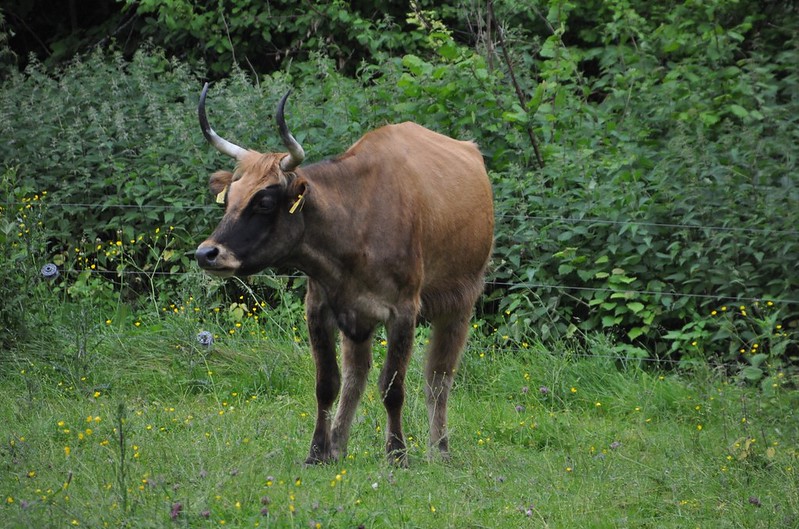
Ecolanders or Ecoland cattle are crossbreeds of Heck cattle and Scottish Highland, or actually Heck cattle with Highland influx. According to the ABU's guide "Wilde Weiden" it was the idea by the Dutch conservation group Ecoplan Natuurontwikkeling to cross Heck and Highland cattle in order to create a breed that is as calm and relaxed as Highland cattle, but with a shorter and wild type-coloured coat, to use them in reserves that are open to visitors and educational courses. 
You can see some of the results, from a herd at Kempen~Broek, on Geer vanne Smeed's blog: 
http://weertnatuur.blogspot.nl/2013/01/taurossen-wijffelterbroek-krijgen-hapje.html
...and flickR stream: 15765434216_8915f58a0d_o.jpg
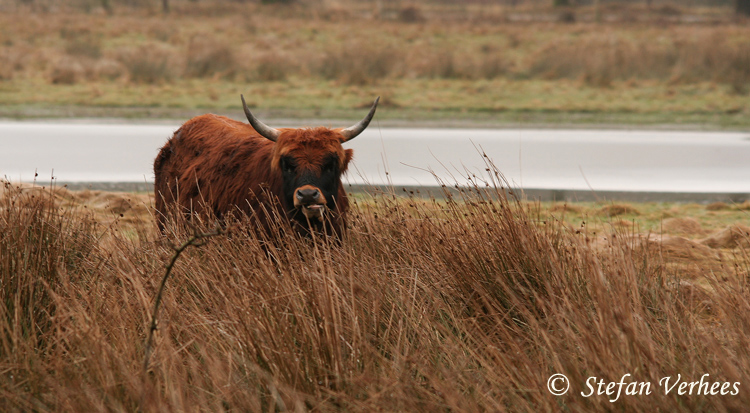
And there is another interesting photo taken by Stefan Verhees: 
http://stefanverhees.weebly.com/uploads/1/0/9/9/10990948/7560259_orig.jpg

As you see, many of those Ecoland cattle are hardly distinguishable from usual Heck cattle, for the simple reason that Highland cattle is one of the important founding breeds. Just look at the photo of the bull in the second link. But in some of the cows, you see the traces of the recent Highland influx. For example, the trunk is heavier than it already is, some have a rather short snout and small head (third link), their coat is shaggier than usual and some also have a shiny red base colour. Why I think this shiny red is a Highland legacy, although Highlands have a completely different colour? The colour is actually not as different as it seems: Highland cattle have many different colour variants, and those with that shiny, uniform red/orangish coat do, of course, not display wild-type colour - but thats merely due to the fact that they have the e-allele on their extension locus, which disables the expression of eumelanin (black and dark brown pigment) in their coat and mucous membranes. Therefore I think that if you combined that allele that causes the rich production of phaeomelanin (red pigment), perhaps the agouti locus that otherwise causes grayish shades, with the E+ of Heck cattle, you'd achieve that shiny wildtype colour displayed by these Ecolanders. Maybe some future Tauros cattle will do as well. 

EDIT: I just was told by Henri Kerkdijk-Otten that these cattle called Ecolanders at Kempen~Broek are in fact usual Heck cattle, what should explain their similarity to usual Heck cattle that I described above (*oops*). 


Happy Holidays!


And me of course! Relax and enjoy the holidays, my dear readers! I'll use the leisure to do some more posts and update this blog a bit. Next posts will include a lot of photos of original aurochs material, the "Ecolanders" with their crappy name and other topics. 

Monday, 22 December 2014

Magnificent Sayaguesa in the Veluwe

There is a herd of Sayaguesa grazing in the Planken Wambuis, part of the Veluwe in Gelderland, Netherlands, that I mentioned on this times several times already. It is a really beautiful herd, and their looks are particularly good. 
In the comment sections of an earlier post, I was provided with a link to a video showing the herd. I really enjoyed it - their proportions are aurochs-like, the heads are elongated and the bulls are well-built. The horns are not bad, in some cows they actually face slightly inwards. 
The ABU got their latest Sayaguesa from there. What is also nice is that their sexual dichromatism is not as reduced as in many other Sayaguesa herds - as you see, many of the cows have brown shades on their trunk and do not have the sold black of the bulls. At 0:39 you see a cow with a light-brown coat, but I don't it is a pure Sayaguesa. It actually looks like a young Limia to me. 


I like the bulls in particular. They resemble the Taurus bull Lamarck from the Lippeaue a lot (which is not surprising since that one is half-Sayaguesa). If those cattle were the product of a "breeding-back" program, I'd probably yell joyfully how aurochs-like they are. The Sayaguesa at the Veluwe once again confirm my view that this breed is probably the most useful one currently used in "breeding-back" attempts. You get good proportions, size , skull, body shape and acceptable horns all in one. If their sexual dichromatism had the desired level, they would look really a lot like the aurochs already (and there are still red Sayaguesa cows). 

As far as I know the managers of the Veluwe herd do not have intentions to breed them for a more aurochs-like apparence. But it would be well-suited. Adding larger horns with a slightly better curvature and more size and slenderness would result in pretty complete aurochs imitations. I would use Chianina and well-horned Heck cattle, therefore creating something like "Taurus cattle 2.0". Why? Both are easily available, and Chianina is certainly the best choice for adding size and slenderness (and some of them even have good horn shapes). The only breed that has as large and useful horns as well-horned Heck cattle are Watussi, and Heck cattle are certainly better adapted to cold climate and they have a way better colour and no fleshy hump and that huge dewlap. 


Next post: A collection of photos of a lot of aurochs material by Markus Bühler. 


Friday, 19 December 2014

I am not so optimistic anymore


When I just got into researching on the Tauros Project, I was really optimistic, almost euphoric, of what might be expected from the breeding results of the projects on a short- and middle-term scale. One of the reasons was that there were only few photos of their animals available, showing only a small number of their cattle, and these individuals usually were quite good. My expectation was that the Tauros Project would surpass the best Heck cattle within a few generations, also because their first crosses looked promising at young age.
But now, having seen photos of a larger number of Tauros-owned cattle, I am not so optimistic anymore about the herds in Keent and Kempen~Broek. The reason for that is that many of the animals did not prove as aurochs-like as I wished them to be: not all the Maremmana, especially the bulls, are as long-legged, long-snouted and well-built as I hoped, and even their horns are sometimes smaller than the goal, making it hard to compensate the small horns of other breeds used; the horn shape of many of the Sayaguesa, Limia and Pajuna is not very useful (in some other individuals however it is); some of the Sayaguesa x Tudanca and at least one Sayaguesa bear white spots at the ventral side of their body; in general the size of the cattle is disappointing – I neither know metric data nor did I see them in real, but photos and videos showing them next to Highland cattle tell me that most of them can’t be that big. The two crossbred bulls they presented so far, Manolo Uno (Maremmana x Pajuna) and Rocky (Maremmana x Limia), did not develop as aurochs-like as they promised when younger as well, but a first-generation animal is not very important to be fair.
For photos of the cattle, go here:

In general there is too much Highland cattle, in my opinion. Their small size, the stubby and short-legged body and the compressed head are very problematic features, as they are not as easy to breed against as are coat colours, which are controlled by only few genes. Especially when the other breeds, as outlined above, are not as tall, well-proportioned, long-snouted and large as hoped. The current Highland cross animals look like old Heck cattle, which is what I expected and I fear that won’t be that easy to breed away.
  
It does not sound fair when a breeding program is judged by their very first animals. But we should not forget that it is the traits that are present in the population that matter, and their frequency, and therefore I do not think that the Dutch Tauros herd will have superiour animals in the near future. But of course they have some very nice animals as well, such as a number of good Sayaguesa cows and a beautiful Limia bull. I expect that Tauros cattle to be very similar to Taurus cattle overall.


Geer vanne Smeed's Photos

In a number of posts I used Geer vanne Smeed's photos (visit his blog at www.weertnatuur.blogspot.com) of Dutch Tauros and Heck cattle, and forgot to give him credits - so I make good for that now. For an overview of his blogposts on the Tauros herd and neighbouring Heck cattle at Kempen~Broek go here: http://weertnatuur.blogspot.nl/search/label/tauros and for the flickR stream here: https://www.flickr.com/photos/64186785@N06/sets/72157648874564947/
Quite frankly I am jealous that I don't live there and can't visit those cattle to take such good photos as often. 

I used his photos in the following posts: 
http://breedingback.blogspot.co.at/2014/08/new-photos-from-kempenbroek.html
http://breedingback.blogspot.co.at/2014/03/tudanca-grey-numerous-and-beautiful.html
http://breedingback.blogspot.co.at/2014/02/heck-cattle-outside-germany-pt-ii.html?showComment=1418642001454

I have to thank Geer vanne Smeed for being the only person who provides us with an extensive collection of qualitative photos of the Tauros cattle, as the project itself does not have the time for that. Also, thanks to him I know photos of the so-called "Ecolanders" (what a shitty name), which are Heck cattle with recent Highland-influx. More on those on a later post. 


Tuesday, 11 November 2014

Sayaguesa bulls arrived at Velebit

The Croatian Velebit is home to a herd of Boskarin cows owned by the Tauros Project. Boskarin are cattle of the Steppe-type, with influence of Podolica, Maremmana and Chianina. They lack, typically for the Steppe-type cattle group, the red pigment in their coat colour, have horns varying in size from medium- to large-sized, are upright and varying curvature (tending to the lyre-shaped type of Gray cattle). The skull seems to be either longish or "normal", but not paedomorphic. I am basing my description of their looks on the photos on the web. 

Sayaguesa will add the necessary amount of red (and black) pigment, and also turn the horns forwards. The long snout of Sayaguesa is positive as well of course. Perhaps there will be some nicely aurochs-like individuals in the second generation (first-generation animals might look good too, but these are genetically irrelevant). Second generation means that we will have to wait for about 3 years until they are born (roughly one year until the first generation is born, depending on when the bull first covers the cows), plus another 2 years until - at the earliest - the first young cows are ready to be inseminated by the bulls. Then, another 9 months pregnancy + 2 years at least until you can get an idea how the crossbreeds will work work out. This makes eight years, so we will have to be patient. 

Sunday, 9 November 2014

Female aurochs in different colours

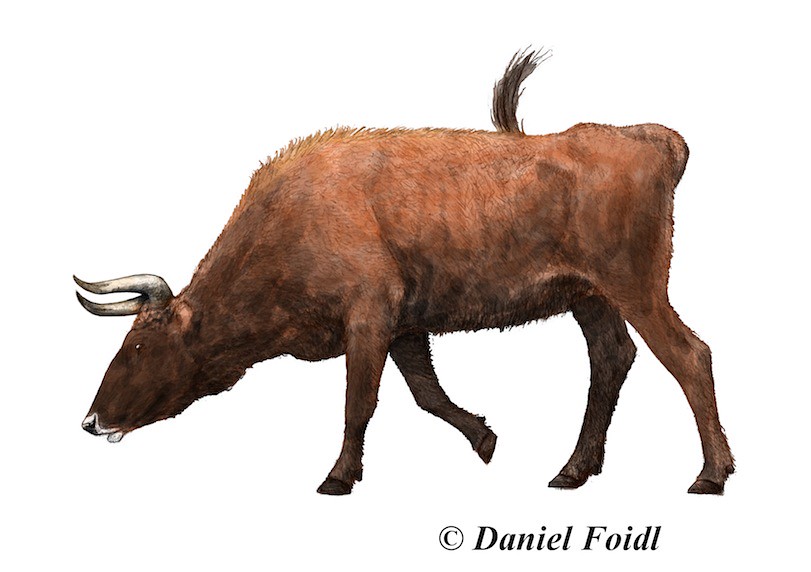
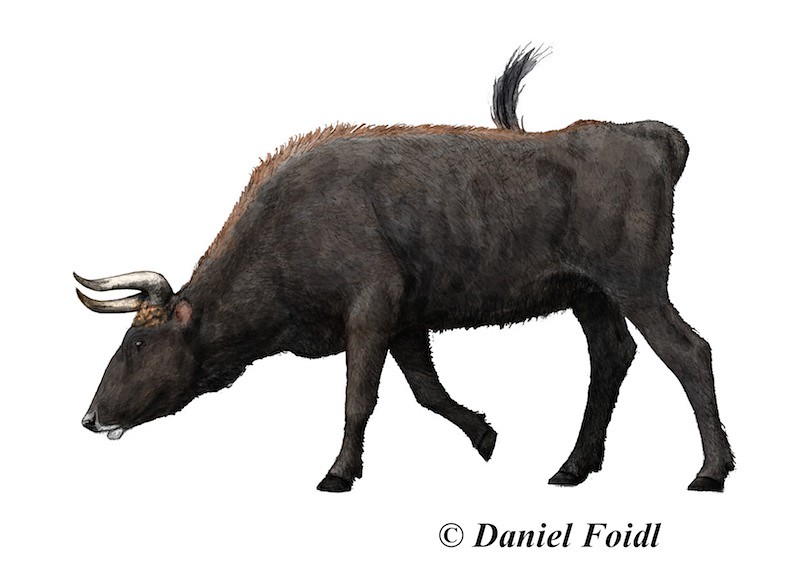
In my post "Female Aurochs remastered" I revised my previous reconstruction of the Sassenberg specimen, which I now believe was too slender and lanky. The new result looks more credible and natural to me. I did the new reconstruction in a dark chestnut brown coat colour like that of many Maronesa and Heck cows, which also appreciates Schneeberger's description from the 16th century. 
Now I did this cow in two other aurochs cow colours. One of them being the shiny orange-red at the trunk that gets darker towards neck, head and legs, and the other one is simply a black bull colour - we know that such cows existed. 


Two "new" bulls from the Lippaue

My last post here as been long ago, I apologize. The times are very busy and my motivation was, honestly, meager... Nevertheless, I decided to present two photos of Taurus bulls at the Lippaue that I haven't covered here yet in great detail. I was provided with the photos by Matthias Scharf from the ABU. 

This bull is called "Linnet". It is half-Sayaguesa and half a mix of Sayaguesa, Chianina and Heck. In summ he is 75% Sayaguesa. Unfortunately his trunk seems to be a bit long for an advanced Taurus bull, but I like his muscular stature. Unfortunately he has a colour saddle. The horns are thick at the base and nicely curved, but they "stop to early", their tips would have to continue to grow in order to reach the right curvature. 

This is a nameless son of Lamarck and this cow. Both are Sayaguesa x (Chianina x Heck) and fullblood siblings. Consequently, this son is a true F2 in the strict genetic sense and there is a chance that more the good features he has are homozygous than in its parents, respectively. Of course his two good-looking parents would also produce less good-looking animals. I really like this young bull - colour, horn size, hump and skull shape are very good. The horn curvature could be better, but I like the horns overall. Based on this photo I can't really judge its proportions. I was told that he isn't large unfortunately. He is a breeding bull at the moment. 

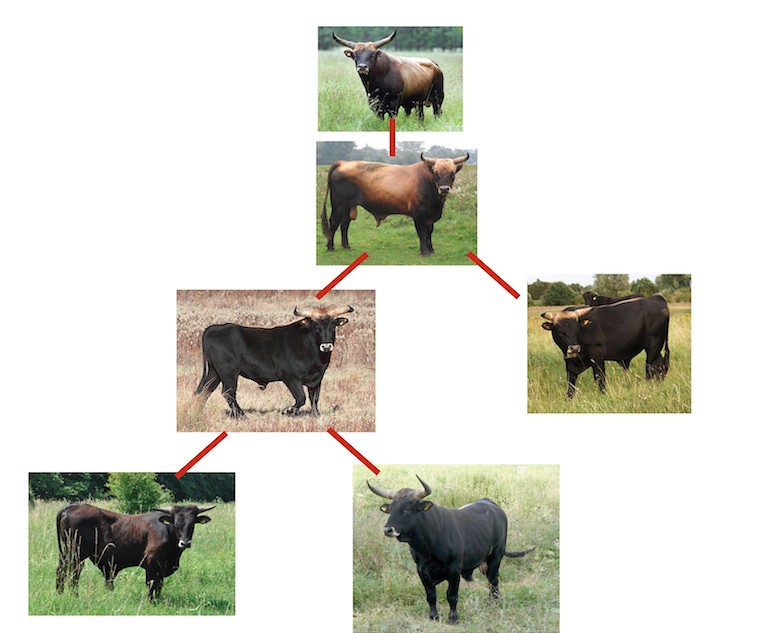
Here is the genealogy of his ancestors and relatives. The bull at the top is a fullblood Heck called Lancelot, from the Neandertal. Its son Luca is half-Chianina. With a Sayaguesa cow (I assume it is the same mother, but there always were several Sayaguesa cows in the reserve) he produced the bulls in the middle, one of them being Lamarck. I don't know the full ancestry of Lamarcks son on the left, but I think it has much Sayaguesa in it. 

Sunday, 5 October 2014

So many blog ideas, so little time

I am really busy with my studies at the moment and that won't change for a long time, that's why the quantity and quality of my posts here decreased significantly during the last months. So it is not a lack of inspiration... in fact I have a lot of ideas of things to write about. For example, I did way too less on the phylogeny/genetics of cattle and aurochs. Also, I have been planning to discuss the question whether Europe was a wholly forested or open habitat without human influence, or the Pleistocene extinctions. I want to do more species diversification as well, including also other extinct animals that are not necessarily connected to "breeding-back". I am also working on a list of locations where Wisent live in feral or semi-feral conditions, and planning at least one post on bison-cattle hybridization. And the African and Indian aurochs deserve more attention here. I have been planning life restorations of both for a long time now and never got to it. I also want to finally finish my dedomestication series, but I simply do not have the time for it (apart from that, the lack of empirical basis on this issue is demotivating as well). There's a number of short posts on my list as well, such as whether the aurochs had a "mane" or not (if you wonder what that is supposed to mean, stay tuned), breeding-back with other domestic species as a "test", an overview and personal review of the existing Aurochs projects, a list of extinct species that I think could possibly be cloned et cetera. And, of course, updates and news from projects or other issues. For example, there was something going on with the Taurus bulls at Lippeaue that is worth to be mentioned here. 

By the way, I am very happy to see that I still have 150-300 clicks on average per day. Thanks to my readers! 

Sunday, 14 September 2014

Female aurochs remastered

I was thinking about my reconstructions of aurochs females lately and found that I was reconstructing them too slim when I look at the skeletons. There seemingly are not as many mounted female aurochs skeletons as there are bulls (why? is there a fossil sex bias, or are they not mounted as often because they are less impressive? Both explanations don't sound credible to me), so I always have to use the cow skeletons from/at Sassenberg and Cambridge. I had a look at the skeletons recently and realized that my previous reconstructions are too slim. The ribcage of the skeletons is deeper and the leg bones probably indicate more massive limbs. Apart from that, I think I exaggerated the slenderness of the abdomen. I used young Lidia cows as a comparison, but looking at the original skeletons, female Gaurs and Bantengs but also Wisents, I now think the abdomen should be heavier. 
Both these reconstructions show the Sassenberg specimen (the horn tips in the lower restoration do not curve correctly inwards by the way). 
A while ago I edited the abdomen of both my cow and bull model on the photos showing them in profile, and they immediately looked more natural. But I still felt the cow wasn't entirely correct, especially when considering that the Cambridge specimen is a bit heavier than the one from Sassenberg. So I did a new reconstruction, again based directly on tracking out the original skeleton. This time I also decided not to show the animal in a short and shiny summer coat like I always did before, but in a shaggier coat that cattle have during fall before developing a full winter fur coat. I gave it a chestnut-brown colour comparable to deer, which is one way to interpret Schneeberger's text and also what Cis van Vuure considers a likely colour for female aurochs. As a template for that colour I used Maronesa and Heck cattle cows of the Wörth lineage. I also made the colour a little bit duller and darker, because cattle fur is darker during winter than during summer (more on that in a future post). This is the result: 
I am very happy with the result. The animal looks much more credible and natural than in my previous reconstructions and also better fits the original skeleton. It is also satisfying that the discrepancy between the build of female aurochs and the cows of many of the primitive breeds seems to be not as big as I previously assumed. The trunk of Chianina, on the other hand, is not nearly as deep (see here, for example). This bears the risk of some crossbreeds to have an actually too slender thorax. 

One reason why I chose the darker brown colour for this individual is that I think it is a credible and suitable colour for Central European landscape. Just look at Wisents and Red deer. This colour also is present in the fall-winter coat of a lot of Heck cattle at Oostvaardersplassen, and they seem very well camouflaged: 
However, the reddish-brown or even orangish-brown colour shades as much as those cows with a nearly totally black colour and a reddish saddle definitely existed, as we know trough cave paintings and the fact that those colours are very widespread among primitive cattle. I am going to do differently coloured versions of my reconstruction above when I have the time for it. 

By the way, the Sassenberg individual was not small-horned as it might look at this drawing. The horns just look that way in profile view, as their width is not visible at this perspective. 

Monday, 1 September 2014

Inbreeding as an option to fixate aurochs traits?

Inbreeding or line breeding is common in animal breeding and basically is reproduction within a small population of closely related individuals reducing genetic diversity. It causes homozygosity and bears the risk of deleterious recessive alleles becoming fixed, reducing the biological fitness of the population and causing an inbreeding depression. But homozygosity also creates a uniform phenotype and therefore might be a method to create a more or less homogeneous, aurochs-like cattle population. In this post I am going to outline a little thought experiment I came up with about a week or so ago. 

The Heck cattle herd on Insel Wörth, Bavaria, is the only closed line within Heck cattle to date. The herd is experiencing inbreeding since the 1980s, since no cattle from other locations were included and consequently all herd members are closely related. Large, thick and well-curved horns are very common in the herd, and many individuals have a similar colour. But there are deviant examples as well, such as cows that are light-brown or reddish with almost no dark areas on head and neck, or with small and thin horns. There currently is one bull with rather steppe cattle-like horns on the island, and there was another cow with a rather straight horn curvature. Bulls with a greyish-beige saddle apparently appear regularly, I would say perhaps 50%, and I was told that the inheritance of horn sizes within the herd works by chance: very large-horned parents sometimes give birth to thin-horned individuals and vice versa. 
Why is the Wörth herd still not stable although it is a closed inbred line? 
Why do such small-horned, tan-coloured cows still appear in the Wörth lineage?
I thought about this and, as an amateur in genetics, came up with the idea that it might be back-crossing with heterozygous parents might be the key factor that made inbreeding inefficient in this herd. Back-crossing with a heterozygous parent makes little sense to me as there is a 0,5 probability that the parent passes on the undesired allele again, what, assuming that the offspring it was mated into is heterozygous as well, does not change anything, or, assuming that the offspring is homozygous, might even produce a heterozygous calf again and therefore make a step backwards. As a result, as far as I understand, a heterozygous individual cannot stabilize a herd, no matter how often it is mated to its offspring again. A homozygous bull, on the other hand, would of course. I think this might be true of "qualitative" traits that are controlled by few loci such as coat colour as much as "quantitative" traits that are controlled by many loci (and environment which we assume to be stable here) such as body size. 
True inbreeding lines created in the laboratory with rats, mice and other model organisms have a homozygosity level of roughly 99%. The important difference in this kind of inbreeding is that exclusively siblings are mated to each other. The rule of thumb is that at least 20 generations are needed to achieve this high level. The time span to do the same with cattle would be endless, but 99% is surely much beyond the extent of homozygosity that is needed for a optically more or less homogeneous aurochs-like breed. 

But it inspired me for thinking about sibling-matings as an option speed up the process of stabilizing the "breeding-back" results. I would start with a P-generation herd that is composed of bulls of one suited breed and cows of another breed that complement each other in terms of aurochs resemblance (or, alternatively, good-looking individuals of existing "breeding back" projects/breeds, wich would have a less predictable offspring on the other hand). The offspring they produce would form a new F1 herd with calf that have a more or less similar appearance to each other (except you work with very heterozygous parents like the already existing "breeding-back" cattle). They would be mated to each other and then a F2 herd would be created (by the way, the P and F1 would still exist and produce offspring, which would be consistently moved to the existing F1 and F2 herds etc.), and this generation would show a more or less continuous spectrum of the traits present in both breeds. Now, strong selection is ready to start. That scheme should be carried out until a herd is formed of which one can be sure that the individuals are sufficiently homogeneous, externally and genetically. I would then choose the best bull, fuse all the herds and remove all the other bulls. Using such a bull which would be mostly homozygous for the desired traits would then stabilize and improve the whole herd and create a larger, sufficiently homogeneous and stable line of aurochs-like cattle that can be used to improve other herds of any chosen breed/project. 
If this concept worked, there still would be some problems. First of all, one would need a lot of place for all those herds - like usual the larger the herds the better it is - and therefore also a lot of money. And of course there will be some animals that suffer from inbreeding depression and have to be selected out. This is called "purging", which is common in laboratory line breeding and also saved the highly inbred Chillingham cattle from extinction. The number of animals that would not be used for further breeding would be quite high, depending on how the strong the selection would be. They could be sold for meat production or to other breeders, as long as the looks of those cattle is appealing to them.
Surely the amount of inbreeding would be high for such a lineage, especially when using only two founder animals as suggested above (personally, I would use a good Wörth-Heck cow with large horns and a very large, slender and well-shaped bull, perhaps one of these "Maltese Oxen").  Probably most people would fear that selecting only against deleterious alleles and only for aurochs-like looks would reduce the hardiness or resistance to diseases. I don't really worry about the hardiness of the cattle, as all aurochs-like cattle seem to be very hardy. However, the resistance against diseases might get reduced due to genetic drift if the other breed is not as resistant against one particular disease than the other. But as described above, my purpose is not to create only one closed line that looks as aurochs-like as possible, but to use animals of such a very stable line to increase the similarity with the aurochs of other aurochs projects, or simply breeds of interest, as a whole. Apart from that, there could be other, parallele projects doing the same but using other breeds, and uniting those stable lines would increase the gene pool. Using homozygous breeding bulls (but also cows of course), will speed up the fixation of the desirable features for any project or breeder who wants to have very aurochs-like cattle without having deviant traits appearing regularly. 

I think the traditional scheme of just crossing and selecting the best-looking animals and selecting out the bad-looking ones is not very effective or at least takes a lot of time. Especially quantitative traits such as horn size or body size show only a slow response to selection (see here, for example).  Whether or not such a concept is practically feasible or effective, or if any of the existing projects/breeders would be interested to try it, it is a nice little thought experiment of mine as being a total amateur in genetics. If there is anything incorrect or imprecise in this text, or if the idea is flawed by any technical reasons, I would be pleased if somebody more knowledgable would point it out to me. 

Saturday, 23 August 2014

New photos from Kempen~Broek

Ok, new is not entirely correct as these photos were published at weertnatuur.blogspot.com in february this year (check out that blog, it has a lot of interesting photos and posts). But I think they might be new to a lot of people, so I post them here. 

Kempen~Broek is, as far as I understand based on the information I have, home to a number of Tauros herds. Visit Theo van der Heijden's youtube channel for some high-quality videos from Kempen~Broek. The photos below show a herd of Maremmana cows covered by a young Maronesa bull and a herd of Limia cows (at least) covered by a Maremmana bull.  
I don't know the identity of the young bull at the left of the uppermost photo, but it is surely not the son of the young Maronesa bull. To be honest, the bulls actually look disappointing to me. The Maronesa's horns probably will continue to grow and the hump might develop a little more, but he will still be rather stubby - additionally to the undesired Maronesa features that were to be expected, the short face and small size. I am looking forward to see the crossbreeds with Maremmana. Some individuals might be slenderer and have better proportions, and a horn orientation intermediate between Maremmana and Maronesa would be the right angle, but I don't expect large animals to arise from that combination.
The Maremmana bull is really longish and the legs are short, he has the proportions and body shape of a Heck bull. I would be surprised if this bull reaches 150 cm at the withers because of the Limia cow next to him. The horn size is ok, but considering that he will produce offspring with Limia and Pajuna cows and subsequently with those crossbreeds, it will probably take its time until the horn size of the whole herd has reached the desired level. The skull is definitely to short, but at least not as compressed as in Maronesa. I used to think that large size, good body proportions and shape, large horns and a long snout are precious Maremmana characteristics, but after all the photos and videos I recently saw I start to doubt that. 
All in all I think that it would be too optimistic to expect TaurOs cattle that surpass current Taurus cattle within the next ten or more years, because both breeds/projects have their pro's and con's and, in sum, many of the founding individuals of the Tauros Project look as good as many current Taurus cattle (watch this promotion video, you see a lot of very nice animals there). But I fear it won't be easy for TaurOs to achieve traits like really large size and sufficiently large horns without having breeds that have these traits in a very prominent way (like Chianina for size, or Watussi or large-horned Heck cattle for the horns). 

The fact that a number of the founding individuals in TaurOs disappointed me is not meant as a critique, that would be unfair. I know it is very difficult to track down the best individuals and if you find them you still have to hope they are for sale and then try to export them. It's not easy, so it is not surprising that some individuals used in an aurochs projects do not have all the desirable features present in their breed.