Wednesday, 1 July 2015

The European water buffalo / water buffalo in Europe


During the Pleistocene and probably also until the antiquary, Europe was not inhabited by only two species of bovine – aurochs and wisent – but three. This third bovine was Bubalus murrensis, an indigenous species of water buffalo. It is extinct and left no living descendants. Nowadays, due to the European rewilding movement, the genus Bubalus has gained some interest for landscape conservationists and “rewilders”. It is important to distinguish between living European variants of the domestic water buffalo, descending from the Asiatic Bubalus arnee, and the indigenous species B. murrensis.
Are water buffalos a perspective for conservation in Europe, and are they further a legitimate megafauna species on this continent?

Bubalus murrensis – the true European water buffalo

B. murrensis was part of a clade within Bubalus that is now extinct and that was different from B. arnee. Since the postcranial skeleton of large bovines are all very similar, most material assigned to that species are skulls.  
It was part of the interglacial fauna, like the aurochs and unlike steppe bison and mammoth. It seemingly disappeared at the end of the Pleistocene or early Holocene. There is sparse Neolithic postcranial material from the East of Austria that have been tentatively assigned to Bubalus by Pucher 1991 [1]. About three years ago, I had email conversation with Erich Pucher about his findings, and he told me that the assignment to Bubalus was on weak ground and he would reclassify them as Bos nowadays. I do not know of more Holocene material that might or might not be remains of B. murrensis, although there is the chance that a number of postcranial elements were erroneously assigned to Bos or Bison

B. murrensis cranium at the left; others are Russian Bubalus sp. specimen.
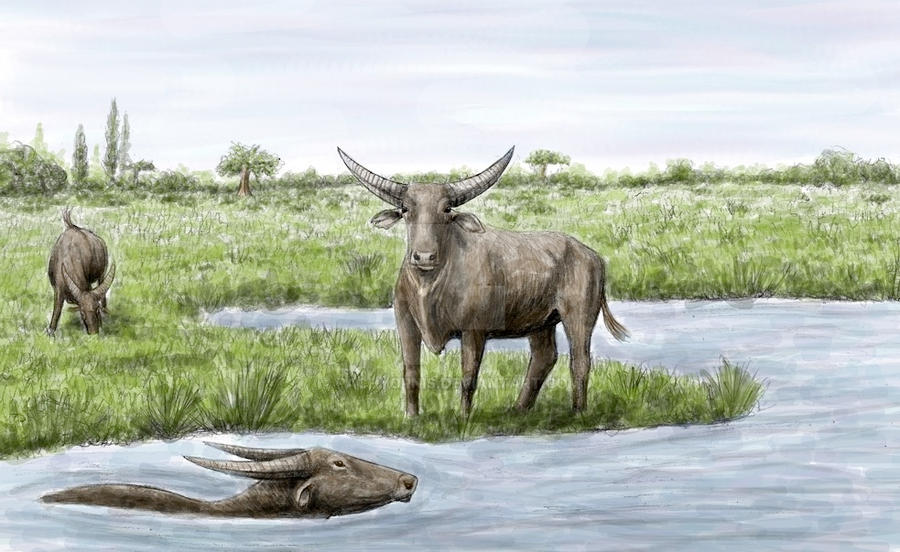
I composed a picture showing a number of buffalo specimen that are extinct species of Bubalus. The only one I know for sure to be murrensis from Germany is the one at the top left, provided by Markus Bühler. The other ones are buffalo skeletons that I found on Russian websites, perhaps they are Asiatic relatives that might provide some clue how their European pendant looked like. The European water buffalo had horns that resembled those of the smaller tamaraw (B. mindorensis) more than the Asiatic water buffalo in that they were oriented more backwards and were not as strongly curved, and their horns probably lacked an upwards curve. Other than that, the rest of the animal might have been quite alike its relatives as bovines do not vary that much in that respect… At the right at the top there is a beautiful life restoration of B. murrensis.
It lived near freshwater habitats just like other members of this genus, many of the remains assigned to this species are from the Netherlands and Germany. A lot of evidence for its presence was found in the Rhone valley, which also was home to the hippopotamus during the Eem interglacial. Bioindicator species suggest that this region was a mosaic of open grassland and forested areas [2]. Due to the sparse palaeontological information we do not know much about its ecology and behaviour. I think it is sound to assume that it was ecologically very similar to its two living relatives, feeding on grasses and water- and swamp plants on watersides of their wetland habitats. We have no clue how gregarious they were. Tamaraw are mostly solitary, while Asiatic water buffalos roam in groups of up to 30 individuals, similar to aurochs/cattle. Probably they were more similar to the latter. I wonder how common they were. There seem to be only very few artistic references to this species in prehistoric art – I only know of petroglyphs from the French cave of Bourdeilles dating back 18.000 years ago that are often believed to show aurochs but I think they more likely depict buffalo because of the horn and head shape. The rarity of artistic references might implicate that B. murrensis was not an important animal in the world of the paleolithic people, perhaps it was a comparably rare animal. But this is speculation. Since it seemingly was not illustrated on coloured cave paintings, we have no idea of its coat colour. Since tamaraw, some domestic and wild Asiatic buffalo have the same “markings” in the form of white areas on their upper lips (something like a very reduced version of the “mealy mouth” in cattle), sometimes also a white tail tip and a crescent-like streak on the ventral side of their neck (I don’t know if there is a particular name for it, call it “neckband”), these markings might have been present in the European water buffalo as well. The rest of the coat colour might have been solid, like in all the other buffalos. Of course we have no idea of the shade of its colour – it might have ranged from greyish over light brown to dark brown or black. Or perhaps it even was a totally different colour… My amateurish illustration on deviantArt shows one possibility.

Domestic buffalo in Europe

Bubalus arnee, the wild Asiatic buffalo, was domesticated about 5000 years ago (the exact time of domestication is a matter of discussion), probably in two separate events by the Indus culture and China [3]. From the Middle East, the domestic buffalo was introduced to Europe as livestock. On this continent it developed landraces that have adapted to the climate here, including a dense and effective winter coat. They can cope with temperatures below -20°C and are also resistant to European parasites. In fact they are better at living on very poor forage than cattle are. While there is a number of specific named breeds in Asia, most buffalo in Europe are of mixed, undetermined origin and there are no clearly marked breeds. I am not that keen researching all those subtypes/breeds of domestic buffalo as it is not really relevant for this post.
It is estimated that there are about 150 million domestic buffalo on this world according to Wikipedia, most of them in Asia. These include a number of feral populations in South East Asia, and also Australia. The longest history as European livestock they have in Eastern Europe, especially the Balkan and also the Carpathians. But they also become  increasingly popular in Germany where they number 2.100 animals already (2010) [4], and also the Netherlands. They can spend all year round outside without a barn or shed and supplementary feeding so some conservation projects use them as grazers just like cattle or horses. Why do they use this non-native species?
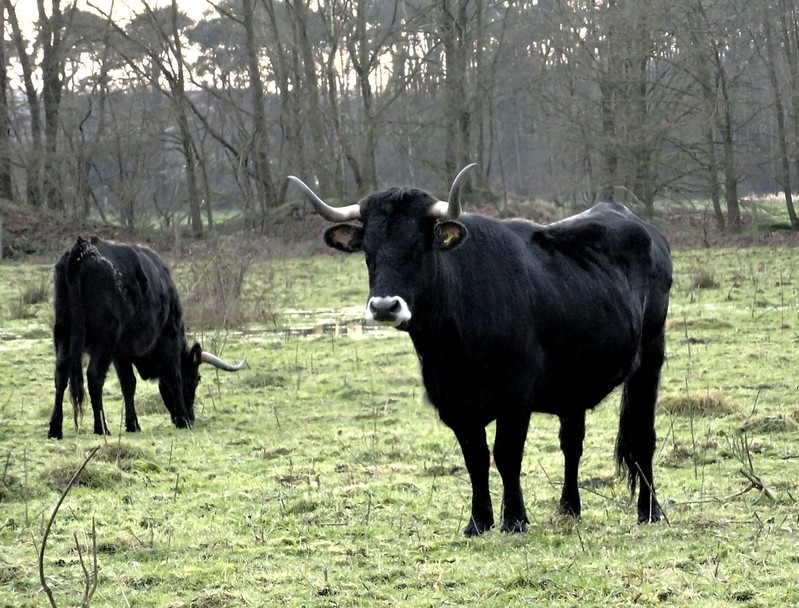
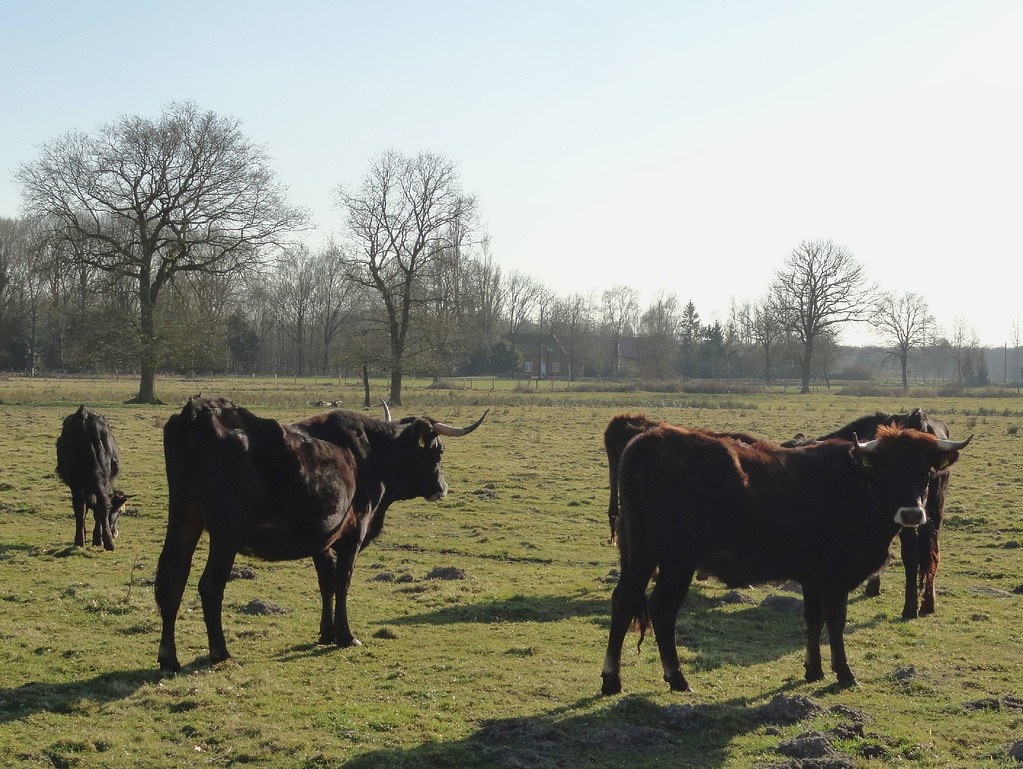
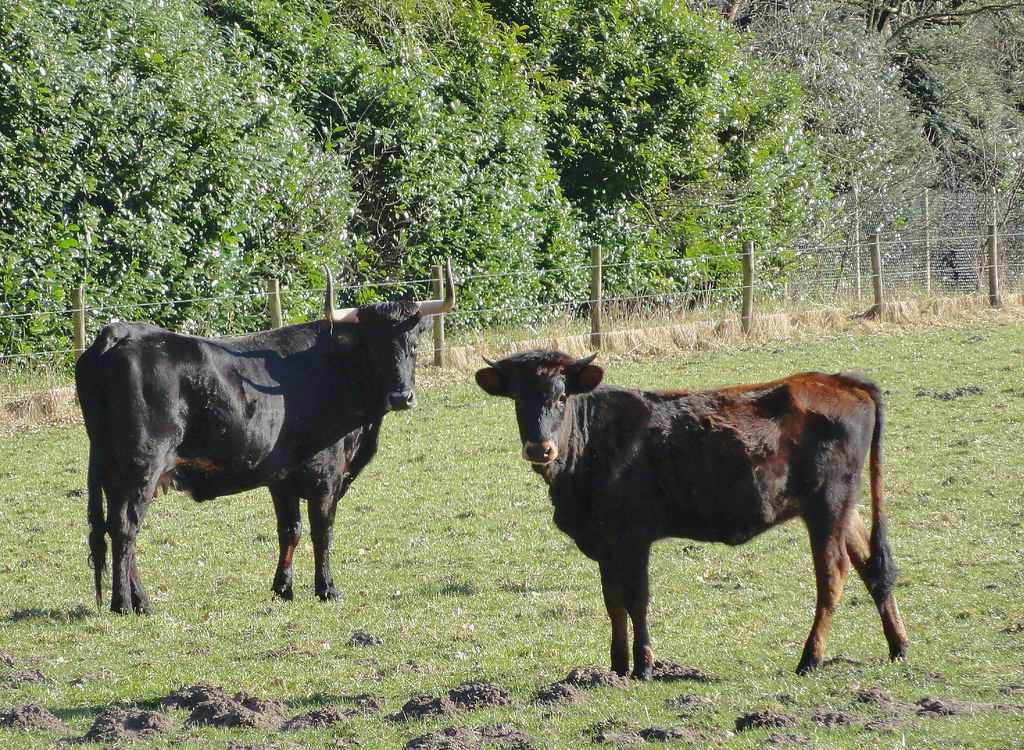
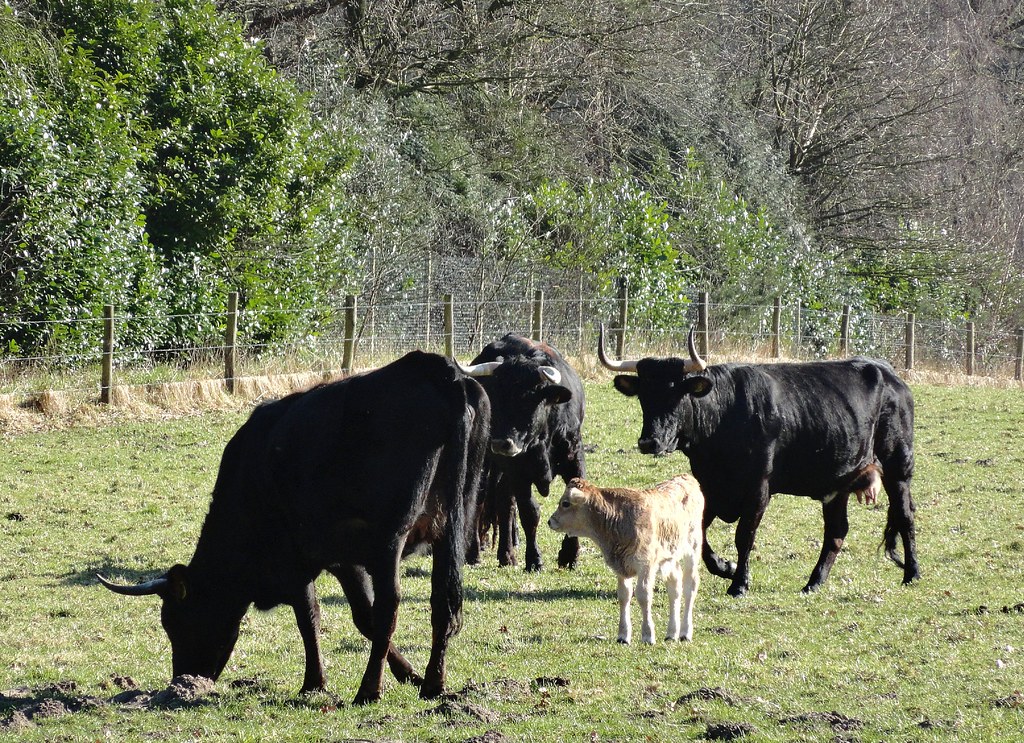
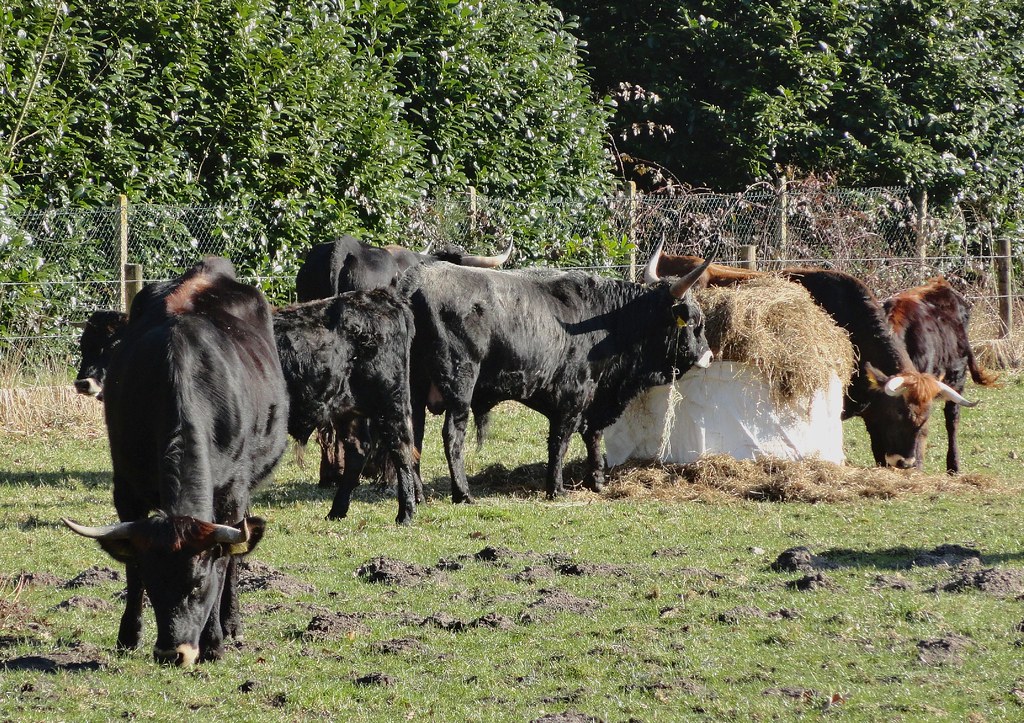
Water buffalo at the NP Neusiedler See-Seewinkel, Austria.

Water buffalo as European megafauna?

Obviously domestic water buffalo can be used in conservation projects, but in order to see whether they should be used, or even be introduced into wilderness areas, or not we should investigate the following questions:

1. What purpose do water buffalo serve in conservation projects?
2. Could this job be done by native species as well?
3. Are domestic water buffalo an adequate proxy for B. murrensis, could they even be regarded as native themselves?

Water buffalo have the same positive effect on flora and fauna diversity that other grazers have. By feeding and trampling, they create a more diverse landscape by hindering single, few species from becoming over-dominant and reducing the amount of plant and animal species present. Their organic waste is habitat and food source for many insect and decomposer species, which, on the other hand, are important for avi- and herpetofauna. But they have one advantage over cattle, horses, sheep and goats: the water buffalo has the highest affinity to wetland, both in physical and dietary respect [4, 5]. by wallowing they create small bodies of water that are important for amphibians, as they experience habitat loss even in nature reserves because of silting and drying. Especially the endangered yellow-bellied toad (which is in fact not a toad) benefits from this, but also a lot of other species as well. Cattle and particularly wild boar (as everybody knows, they wallow as well) do that too, but not to the same extent. And cattle make only limited use of wetland, as do goats and sheep. Cattle cannot digest a number of water plants in the first place [4.]. Elk have been used in wetland conservation with success, but they are browsers and do not prevent the unwanted succession of grasses [4].
That is the reason why conservationists have to artificially create these small, non-persistent waterbodies, by using trucks or even tanks (f.e. see here in the Lippeaue) [5]. No question that this is not a satisfying solution on long-term sight for reserves should be as natural as possible. Water buffalo consume wetland or water plants that none of the other species do, and are most efficient in creating small waterbodies by wallowing and trampling. So perhaps water buffalo are not only good but almost necessary for many European nature reserves and biotopes containing wetlands [4, 5].
But if that was the case, how did all this diversity survive all the millennia of the absence of Bubalus? What did amphibians and waterbirds do before we had the idea of using water buffalos or tanks in natural reserves? I think that the work of cattle/aurochs (and also other large grazers), wild boar and elk, not to forget the dynamics of natural waterbodies, were sufficient to keep up the diversity up over the Holocene. In fact, it was and is the industrialization and water management that is destroying the habitat of amphibians and other wetland dwelling species and not the loss of a keystone species several millennia ago. So in my view, the use of water buffalos is certainly beneficial, but not indispensably necessary.

Another argument raised by those who advocate an introduction of water buffalos into European nature reserves is that domestic water buffalos have a legitimation as native animals here because their genus, Bubalus, was present here until the Pleistocene extinction wave and that they would be present without human influence anyway because either B. murrensis was hunted to extinction or B. arnee would have migrated to Europe if humans would not have hindered them [6]. In my opinion, it is speculation that B. murrensis was hunted to extinction. While I am convinced that the overkill hypothesis is certainly more plausible than any other in cases such as the woolly mammoth, and that way more Pleistocene megafauna species would still be alive today without human influence, I think it is too much of a stretch to blame humans categorically for the extinction of each single species that died out around that time – a time that undoubtedly also experienced massive climatic and ecologic changes. And the poor presence of Bubalus in Pleistocene art makes me think that it probably was not a very important game species to humans. Of course it is possible that Bubalus survived longer into the Holocene but and that we did not notice that in archaeological evidence because most of the Holocene Bubalus material has been assigned to Bison and Bos. But where are the crania, or at least horn fragments? One argument is that water buffalos died out earlier than the other two bovine species because human settlements focused on large fertile deltas, the prime habitat of Bubalus. However I have no doubt that there would have still been enough space for this species to continue living into historical times and I also do not think that civilization was intense enough to prevent Bubalus arnee to migrate into the west and, in consequence, Europe.
Nevertheless, lets assume that Bubalus murrensis would have still been around in Europe without human influence and it therefore has a legitimate place in modern European nature reserves. Would domestic buffalo be an adequate proxy? I do think so. They are not the same species (the claim that B. murrensis was merely a chronospecies is, as far as I know, baseless), but ecologically and morphologically probably very similar. Despite being domestic, they are as suited as most cattle to live here in a feral state.

In the end I would say that calling Bubalus a native clade in modern Europe is far-fetched,  and regarding domestic buffalo based on very weak ground as B. arnee probably never inhabited this continent. Actually it sounds like a classic non sequitur: “I am in Innsbruck. Innsbruck is located in Austria, just like Vienna. Therefore I am in Vienna”. Nonetheless, water buffalo can live here, perhaps would without human influence or perhaps not, and they would probably do no harm if introduced here (I do not think they would be considerable competitors for other grazers) but would actually be beneficial even though probably not necessary. Imagining a wilderness area with three bovine species instead of two that all look rather different from each other is tempting and inspiring, and it would be interesting to see how these three species would interact, ecologically and physically. Therefore I would certainly have no objections against a project releasing water buffalos into a European reserve, although I think Europe can do well without them and truly native species should have priority in any case.
The public acceptance of feral water buffalo would probably be higher than the academic.

The water buffalo project of the TNF

The True Nature Foundation is currently preparing a project that aims to introduce water buffalo into a number of suited areas [7]. The plan is to build up herds of European domestic buffalo that are adapted to live here in a feral state and to inseminate them with semen of wild Asiatic buffalo in order to create a buffalo population with wild-type features but also adaption to European climate parasites and forage at the same time. Sounds like an ideal plan to me and I actually had the same idea as well. They also claim that they want to reconstruct the physical characteristics of the Bubalus murrensis, but I wonder how that should work. We have no idea of its colouration, whether it had those white markings or was solid coloured, and if in which tone (grey like Asiatic buffalo or dark brown to black like European domestic buffalo?). It is likely that it had the “standard body” of water buffalo with the same size as B. arnee, which is of course feasible to achieve but not a characteristic trait of B. murrensis. The only diagnostic optical trait of this species we know of is its horn shape, which is, as I described above, more like that of the tamaraw than of any domestic or wild Asiatic water buffalo. Therefore I suggested also using semen of tamaraw. I think it is likely that both species hybridize without restricted fertility and it would bring in the genes for a murrensis-like horn shape. Also it would add more genetic diversity and other wild-type genes. The colour of that population would be a bit of a mosaic, but by far not as heterogeneous as in a random bunch of domestic cattle.
What’s the good of trying to create optic similarity? Well, its not a functional one. Actually it is merely an emotional one, it is more satisfying when the animal that is supposed to fill the old niche of B. murrensis also resembles this species appearance, even if this resemblance is only superficial and artificial.
 
The crossbreeding that will be executed by the TNF's project. Looking forward to seeing the results.
But why using a population of hybrids instead of pure herds of wild Asiatic water buffalo? First of all, it is not sure at all that they would do well in Europe. They are from a different climatic zone with different parasites and diseases. Furthermore, and that brings as to the next point, wild Asiatic buffalos are very rare and endangered, and there are only few populations left in the wild. So I doubt that owners would give their animals to such a project introducing them into a climate and region where they are not native – and I completely agree on that. In my opinion, and probably that of most other people as well, the few true wild water buffalo should be used for conservation programs in their home range. So taking a herd of domestic buffalo and inseminating them with wild buffalo sperm is the most ideal option to me, also because the domestic buffalos are adapted to Europe already. I don’t think such a population would be unsatisfying. For once, most people would not know that a domestic water buffalo is domestic, since it does not nearly look as domestic as ordinary cattle do. Furthermore, they would inherit wild traits anyway and the herd would not be very heterogeneous.

Behaviour

We know nothing about the behaviour of B. murrensis, especially towards humans. Actually I am not fond of the issue that is always made of this aspect of the behaviour of bovines in nature, but it has to be addressed because people are concerned about that when these animals are to be released. The behaviour of wild Asiatic buffalo is described as aggressive when teased but preferring flight. So “standard” for wild bovines. Domestic buffalo are said to be very gentle and friendly in normal domestic use. But very likely their behaviour is plastic and depends on socialization just like that of cattle I guess, so their mood might change when living under semi-feral conditions. I visited the National Park Neusiedler See-Seewinkel in Burgenland, Austria, in 2013 where Hungarian Grey cattle graze together with water buffalo. The buffalo were very curious and cuddly. One of them showed threating behaviour but probably because they had calves. I never heard or read that water buffalo are problematic because of aggressive behaviour, so they probably are not any more dangerous or not-dangerous than cattle under semi-feral conditions.  
Water buffalo and cattle live together in some semi-natural reserves like in Neusiedl or Spreeaue (Germany), and there is, as far as I know, no agonistic behaviour between both species. Bos and Bubalus do not hybridize, a mating either results in no embryo or a miscarry at early stage [8], so there is no danger of intermixing. Probably not with wisent either, because Bison is way closer related to Bos than Bubalus.

Legal issues

Domestic buffalo are legally treated in almost the same way as domestic cattle. I don’t know what the situation with wild Asiatic buffalo is, since these are wild and exotic animals. It is probably also an interesting question how a hybrid population of wild and domestic buffalo will be treated… Let’s see what the TNF is going to do about that.


Literature

1. Pucher, Erich: Erstnachweis des europäischen Wildesels (Equus hydruntinus, Regalia, 1907) im Holozän Österreichs. 1991.
2. Schreiber, Dieter: Finds of Bubalus murrensis (Bovinae, Mammalia) from the Upper Rhine valley: a focus to the complex sedimentological conditions of a quaternary fluviatile system. 18th International Senckenberg Conference 2004
3. Kumar et al.: Mitochondrial DNA analyses of Indian water buffalo support a distinct genetic origin of river and swamp buffalo. 2007.
4. Wiegleb, Gerhard; Krawczynski, Rene: Biodiversity management by water buffalos in restored wetlands. 2010.
5. Stumpf, Thomas: Machbarkeitsstudie zum Einsatz von Wasserbüffeln in der Landschaftspflege im Rheinland.
6. Krawczynski, Rene: Visioning feral water buffalos for Europe.

Tuesday, 23 June 2015

Anonymous comments + Teaser

My blog has recieved almost 600 comments by now, which is awesome. I appreciate each of them and am thankful for the vivid interest in my posts!
But one thing is that a lot of commenters here write anonymous comments. That's not a problem per se, but confuses me because I don't know with how many people I am dealing with and who I wrote something already or not, with the result that I wrote the same stuff multiple times. That's a bit impractical. Therefore I would like to ask my commenters to pick a consistant name for their comments, just for me to know who I am dealing with to maintain a useful mode of communication. When posting, there is a function "Comment as" where you have a lot of options - one of them is "name/URL" where you can type just any jibberish as "name" if you prefer not to reveal your true identity. Or you could simply write your name or "name" below or above your actual text in the comment. I prefer pseudonymous over anonymous. 
But again, I appreciate each comment that I recieve and am very happy that a number of posts created a lot of fruiteful discussion. This request is just for my orient myself easier with all responses that I recieve. Thanks, folks! 

And now a little teaser: 
My next post is going to be on the European water buffalo and buffalo in Europe. I have been planning to write on that for ages, but I never got to it. 
Domestic water buffalo in the Nationalpark Neusiedlersee-Seewinkel, Austria.

Thursday, 18 June 2015

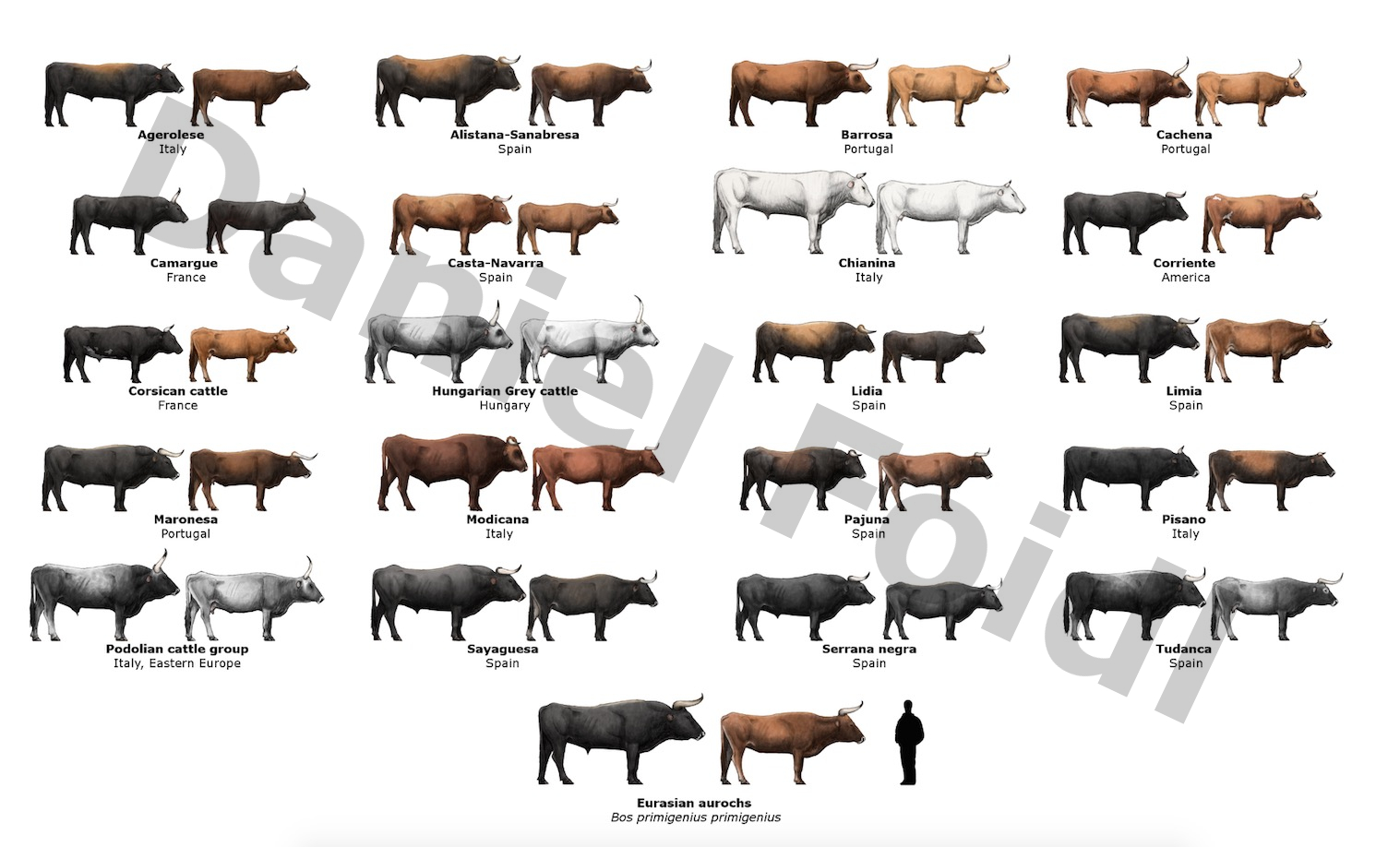
An illustration of 20 aurochs-like breeds and more


What I am going to present to you now is the work of several weeks. I am sure that a lot of my readers will know my table of a selection of aurochs-like cattle I did for Wikipedia, showing breeds used in the Tauros Project in comparison to the aurochs. However, looking at it now it is unsatisfying. Some of the drawings are anatomically imprecise and sloppy, and not always artistically convincing. Furthermore, out of laziness, some of breeds are just modified versions of the aurochs drawing at the bottom. Also, many of the drawings are “too optimistic” over proportions, body conformation or size of the respective breeds. And there is another problem since the table was originally meant to be an illustration of the Tauros breeds: Highland cattle and Tudanca are missing. So I felt I had to do a new one.


But I wanted to draw way more breeds than just the cattle used in Tauros, therefore I decided to split the images up: one table showing a selection of aurochs-like breeds in general, and one showing the breeds of Tauros. Then I had the idea to do one for the Uruz Project as well. And also my aurochs vs. Heck cattle drawing desperately needed a remake. All in all I decided to do 23 breeds plus the aurochs as a reference – both male and female, therefore 48 individuals.


I believe that one cannot make a useful distinction between “aurochs-like” and “non aurochs-like” cattle because there is a fluid continuum, therefore the level of primitiveness I chose is arbitrary. As on the original version, optics are the main criterion, otherwise I had to include feral but not that aurochs-like cattle as well. I chose to do the primitive landraces, so Heck cattle is not included, because it is a result of the first “breeding-back” attempt and therefore another story. But I did this breed as well, on the “Heck vs. aurochs” table. (I could have illustrated Taurus cattle as well, but for now this “breed” is a bunch of recent crossbreeds, many of them still half-pure, and there is a continuum to non-crossed Heck cattle, what is why I regard it as a special, advanced form of Heck cattle) This highly heterogeneous breed was a bit of a challenge, because my intention was to present average, representative individuals and there are just so many possibilities.

Actually I faced that problem in a lot of breeds. I did not want to do the “best of the best” individuals, but animals that give a balanced impression for the whole breed. However, I excluded the really ugly and derived or obviously crossed individuals from my consideration. My Limia bull has a light colour saddle, although there are Limia bulls that do not – I gave my bull a saddle not to implicate that the colour of this breed is always the same as in the aurochs. The same goes for my Lidia and Heck, although there are members of the breed with a fairly accurate aurochs colour. The same goes for horn shapes. I had to pick those traits that are prevalent, and if these are very aurochs-like but not always, I included some minor “flaws” in my drawing. Otherwise the image would be blurred.

All animals are drawn to same scale. My aurochs bull is meant to be 180cm at the shoulders, because I intended to take the Eurasian, specifically Central European, aurochs as a reference, which is usually the target of “breeding-back” projects. For some breeds, deciding for the right size was tricky, especially those which bear a lot of variation. I mainly took the Domestic Animal Diversity Information System as a reference, but also other sources and what I some breeders told me. For some breeds I was not able to find precise information, so I had to guess.


My drawings are pencil drawings that were painted with GIMP. Each individual was painted separately, but I did not do a pencil drawing for all of them: I edited the pencil drawing of the Pajuna bull and cow into Modicana, the Casta-Navarra bull is the Lidia bull with head of my Alistana-Sanabresa, both Serrena are a plumper version of the Sayaguesa, and the Tudanca cow is the Limia cow with a fitting horn shape.

Only the great table shows a human (man, about 180cm tall) for comparison, I decided not to insert a human or scale bar into the other images to not distort it.


Table of the 20 breeds:


The table shows an arbitrary selection of breeds. I could have illustrated twice or thrice as much. Texas Longhorn is not on the table because I decided so – not that some of its individuals are not as aurochs-like as Camargue or Serrana negra and so on. Serrana negra, which looks like a stockier black version of Sayaguesa, is present while Berrenda, a piebald version of Lidia, is not – arbitrary. Betizu is not included because I primarily see it as a feral breed (which are another story) that does not have a resemblance to the aurochs that is as eye-catching as in most of the other chosen breeds. Chillingham cattle is not on the list because I do not consider them aurochs-like enough, and I even do not regard them as truly feral. I did not include the ominous “Maltese ox” because there I do not have enough information on it – not even a clue on how many herds there are, I only know of one and I fear there are not many more. Some of you might wonder why I did separate illustrations for “Podolian cattle group” and Hungarian Grey. Of course the latter one is a member of the former, and there is a continuum between all the breeds of that cattle family. But I decided to do a separate drawing for Hungarian Grey because the almost completely white, bulldog-faced members of the breed are certainly rather distinct from the less derived Podolian cattle and I needed one for the Uruz table anyway. My Podolian bull and cow are a generalized type of what we find many of the less-derived Podolian strains, such as Maremmana, Italian Podolica and Boskarin.  


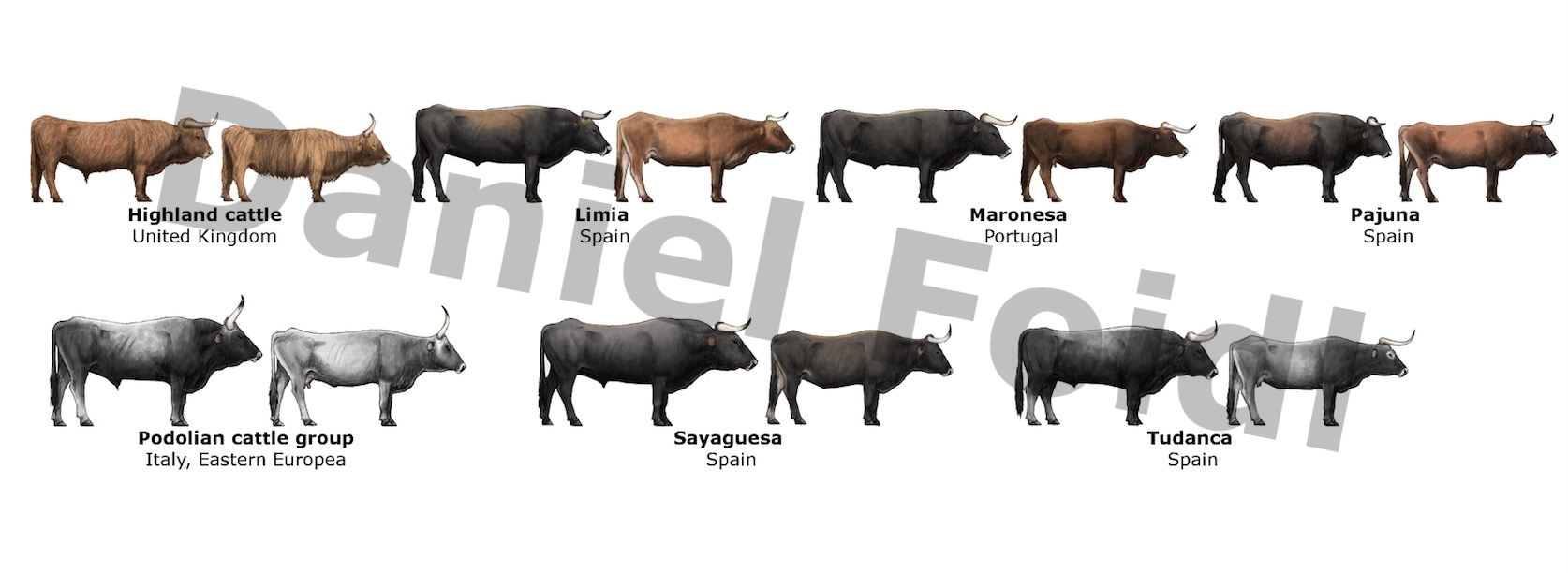
Breeds of the Tauros Project:


These are the main breeds of the Tauros Project. You might point out that one of their Sayaguesa cows is 25% Alistana-Sanabresa, but I do not consider that relevant – otherwise I would mention that breed as a founding breed for Taurus cattle as well. The “Podolian cattle” are representative of Podolica, Maremmana and Boskarin, and whatever they are going to work with from that group. From what I have heard they are also going to use local breeds in Eastern Europe, but so far there is nothing official that I know of.


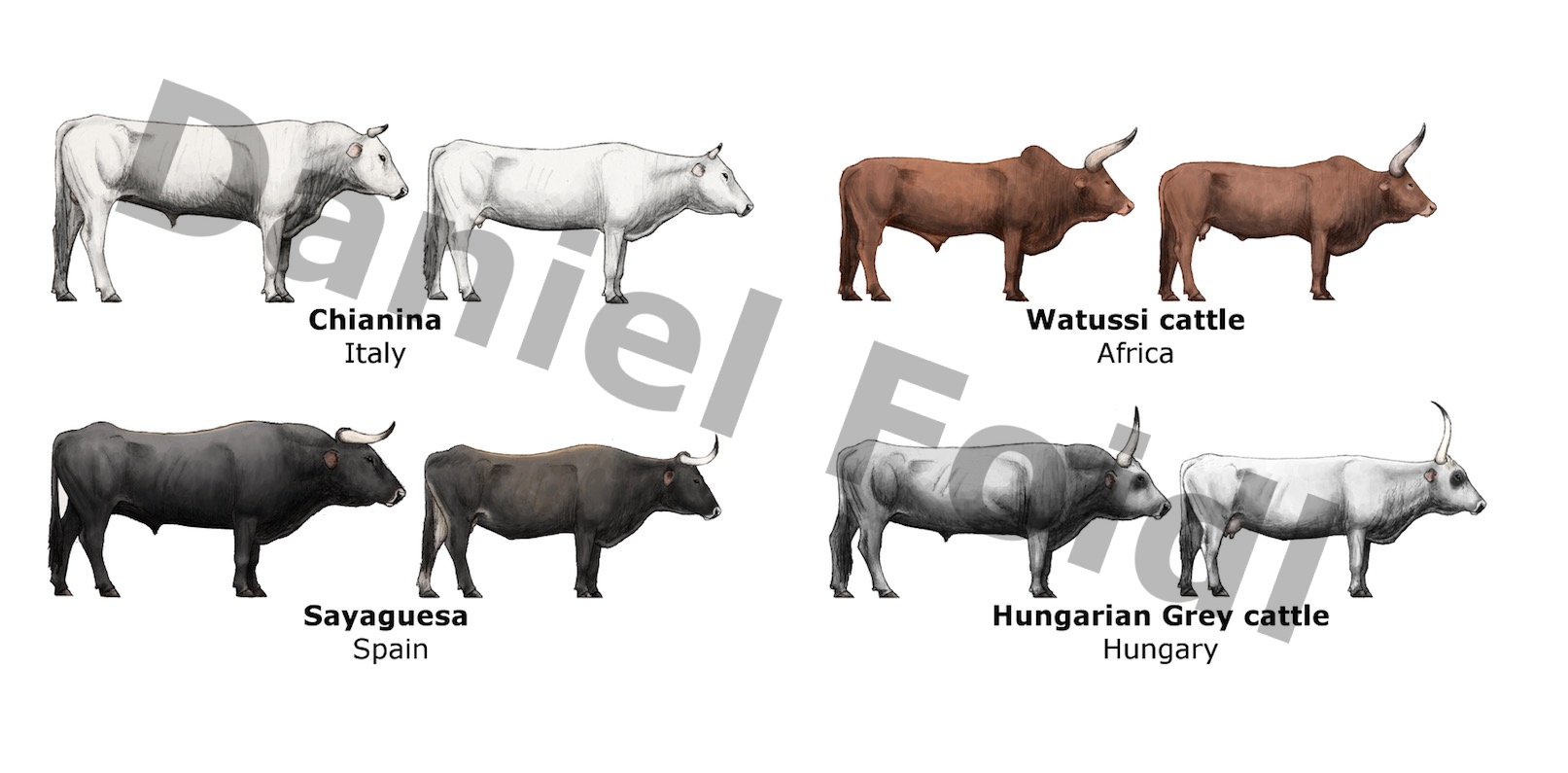
Breeds of the Uruz Project:


Well there is not much to say. The Uruz Project also intends to do breeding projects with Maronesa, Barrosa and Lidia, but only by selection within the breed alone. My table shows the breeds that are used for crossbreeding for now.


Heck cattle compared to the aurochs:

I chose normal Heck cattle size of about 142 cm (bull) and 132 cm (cow) at the shoulders. There were about a dozen possible colours for both sexes in sum, and the level of sexual dichromatism ranges from as strong as in the aurochs to nil. My Heck bull has a light colour saddle, to show that a considerable number of Heck bulls has it (probably about the half or so) and that the sexual dichromatism weaker than in the aurochs after all. This colour saddle could have had a reddish tone, but I decided to give it a light beige tone to show that Heck cattle often have a more or less diluted colour without exaggerating it. The cow however is undiluted. It is a little bit darker than what we imagine most aurochs cows to be. All in all I think that both individuals display colour schemes that are very widespread in Heck cattle, and that I was neither too pessimistic nor too optimistic regarding sexual dimorphism. Some Heck cattle have small white spots on their belly or in rare cases are completely piebald, so I was not sure whether one of my Heck individuals should show a little spot or not. I came to the conclusion that, although it is very apparent in a number of individuals, they are not common enough in the population to be necessarily included into my illustration.

There are also a lot of possibilities of what the horns of a Heck bull or cow looks like. Either the horn shape is more or less reminiscent to that of the aurochs or not at all – either their size is as large as in the aurochs or even really large, or rather small. Often the horns are as upright as in Podolian cattle, sometimes about 90° relative to the skull and very rarely below. I chose to give my Heck cattle “usual” horns that are common in the breed: medium-sized horns, with a curvature that is basically reminiscent to that of the aurochs but too weakly pronounced, to much upwards and outwards, which the bull having horns facing slightly more forwards than in the cow. Regarding body shape, proportions, dewlap, udder and skull shape, I tried to avoid the extremes and to show what is most common in the breed.

Honestly I have to admit that I think I did a good job at illustrating “typical” Heck cattle and that my comparison with its ancient predecessor is fair.


Overall I am very contended with my new illustrations, both regarding authenticity and also artistic quality. It was a lot of work, but also a lot of fun. I hope you like them too!


(Sorry about the watermarks. They are just the consequences of experiences I had to make)


Saturday, 25 April 2015

Complete genome of two woolly mammoths sequenced

Mammoth DNA made it into the news again. Until recently, the genome of Mammuthus primigenius was not completely resolved yet, but now it is - not only of one individual, but actually two. These two individuals, both males and from Siberia, lived about 40.000 years apart from each other. The older one is from approx. 44,800 years ago, late Pleistocene, and the other one 4,300 years ago. The younger one lived on Wrangel Island, the last refuge of the Woolly Mammoth, back the time when the ancient Egyptians built their pyramids (which is a fascinating thought to me). 
The study, published by Palkopoulou et al.[1] in Current Biology, revealed interesting but not surprising facts. The population of the Eurasian woolly mammoth went through a considerable bottleneck during the middle Pleistocene, which is consistent with the fact that their habitat had shrunken dramatically back this time due to the interglacial climate [2]. The same happened at the early Holocene of course, but still mammoths survived into the antiquary. The last refugee population on Wrangel had a rather small genetic diversity, and likely also suffered from an inbreeding depression, which is confirmed by this study. Undoubtedly it was a mix of several factors that drove the last mammoths to extinction, but I think it is likely that man played a considerable role in it. In my opinion, perhaps not the vulnerable Wrangel population but at least the core population in the North Siberian tundra might have survived without any human hunting pressure. 

[1] Palkopoulou et al.: "Complete genomes reveal signatures of demographic declines in the Woolly Mammoth", Current Biology 2015.
[2] Nogues-Bravo et al.: "Climate change, humans, and the extinction of the Woolly Mammoth", PLOS Biology, 2008.

Using extant wild cattle to create an aurochs replica?


I have been asked by several people if crossbreeding with existing, extant wild cattle is a good idea for creating a bovine that resembles the aurochs and is suited to live in Europe’s wilderness. I have been wondering that myself already, and indeed it is tempting. As so many aspects in “breeding-back”, rewilding or “de-extinction”, this question is subjective. But I am going to try to list some of the pro’s and con’s and draw my personal conclusion.

The thoughts behind this idea are that domestic cattle have lost certain wild animal traits, what they undoubtedly did, and that wild bovines could bring them in, otherwise the cattle would have to redevelop them by dedomestication. And apart from that, they would be able to contribute morphological and external traits resembling the aurochs at least as good as primitive domestic cattle could, or even better. For example, Java banteng have a strong, well-marked sexual dimorphism and the tone of their coat colour is reminiscent to that of the aurochs (light brown in cows, black in bulls). Gaurs have an impressive size, bigger than any living cattle. Some wild yaks have horns that perfectly resemblethose of the aurochs, and they would contribute excellent cold tolerance. Yaks are closer to bison than cattle, and the males of the first generation have fertility problems. But that would disappear as the breeding progresses. The wisent would contribute aurochs-like proportions with a well-pronounced hump, but there are even more pre- and postzygotic isolation mechanisms, and wisent and aurochs were sympatric, so I would not use them. Actually, all of those wild bovines would add high processus spinosi in the shoulder area. The undesired traits they contribute, such as the overlong coat of the yak, the upright horns or white “socks” of banteng and gaur would be selected out just as any other undesired trait.

So using those wild bovines seems advantageous for optic traits and probably also cold resistance. But there are other aspects that must be considered. First of all, they are not just different varieties of one and the same species, but completely different species. They diverged more than two million years ago (the age of the oldest aurochs remains), so there are considerable differences not only in morphology but also genetics and ecology. The argumentation that an aurochs replica made by “breeding back” would be ecologically equivalent to the aurochs because domestic cattle are a domesticated variation of this species would be gone, and it is likely that the other species differ ecologically from the aurochs. The gaur for example was sympatric with the aurochs and prefers dense forest, live on higher altitudes and browse more than cattle. This distinguishes it from the aurochs in the same way as the wisent. The banteng on the other hand, whose range did not overlap with the aurochs but with the gaur, dwells in dryer and open landscapes and is therefore comparable to the aurochs. Yaks definitely are grazers. According to Wikipedia, they need less food intake than robust cattle and survive a couple of days without water and food, and they cope with way colder temperatures than cattle usually do.
While I don’t know of fertility problems between the closely related Bos members gaur, banteng and aurochs, cattle and yak do have some as stated above. Yak are closer to bison, which might be problematic – it could increase the chance of hybrid cattle interbreeding with wisents. But this is just an assumption, I do not know if yak and bison readily interbreed at all.

From the ecological point of view, yak and banteng shouldn’t be that problematic. The yak would probably even be beneficial. Morphologically/optically, they would be advantageous as well: banteng contribute size, high shoulder spines and a well-marked sexual dimorphism, and (wild) yaks add perfectly aurochs-like horns. So why not using them, at least in small doses?

There are people who are opposed to the usage of breeds with visible zebuine influence (like Watussi) because zebuine and taurine cattle diverged in the late Pleistocene, but still are B. primigenius, so they would totally reject the usage of extant wild bovines in the first place. The argument that dedomesticated, aurochs-like cattle have a legitimation as native wild animals in Europe because they belong to the same species as the aurochs would lose its credibility since such a population would consist of hybrids, at least to a certain degree. This would be problematic for their academic and public acceptance. Considering the controversies around releasing endangered animals even with subtle introgression of another subspecies, I would be surprised if the majority, or even a third, of serious scientists would be in favour of releasing a population consisting of domestic stand-ins for an extinct species mixed with species that are certainly not native – which is understandable. And I can imagine headlines in crappy tabloids like “Hybrid monster cattle to be released into nature!”. Of course I am aware that hybridization is a part of evolution and takes place anywhere closely related species neighbour each other, and regular readers of my blog will know that I am not averse against bison introgression into controlled wisent herds as diversity donors. But primarily I think that man should try to conserve or reconstruct nature as it is or was, and not to try playing evolution if not necessary. Regardless of how strong the hybrid influence would be, the population will probably display a mosaic of not only morphology but also ecology and behaviour. I have not mentioned yet that yaks also live on higher altitudes than cattle, and banteng have a different combat behaviour. They have a higher profile and display it to their opponent, raising their head to look as large as possible. They do not fight nearly as often as cattle do, what explains their upright horn shape. Who knows what kind of effect it will have on the behaviour of the population.

So there are arguments for and against using wild cattle to breed an aurochs substitute. My personal opinion is that I probably would not do it, because of the scientific and public response and a weaker argumentation basis as outlined above. Nevertheless it would be interesting to see hybrids between Yak, Banteng and primitive cattle. A “test herd” could be an idea.

Monday, 6 April 2015

Two new nice videos of Taurus cattle from the Lippeaue

The Lippeaue, which is the centre of Taurus cattle breeding in Germany  probably has the best animals of this breed. I covered them in a lot of other posts already (see here, for example).
Now, a worker of the ABU has published some more videos of their cattle and I hope you enjoy them.

This video shows a small group of cows and their offspring crossing a stream. They are just as elegant as good Limia or Pajuna, their colour is alright and also the head shape. I really like what I see. Just the horns should be better, perhaps this is going to change when the genes of the recently purchased Wörth cow will be spread through the population. The grey one is, of course, a pure Chianina.
This cow is 65% Chianina and one of their largest animals - I think her size is really impressing, and also her horns - albeit small - grew well.
That's a (Heck x Chianina) x Sayaguesa bull. Although its body shape could be better, he looks elegant and its size seems to be good as well.

I am looking forward to visit this herd again. Those Taurus cattle do the best job in improving the whole Heck cattle population in Germany.

It's horn time!


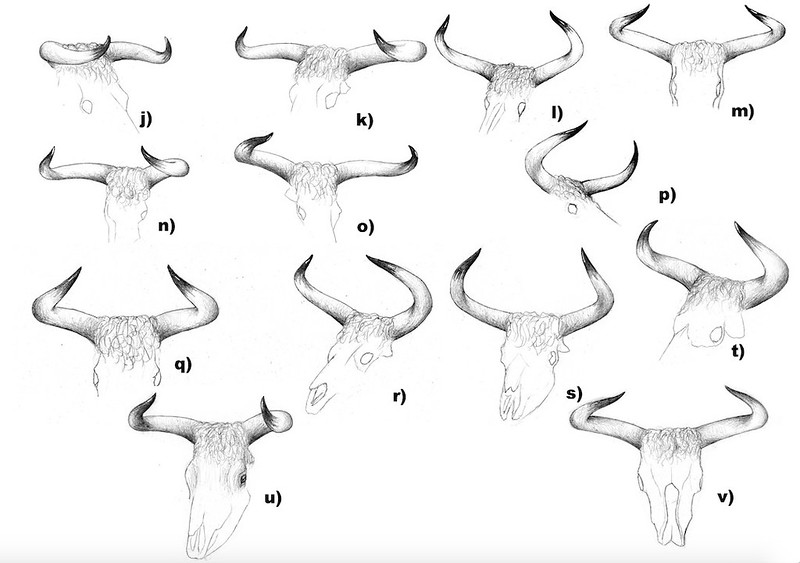
Horns are probably the most wonderful body part of a bovine. Each species has characteristic horns, and so had the aurochs. An aurochs look-alike would not be complete if its horns would not resemble their wild ancestors. In order to breed cattle with authentic aurochs-like horns, one has to know what they looked like*. This is not problematic, since there are dozens of well-preserved aurochs skulls with complete or nearly complete horns. But beware that bony horn cores actually do not represent the actual size and shape of the horn because the keratinous sheath is missing. That’s why I did a lot of sketches done by tracking out the original skulls and adding the keratinous sheath. The sheath continues the spiral-like curve of the bony core and adds about 8% in diameter and 10-20% in length. Recently I did 22 reconstructions of aurochs horns based on photos of skull material that I am going to present here.


* For a detailed description of what the horns of this species were like, go here.


a) Location and age unknown to me. Rather wide-ranging and large – Pleistocene?

b) Italy, Pleistocene. Massive horn cores and skull, definitely male.

c) Britain, age unknown to me.

d) Germany, age unknown to me.

e) Germany, age unknown to me.

f) Location and age unknown to me. Likely male.

g) Germany, Pleistocene. Really wide-ranging horns.

h) Britain, Holocene. Likely a cow.

i) Italy, Pleistocene. Slightly asymmetric. Very likely a cow.

j) Denmark, early Holocene (Preljerup). Decent inwards-curve. Definitely a bull.

k) Italy, Pleistocene. Wide-ranging but well-pronounced curve. Likely a male.

l) Austria, Bronze Age. Wide-ranging. Likely a cow.

m) Germany, perhaps Holocene.

n) Britain, Pleistocene. Large specimen with impressive horns. Definitely a male.

o) Denmark, early Holocene. Wide-ranging, long-snouted à male.

p) Location unknown to me but perhaps Britain, age unknown to me. Wide-ranging, probably a cow.

q) Germany, age unknown to me. Well-pronounced curvature. Probably a bull.

r) Denmark, perhaps early Holocene. Rather upright and large horns, long skull. Likely a bull.

s) Denmark, early Holocene (Vig). Rather upright and weakly curved, long rostrum. Likely a bull.

t) Location and age unknown to me. Rather thick cores. Male.

u) Poland, age unknown to me. Long snout and small orbital openings à male.

v) Poland, age unknown to me.


It’s interesting to see the amount of variability regarding horn shapes regarding orientation relative to the skull, size and how far they curve outwards. According to Cis van Vuure, the orientation of the horn varies from 50° to 70° degrees, but using a photo I measured that the horns of the Vig bulls have an angle of about 80°, and that other bull from Denmark with the upright horns had probably an even higher angle. But the basic curvature itself is always the same (see the post linked above). In the sample presented in my drawings you won’t find a pair of horns that is even remotely lyre-shaped or facing straight outwards, or any other deviant shape.

I have been wondering why the horns of the aurochs were that variable. When you look at the horns of other wild bovines, they are rather stable. OK, the horn sample we have covers a large geological and geographical scale. But there is no clear gradient, neither in time or location, so the variability is found within the same population (one exception: I noticed that southern aurochs had a smaller angle between horns and snout than northern ones, with those Danish bulls on the one and the oldestAfrican aurochs skull at the other extreme. I assume that this is likely a result of genetic drift.)

One explanation could be that the selective pressure on one particular horn type was not that large as in other bovines, but that argument is not very strong because the horns of the aurochs were in more active, functional use than those of gaurs or banteng for example. Another explanation is that the population of the aurochs increased very rapidly as it spread over Europe and went through only through little genetic bottlenecks. But this idea does not satisfy me completely as well.


When you look at the horns as they are illustrated above, you might notice that some of them match very well with those of some modern day cattle. A lot of those horns resemble those of some Watussi and Heck cattle of the Wörth and Neanderthal lineage. Others also resemble those of a number of Highlands, Barrosa and also Texas longhorn. And of course, there are those with the “Iberian” type of horns as well.


Friday, 3 April 2015

The Tauros cattle at Siendonk & Vosseven

Geer vanne Smeed from weertnatuur.blogspot.com has allowed me to post some of his recent photos of Tauros cattle at Siendonk and Vosseven, Netherlands. I am going to share them with you and try to figure out the identity of the animals shown. All the photos shown here are copyright of G. v. Smeed and used with permission.

 Luueke/Vosseven: 


 This photo is from Janurary and either shows a Sayaguesa (UPDATE: There are no pure Sayaguesa in that herd.) or a Sayaguesa x Tudanca cow. That herd was covered by a Limia bull, what means that the young cow at the left of the photo below is a (Sayaguesa x Tudanca) x Limia cow: 
And has it seems, the Limia bull has now been removed and replaced by the young Maronesa bull from Keent: 
That bull looks a lot better than the one from Loozerheide. The proportions of this bull are going to change for several years, but it appears that it relationship between leg length and trunk length will be alright. If that bull is able to mate this year already (which I assume), we will see the birth of (Sayaguesa x Tudanca) x Maronesa and perhaps also ((Sayaguesa x Tudanca) x Limia) Maronesa next year already. 

Siendonk: 
The herd has been covered by a Maremmana and Pajuna bull since 2013 and consited/consists of Sayaguesa, Maremmana, one Tudanca and several Limia cows. Since the ancestry (not even maternal) is not being documented, we can only guess on the identity of the crossbred animals, which is frustrating. Some of the offspring might also be purebred, what makes it even more ambiguous. 
The young cow at the uppermost photo could be anything: Pajuna x Sayaguesa, Pajuna x Limia, Pajuna x Maremmana, Maremmana x Sayaguesa are likely candidates in my opinion. The cow at the left should be a pure Sayaguesa. The second from above shows a Sayaguesa as well. The next two photos show pure Limia cows, one adult cow which's identity I cannot tell (front), a young Maremmana bull that might be the son of the former one, another subadult bull that I go into later, and another young bull that is between the cow at the front and the Maremmana. There is a grey calf as well (surely a Maremmana descendant, perhaps pure or half Tudanca), which is also seen at the lower most photo together with one of those two mysterious bulls. The way I see it, those two subadult bulls might either be pure Sayaguesa, or any combination between Sayaguesa, Limia and Pajuna.

As you see, these are all just guesses and I might also be wrong on a couple of things, because the information the managers give (and have!) is simply too sparse. 

Thanks to Gerard for taking all these good and informative photos and allowing me to share them here!


Wednesday, 1 April 2015

Living near-aurochs relicts found in Poland?


It’s not uncommon that web or field research unearths some surprisingly aurochs-like or, in terms of dedomestication, spectacular breeds. But these news struck me the most. Hold on your horns.

It seems that aurochs enthusiasts involved in some rewilding projects have, looking for primitive landraces in Poland, discovered a really remarkable population of cattle. Farmer Julius Woźniak from Łódź is the owner of a herd of about 20 cattle that show significant similarity to the aurochs: they are comparably large (bulls reach about 165cm at the shoulders, so they are about the size of Sayaguesa or a little larger), the horns are nearly completely aurochs-like just slightly thinner and rarely some deviant shapes show up, and the colour is perfectly aurochs-like – bulls are black with an eel stripe, light muzzle ring and dark, prominent forelocks. Cows are of a reddish-brown colour with darker shades just like in some Maronesa and Heck cows. Occasionally there are black cows, just like Anton Schneeberger reported in the 16th century. Deviant colours do not appear – only some calves show an ashy grey tone that disappears later on. Those cattle are kept in a very traditional manner – they wander around freely all the year round, where they thrive in clear forests and sometimes also visit the mountains. Only when the owner wants to seize them, he goes into the forest and looks for them with a his dogs and gathers them together. He only uses their meat and coat, he never milked one of them. “They almost give no milk. And I would never try to milk one of those cows. They are nasty beasts”, Wozniak says. In some rural regions of Poland there are still wolf packs that regularly kill farm animals, and it also happens that some calves get poached by the wolves, but it is said that the cows show a great will to defend their calves and surround them in circles when they are in danger. Adult animals do not have to fear them. Wozniak once witnessed such a wolf attack “I saw two or three wolves teasing one of my adult bulls. He tossed one of them into the air about four or five metres wide. Then the wolves were gone”. The remark that he has more than one adult bull is interesting – perhaps there is mating competition between the bulls, and therefore some form of natural selection.

This kind immediately caught the attention of the researchers. Wozniak allowed them to take hair samples from one young bull that was about to be slaughtered, and they delivered it to a lab at the University of Warsaw, under the guidance of a certain Prof.  Rubenstein. The lab is going to test and compare the samples to “other Polish rural cattle, milk and beef cattle, one Iberian breed [I don’t know which one] and Heck cattle [I wonder for which purpose…]”. Rubenstein says: “If it turns out that these bull has any phylogenetic markers, be it mitochondrial, Y chromosomal or whatever, that are not present in any other European cattle, it would be a strong hint that the cattle of Mr. Wozniak are of a unique and ancient origin. We also want to do a molecular clock analysis to get some clue when this breed diverged from other cattle”. I hope that this sample is representative enough. A priori, I rule out that these cattle are the result of local domestication. But, considering that Poland, as most of my readers will know, was the latest refuge of the aurochs, it may be that these cattle are the result of massive late introgression of the aurochs and that they have been kept isolated from other cattle for a long time.

How credible is that scenario? I think it’s not unlikely. Remember that the last (and probably already mixed) wild horses in Poland were kept in the Zamość game park until 1806 when they were donated for economical reasons to a number of farmers in the Bilgoraj region. Cis van Vuure in his 2005 book pointed to the possibility that one or even more game parks might have aurochs even past 1627 because of an ambiguous letter from that time. So perhaps there were still some small aurochs herds around during the middle or even later half of the 17th century. I can imagine that there was a similar scenario like that with the wild horses. Maybe one of these game parks was not interested in keeping them anymore and donated them to some neighbouring farmers. Aurochs were surely not easy to handle, but looking at how Wozniak keeps his cattle it might be less problematic, also considering that they were probably mixed with some local cattle that must have been primitive anyway (perhaps like those rural Romanian cattle?). It might be well possible that some of these farmers lived in regions that were comparably isolated and that these aurochs hybrids subsequently barely mixed with other cattle. And these semi-wild circumstances under which they were kept probably preserved a lot of typical aurochs characteristics.

What Wozniak told us fits this idea: He said that this breed (or lets call it a population) does not have a particular name. His family has been breeding them for generations and he knows only of two other breeders – he has not seen these cattle in any other region yet. The two aurochs enthusiasts have shown him photos of Maronesa, Sayaguesa and Heck cattle. Wozniak said that they look similar but he does not think that these cattle are related to his.


I am incredibly exited and I can’t wait for the results of the genetic analysis. And even if these cattle do not turn out as the descendants of the last aurochs on earth, it would be a remarkable breed anyway and very useful for “breeding back”.


I was provided with some decent photos of these cattle. If you want to have a look, go here, here and here.