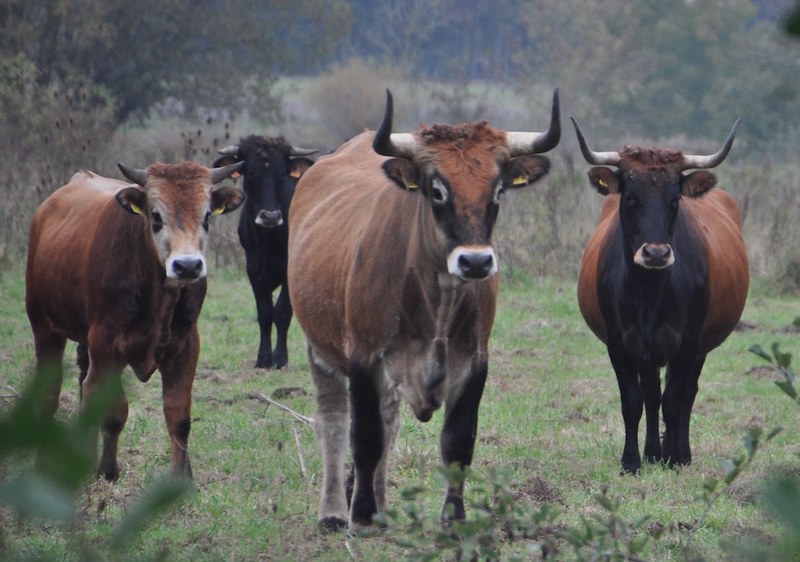
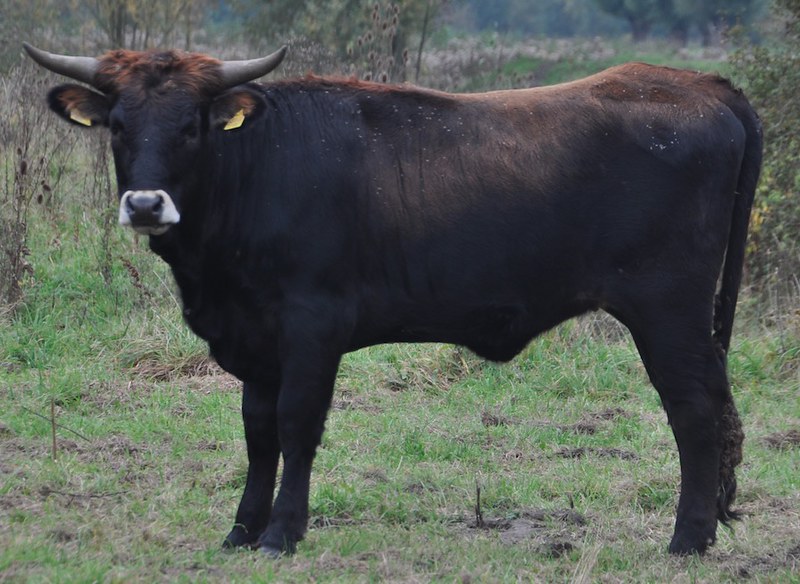
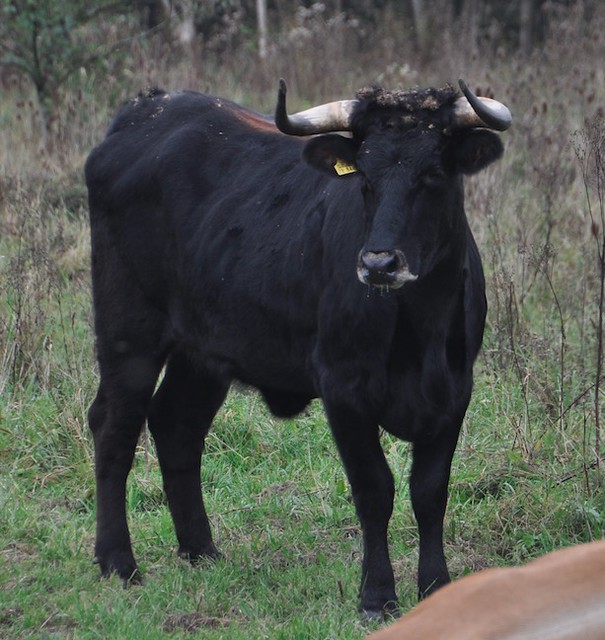
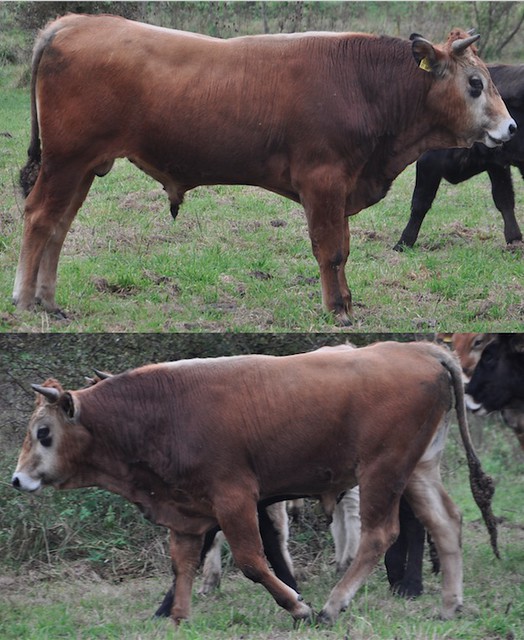
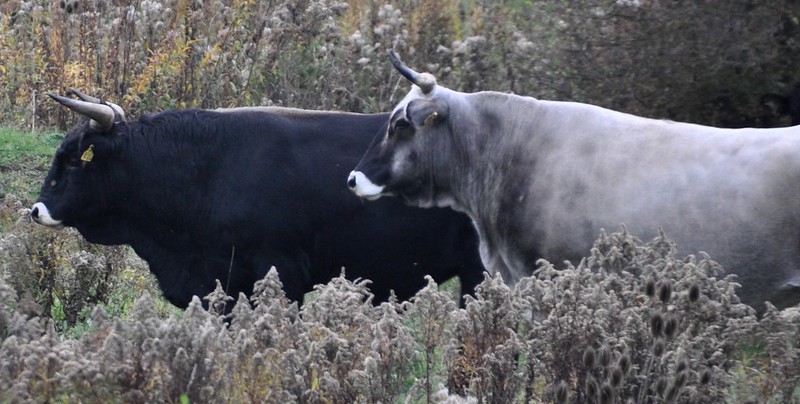
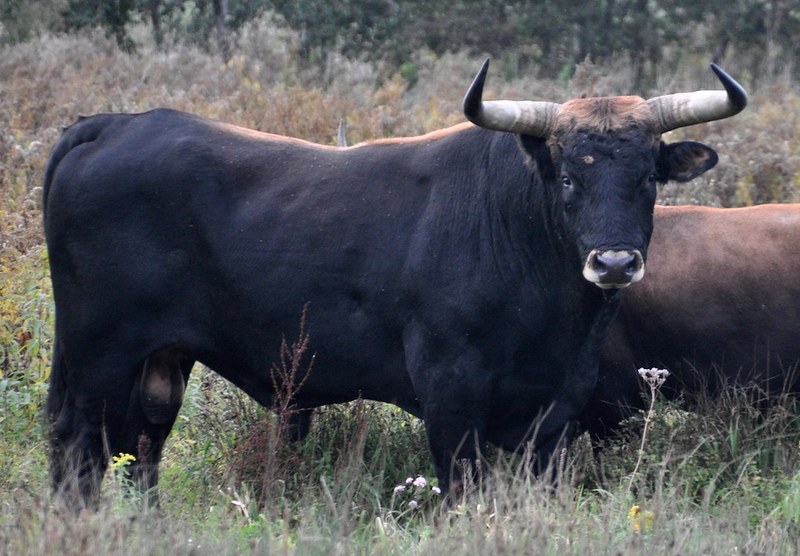
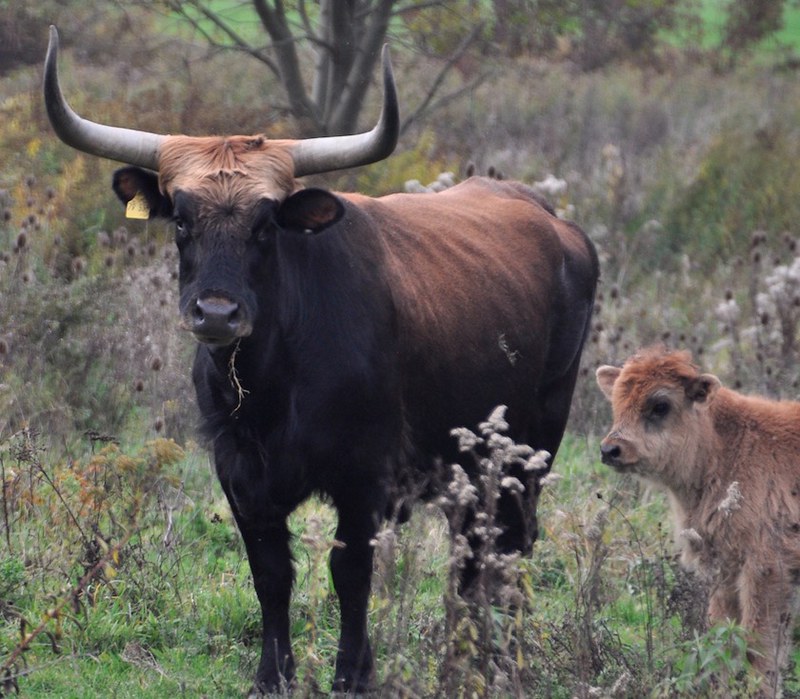
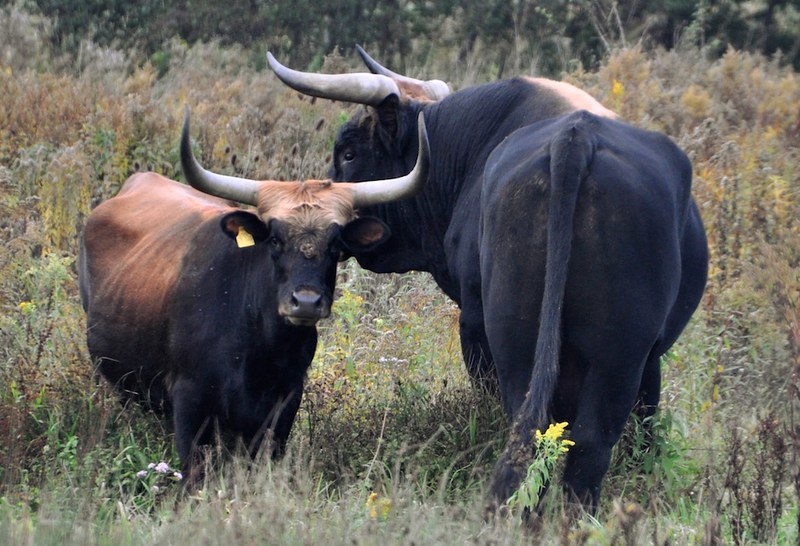
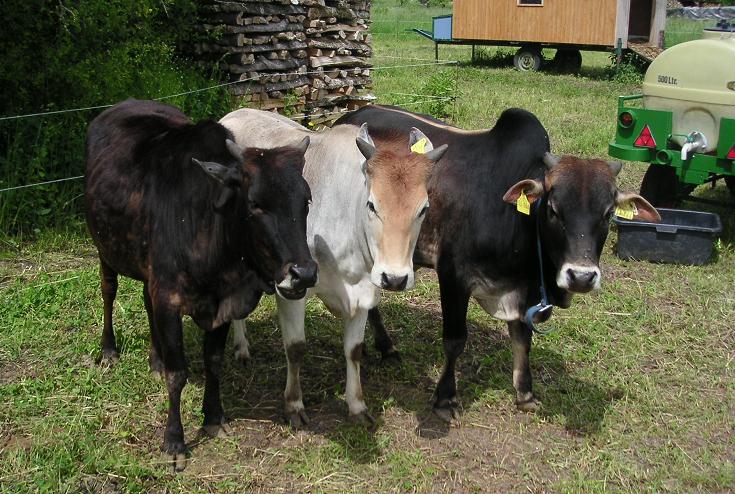
Friday, 20 November 2015

A second trip to the Lippeaue Pt.II: The herds #2

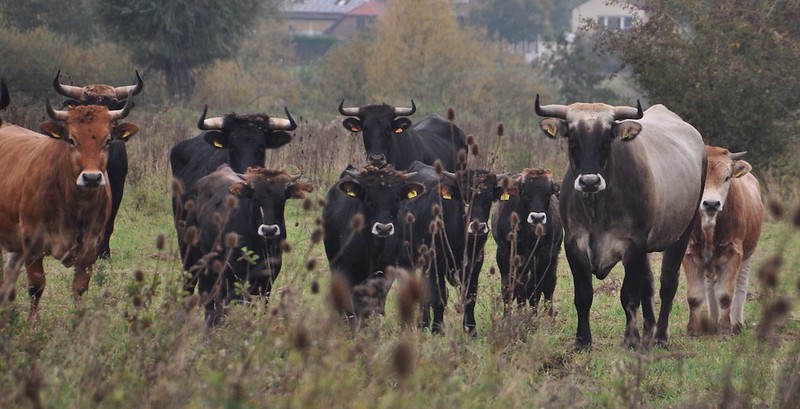
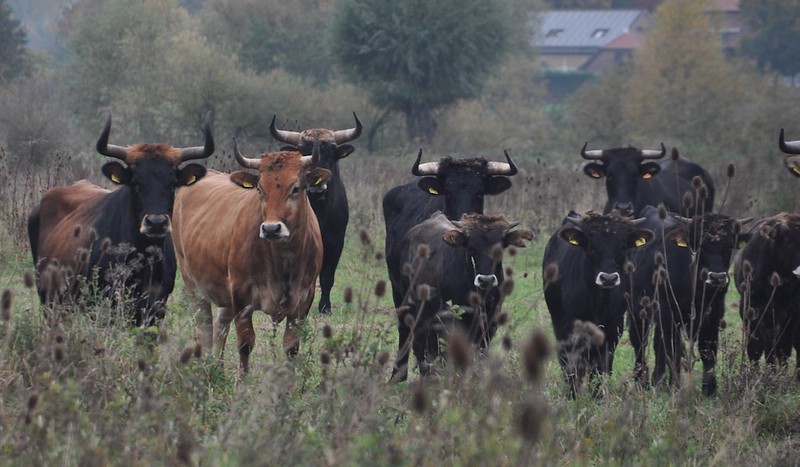
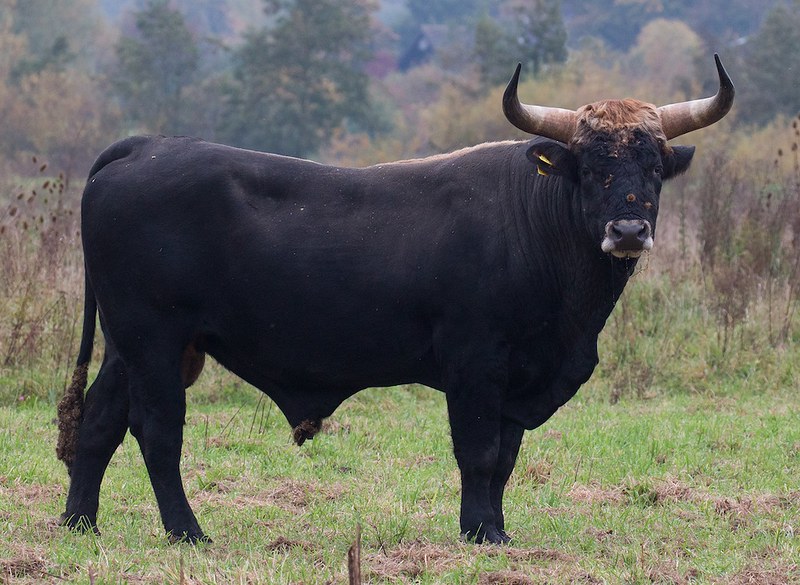
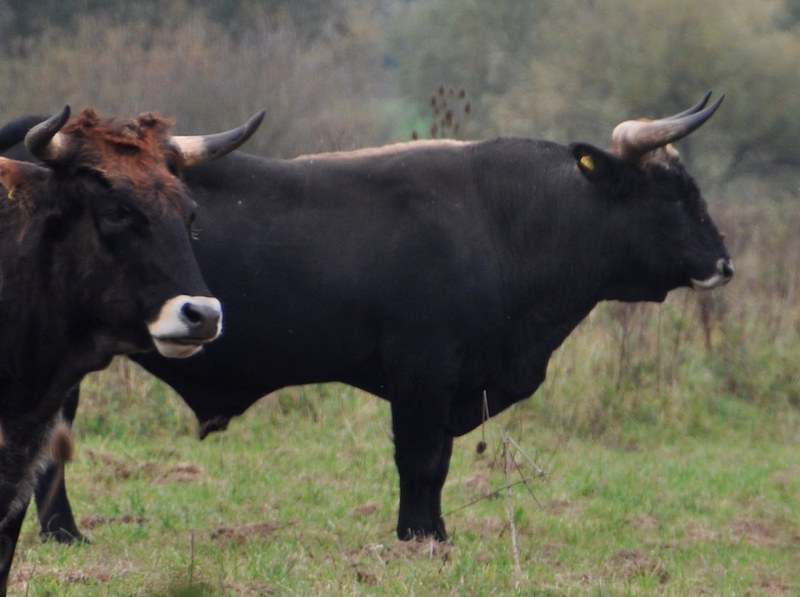
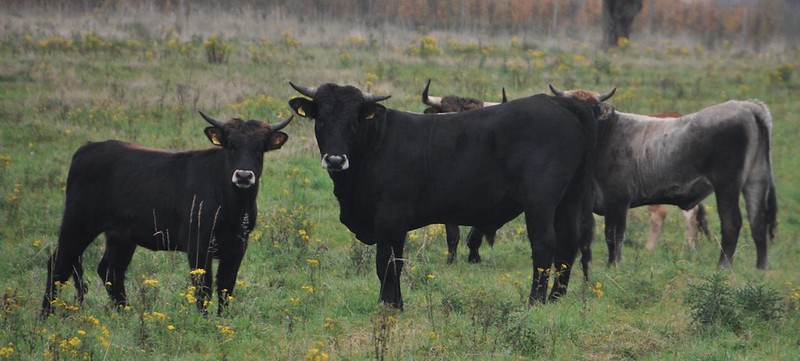
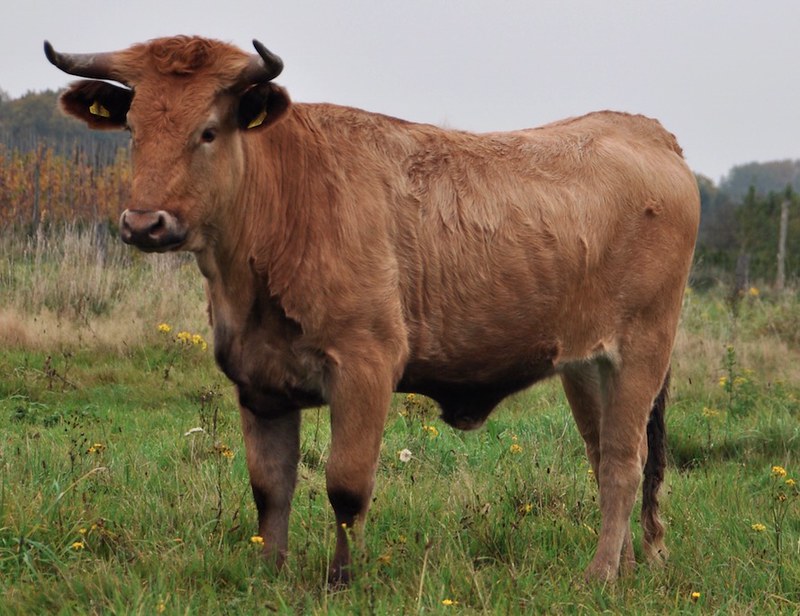
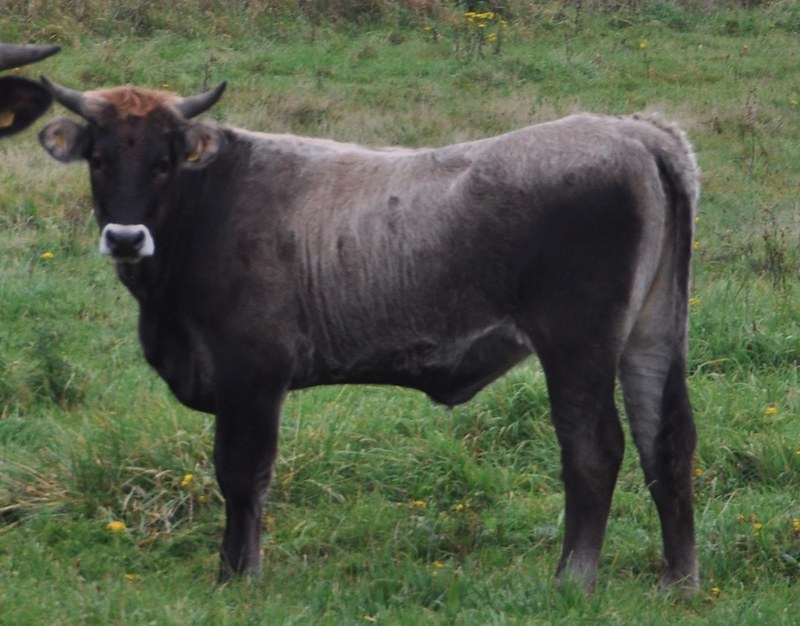
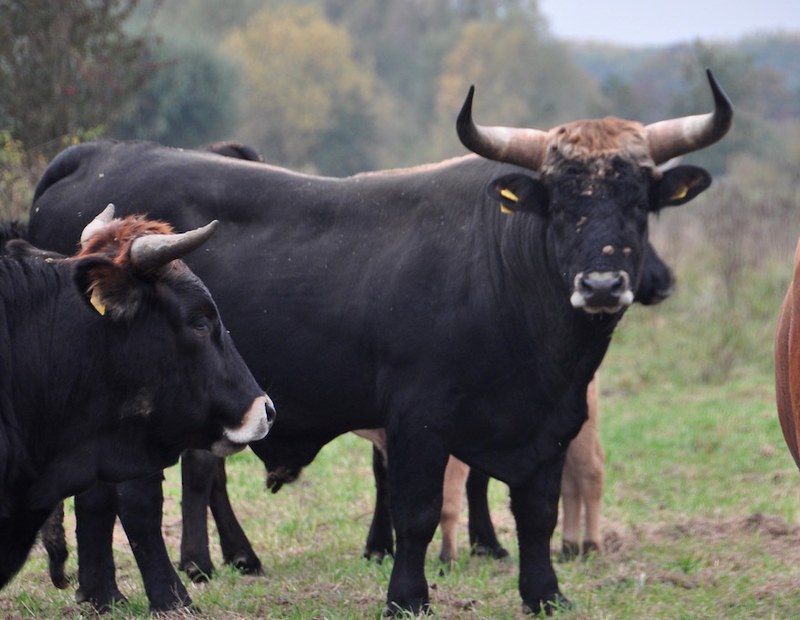
The previous post covered three of the two current herds in the Lippeaue from my 2015 trip. This post is on the remaining two, Klostermersch-Südseite and Hellinghauser Mersch. 
(I claim copyright for my photos, please do not use without permission)

Klostermersch-Südseite

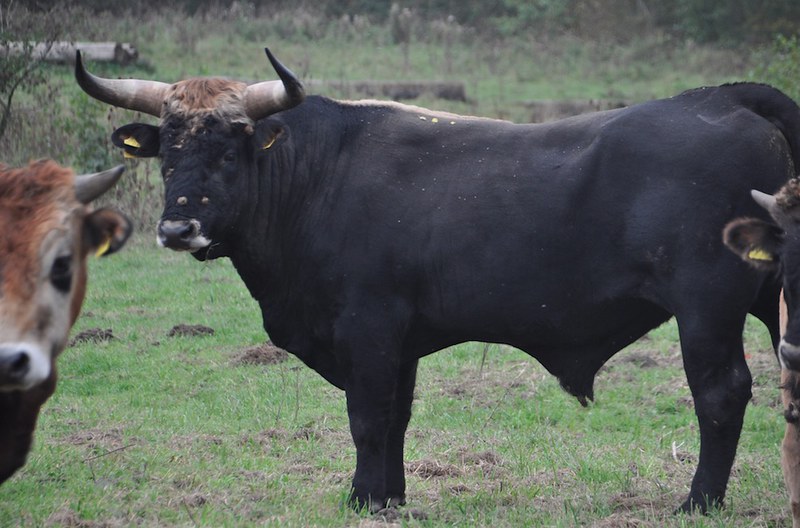
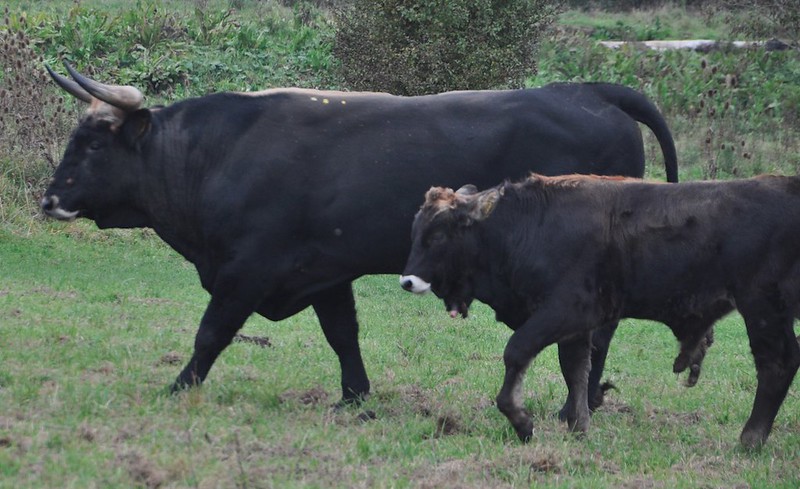
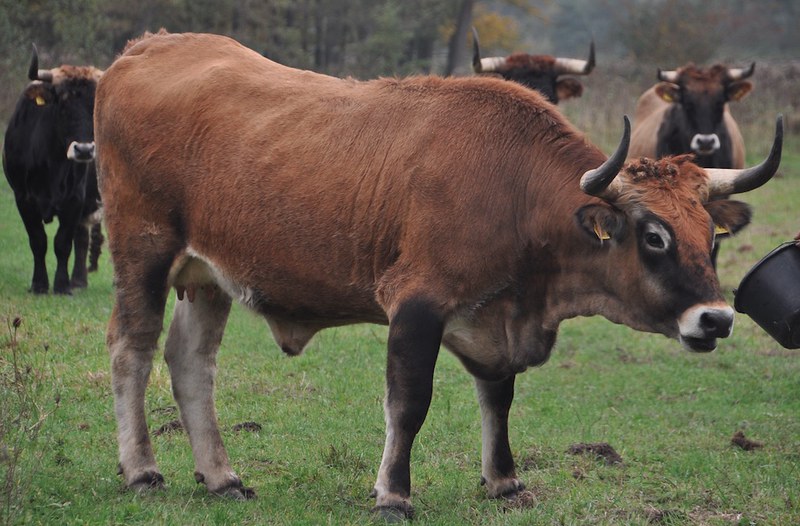
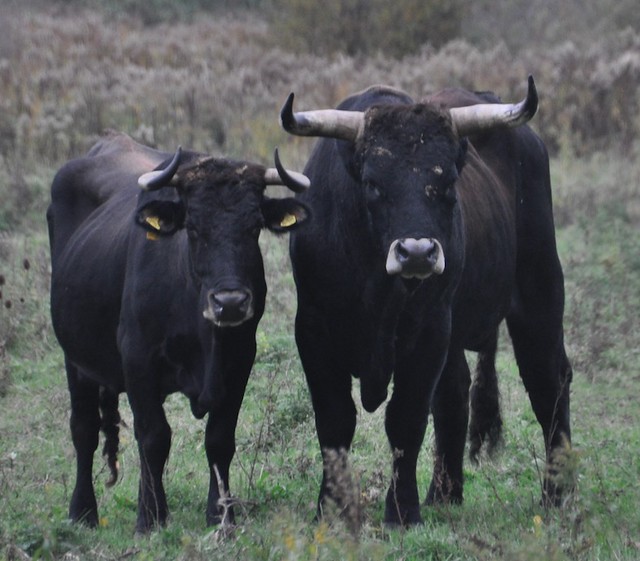
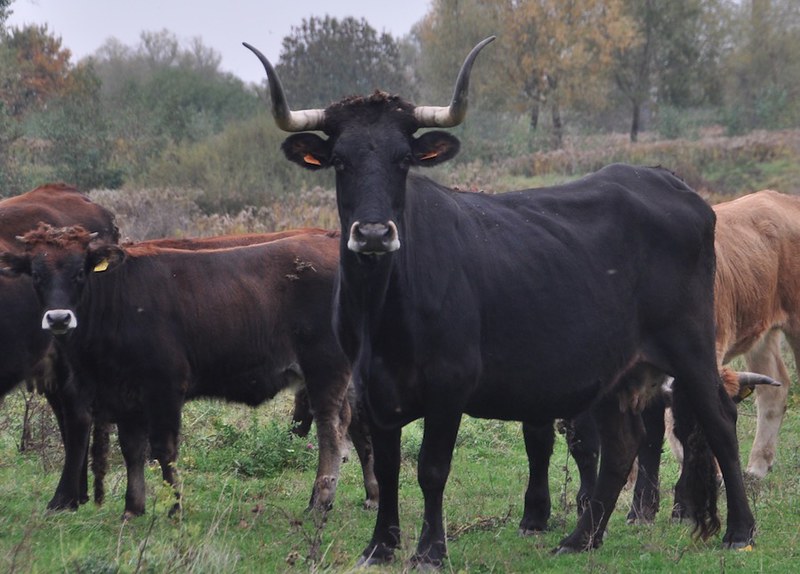
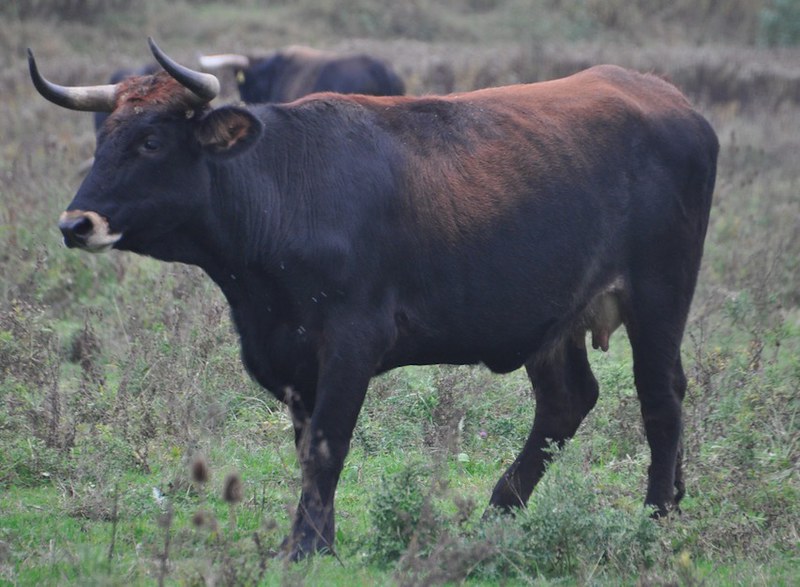
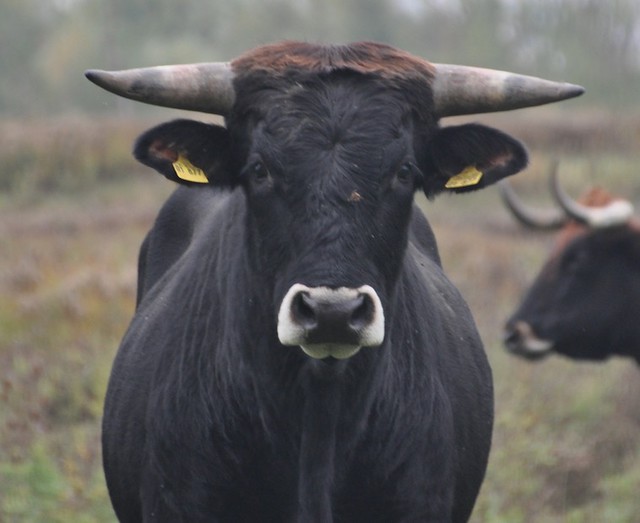
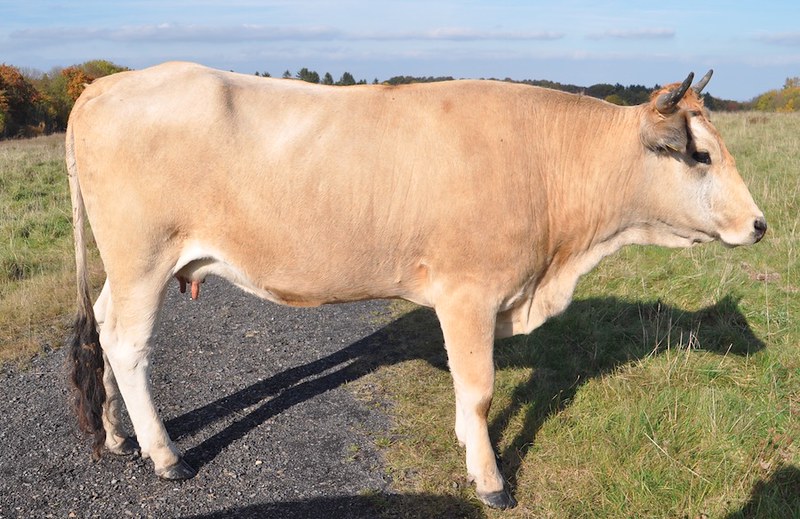
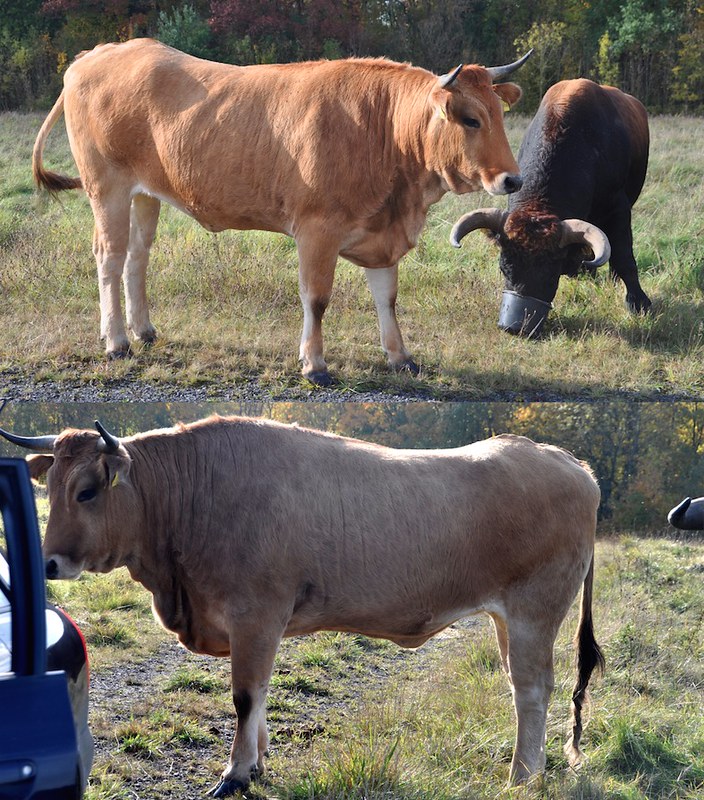
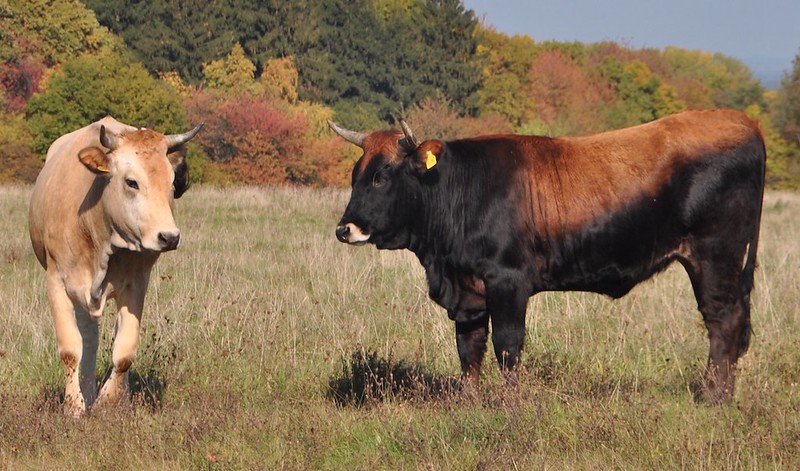
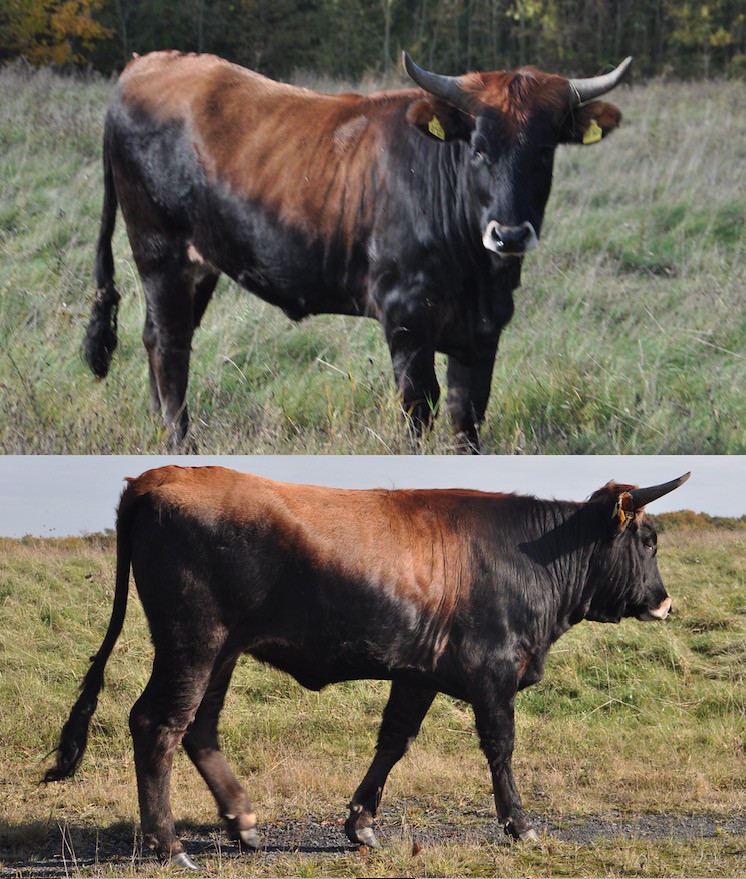
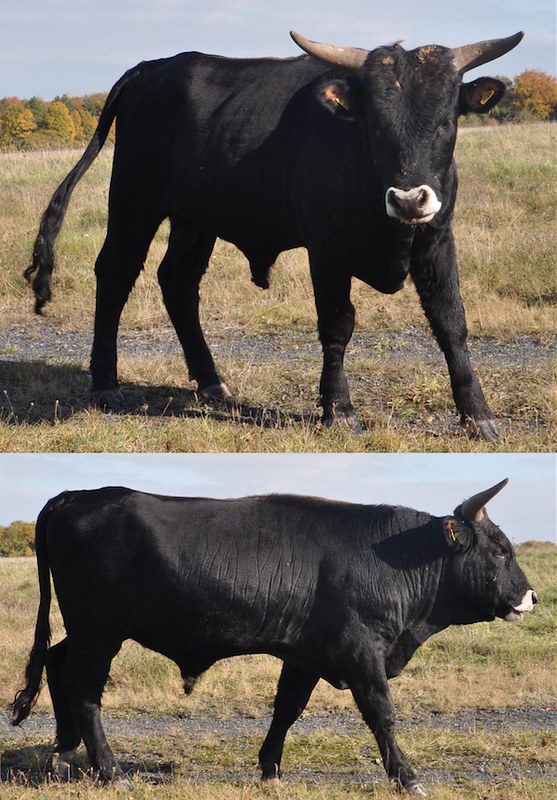
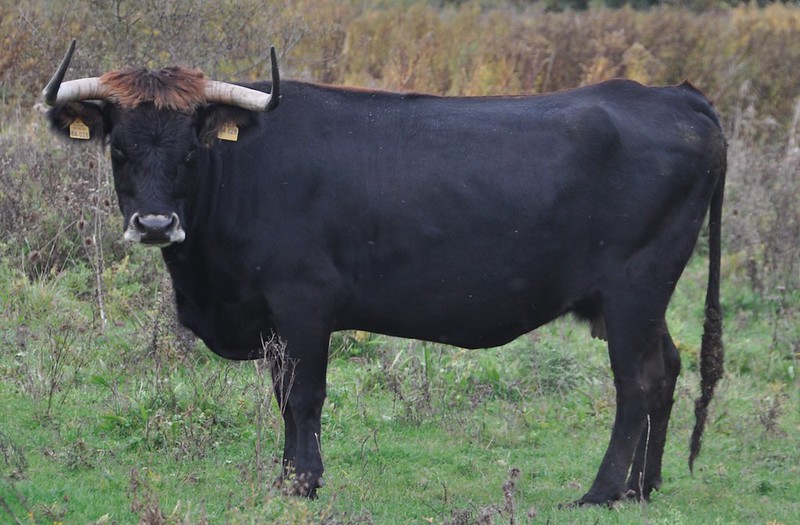
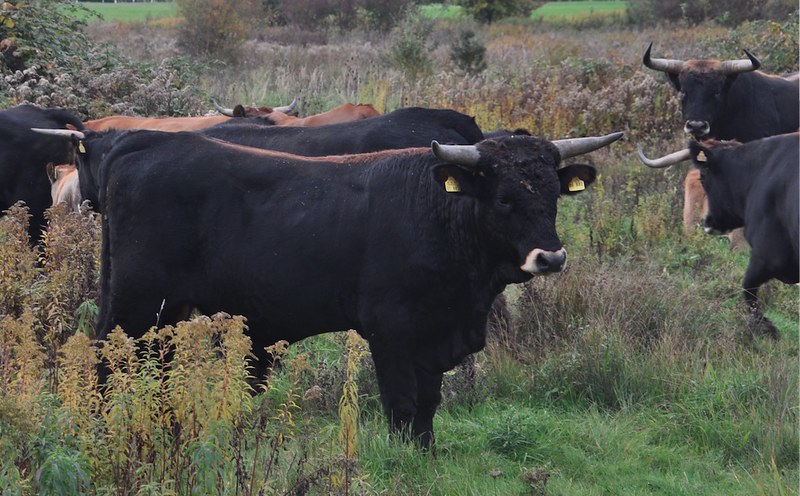
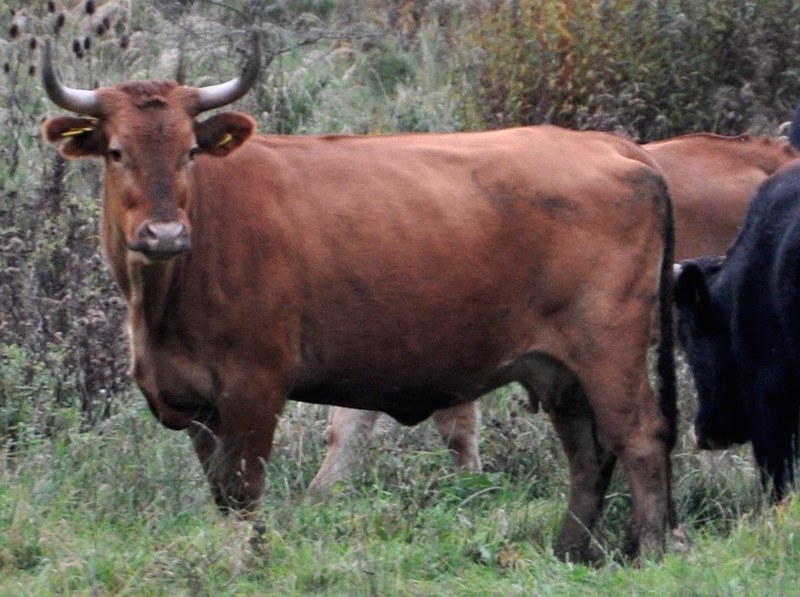
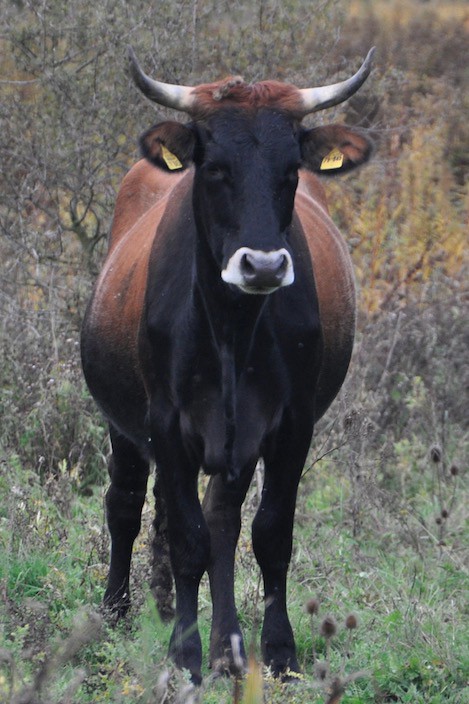
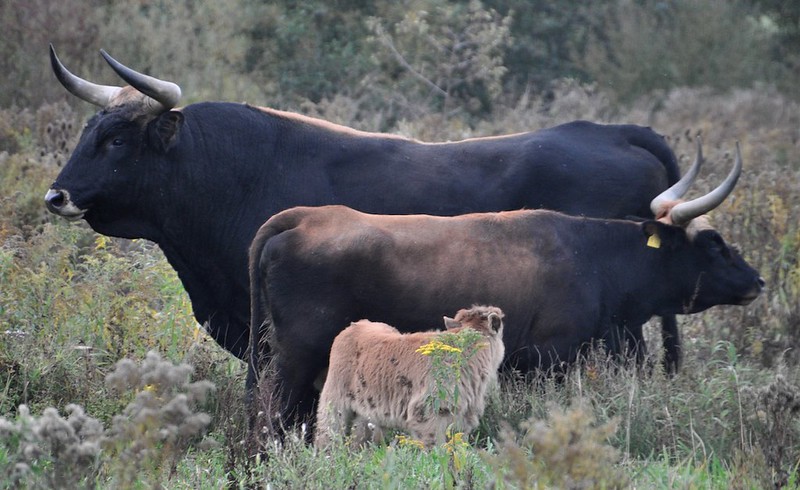
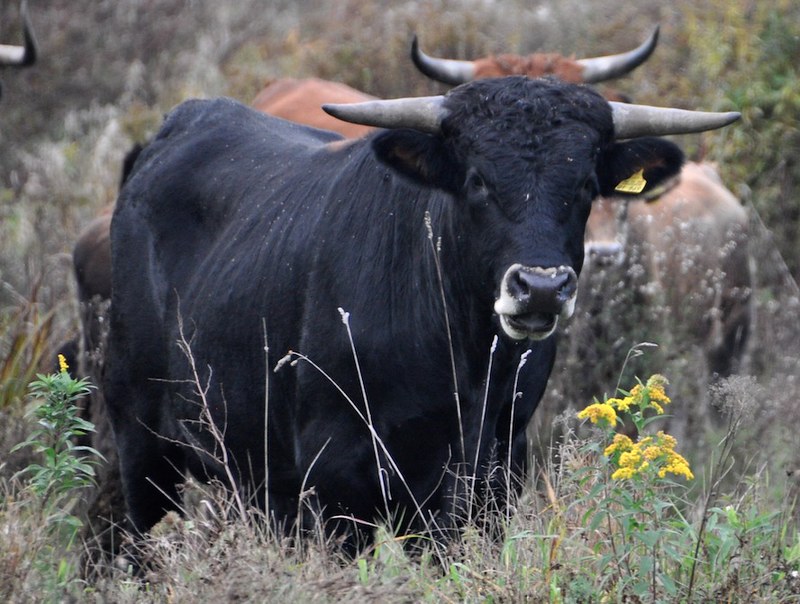
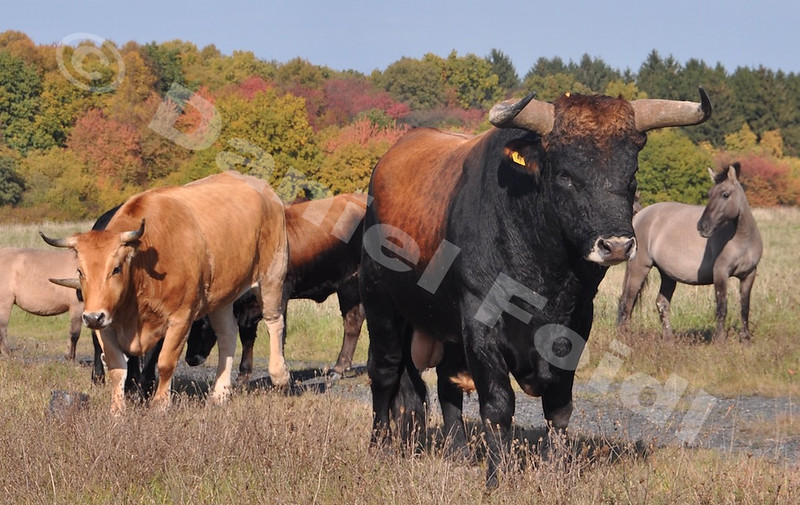
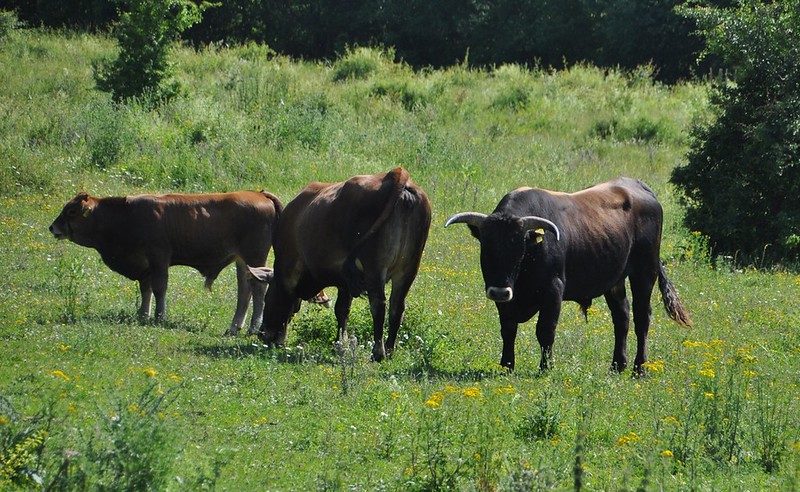
In 2013, I hoped that this son of Lamarck would become a breeding bull, since he looked quite promising to me. Well, he is now, and his name is Londo. He looks a lot like his father, his horns are even a bit thicker. His deficiency compared to Lamarck are his shorter legs and the longer trunk, and he is comparably small. But he is a “true F2” because both his parents were of the same cross combination (his mother 84 024 is a fullblood sister of his father), and so he should be more genetically stable (Lamarck should actually be not stable at all). Might this be more important than his undesirable traits? I think we cannot know. But he will be used until a better bull will be available. Maybe the bull calf he produced with Larissa will be better. Larissa is the largest animal in the whole Lippeaue, also larger than the bulls. Larissa is half Chianina and half Lombriz (Sayaguesa x (Heck x Chianina)), therefore about 62% Chianina. Larissa has a three years old daughter, 79 824, whose father was Churro. She is called Lena now, on my suggestion (the name of my deceased Golden retriever). Her colour is interesting. Lerida, one of the oldest cows, is still present. She is a Heck x Sayaguesa and has always been one of my favourite cows of the early Taurus cattle. Together with Churro, Lerida gave birth to a beautiful cow (79 846) that looks good despite her wholly black colour. I also like Laniana because of her authentic colour, although the horns are not that good. She is a daughter of Lombriz and one eighth Lidia. In this herd, there are two new Sayaguesa cows. One has nicely curved horns, the other one rather-Chianina like ones, but both are long-snouted.
Lale is daughter of Lucio and Ludovica, therefore (Heck x Sayaguesa) x (Heck x Chianina). Except for some traits in the head and her larger size, she could almost be mistaken for a normal Heck cow, but gave rise to nice offspring (f.e. here, not present in the herd anymore).
Speaking of size, we managed to measure two cows in this herd as well: Liberta, and a Chianina (Larissa’s mother). Both were measured with about 153cm at the shoulders, but considering that they were feeding at the moment they might be one or two centimetres larger. Considering that Bionade is the same size, and that Larissa, being the larges individual in the Lippeaue, is larger than all three, Larissa might be 160cm tall at the shoulders. That, of course, means that all the current bulls are below this mark. Liberta is a daughter of Lombritz plus a (Sayaguesa x Heck) x (Sayaguesa x Heck) cow Lissy, so a total mix. 
One explanation for that might be that all the breeding bulls chosen have and had not that much Chianina in their ancestry (25% or below, with the exception of Luca). So my hope for big bulls (for bulls, only a size of at least 160cm is ok for me, and everything above satisfying) are those with much Chianina. There is one young bull that is the same combination as Larissa (but with Laokoon as father instead of Lombriz) that made a good impression to me (01 885). Slightly more than a year old, and was walking with grace on long legs when I saw him. The body looks tight and the back is well-shaped. Being half-Chianina, the colour is diluted and the horns do not look as if they are going to grow large. But I plead for giving that bull a chance to see how he works out. Of course, a lightly coloured bull is considered unsatisfying, but colour is regulated by only few loci so it will change easy, the genes for those dilutions must be widely distributed in the population anyway, and a lot of diluted cows are permitted in the Lippeaue. So I, personally, would use a bull with that colour if he is large and well-shaped. Whether a bull is going to grow large or not is not easy to say by that age. I was told that one indicator for how large cattle grow are leg proportions at young age. If a young bull has rather long legs like on stilts, it might grow large (allometrically, this makes sense). There was a second half-Chianina bull as well, a son of Londo, but that one did not work out well, it is going to be removed.
By the way, there was another cow with a dark mouth, again with no Lidia but nearly evenly distributed portions of the three other breeds. Since it never appears (as far as I know) in Sayaguesa, and is that rare in Heck cattle that it would be a pretty large coincidence if it shows up in these crossbreeds, I think Chianina might be responsible for that trait, masked by the dilution factors as speculated above. 
Londo, son of Lamarck (photo © Margret Bunzel-Drüke)
Londo with a cow that is nonidentifiable to me
Lena, Larissa's half-Sayaguesa daughter
01 885, a Sayaguesa, Lena, Laniana
Laura, pure Chianina and mother of Larissa and Lombriz
55 392, Londo x Chianina
Lale, (Heck x Sayaguesa) x (Heck x Chianina)
Liberta, more than 153cm tall.
Young cow, non identifiable to me
79 846, one quarter Heck, three quarter Sayaguesa (Lerida + Churro)
01 885, half Chianina.
Cow in the foreground is a daughter of Laokoon and Liberta


Hellinghauser Mersch

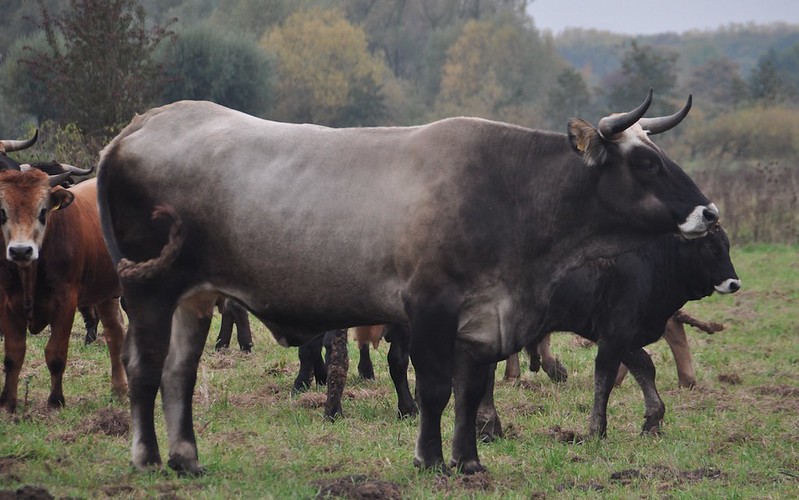
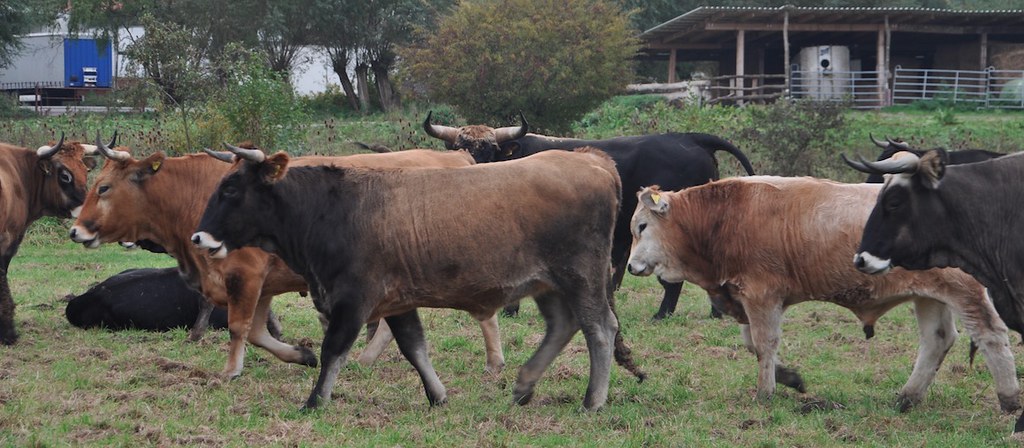
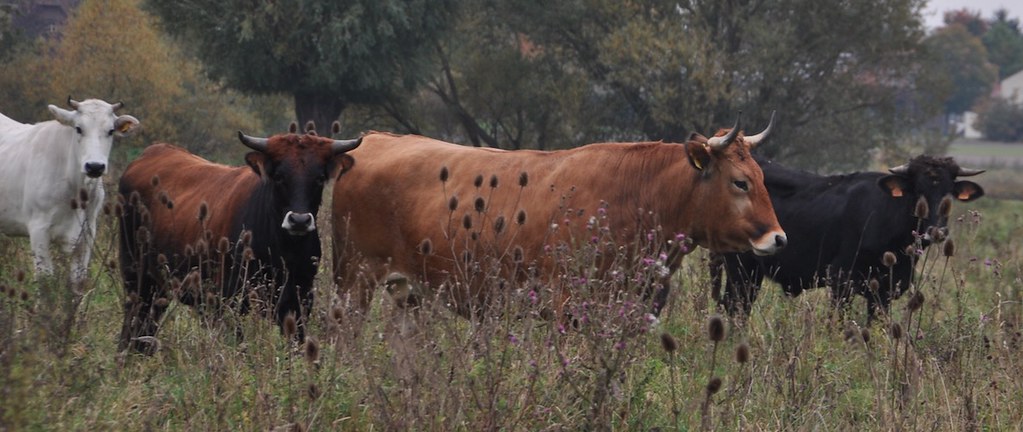
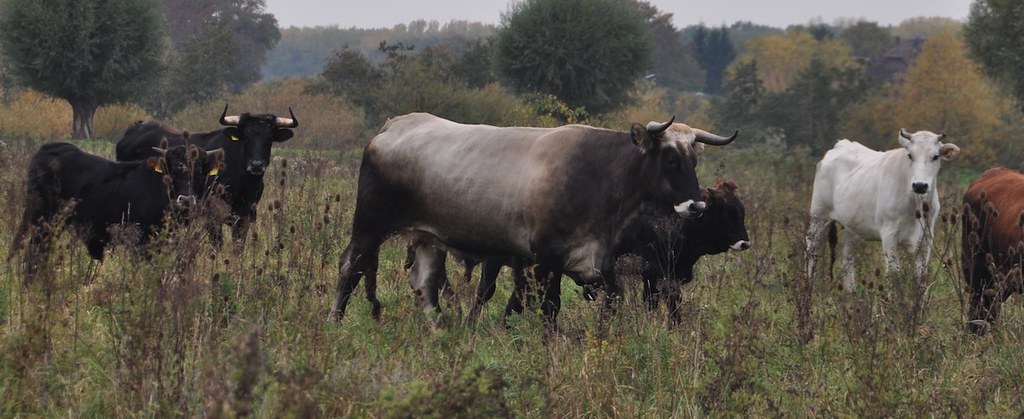
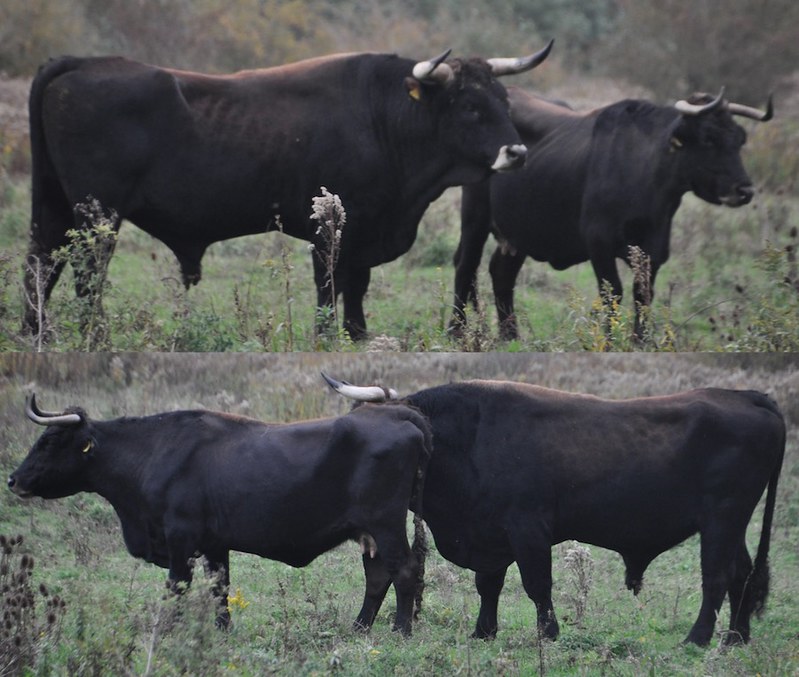
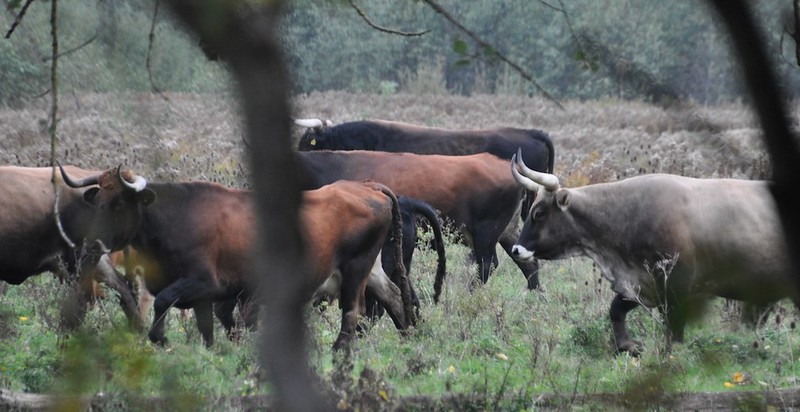
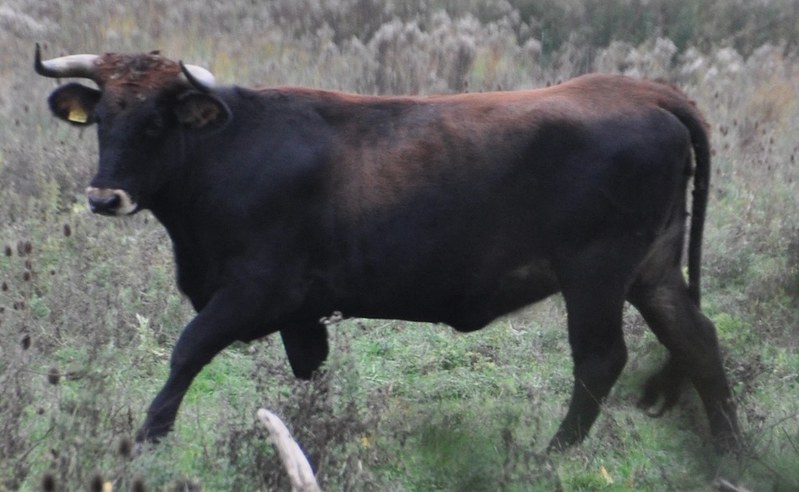
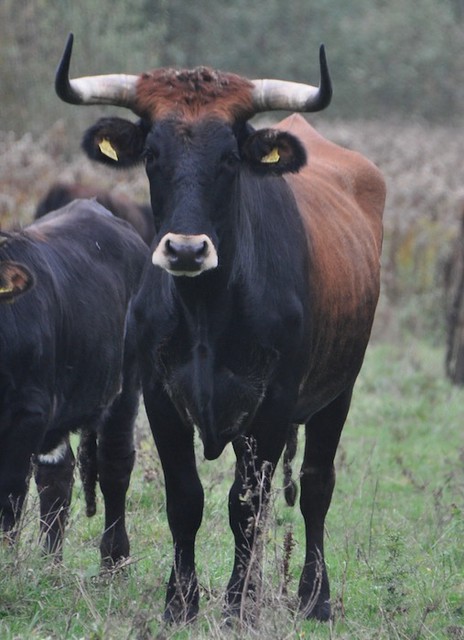
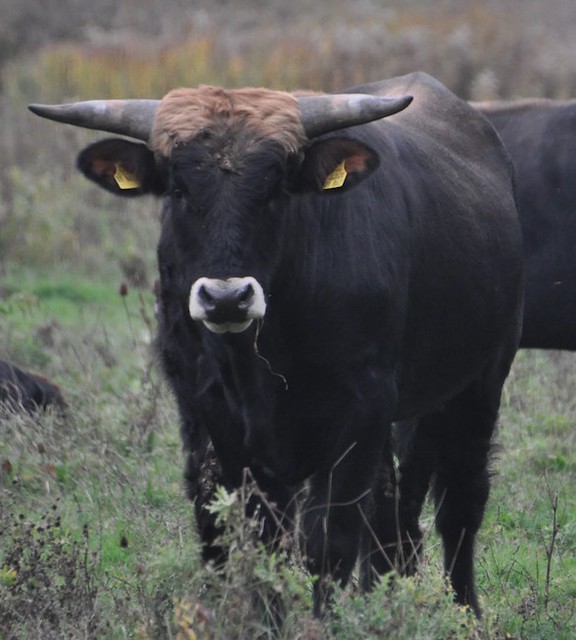
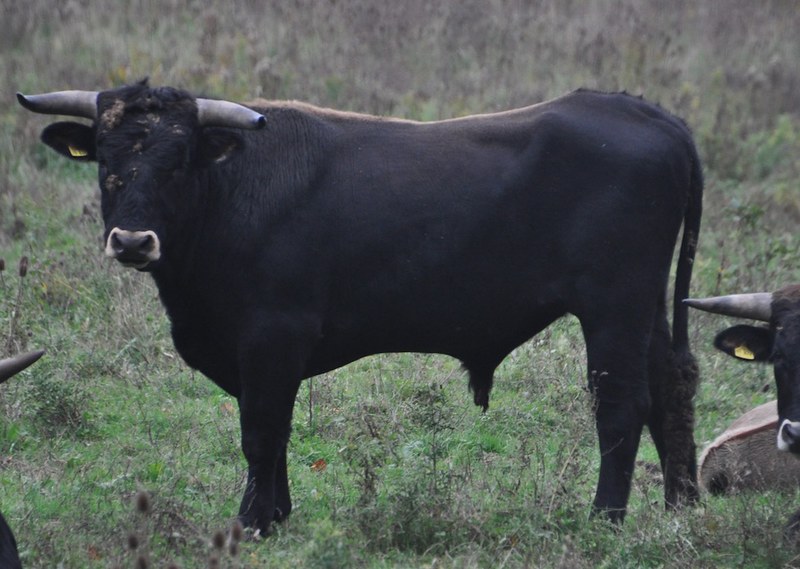
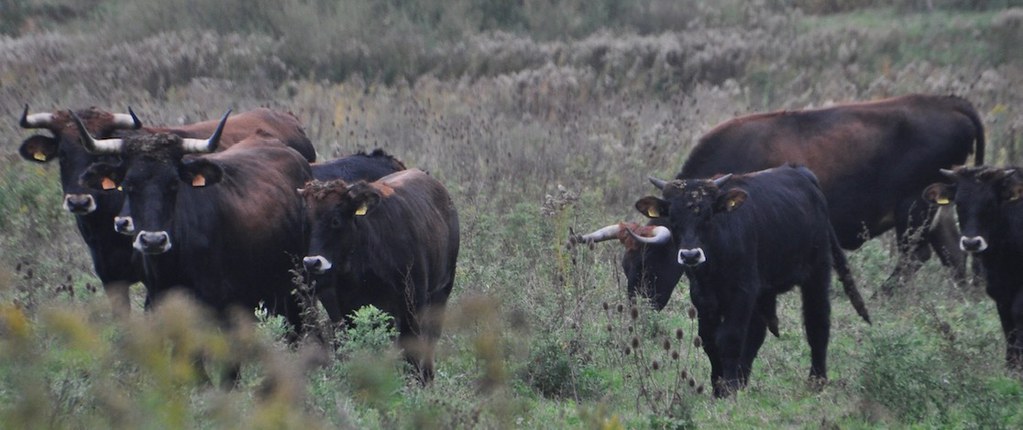
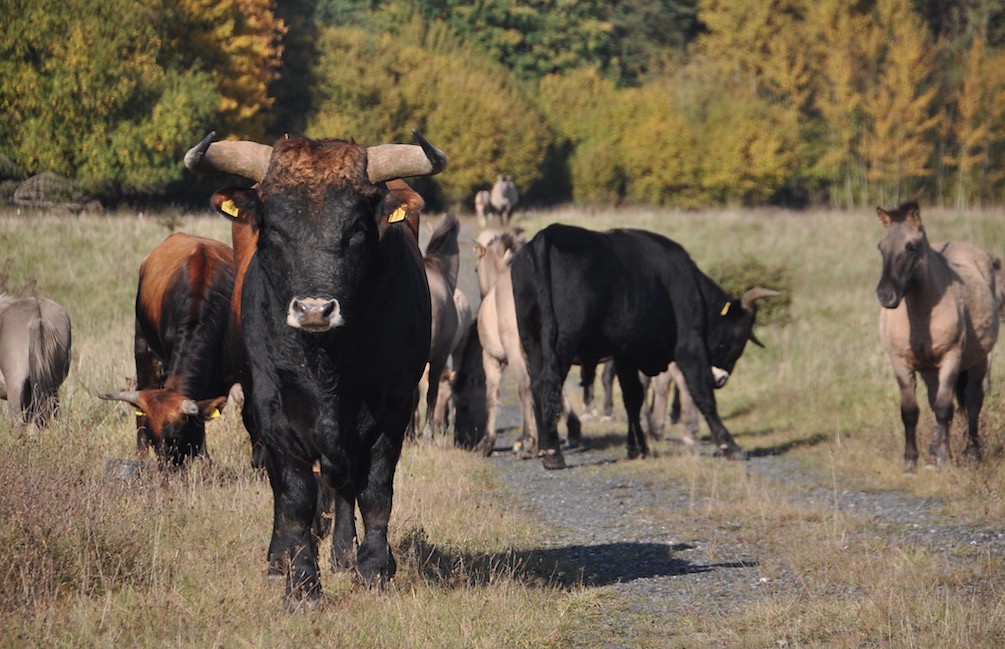
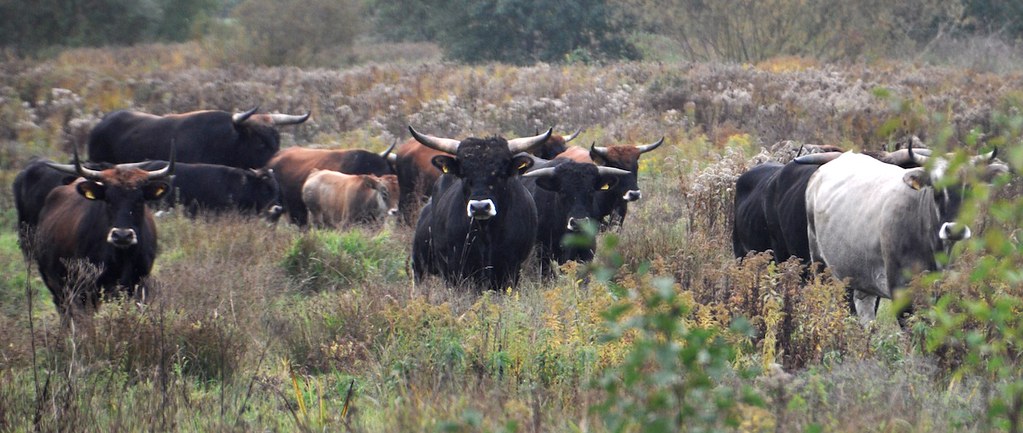
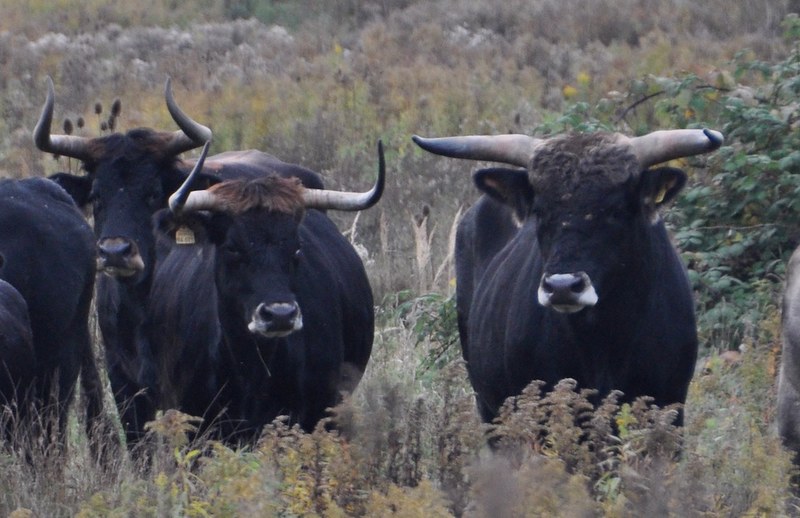
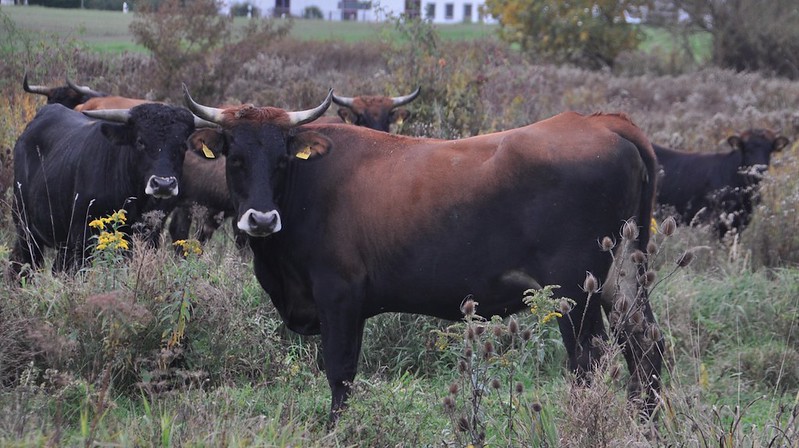
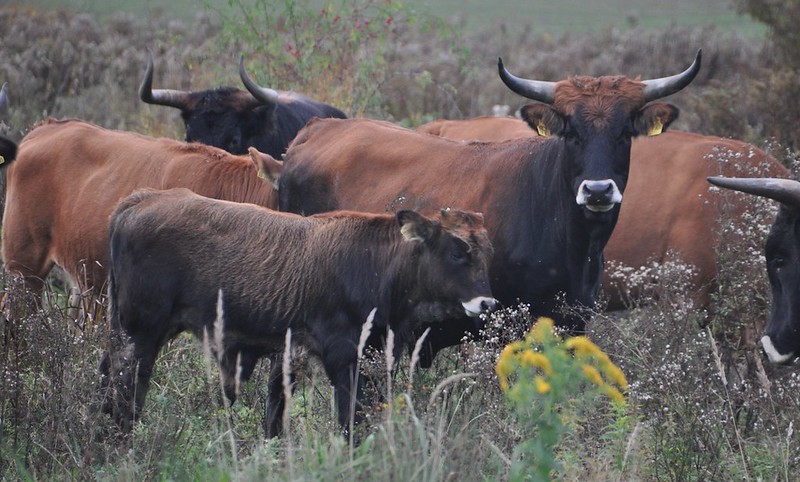
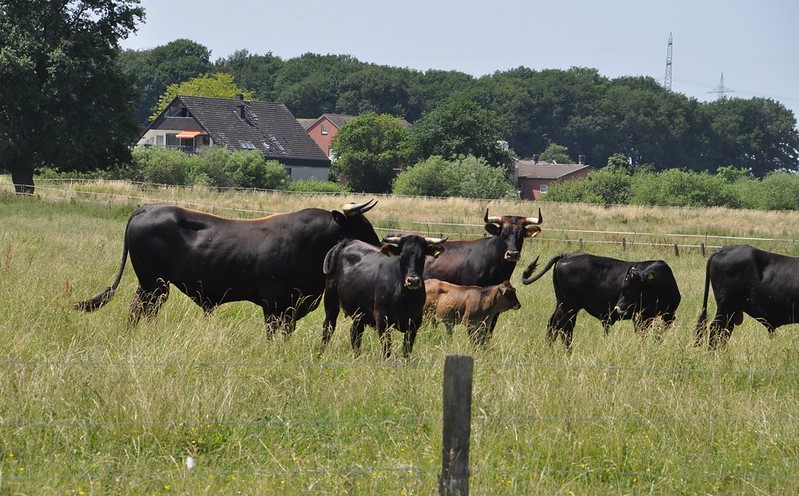
This herd is the largest (it is actually that large that they have to remove some more animals this year). The new breeding bull there is 42 623, simply called “Laokoons brother”, moved from Klostermersch-Süd (where he was in 2013) to Hellinghauser Mersch early this year (video). All in all, it is a nice bull despite its a bit massive body and the colour saddle. The face is not that long and its horns should have a stronger inwards-curve, but he has a prominent shoulder hump and it turned out he grew quite big. He is four and a half years old now. Dona Urraca looks small compared to him, although she is actually a large cow (in 2013, I was standing directly beside her. But I will not guess what size she is and therefore not about 42 623 either). With an age of 19 years, D. Urraca is the oldest individual in the Lippeaue today and still calving. Most of the animals with good, inwards-curving horns descend from her. There are two cows in this herd I like the most: 42 604 and 79 289. Both are fullblood sisters (parents are Lamarck and Julia, the red Sayaguesa), look good and astonishingly similar. I saw the former as a 2 year old in 2013 and thought she was very promising, and she turned into a really nice animal (and has born three calfs by now). Just look at how the horn shape changed. Another nice cow is 79 813, daughter of Lamarck and Lepisma, the Luca x Lidia cow. Horns and stature of that young cow are good. She is a cautious one, but I hope she will be kept in the herd. Lepisma has a young bull to date, that has Lamarck as father. It will not be kept, which is understandable: greyish saddle, longish body at this age already, and a somewhat compressed face. Loren, the large greyish one, is mostly Heck and Chianina with only few Sayaguesa in her. She did not impress me at all when I saw her in 2013, and when I saw that she is still in the herd earlier this year I was surprised. But I was told that she is a stabilizing element in the social structure of the herd, a kind of alpha cow. However, she has a greyish daughter with meagre horns that will be removed. Loren’s mother is Lirgit. Lirgit herself is a daughter of Luca and Lola, which was a daughter of the Dutch Heck bull Mator and a Heck x Sayaguesa cow. Yes, they also used a bull from Slikken van Flakee for some time some years ago and therefore not exclusively Neandertal Hecks. Some more cows need to be removed from the herd, I suggested to remove Laola ( Sayaguesa x (Heck x Chianina) ) because of the massive Heck-like body with the large udder (her head and horns somehow remind me of Maronesa), but they want to keep her, probably because of her good colour. An interesting example for how a cow might gain weight with time is 84 028, mother of Londo. Compare the photos from 2013 and 2015. 42 617 is going to be removed (too nervous), looking at her aspect it is perhaps not that much of a loss.
The herd has three Sayaguesa cows. The red one, Julia, was mentioned already. Another one has a reddish saddle but outwards-facing horn tips. The third cow also has this horn shape, is completely black but has a good skull shape. By the way, the red colour of Julia is because she is from a herd with influence from Alistana-Sanabresa. The Sayaguesa in the Lippeaue and in the Tauros Project are from the same herds (except the old ones).
Hellinghauser Mersch also has a number of young bulls with an age of at least one and two years. They have to remove some of them, and we discussed which one should be chosen to be shot the next day. It was not easy because the quality is hard to guess at that age, especially regarding horns and body shape. All of them had a flawless colour, and I am focusing a lot on body shape (see the bull I described as my favourite). I suggested to take the bull with the blond forelocks, which had the bulkiest trunk and the least promising horns. It was shot the next day. The bull I called my favourite looks good now, but mind that its trunk will become heavier and longer. I cannot say what the horns might going to be like, but it has a good hump already.
"Laokoon's brother" and Dona-Urraca. Notice the size difference.
Julia, the red Sayaguesa, on the left side in the foreground
79 289
42 604
Loren (middle)
Lirgit
79 813, quarter Lidia, daughter of Lamarck
Young cow, 42 289, and 42 617
Laola, Sayaguesa x (Heck x Chianina)
Lepisma and her quarter Lidia bull calf
Daugther of Lamarck and 604
42 604
84 028, Londo's mother today
Loren's daughter that will be removed at far right; Julia in front of 623
One of the Sayaguesa cows from the Netherlands
A "saddled" Sayaguesa
Young cow, I don't know the identity
The "blond" bull that was chosen to be selected out (father Lamarck, mother Lepisma)
My "favourite" young bull at H. Mersch, father Lamarck, mother Julia
Don't know the identity
Another young bull


One of the young bulls in the herd has a large white spot on its belly. Spots are seemingly passed on by cows only, and spotted individuals always have at least one spotted parent. So they are not sure if they should keep a good cow with spots or not (one example was 92 580, she was removed because of her white spots despite being quite good). In general there are several types of white spots (excluding colour-sided and roan-pattern now): those on the belly, “socks” on the hind legs and an elongated spot in the middle of the face. Only those on the belly occur in the Lippeaue. All four breeds might have brought that trait into the population.


For the next post, go here. 

Thursday, 19 November 2015

A second trip to the Lippeaue Pt.II: The Herds #1

The Lippeaue herds counted 101 animals when I visited the herd. There are five herds: Klostermersch-Südseite (25 animals, 6 being calves), Klostermersch-Nordseite (22 animals, 7 being calves), Hellinghauser Mersch (38 animals, 14 being calves), Disselmersch (7 animals), Kleiberg (7 animals, 1 being a calf). This post covers Kleiberg, Klostermersch-Nord and Disselmersch. Klostermersch-Süd and Hellinghauser Mersch are going to be featured in a second one. 
(I claim copyright for my photos, please do not use without permission)

Kleiberg

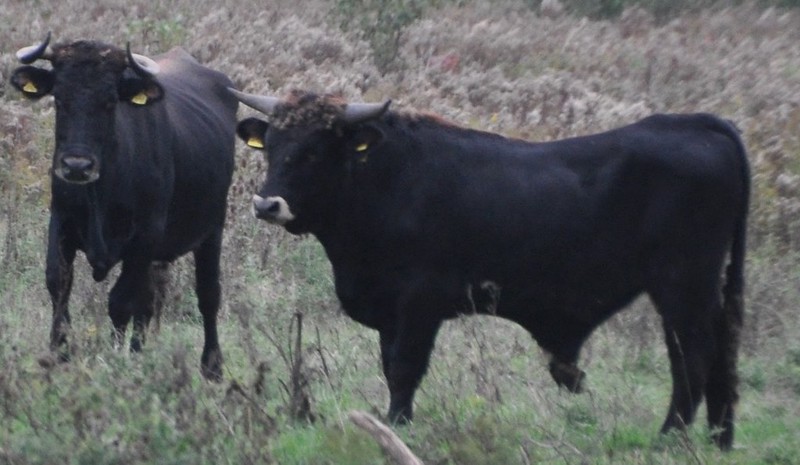
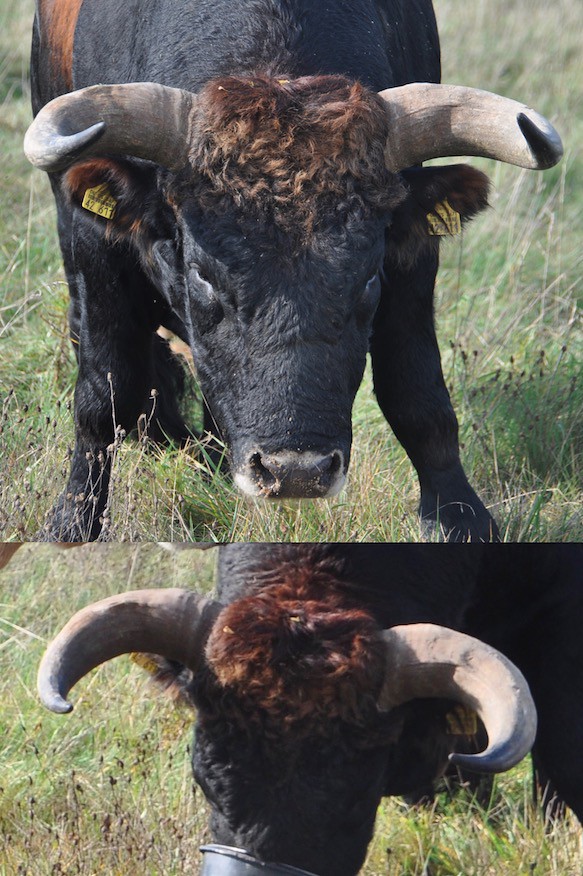
This site was created only two years ago in 2013, with a starter herd numbering 3 individuals. Now there are several adult and subadult animals. The breeding bull is Linnet, son of their now dead Sayaguesa bull Churro and a cow that I simply classify as a “mix” (without Lidia). Linnet made a good impression on me when I first saw him on a video, but now he looks short-legged, so it is not sure how long he will be kept as a breeding bull. He has a colour saddle, which I am not a fan of, and also a bit paedomorphic face. The horns have a nice curvature (see the photo), but in an aurochs they would probably protrude several inches longer (nevertheless nice, thick horns). The oldest individual is the cow Ludovica, one of the “oldies” (Heck x Chianina). She is the stabilizing element in the herd in the social sense. Together with Linnet she gave rise to a beautiful young bull (01 851). For now, 01 851 has good proportions, but the question always is how much that is going to change. The coolest thing to me in this herd are two Chianina x Sayaguesa cows. Bionade was introduced in my 2013 post already. She is 3 years old now. Her colour is very diluted, which is not surprising since she is half Chianina which have dilution genes on at least two loci (dun [semidominant], agouti [recessive]), perhaps more. The horns are tiny, but I do not consider that dramatic considering the potential she bears regarding size and body shape/proportions. She is rather tame, and I measured her at about 155cm. The other Chianina x Sayaguesa cow (79 810) has a really nice body shape: slender waist, hump and good proportions. In this respect she is one of the best cows in my opinion. Bionade has a calf plus a 1,5 year old daughter 01 816. She looks good, let us see how her horns are going to be. The father is Laokoon (Sayaguesa x (Heck x Chianina)), who was sold.
Breeding bull Linnet (Sayaguesa x mix)
Linnet's horns: good curvature, but should protrude longer 
Bionade, Sayaguesa x Chianina. 155 cm tall at the shoulders.
79 810, another Sayaguesa x Chianina.
Bionade and 01 816
01 816, Bionade's daughter
Ludovica, an old Heck x Chianina
01 851, son of Linnet & Ludovica


Klostermersch-Nordseite

This herd is the one with the highest Lidia portion, because (unless I am wrong), the Lidia x Heck bull Loco (now dead) was used as a breeding bull for a few years. Loco is the father of Latino, who also produced a few animals (by the way, my suspicion I had in 2013 that Latino is the father of this bull at the right at Pöppelsche was confirmed). He is the father of Limicola falcinellus, whose mother had Loco as father as well. She also has a bit of Chianina in her ancestry. Luzerne is a cow that could be mistaken for a “normal” Heck cow – she is indeed largely Heck, but also Sayaguesa and Lidia. The herd has a number of nice young bulls. The best one of those, 79 843 (I presume), a son of L. falcinellus, has large horns and looks nice over all. But he will be removed because he is one of the “nervous ones”. But there are other nice young bulls there as well that I am unable to identify because the ear marks are not clear on my photos. There is a half-Chianina cow (Linea) in the herd, which is another daughter of Lombriz and half-blood sister of Larissa. She is, not surprisingly, the tallest one in the herd, but not as tall as her sister. 92 579 is an interesting case because of her colour with the dark mouth. It is a dilution that is found in Highland pretty often, but also in Lidia and rarely appears in Heck cattle to (the most obvious trait is the dark mouth). Because it is way more common in Lidia than Heck cattle, I thought Lidia might be responsible for that colour at first. But in Disselmersch, there is another cow with that colour that does not have Lidia ancestry. Maybe Chianina carries the alleles for that colour, masked by the dilution factors. The cow Lambada has very good horns speaking of curvature (they could be longer and thicker) and is three quarters Heck and one quarter Sayaguesa. The cow 79 845 is the daughter of Churro (pure Sayaguesa bull) and Linea, so mostly Sayaguesa and Chianina.
One of the highlights in the herd is Lamarck. He is eight years old now and the new breeding bull at Klostermersch-Nordseite (was also used on Kl.-Südseite for a short time) now, and I still think that he is the best-looking Taurus bull I have seen so far. He is good in all respects – not perfect, but really nice. I guess most of my readers will know, but Lamarck is the son of Luca and Dona-Urraca, therefore Sayaguesa x (Heck x Chianina).
Another highlight is the presence of a Wörth cow named Nadia. There had been no pure Heck cattle in the Lippeaue for a few years (for good reason, of course), but I always thought a cross between a large-horned Wörth cow and a good Taurus bull would be interesting. Early in February, Walter Frisch sold his herd at Insel Wörth, and the ABU decided to by a good cow. Although huge-horned Erni was not available, they got a good one (at first I thought they would purchase Arizona, but they choose Nadia, which has larger horns). The Wörth cow and Lamarck are flirting around a lot, so we can expect the vision of a Taurus-Wörth cross becoming reality next year. Of course it will depend on chance how this combination will look like, but it is about the potential that is in it. If you look at the photos, you can also see the prominent size difference. 
Lambada, Limicola falc., and 79 843
Luzerne
Limicola falcinellus
Young bull, don't know which one
Linea, 79 843
92 579
79 845
Young bull, don't know which one.
Lamarck, Sayaguesa x (Chianina x Heck)
Nadia, a Heck cow from Insel Wörth
Lamarck and Nadia; note the size difference.

Disselmersch

This is the herd that changed the most since 2013. Back then, the herd was composed of animals that were mostly influenced by Heck and Sayaguesa only. The breeding bull Larwin was slaughtered because he was not good: small head, long body with short legs, long dewlap. The oldest cow there died and I was not able to find other individuals of the old herd in the current stock list. The new herd is composed of young individuals. The bull, 01 856, is not bad overall. I especially like the shape of his head, but the horns are really small. The bull is about one and a half years old, so they would continue to grow, but they would still remain less then desirable. So it was decided that he is going to be slaughtered and – if I remember correctly – replaced by the young bull from Kleiberg. 01 856 is the son of Laokoon and Larissa. The best cow there is 42 650, a daughter of Lamarck and Lirgit. 79 842 is a daughter of Lamarck as well, and her mother was 42 634, a “true F2” Sayaguesa x (Heck x Chianina) (now butchered, behaviour was undesirable). That means she might be genetically more stable, but her aspect is not that impressing to me. 01 852 is another one of the three dark-mouthed cows. Her parents are Laokoon – Sayaguesa x (Heck x Chianina) and Lale – (Heck x Sayaguesa) x (Heck x Chianina). So she rules out that Lidia is responsible for that colour variant. The young greyish cow looks promising (don’t know her combination EDIT: She is a fullblood sister of Larissa, therefore 62% Chianina) in regards to her proportions and body shape, but unfortunately she might be infertile because she is twin with a male.
The bull 01 856 in the middle
79 842 (left) and 42 650 (right)
01 852. With its pink nose and the dark mouth, her colour reminds me of Highland and other breeds.
Well proportioned but maybe infertile.
By the way, here you can have a look at a video of the Disselmersch herd (not filmed by me):


For the next part, go here. 

Wednesday, 18 November 2015

A second trip to the Lippeaue Pt.I: Breeding in general

The Lippeaue reserve is the largest Taurus cattle breeding site in Germany and where Taurus cattle had their start in 1996. Crossbreeding with Chianina, Sayaguesa and also Lidia had a very positive effect on the authenticity of Heck cattle as an aurochs substitute. In 2013, I met with Margret Bunzel-Drüke and Matthias Scharf from the Arbeitsgemeinschaft Biologischer Umweltschutz (ABU) to take a look at the Taurus cattle living in the Lippeaue reserve and to discuss. Now, two years later, I went to the Lippeaue once again to see how the herd developed and progressed, and we met again. Just like in 2013, it was a very enjoyable, interesting and informative trip!
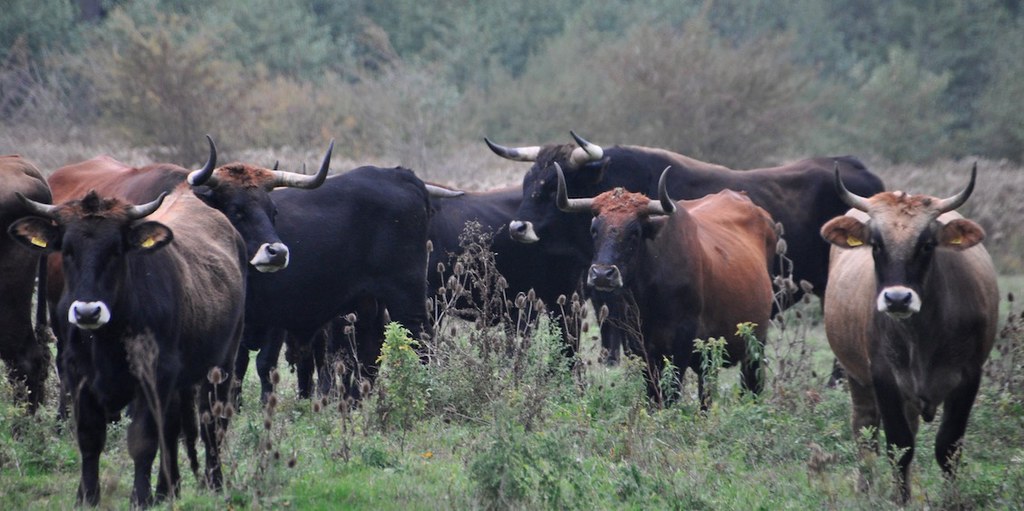
 
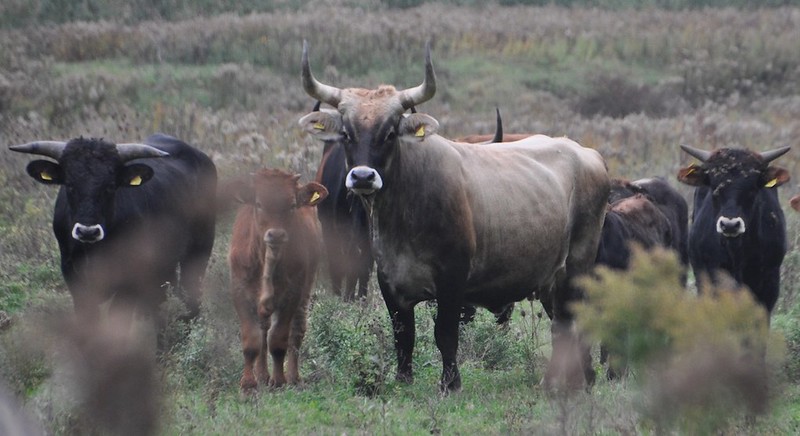
Part of the herd at Hellinghauser Mersch
I had so much material to go on that my post got ever longer (11 word pages), so I decided to split it up. The horses of the Lippeaue will be covered in an own post.

Why are the Lippeaue herds so interesting to me? Because they serve as a kind of case study to me; these Taurus cattle are easily accessible to me, all of the individuals are identifiable thanks to their ear marks and their ancestry is documented. You see how certain breed combinations work out and how many ways there are, how coincidental heredity is, as much as how the population is progressing since the start of crossbreeding in 1996. Apart from that, they are on average really aurochs-like and all their founding breeds are good in their own respects. Of course, as many beautiful and qualitative individuals have been born, as much also went to the butcher – that’s heredity. When you read that certain individuals were or are going to be removed, “removed” does not always mean they are going to be slaughtered. The better ones are usually sold to other breeders.

This time I saw all five herds (Hellinghauser Mersch, Klostermersch-Süd, Klostermersch-Nord, Disselmersch, Kleiberg). Twelve animals were sold one day before I arrived, and the herd currently numbers 101 individuals according to the current stock list. But mind that 53 are below the age of two years. Since 2013 young individuals grew up, some in a quite satisfying way, others were removed, breeding bulls were moved, removed or replaced, and also a number of new genetic combinations were born. I am going to go through the herds one by one.
As to how the herd progressed compared to 2013, the span of two years is not sufficient to watch considerable differences – it is not even one generation span. But what I intended to look at, and saw, is which individuals were kept in the herd and how those individuals that looked interesting to me back then have developed in the meantime.

Unfortunately the weather was not as warm and sunny as the last time, so the recent photos are not as shiny and high-resoluted as those from 2013 are. Nevertheless, I am satisfied with most of the shots.

The cattle primarily serve as tool in the reserve, and breeding them towards an aurochs-like appearance is actually a kind of “side project”. Therefore there are some limitations. First of all, area is limited, and consequently the population number as well (they have both a minimum and maximum). And so it is not always possible to keep as many good animals as you want. Another thing is money and bureaucracy. It would cost a lot of money and effort to pick the best cattle from anywhere over the world for breeding, f.e. Corriente. Even artificial insemination would not be easy, because the cows have to be tame enough for that. Due to the restrictive laws in the EU, its even rather difficult to move animals within a country, let alone between European countries. Because of the limited amount of space and money, it is not always possible to try breeding strategies that might be more promising than the “classical way”. Because, again, breeding-back is only a site project of restorative grazing in the Lippeaue. The primary function of the herds is their positive effect on the ecosystem in this nature reserve.

Nevertheless we discussed some ideas for breeding strategies, such as replacing bulls and cows at faster rate to speed up the progress of the herd, f.e. to exchange breeding bulls once in four years. I was told that the problem with that idea is that it takes its time until one can see how good the animal is going to get. Horn growth and body shape are not completed before at least the age of four, as well as body size. Setting up an extra herd for young bulls might be a desirable idea, but the problem is that there is not enough space for it. An inbreeding-based breeding strategy based on “true F-generation” mating (as described here) would have its pro’s and con’s. Inbreeding of that kind would certainly lead to stabilization, but also to a high dropout rate due to diseases and unsatisfying phenotypes. Many of those animals would not be of interest for other breeders, and that would not be affordable for the ABU.
So they have to stick with the “classical” breeding method: using a breeding bull with desirable traits, and selecting out the unsatisfying animals.   

You might ask then, why not doing stronger selection if other strategies are probably not feasible? Because, just like the area should not be over-crowded they also have to maintain a certain population number for efficient grazing. So a certain quantity of the “ugly ones” has to stay in the herd as well.
Not only that, you also have to keep an eye on the social structure within the herds. In grazing projects, zoos or pastures of private breeders, groups of cattle with different behaviour and personality are put basically randomly together on a confined area. In nature, cattle form herds in a way that works best and arrange functional social structures for themselves. But in this situation, the cattle live together in a confined space if they want or not. So there is potential for conflicts. Some individuals are stabilizing elements in a herd, others might be even destabilizing. Therefore you also have to consider the social structure within the herd, disrupting it might lead to conflicts.

Another issue is temperament. It varies from individual to individual within the population. Of course does the influence of Lidia increase the risk of having a nervous and hot-tempered animal, but there are also Lidia influenced cattle that are comparably calm while some of those without Lidia might also turn out to be “on the nervous side”. You might discuss if nervous, cautious or hot-tempered behaviour is the more “natural” state or not (surely true aurochs were no pets). And some of these might also have some really good looks. But: one has to work with those cattle, and handle them. The law dictates blood samples, ear marks et cetera. It is not a good idea to keep an animal that literally explodes when being examined or transported and afterwards tries to harm or kill you. So there is no space for overly nervous and hot-tempered individuals, no matter how beautiful they are. That’s pragmatic, but everyone would do so (after all, it is no coincidence that most grazing projects work with domestic cattle instead of wisent). I would not say that these particular Taurus individuals are necessarily “aggressive”. I guess no Taurus bull or cow would attack without a reason, and some cattle do react quite “domestic” when being handled, others less. And honestly, I suspect that most other cattle breeds, at least the primitive ones, would not react differently living under the same circumstances.

So breeding would be way easier if there was a large area accessible that has the capacity to support a large quantity of cattle. The animals would be able to form herds themselves, so that one would not have to pay too much attention on social structure. Temperament would also be no big problem anymore if the population gets a special status like that in the Oostvaardersplassen (it is, however, in question for how long that status will be maintained in the future, unfortunately) so that annual handling is no problem anymore. And large quantities would enable stronger selection. Another advantage would be the partial natural selection that is the consequence of bulls fighting for their breeding rights plus female selection of “sneakers”.
But unfortunately, a scenario like this is probably a dream. Or at least not in sight.

What makes selection tricky is that different people have different priorities. The goal of Taurus cattle is and was to surpass Heck cattle in size and horn shape, also to improve their elegance. Now, Heck cattle is surpassed – but that does not mean that all aurochs traits have been achieved satisfyingly. My personal priorities are size and body shape/proportions, because they are strikingly different from most modern day cattle. I also appreciate sexual dimorphism very much and I am dislike diluted colour variants. Margret, on the other hand, focuses more on horn curvature because the aurochs – as we all know – had a horn shape that was also very characteristic. I consider bull sizes from 160-165cm upwards satisfying, but not below. Of course it is legitimate to be satisfied with bulls ranging from 150-160 cm as well, since not all aurochs were giants (yet still my dream is a 170cm bull…). They tolerate the colour saddle in bulls, which is something I would not do (reduced sexual dimorphism), but I was told that only about one in ten or eight bulls have a saddle (so if a breeding bull has this trait, it is not because it is widespread in the population but because the bull was chosen for other, good traits). Where we agree is that there is room for colour shades in the coat colour of the cows – written and artistic sources are not all too precise about that, and wildtype-coloured cows occur in various shades that all look believable, and perhaps there was regional variation. But I, personally, think this colour shade for example shade is too light. On the other hand, colour is controlled by only a few loci so it is not as hard to breed as other traits like body shape or size. We agree that black cows can be tolerated, as long as they are not too common in the herd (f.e. 50% would definitely be to high).
 
Lucio, now dead, a very large Sayaguesa x Heck bull and one of the founding individuals.
Next to him, a pure Heck cow - notice the size difference. Photo © Martin Scharf.
I have always been keen on knowing the size of Taurus cattle. Lucio, a beautiful but massive Heck x Sayaguesa, one of the first Taurus bulls that were born, was very large and measured somewhere between 160-165cm. I tried several times to calculate the size of Luca, the Heck x Chianina bull whose skull is hanging onmy wall, using photos and its horn span. The result I considered most reliable was 148cm, but I was told that must have been incorrect. Luca was described as a very large one that was probably the same size as Lucio.
To get some more data, I took a yardstick with me and we were able to measure 3 more individuals that were trustful enough. By the way, I had the opportunity to stroke two cows and a calf, which was nice.


 The next post is going to cover the herds and the current population as a whole. With, as promised, lots of photos. 

For the next part, go here. 

Friday, 13 November 2015

Soon, I promise

As announced in my previous post, a post on my recent 2015 trip to the Taurus cattle herds at the Lippeaue, Germany, is about to come. But I am really busy with university at the moment, the article turned out to be quite long and I have a lot of photo material. So sorry for have you waiting for so long. But the post(s) is/are about to come in a few days. 
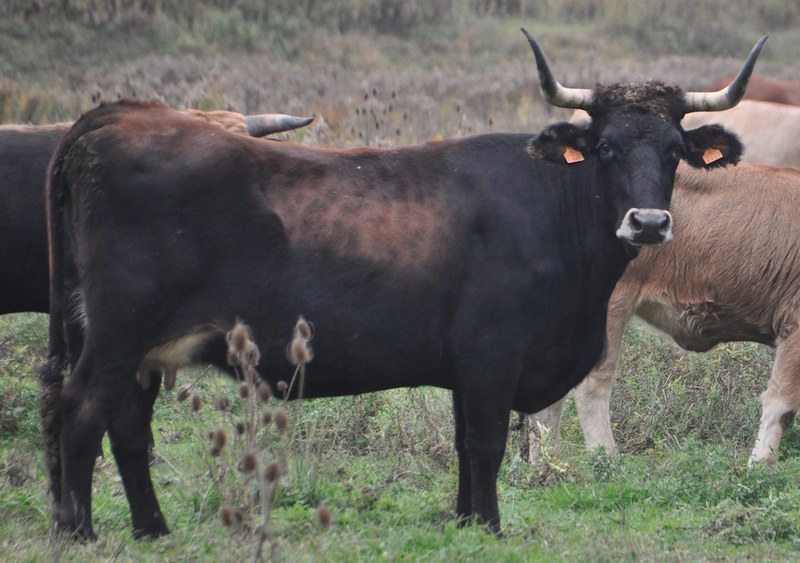
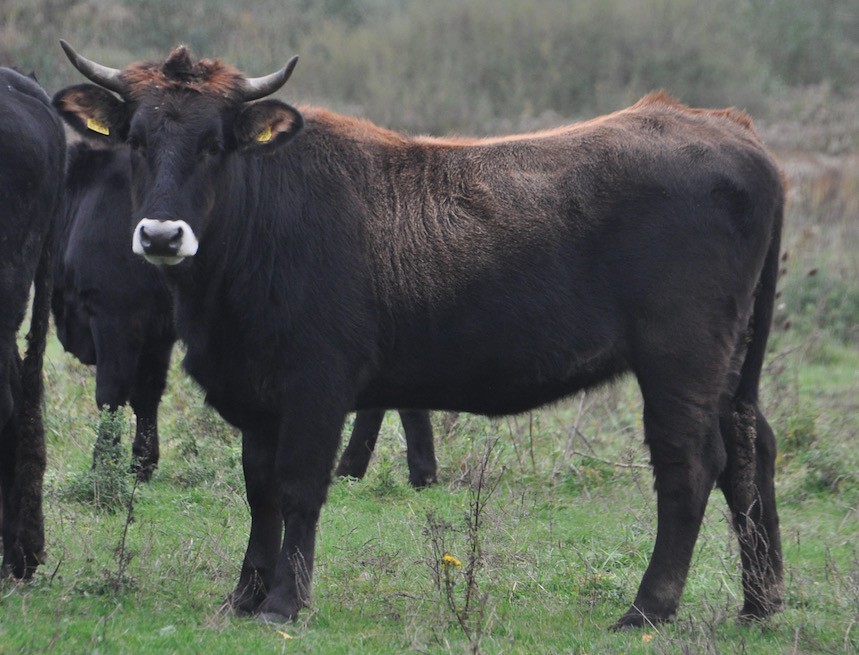
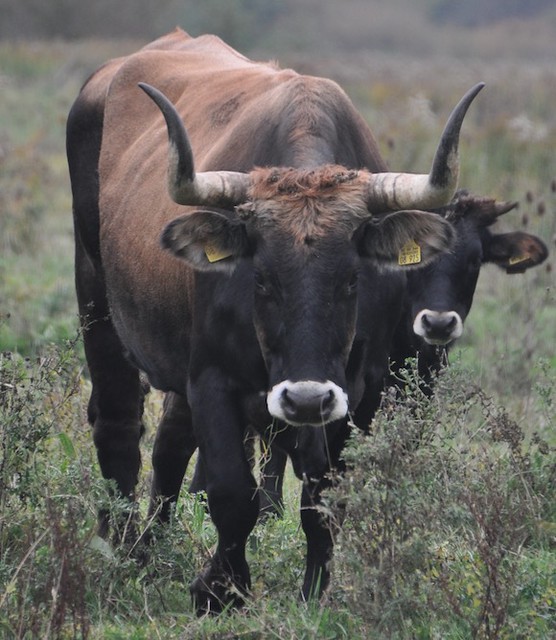
Until then, another spoiler pic: 

Monday, 26 October 2015

Back from the Lippeaue

My first trip to the Lippeaue, the largest Taurus cattle breeding site in Germany and where the breed had its start, was in 2013. Now, two years later, I visited the reserve Naturreservat Lippeauen in Germany again to see how the herd developed within the the last two years. 
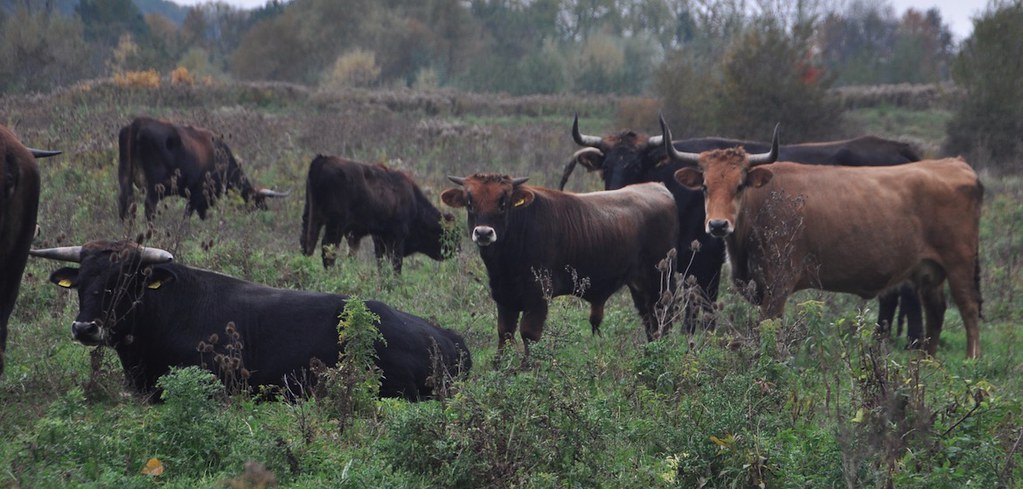
At the moment I am preparing a large, extensive post on my trip and the animals with lots of pictures, but it will take its time until it is finished. So for now, a little teaser in form of a photo: 

Saturday, 17 October 2015

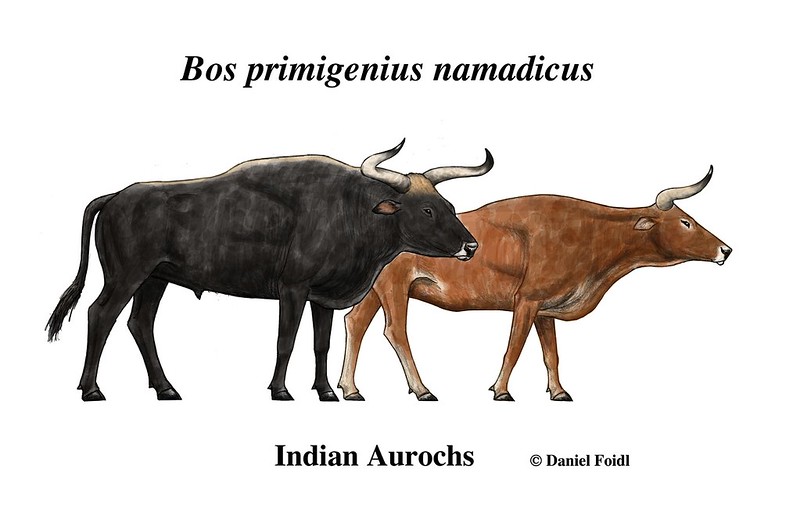
Life illustration of the Indian aurochs

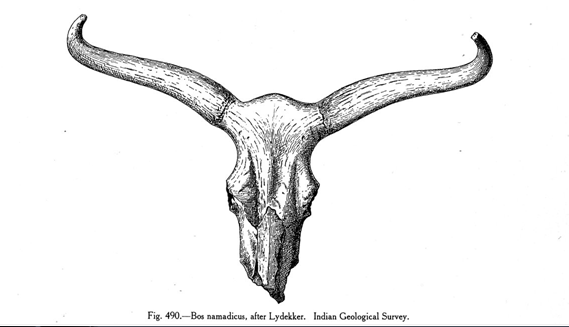
The whole aurochs issue is centred almost entirely around the European subspecies, B. p. primigenius because it is the best-documented subspecies and survived the longest. The Indian aurochs, the wild ancestor of the zebu, was the first one to disappear and is very enigmatic. There are only few skeletal remains (a number of crania, some postcranial material), no artistic depictions have been claimed to show this population nor are there written accounts. What we can infer from the fossil-subfossil record is that namadicus was smaller than primigenius (van Vuure 2005 mentions that some crania were slightly smaller than those female Pleistocene primigenius). But proportionally, its horns were larger and more wide-ranging (the only graphic representation of namadicus material I was able to find is that skull).
Therefore, much of its appearance is unknown. In a post I did two years ago, I tried to deduce some additional traits based on the scarce info we have and what seems credible looking at living zebu and relatives. I consider the presence of a fleshy zebuine hump unlikely for the wild-type (see the 2013 article). From all the traits I hypothesized back then, here is a short summary plus some new thoughts regarding colouration: 
- proportions and body shape similar to primigenius, including a hump caused by high processus spinosi (no reason to think otherwise)
- a posteriorly slightly down-turned pelvis
- The dewlap might have been longer than in the European subspecies (although probably not as extreme as in living zebu). Bovids in tropical climate often have fleshy appendages for display and thermoregulation.
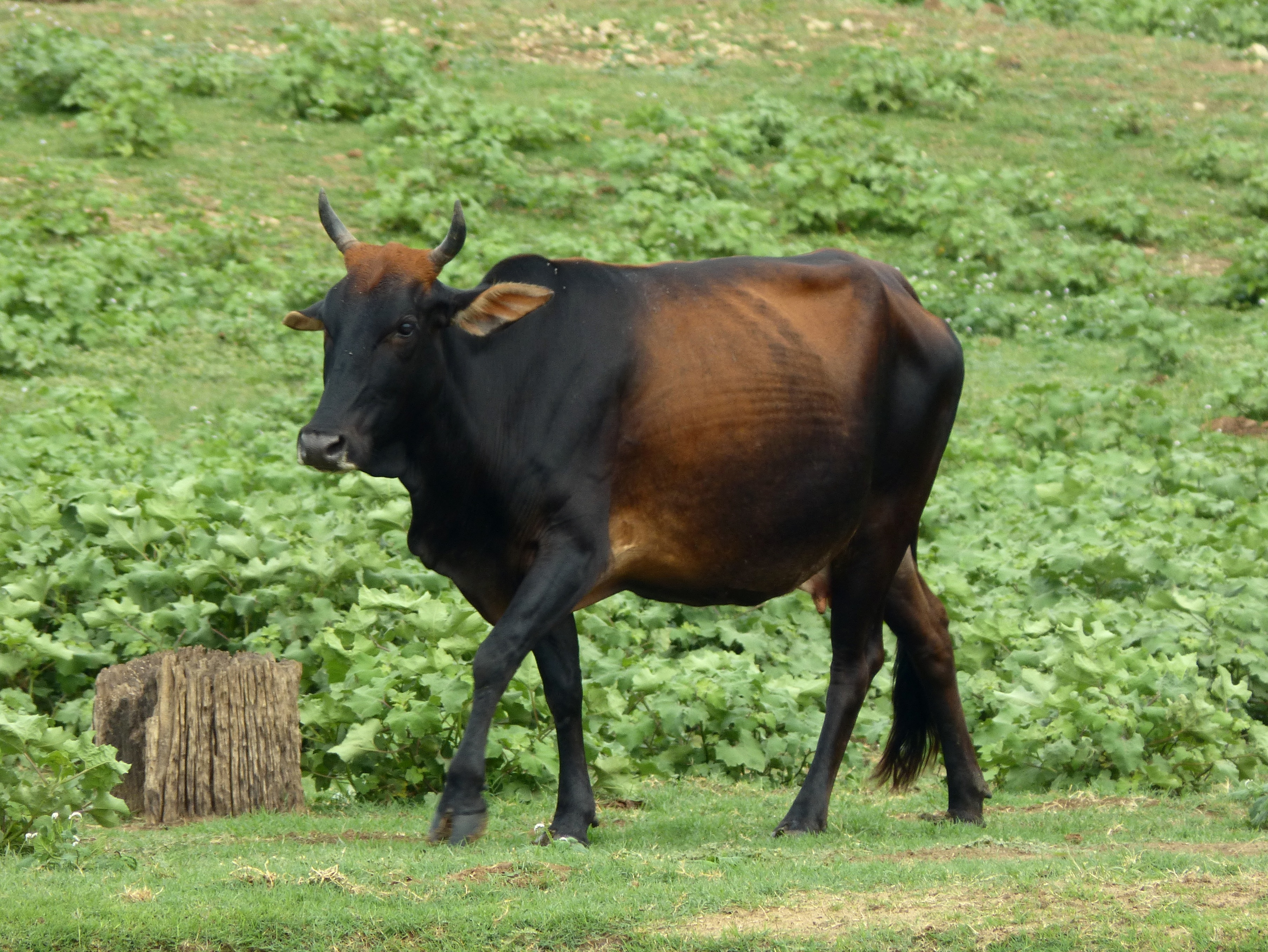
- Since all un-mixed zebu breeds (as far as I know) have a typical E+//E+ colour, namadicus probably had a colour very similar to the European aurochs: black or very dark bulls, much lighter coloured bulls, muzzle ring in both sexes and a dorsal stripe at least in bulls. Many zebu have a diluted colour similar to podolian cattle, but there are some that have a colour not different from the European aurochs (see here). Zebus usually have the “zebu tipping gene” that causes a lightly coloured area between the forelegs that may also extend to the belly and dewlap. This might either be a mutation that happened right at the base of domestication, or it was a trait possessed by namadicus already. In my new reconstruction, I illustrate the latter option. The question if the hair between the horns had a colour different from the rest of the head is as unclear as it is in the European subspecies (it probably did not have the curlyforelocks of the European subspecies, since no zebu and no tropical bovine has them). Some zebu show white rings around the eye, even males, as on this photo by Markus Bühler. Perhaps this was the case in namadicus too, especially because Banteng also show it. I consider it likely that cows would have it, but perhaps not all bulls. Many aurochs-like-coloured zebu bulls have a saddle, and this kind of saddle is different from that of taurine bulls: interestingly, their saddle is not centred on the back of the trunk, but on the sides. This might be a mutation as well, but for this illustration I speculated it is a primitive state.  
All in all we get a more colourful aurochs for India. That is not unlikely, because bovids of tropical climates are often rather colourful.

Before I present my current reconstruction, I want to share some comments on my old one (by the way; I have to admit that I am seemingly a kind of pioneer in illustrating B.p. namadicus, I did my first reconstruction in 2011 and I saw only one further illustration that might be namadicus). The old one has some anatomical flaws (position of the hump in the bull), and artistic ones (perspective of the horns). I drew the waist a bit too slender for my taste now, and the deep ribcage plus the high, straight hump makes it look too gaur-ish too me today. Regarding the cow, I would still agree with it more or less nowadays, but I will illustrate a female Indian aurochs another day. So for now, I drew only a bull. Colour and stature were inspired by this miniature zebu bull.

It might surprise that all its living descendants look so different. But I would say that is because there are simply no truly primitive zebus left. Imagine all primitive taurine breeds would vanish and the only breeds we would have left are such like Angus, Holstein, Galloway and Belgian blue. I cannot say why there are no primitive zebus left. It is possible that a genetic bottleneck was responsible, or strong artificial selection or both.

As I outlined in my 2013 post, a breeding-back project for B. primigenius namadicus could be done. But only a rather minimalistic one, since we have no precise idea of the wild-type and all descendants are rather derived. On the other hand,  there are zebus which have a rather aurochs-like colouration, such as those linked in this post, and there are breeds like Some Gudzerat/Kankrej and other zebu that have proportions and horn dimensions that are good and also useful horns (in our minimalist expectations). Watussi have horn sizes that would help compensating the small horn sizes of other zebu, and some of them also have a curvature that is not bad (being Sanga cattle, they are mixed with taurine cattle; but the reverse also is often the case so why not tolerating it). Looking at site for primitive, useful zebu in India and south-east Asia might also show up some helpful results.
I think it would be possible to breed a population of zebu that have the right colouration and horn size, and a horn curve plus proportions that is tolerable. I might illustrate this idea too some day. They would still show some of the “weird” zebu traits (overlong dewlap, large hanging ears, fleshy hump). Nature would on a long-term sight further refine traits such as body shape, neck- and shoulder muscles (zebu hump vs. spine-caused hump), dewlap, horn orientation (there are no zebu with forwards-pointing horns that I know of) and so on. Since we have no certain clue on colouration, a certain amount of variation should be permitted (after all, even the grey dilution factors could be a primitive state).

I am going to illustrate the African subspecies, B. p. africanus, soon.


Thursday, 15 October 2015

Tauros cattle arrived in CZ Republic

Today I was addressed to an article by derstandard.at by Margret Bunzel-Drüke from the ABU. It reports that a small starter herd of Tauros cattle have arrived in the CZ Republic. See here or here, for example. You see some photos of the herd on each of these links.  

It has been prepared to set up a Tauros site in this country since at least 2010 if I remember correctly, now a herd of one bull and five cows accompanied by 15 Exmoor ponies have been released in the ex-military base Milovice on 40 hectares. 

The background of these six animals is nebulous to me as usual. They are all rather young, so they might be second-generation crosses (at least some of them). I think that this cow, because of the shape and size of its horns, is likely to be half Highland x Maremmana, I have no idea what the father might be. The other long horned cow on the larger photo, might be Maremmana x Sayaguesa based on its looks, or of the same combination as the other one (because of the longer hair on its belly). The bull next to it looks as if it is the son of their Pajuna bull, it might also have a Highlander and/or Maremmana in its ancestry because of the large horns. Regarding the other animals, I have no clue. They could have anything from Sayaguesa, Pajuna, Tudanca, Limia and also Maronesa (in the case of the low-horned cow on this photo) in their ancestry. 

All in all, based on what I have seen so far, the sexual dimorphism in the Tauros herds is weak so far. That is because the founding breeds are variable in this respect. In this variability, the Tauros animals tend to be on the "dark end" of the colour spectrum, as far as I can tell. It is not possible to tell what the horns will be like yet, because there is so much variability to be expected. I hope that the influence of Highland and Maremmana is enough to breed spectacular horn sizes. It is nice to see that many of the early cross products are slender and well-proportioned right from the beginning, what is not surprising since most of the founding breeds are of that type. 

Wednesday, 7 October 2015

News from Lauresham

The first breeding site of the Uruz Project to be set up was Kloster Lorsch, Hessen, Germany. It is run by the Freilichtlabor Lauresham and the Förderkreis Große Pflanzenfresser im Kreis Bergstraße e.V., composed of a herd of very useful Chianina cows plus a young Watussi bull that had died in winter 14/15, delaying the project.
Recently both the groups mentioned plus Felix Hohmeyer (cooperating with them) quitted the cooperation with the True Nature Foundation and the Uruz Project. Therefore the herds at Lorsch and Bielefeld are not part of the UP anymore, therefore the Freilichtlabor and the Förderkreis Große Pflanzenfresser are doing breeding-back on their own now.
The herd at Lorsch currently consists of Chianina cows only, but they got a new young Watussi bull that is kept somewhere else until he is old enough (you might wonder why they don't by an adult one in the first place, the reason is that there was none available). The herd at Bielefeld currently consists, as planned, of a number of Watussi cows from Brüggen (NRW), plus the young Chianina bull "Bruno", a son of the cows from Lorsch.
Young Chianina bull plus a Watussi cow at Bielefeld. Kindly provided by Claus Kropp.
They are pretty sure the bull covered the cow already, so that we can finally expect a first-generation cross animal for 2016. At first glimpse looks "small", but keep in mind that he is only 1 1/5 years old and therefore he is quite large for his age. Furthermore, he is the son of the largest cow at Lorsch (165cm), therefore Claus Kropp is confident that he will get really tall.

A new herd in Einhausen is planned to be set up for this year. They want to keep with the original idea of creating to breed lines consisting of Chianina x Watussi plus Sayaguesa x Hungarian Grey/Maremmana. I don't know which one the new herd is going to be part of.

They have created a breeding book plus a photo gallery to document the identity of the animals. It is not sure whether the photo gallery and breeding book will become online or not.
This is a thing the Tauros Project missed, leading to a situation where the responsible people sometimes don't know the identity of some of their animals themselves, as far as we "outsiders" know.