Monday, 30 March 2020

Some more photos and videos of TaurOs cattle

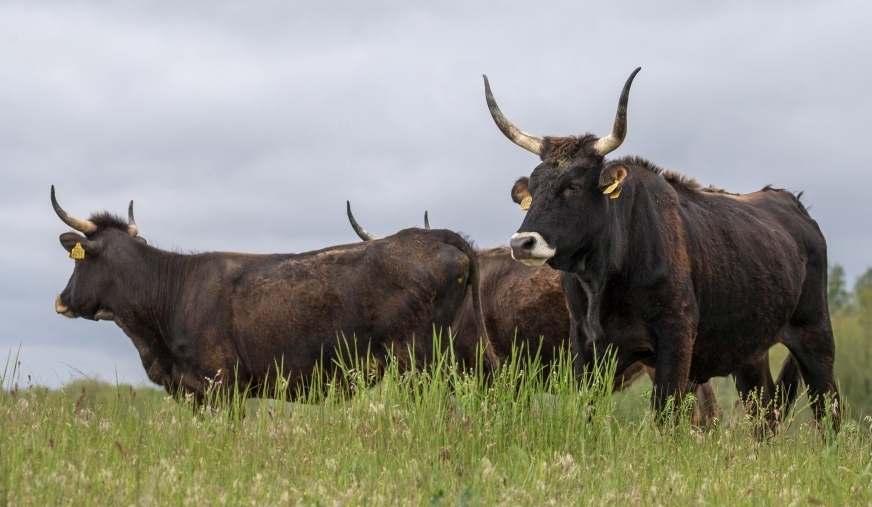
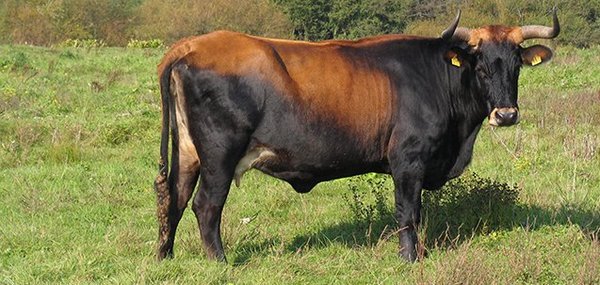
It is not easy to find information on the TaurOs cattle herds. While doing google search I found a photo of a TaurOs bull in Keent, Netherlands. 
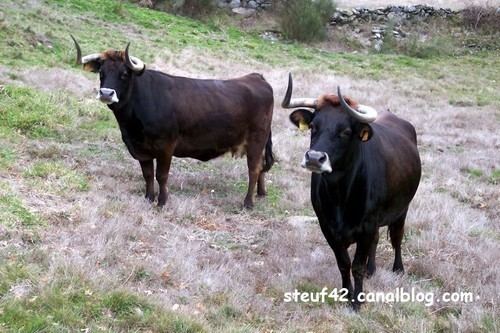
The bull looks much like a Pajuna, but the horns do not fit at all. They are much larger and upright than in Pajuna - maybe it's another cross with Maremmana, or a different type of cross. It is hard to guess based on the looks of the animal alone. Here are some cows from Keent. Based on colour and horn shape they might be Sayaguesa x Maremmana crosses, but could also be anything else. 

I also found two new videos of the herd at Milovice, Czech Republic. This video shows, additionally to the bull that looks a bit like a Texas longhorn, two new bulls (6:48). I don't know if they are descendants of the cows in the herd or if they have been moved to the herd recently. Based on their looks they might have Pajuna in their genes. The other video shows some atmospheric shots. 

Looking at the pictures and videos, horns protruding outwards or having a corkscrew-like shape are very common in TaurOs cattle, additionally to upright Maremmana-like horns. The goal should be horns facing forwards and inwards as in the aurochs. Of the breeds used in the project, Maronesa is the only one that has inwards-facing horns on a regular basis. So the horn shape of TaurOs cattle can be improved by producing a number of good Maronesa crosses with inwards-facing horns and using them as breeding bulls at their numerous breeding sites. Otherwise it might become rather difficult for the project to achieve aurochs-like horn shapes. 

Sunday, 29 March 2020

Two new aurochs drawings

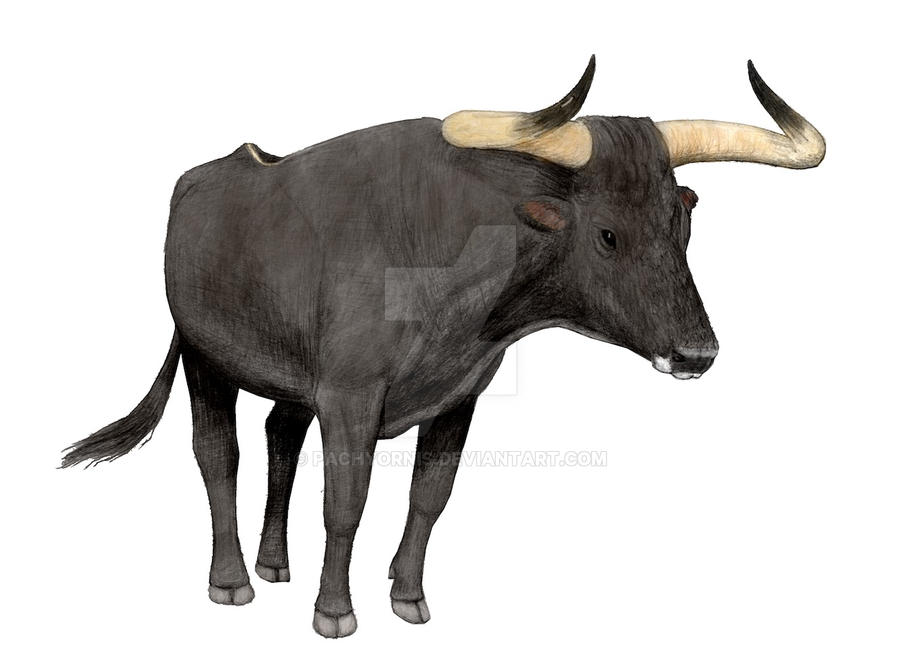
Recently I did some new aurochs drawings, one of them is a reconstruction. 
This is a reconstruction of the 182cm tall Vig specimen, based on this photo. The Vig bull is the largest specimen on display. Its horns are more upright (somewhere between 80 and 90° to the snout) and less curved than usual in bulls. Looking at the reconstruction, a mix of Lidia, Chianina, Camargue and Watussi might be suitable to produce a convincing look-alike for this specimen. In case anyone is wondering where the eel stripe is, it would not be visible from this perspective. 
This is a portrait of a bull that is mainly based on the Sassenberg and Braunschweig bull specimen. 


Tuesday, 24 March 2020

Second-generation Auerrind calf born!

Today the Auerrind project announced that the first second-generation calf has been born. It is a bull and the son of the Chianina x Sayaguesa bull and the Maremmana x Watussi cow. 

It will be very interesting to see it grow up. It is completely open what it will look like as the chance that it has a trait of the four founding breeds is equally 25% for all breeds. 

Sunday, 22 March 2020

Aurochs cow colour schemes

While the colour of aurochs bulls is easy to determine (black or very, very dark brown), there is a larger spectrum for the possible colour of aurochs cows. Historic evidence indicates that there was variation, which is also in accordance with the colour of wildtype-coloured domestic cows. 

I tried to illustrate this variation on with a drawing. It shows an aurochs cow which is based on the Camebridge specimen in four different colours, representing the spectrum which is documented by cave paintings and the report from Schneeberger in Gesner 1602. They mainly differ in the degree of eumelanisation. Eumelanin is black pigment, and in wildtype coloured cattle black hair starts to grow on the sides of the trunk, legs, head and neck and continues to grow up to the top of the body, leaving only a dorsal stripe of a lighter colour. Wildtype coloured cattle can either be fully eumelanised (“bull colour”), not eumelanised at all or somewhere in between, depending on when this process stops.

Top left: This colour scheme is completely reddish brown with a dark eel stripe and dark forelocks, and having no black hair except for the tail tip. This colour scheme is similar to that of banteng cows and found in wildtype-coloured domestic cows (see here for a Taurus cow showing this colour). There are cave paintings which might show this variant. The other colour variants, or actually all wildtype coloured cattle, also have a dark eel stripe but reduced to a very fine line that is not always discernable. 

Top right: This is the “standard” colour scheme. Reddish brown with black or very dark brown head, neck, legs, sides of the trunk and tail tip. This colour is very common in wildtype-coloured domestic cattle and you can see it in this Heck cow. It is also illustrated in cave paintings and therefore was most likely present in wild aurochs. Some wildtype-coloured domestic cattle have dark brown hair instead of reddish brown hair, which can be seen in Maronesa cows or some Heck cows (I know of no cave painting that unambiguously shows this colour but it might have belonged to the natural variation of wild aurochs as well). 

Bottom left: This colour scheme is basically black with a reddish brown colour saddle. This colour variant has been illustrated in cave paintings and is nicely shown by the Taurus cow Lerida

Bottom right: “Bull colour”. Apparently, aurochs cows sometimes also had a colour identical to that of bulls. Cave paintings show a black cow and Schneeberger also reports this. This Taurus cow shows this colour. 

There is a continuum between those colour schemes. They represent a spectrum and all possible colours along this spectrum can be found in wildtype coloured domestic cattle, and probably also the aurochs. Apparently there was less selective pressure on the exact colour of aurochs cows so that we find this variation. 

That means that “breeding-back” has room for variation concerning which cow colours are to be permitted in breeding. Other, lighter, colours like beige or very light brown indicate dilution alleles (f.e. see this Taurus cow) and should be selected out as they are most likely domestic mutations. 

Wednesday, 18 March 2020

When to cull cattle selectively in a wild state?

The ultimate goal of breeding-back is to release the herds into nature, opposing them to natural selection so that they become dedomesticated wild animals after a sufficient amount of time. However, there is the problem that breeding-back herds are not genetically uniform and when artificial selection is stopped, their phenotype becomes increasingly heterogeneous in the starting phase. This is what happened to Heck cattle in Oostvaardersplassen. All possible phenotypes may appear. Therefore there is the question whether selective culling should be applied at the start of the dedomestication phase in order to assist natural selection to stabilize a wild animal-like phenotype and prevent very domestic phenotypes. 

Concerning adaptions necessary for survival, cattle and aurochs probably differ in a similar manner as wild and domestic yak. That means we can assume that in domestic cattle, aspects such as fat storage, digestion, metabolism, endurance and respiration are probably different from aurochs and less adapted for a survival in nature, leading to a higher death rate (this is what we see when comparing domestic to wild yaks), and perhaps this is true for other physiological aspects too. Natural selection prefers those individuals with the better genes for a survival in nature. Not to forget, we have intraspecific selection factors such as sexual selection and combat that will influence the cattle (predators, if present, can be a selection factor as well). These selection factors will prefer those individuals that have a higher chance for winning intraspecific fights and being chosen by mating partners, and therefore have a higher reproductive success. This can be caused by genes influencing behaviour traits and certain morphological traits. Not to forget, both factors are connected. Individuals with a more aware and active behaviour as much as the higher readiness to take risks will have a higher chance of winning fights and thus have a higher reproductive success. These behaviour traits are influenced by the corticosteroid hormones, which also influence morphology and are involved in producing the typical domestic morphology. Some individuals might have behaviour traits that are connected to hormonal levels that would enforce a wildtype like body conformation although they do not look “good” in overall appearance. We would have to acknowledge the fact that nature knows better concerning natural selection. 

What selective culling would do is mainly to remove individuals whose horns have the wrong shape or size or that have the wrong colour. This would, in turn, slow down the process of dedomestication as this could often also eliminate individuals that might have alleles for physiological traits advantageous for survival. We cannot know if an individual that has the wrong colour or small horns has alleles for better fat storage, metabolism or other “invisible” factors crucial for survival, or if it has a more wildtype like behaviour. Thus, selective culling based on such optical factors at the beginning of dedomestication would be counteractive. 
And there is the problem of balancing traits. Most people tend to overemphasize colour because it is the first and strongest impression. Yet it is only regulated by very few genes, while other aspects such as skeletal proportions, body shape and body size have a much more complicated background. For example, the Oostvaardersplassen herd has a bull that has a very aurochs-like morphology in build and shape like no other Heck bull has, it almost looks like a Spanish fighting bull. However, it has a grey colour and upright horns. I, personally, would never cull this individual as a lot of genes are involved in skeletal proportions and morphology but only one allele causes this kind of dilution. But someone else might consider this individual to be one of those with the “undesired traits” because of its grey colour and would cull it. 

Thus, my opinion is that breeding back cattle that have just been released into wilderness should not be culled selectively at all in the first decades. At first, the cattle would have to seize their genetic potential without disturbance by artificial selection in order to get dedomesticated and have a chance of survival that is as high as possible. They would have to have get uniform for the traits enforced by natural and sexual selection as quickly as possible and the result will undoubtedly be aurochs-like due to the regression to the wildtype, as wildtype traits (be it morphological, physiological or anything else) are more beneficial under natural circumstances as the wildtype is a product of nature. Relying on pleiotropic effects might also lead to some surprises just like in the Farm fox experiment, only in the opposite direction. For traits that would take longer to be influenced by natural selection, such as colour variants or horn shape, selective culling could be used after a few decades. But I, personally, would not cull selectively within the first thirty years of dedomestication. 

Saturday, 14 March 2020

Some questions and answers

This post is a kind of Q&A post with questions that I have been asked quite frequently or that simply might be interesting. Note that the answers to the questions represent my personal opinion or interpretations based on the sources that I have.

How many types of European wild horses do you think there were during the Holocene?
The common anecdote of a “forest tarpan” and a “steppe tarpan” is not based on reliable evidence. Rather, genetics suggest that there was a continuum from the Russian steppes to the Pyrenees, and the Iberian peninsular being a separate gene pool. Whether or not there were any morphological differences between these populations or within the continuum is not examined yet. So there is no hard evidence for different geographical horse types. Geologically, however, the populations changed over time according to newest genetic evidence. During the Pleistocene, dun horses were predominant while during the Holocene, black phenotypes became more dominant, which is probably related to the shift from an open to a forested habitat. 

When did the European wild horse die out?
This cannot be ascertained as multiple scenarios are possible. Either the genuine wild populations died out completely and were later replaced by feral horse populations in historic or prehistoric times, or there was a gradual shift by continuous depletion of the genuine wild population and intermixing with feral horses, so that the last free-ranging horses at the end of the 19th century were completely feral horses with no wild genes. It is also possible that they were hybrids or, perhaps less likely, still pure wild horses – there is simply not enough data for it.  

Why is there so much less on wild horses on the Breeding-back blog? 
Because there is much less to say. First of all, it is not certain when predomestic horses really died out in Europe, there is not a single articulated Holocene wild horse skeleton or at least a cranium that can be found anywhere, the true life appearance of wild horses as much as the historic sources are dubious and not to forget that the difference between wild horses and domestic horses is not as large as between aurochs and cattle. 

Your opinion on the word “Tarpan”? 
My opinion is that this word should not be used in order to avoid confusion. It was not a vernacular term for the European wild horse as often claimed, but rather a local term in the Russian steppes for the free-ranging horses, whatever these were (it is possible that they were feral domestic horses, caballine wild horses, caballine wild horses mixed with feral horses, Przewalski’s horses or Przewalski’s horses mixed with feral horses). The word “Tarpan” is also connected to the unsupported hypothesis of a “forest tarpan” and a “steppe tarpan” as much as myths such as the alleged origin of the Konik. It would be better to abandon the term overall, regardless its widespread use, and simply refer to predomestic horses in Europe as exactly that or simply European wild horses. 

What do you think about water buffaloes for Europe nature systems? 
I am aware of the ecological benefits of water buffaloes in the reserves where they have been used due to the turbation of small water bodies they make, but I don’t think that water buffaloes would be inevitably necessary in European ecosystems. The subfossil record does not document it unambiguously, also the evidence in Austria is dubious. However, I do think that water buffaloes that are suited to European climate would do no harm. A crossbreed of European domestic buffaloes and Asiatic wild buffaloes might be the best option for this job.  

Did the Heck brothers good work or not?
There is an extensive article on this question. I think we owe the Heck brothers something for inventing the idea of breeding-back. Without their initiative, there probably would be none of the projects or cattle that we have today. But yes, their work was sloppy to a certain degree and could have been done better with the possibilities back then, f.e. they could have done more precise research on the actual morphology of the aurochs, they could have made a herd book and more strict selection criteria. And of course, claiming their heterogeneous breeding result with its only vague resemblance to the aurochs is a revived aurochs was a-zoological. 

Hybridization with living wild bovines for “breeding-back” yes or no? 
I tend to say “no” to this idea. It would make breeding back results species hybrids, what would make the academic and public acceptance for the breeding back results even more difficult. However, a small-scale project crossing wild yaks with breeding back results could be interesting and might also be beneficial for the survival rate of the cattle during winter, as wild yaks are way better adapted to surviving cold winters than domestic cattle. 

Which cattle breed that is currently not used would you like to see being used in breeding-back? 
Quite a lot: Maltese, Chillingham, Corriente, Florida Cracker, Turano-Mongolian breeds, Camargue and others. They would add diversity to the gene pool, and have many beneficial traits; Camargue and Maltese have a very slender morphology, Corriente look very good in general, Chillingham and Turano-mongolian cattle are very hardy and suited to cold climate. 

Will the aurochs ever return in its original form? 
As the full genome of one British aurochs bull from the early Holocene has been completely resolved, it is possible – one way would be to edit the genome of a cattle individual with CRISPR-Cas9 and replace the domestic alleles with aurochs alleles and let a large domestic surrogate mother carry the aurochs calf. It would be interesting to see how far epigenetics and “junk” DNA will influence the development of the individual. I wrote an article on what to do with a living aurochs. 

Which is the best breeding-back project? 
I think there is no fair way just to pick one project or breed. All the current projects have advantages. For example, the Auerrind project has really good quality founder individuals and is experimenting with interesting combinations. The Tauros Programme has quantity, they gained areas and herds rather quickly and now they have to breed for quality individuals. Taurus cattle has both considerable quantity (about 100 individuals in the Lippeaue and 400 in Hortobagy alone) and a lot of high quality individuals that are on the top of what “breeding-back” has achieved so far (Lamarck, Lerida, and other Taurus individuals). It would be most beneficial in my opinion if the three major projects would cooperate, and it seems like this is going to happen some time in some form. One large metapopulation of the best breeding-back cattle available would be an ideal scenario. The resulting cattle could simply be summed up under the umbrella term “breeding-back cattle” or “aurochs-like cattle”. 

Which “breeding-back” herd currently has the best animals? 
In my opinion, definitely the Lippeaue Taurus cattle herd in Soest, Germany. Not because it is the herd that I know best but simply it has a lot of quality animals to offer which have not been surpassed or equalled in other herds yet – Lamarck, Lerida, 42 623, Loxia, Lambretta and many others. In Hortobagy, Hungary, there might be some individuals of a similar quality but I do not know those herds thoroughly enough. 

Which one do you consider the most aurochs-like breed? 
This is a question that is very hard to answer. It also depends on what level you compare the cattle. But, as all factors of a living organism are interconnected, most cattle that have a less-derived anatomy also have less derived behaviour and survival capacity. Actually I think the Iberian fighting bull, Lidia, is one of the least-derived cattle breeds on this world. It is one of the very few cattle breeds that truly has a wild cattle-like morphology despite being small and often having too short legs. Its morphology and behaviour suggests to me that its “domestication syndrome” is not as intense as in many other breeds. There are people who do not consider it aurochs-like because of its exaggerated aggression level, but the tame and docile nature of other breeds is not aurochs-like either. The aurochs was probably in between. A breed that I also consider very aurochs-like, but not in the same way, is Maronesa. It is the only primitive breed that has a well-pronounced inwards curve in the horns and a flawless colour setting with, most importantly, a well-marked sexual dimorphism. This breed is, however, short-legged (bulls) and of small body size. Corriente is also a very aurochs-like breed overall, but small as well. The Maltese ox is remarkable for being large, long-legged and long-snouted but the horns are meagre. After all, all breeds have their pro’s and con’s, but I would say that these four are on the top of those breeds that I am aware of. Lidia, however, sticks out to me for the overall very primitive appearance and morphology. 

Saying that Maronesa or Lidia, for example, are very aurochs-like, would you expect those breeds also to be genetically closer to the aurochs than derived breeds? 
Yes, I think it would show in the genetics to some degree. But I still think that the aurochs is so far removed from all living domestic cattle that the difference might not be that noticeable. It should not be forgotten that there are eight millennia of domestication, a rather dramatic process concerning the genetic structure, are between aurochs and cattle, regardless of local hybridization. 

Is recreating the aurochs by selective breeding possible? 
As I explained in a number of recent posts (for a summary, go here), I do not think it is possible to recreate the aurochs by selective breeding with modern domestic cattle. Domestic cattle are too remote (both in evolutional and organismic matter) from their wild ancestor, the domestication process was probably too intense and domestic cattle are too derived so that a lot of the original gene material of the wildtype was probably lost during this process that is lasting for eight millennia now. 

Can we call breeding-back results “new aurochs”?
I think that we should not call any cattle “new aurochs”. It is true that aurochs of the 21st century would differ a little bit from those of the 16th century, just as those of the 16th century differed slightly from those of the late Pleistocene, but domestic cattle bred for optical resemblance would still be a huge step apart from all geological and geographical variants of the predomestic wild aurochs. Calling domestic cattle a new aurochs just provokes associations with the overly simplistic negligence of the Heck brothers, who indeed thought they had revived the aurochs just by crossing a couple of cattle breeds. It also gives the wrong impression that whenever a wild animal disappears, we can “breed it back” anytime anyway. 
Only a totally dedomesticated strain of aurochs-like cattle would be something that I would call a postdomestic wildtype, just as the aurochs was the predomestic wildtype, but I would not call them aurochs, as it is zoological consensus that “aurochs” refers to the predomestic wildtype of cattle. 

What do you think on the relationship of the quagga and the “Rau quagga”? 
I covered this issue in this post. To me, the Rau zebras are normal plains zebras that have been selected for a reduced stripe pattern while the quagga apparently was more distinct – although this topic is perhaps understudied. Regardless of whether it was a distinct subspecies, a geographical cline or just a colour variant, the Rau Zebras share only a superficial resemblance with the Quagga due to the reduced stripe pattern. While the reduction of stripe pattern in Rau zebras is impressive, it is not completely identical to that of the Quagga, and on a genetic basis, the Rau zebras have nothing to do with the Quagga. In the same way Burchell’s zebras would not suddenly become Grant’s zebras when bred for a more extreme stripe pattern, or Timber wolves would not end up as polar wolves when bred for an exclusively white phenotype. Therefore, I think the Rau zebras should not be called “Rau quaggas” as they are not any more related to the quagga in any sense than other Burchell’s zebras. 

If I would do a breeding project, what would it be like? 
I have so many ideas. For once, I would like to try the combination Maronesa x Chianina/Maltese and supplement it cautiously with few doses of Watussi for horn volume. Or, in order to increase genetic diversity in “breeding-back” start a project working with breeds never used in “breeding-back” before, also including Turano-Mongolian breeds (see this post) or Chillingham cattle and Corriente.. It would also be interesting to breed a herd of the best Lidia individuals which resemble the aurochs to a large extent, and supplying them with breeds that add size (f.e. Chianina, Maltese) and horn volume (Watussi, for example). 
Very tempting to me is the idea to take herd of good “breeding-back” results and select them for wildtype-like behaviour (shyness, low agreeableness, more extreme fight/flight reaction) and to see if the morphology also reverts back to a more wildtype-like condition (this idea would be a reverse experiment the Farm fox experiment and has been introduced in this post). 
Also, it has been an idea of mine to breed an aurochs-like zebu herd (see here). 
Selective breeding with horses for a strong stripe pattern would be to see how far selective breeding can drive the stripe pattern in horses would be interesting as well. 
Apart from “breeding-back” herds, what I would really like is to carry out a project that creates a large and healthy wisent herd that was supplemented by cautious hybridization/introgression from American bison as described in this post. 

If I would want to start a breeding herd now, which where would I take the cattle from? 
I would take some good individuals from the Lippeaue plus perhaps some good and promising Auerrind crosses, and would maybe add one or two individuals from breeds not yet used in breeding back, such as Chillingham or Corriente. This is the composition I would take if I want a larger breeding-back herd. If I’d like to breed on a smaller basis for a line focusing on quality only, I would simply take some good Lippeaue Taurus cattle and try to breed them for maximum quality.

If one extinct species could be reconstructed with genetic methods, which one would be of your preference?
Most resources are concentrating on the woolly mammoth at the moment, and I think this is a good choice – the woolly mammoth is spectacular, popular and important enough to be the first extinct species brought back to life. It would also be my whish that the Tasmanian tiger or moas could be recreated, although this is probably impossible due to the lack of genetic information and suitable surrogate animals. And of course, genetically recreated aurochs would also be very delightful. 

Which one is the most wild horse-like: Konik, Exmoor, Sorraia, Dülmen or others? 
In my opinion, none of them is particularly close to the European wild horse. In the case of the Dülmen pony, it is evident that the modern population is a mix of mostly northern ponies and the Konik, and there is no evidence that the original population from the medieval times were true wild horses. For the other three breeds, genetic tests never unambiguously showed a special status for any of those breeds, and the breed history for both the Konik and the Sorraia shows that it was bred using rural horses, and it also seems that the modern Exmoor pony is an invention of the 20th century. 
If any of those breeds would indeed descend from one of the last remaining wild horse populations, it would definitely show in the genetics; they would be quite set apart from European domestic horses. Also, their documented breed history evidences otherwise as well. Furthermore, their phenotype does not match up. Most recent genetic evidence suggests that Holocene wild horses were mostly of a black phenotype, while none of those breeds above are of that colour. 

Are zebu and taurine cattle different species? 
I think there is definitely no good reason to classify zebuine cattle and taurine cattle as separate species. Surely they are phenotypically far removed from each other, but that is due to artificial selection. Indian and European aurochs, the “natural” state of both clades, were probably not so far removed from each other. There are some gametic processes that show incipient speciation, but subspecies are always incipient species. It is purely a matter of taxonomy that has no relevance for the actual science, but zebuine and taurine cattle and therefore also European and Indian aurochs should be listed as one species in my opinion. 

Heck cattle is a good or bad “breeding-back” breed? 
Heck cattle of course does not meet the initial goal of phenotypically replicating the aurochs, far from it. However, it is an extremely heterogeneous population. While some herds, especially those in zoos and private farms that experienced little selective breeding, are barely useful for breeding back, there are many herds nowadays that are a pretty good basis to work with. Especially regarding the horns, as many of the better Heck cattle have horns that are very good in terms of dimensions and OK in terms of curvature, thanks to lineages such as the Neandertal herd or Walter Frisch’s former herd in Wörth/Steinberg. Not to forget, Heck cattle always have a very good winter coat and are well-suited to Central European climate, which is useful when crossbreeding with southern breeds. 

Was original Europe one big forest or a grassland savannah? 
I believe that as so often, the truth probably was between both extremes. For once, I think the theory that the natural state without any human interference would be forest in Europe is flawed by the fact that we have many indicator species for open land that were present in Europe’s interglacials long before humans arrived, so Europe could not have been just one big forest. Furthermore, bovines were shown to have been pretty common game in the subfossil record, and I do not believe that forest alone would have provided enough suitable space for such large populations to dwell. However, it seems that palinological evidence shows that Europe was not one big grassland, and the faunal utopia of aurochs, wisent, water buffalo, elks, wild horses, Equus hydruntinus and other large game present all over Europe is not backed up by the subfossil evidence either. For example, the European wild horse was much less common in the Holocene than in the Pleistocene, and the record for water buffaloes is dubious. There is solid evidence for wild ass in parts of Austria, but as far as I know only in Austria. Europe probably was not such a large game paradise as Africa, but neither was it a closed canopy forest. Considering that this continent is very multifaceted geologically and geographically, I think it probably was a mosaic of closed, semi-open and open landscapes. 


Tuesday, 25 February 2020

The Taurus-Heck continuum

Taurus cattle can either be regarded as a separate breed or as a Heck cattle variety. I like to regard Taurus cattle as an advanced Heck cattle variety because of the breeding history (taking good Heck cattle and supplementing them with suited breeds in order to improve their aurochs-likeness), and because there is a continuum between Heck cattle and Taurus cattle. The Lippeaue cattle is surely most advanced as the Heck cattle percentage is lowest there (as low as 25%), but there are other herds which have a higher portion from the stem breed and, more importantly, there are many Heck herds that have influence from Taurus cattle, as more and more Heck cattle breeders incorporate Taurus individuals into their herds because they are larger and look better. So that there is a continuum between both cattle types. Because of that, the 2009 Weideleitfaden of the ABU states that it will probably be impossible to differentiate between Heck and Taurus cattle on the long-term sight (as Taurus cattle have more aurochs characteristics than Heck cattle, this is a good thing of course). It is my impression that the Taurus percentage in the Heck cattle population in general is rising and becomes more widespread.

While doing google searches, I came across a bull that shows this phenomenon perfectly. It is the breeding bull at the Steveraue in Olfen, Germany. It is unquestionably a Heck bull, but it has Taurus characteristics such as having more forwards-facing horns, a higher hump and is higher on the legs than old-school Heck bulls. 


Sunday, 16 February 2020

Behaviour selection - a new perspective for "breeding-back"?

Most „breeding-back“ projects do select on behaviour in some way. Individuals that are too aggressive, or too nervous and explosively behaving, are getting culled in all projects because they are too difficult and dangerous to work with. A question that came up in my mind while researching on the connections between behaviour and morphology is if a project that selects on wildtype-like behaviour would be capable of reversing some typically domestic changes in morphology and other aspects that traditional breeding-back cannot. 

Behaviour is interconnected with a number of other organismic traits as outlined in a number of posts (go here), what also shows in a connection between tame behaviour and morphological changes associated with domestication (see the Farm fox experiment). Selection exclusively on tameness produces most of the typical symptoms of the domestication syndrome, f.e. reduced brain volume, neoteny, piebald colour and other morphological changes because of developmental cascades and pleiotropic effects. So tame and neotenic behaviour goes hand in hand with a domestic morphology. Domestic cattle have been selected on docility and agreeableness for millennia. The Iberian fighting bull (Lidia), on the other hand, is the cattle breed that has the most aurochs-like (or: least derived) morphology, and is also the least tame breed as it was selected on agility and aggression and not tame and agreeable behaviour. This of course provokes the question whether this is a coincidence or not; did the Spanish fighting bull keep its aurochs-like morphology because it was never selected on tameness, but on aggression instead? This has been outlined in the post The looks vs. behaviour problem and the Spanish fighting bull (the fact that Lidia are allowed to fight for mating rights alone cannot explain their aurochs-like morphology, as this is also true for other breeds that do not have an aurochs-like morphology such as Eringer or Chillingham cattle).  
And an even more interesting question: would domestic cattle that are selected on wildtype behaviour traits (important: not necessarily aggression) also redevelop an aurochs-like morphology? 

The latter question could be highly relevant. While modern breeding-back has produced a number of very beautiful results with good horns, size and colour, none of them has a morphology as aurochs-like as in good Lidia bulls, and have a morphology and skull shape that reveals they are domestic cattle. If selection on wildtype behaviour could indeed reverse the processes and cascades that develop the domestic morphology we see and perhaps even more, the results could be more aurochs-like than anything else after a sufficient amount of time. A project selecting aurochs-like cattle for wildtype behaviour might be worth a try. 

It is important to note that cattle behaviour towards humans also depends a lot on socialization and not only genetics. If raised under natural circumstances and treated the same, you could probably also fight with a Holstein bull, while you could probably also milk a Lidia cow if raised in a barn with a lot of human contact. But there are genetic differences regarding the potential behaviour spectrum the cattle will show. For example, Lidia has of course a much more extreme fight/flight reaction than Highland cattle, and most if not all cattle will be in between. 

Crossbred populations of course show a mosaic of possible behaviours, and so do “breeding-back” herds. For example, individuals of breed combinations without any Lidia in the mix showed the same nervous behaviour as most of the Lidia crosses, while some Lidia crosses were as relaxed as non-Lidia individuals. As all of them are raised in the same population under the same circumstances, the chance is high that this has a genetic background. But not only the behaviour towards humans when being handled or flight distance is relevant, but the whole behavioural spectrum. Heck cattle, being a mix of derived and less-derived cattle breeds, is also heterogeneous on behaviour aspects such as calving. While most Heck cows calve outside the herd near a shelter as most bovid species do, some calve in the herd, which is a domestic condition. 

Selection on wildtype behaviour

By selection on wildtype behaviour I do not mean aggression/nervousness, and not the behaviour towards humans alone, but the whole set of behavioural nuances. This would include flight distance (we do not know what the flight distance of wild aurochs was, but you probably would not have been able to approach and stroke them), stress response, agility, awareness (not nervousness), calving in a shelter, herding behaviour, and other aspects. Individuals that are too tame could be selected out, as well as cows that calve in midst of the herd or do not show herding behaviour. Stress response and agility could be tested in a manner similar to how it is tested in Lidia cattle, where riders ride in the herd and tease the individuals with sticks. Not that the most aggressive individuals would be favoured, but rather those that behave and move apathetic would be selected out. 

Selection on stress response, awareness and agility would certainly influence the production of corticosteroids and perhaps even thyroid hormones, what itself would probably influence the development and morphology of the animals. It could be seen as a true reversal of the selective pressure that led to domestication, as selection on tameness affected the production of exactly these hormones, what probably also caused the typical domestic morphology. 

The question is which cattle to take for such a project. I would select good individuals of breeding-back projects in order to achieve a basic similarity with the aurochs right from the beginning, and because they are mixed populations and thus have a wider spectrum of different behaviours than purebred herds. 

How to handle these cattle 

For such a project it would probably not be possible to handle the cattle the way they are handled in grazing projects. As I wrote above, many cattle in grazing projects are slaughtered because they are too difficult to handle and a project selecting on wildtype behaviour would probably produce a lot of such. It would be best to keep the cattle the way Lidia or bison are kept, also concerning the equipment. In the end, a wild aurochs would also be much more difficult to handle than domestic cattle (and even the best breeding back cattle are still domestic cattle). Also, it probably has a reason why most grazing projects use cattle and not wisents. 

The perspective 

The goal of the project would be to see if a selection on wildtype behaviour would indeed also lead to a more wildtype-like morphology due to the hormonal and developmental cascades that caused them in the first place when cattle were domesticated. It would, basically, be the reverse to the famous Farm fox project and with another species. Probably the cattle would be more active and agile, and if their body changes they might indeed develop longer legs plus a slenderer, more athletic and muscular body. Perhaps even other effects of domestication such as paedomorphy, which influence the skull shape and horn growth, might become reduced. 
It is just an idea, but in my opinion an idea that is really worth testing. 


Friday, 14 February 2020

A Taurus steer in Hortobagy, Hungary

Steers can be very interesting to look at as they differ in morphology from functional bulls. They grow taller, have longer legs, longer horns and a longer snout. Therefore, they are more aurochs-like in these respects. One possible explanation might be that castration reduces the effect of the developmental delay caused by domestication that results in the morphology we see. So the horns continue to grow when they would stop growing in a functional bull, and so also other parts of the skeleton. You see that very clearly in Chianina steers, which have considerably longer horns than functional bulls of the breed. Thus, the horns of domestic bulls which are almost always shorter and less curved than in the aurochs, even in aurochs-like breeds, might be another symptom of so-called paedomorphy. 

The morphology of steers is a very strong hint that development contributes a lot to the typical domestic cattle morphology, and not mutated novel alleles for the actual traits alone. Altering the developmental processes and timing will result in the domestic phenotype, reversing these changes might let the aurochs phenotype surface again (for the trait looked at). It is therefore always interesting to look at steers and compare them with functional bulls of the same breed. 

In Hortobagy, where they have the largest Taurus cattle breeding site with about 400 individuals, they also have bull herds. Some of these bulls are castrated. I have seen couple of photos of Taurus steers before, and recently I discovered a photo online. Go here for the photo. 

The hump is well-expressed, the colour and the head look like those of a cow. As the degree of melanisation in the fur is linked to testosterone level in E+ cattle, the steer does not have enough testosterone to develop the black colour of bulls and therefore it retained the reddish brown colour scheme of a cow. Castrated banteng bulls show the same phenomenon (van Vuure, 2005). The horns grew much longer than in functional Taurus bulls and thus are more strongly curved. Not as curved and inwards-facing as in aurochs, but more so than in functional Taurus bulls. 

It is particularly interesting to look at the horns of steers, as they reveal the genetic potential for horn growth and curvature that functional bulls of the breed have. While in functional individuals the horns might only be shaped like bananas, they actually might have the genetic potential for an aurochs-like horn curve if they were not stopped to grow by development. 

This, in turn, has implications for “breeding-back”. It means that selective breeding on the actual horn shape might not be that effective, because the “error” does not lie in the horn genetics of the animal, but rather the developmental calibration of the whole organism. The insufficient horn curvature is thus a symptom of the basic domestic nature of the animal, which is even harder to reverse by selective breeding. As long the animals are domestic, their horns will stop growing earlier than in an aurochs and thus are shorter and less curved. 
However, some Lidia and Maronesa bulls happen to have an aurochs-like horn shape despite being domestic and displaying other domestic traits. 

Sunday, 1 December 2019

Breeding works with coincidence

When two individuals of different genotypes are crossed, it is not that important what the F1 looks like, as it represents maximum heterozygosity that is possible between two breeds. On each locus, it will have one allele from breed A and one from breed B while the goal of targeted breeding is the opposite, it wants to unite the desired traits of A and B on each locus homozygous, therefore, to stabilize the desired characteristics of the parental breeds in the new line. Therefore, the looks of an F1 are not actually all that relevant. In second-generation crosses, it becomes more complicated. Genes (or actually: chromosomes) get passed on entirely by coincidence, therefore there are numerous possibilities what a true F2 will look like, with a pure individual of breed A or B being the ends of the extremes. At this very early stage of crossbreeding, it would be a quite big coincidence if two F2 would happen to look exactly the same. I have an example from the Lippeaue here: 
 
Lale (Heck x Sayaguesa) x (Heck x Chianina)
Latina (Heck x Sayaguesa) x (Heck x Chianina) © Matthias Scharf
Both cows are (Sayaguesa x Heck) x (Chianina x Heck), yet they look very different. Lale has comparably long horn, a Heck cattle-like appearance overall except for the head, plus a slightly diluted coat colour. Latina, on the other hand, has the long-legged stature of Chianina and also the head and very small horns resemble Chianina. It has no phenotypically visible dilution in its coat colour. The likelihood for each trait was 1/4 for Sayaguesa or Chianina traits and 1/2 for Heck traits. 
There is also a (Sayaguesa x Heck) x (Grey cattle x Watussi) bull called Rimu in Hortobagy. It turned out quite nice as you see on the photos. It was a lucky coincidence that it looks this way, it could have also gotten the semi-dominant dilution of Steppe cattle, the short face of Heck cattle or upright horns. The likelihood would have been 1/4 for each of the traits of the founding breeds. 

So when I write “Sayaguesa and Chianina is a good combination” (f.e. here), I do not mean that I believe that F2 will perfectly unite the good traits of the founding individuals in one, but simply that they have the potential to do so. A F2 Chianina x Sayaguesa might either have a perfect aurochs colour, good horns, long faces, long legs and large size (the maximum potential for aurochs-likeness that is in this combination), or it might end up completely white or at least diluted, having tiny horns and being not as large and long-legged as Chianina (so none of the desired traits of the founding breeds united in one individual) – most individuals will end up somewhere in between. F2 will show the full spectrum of all possible phenotypes, no matter which breeds are involved. You can say the same of all possible genotypes as long as you are not crossing or backcrossing with purebred individuals (basically, the un-stable inheritance of Heck cattle, which have a heterogeneous genotype, represents the same phenomenon).  

Thus, breeding is simply a numbers game, you need either luck or you have the produce large quantities of the combinations and select the best out. As cattle unfortunately have the small litter size of only 1, perfect breeding takes a while.


Thursday, 28 November 2019

An overview over the F1 Auerrind cattle

The website of the Auerrind project just posted an overview over the F1 Auerrind crosses so far. It is very nice to see them all in a row, and as recently announced, the first second generation crosses of the project are under way as well. As Claus Kropp correctly writes, it is not that important what the F1 look like but what genetic potential they have. Nevertheless I want to shortly describe the F1 here in this post. 

The Auerrind project has five Sayaguesa x Chianina so far. The cows are noticeably lighter in colour than the bulls. The bulls have slight greyish tone because Chianina has a semi-dominant dilution allele that removes the black pigment, additionally to recessive dilution alleles that remove the red pigment. Therefore, F2 Sayaguesa x Chianina have a chance of 1:4 for having the phenotypically right colour, 1:2 for looking the same as the F1, and 1:4 for being completely diluted concerning this allele. That's not so dramatic for breeding, as colour is the easiest to breed for. I like the body shape of the older F1 bull, it seems to develop quite good. 

In the Sayaguesa x Grey cattle crosses you see that the cow is much lighter in colour than the bull. The colour of the cow is slightly diluted, while the bull is completely black. All in all, the bull looks a bit like an aurochs-coloured Grey cattle bull to me, it is interesting that the Grey cattle influence is that strongly visible in this individual, whereas you see the Sayaguesa influence in the Sayaguesa x Maremmana very clearly. Good breeding partners for both combinations might be Sayaguesa x Chianina, which would have the potential for good size, body shape, horn shape and skull shape, whereas there is a chance that they would have some greyish dilution in the fur colour.

The Maremmana x Watussi look interesting as well. The colour of the cow is very beautiful. Hard to say what would be the ideal breeding combination for these two, perhaps Sayaguesa x Chianina or something 3/4 Sayaguesa. 

There also is another photo of Alvarez, the Sayaguesa x Watussi bull. It seems to grow very impressive horns that also face forward, and its face is rather Sayaguesa-like. The colour is perfect. As I wrote in another post, I think Sayaguesa x Chianina would be the perfect combination for this guy, and such crosses are about to be produced soon. 

It also has a photo of the first Chianina x Watussi individual. It is a cow, and the colour is very reminiscent of that of the Sayaguesa x Chianina cows. It will be very interesting to see how large its body size and horn size will be, since it is a mix of a large but small-horned and a small but large-horned breed. If bred to a Sayaguesa bull, the results could be pretty similar to the Sayaguesa x (Heck x Chianina) individuals from the Taurus cattle, which turned out to be a very successful combination, perhaps with even larger horns. Another option would be Sayaguesa x Chianina (this combination is good in almost each combination as it has a lot of the important traits except for horns size). 


Sunday, 24 November 2019

New photo of Alvarez the Auerrind bull

The Sayaguesa x Watussi bull is now subadult and Claus Kropp presented a recent photo:
© Auerrindprojekt
As you see, it has a flawless colour, the horns seem to start to curve forwards and not as upwards as in Watussi, and the body shape is a bit better than in Watussi. It is as large or a little larger than its father and still growing. It will be very interesting what the final horn shape and size is going to be. 

Maybe the ideal breeding partner for this bull is Sayaguesa x Chianina (the bull will be moved to the herd with the cows of this combination soon). It is, of course, playing with luck how good the second-generation individual will look like. Alvarez might either pass on either the flawless colour, Sayaguesa-type body and large horns, or Watussi traits and Sayaguesa-type horn size et cetera, while the Sayaguesa x Chianina might either pass on the right colour or dilutions, small horns or the right horn curvature and colour and so on. Breeding works with luck. 
One method to reduce the amount of luck necessary would be to produce good F2 of the respective generations first. An F2 for Sayaguesa x Watussi should have many Sayaguesa traits but have large and thick horns, a F2 for Sayaguesa x China should have the right colour, right horn shape and be large, long-legged and slender. F2 would also be more stable on these traits than F1, which are not stable at all for genetic reasons. These good F2 could then be bred to each other in order to seize the maximum potential in this combination. This would, however, add one additional generation to the breeding, but I think it would be worth the effort. 

Anyway, a (Sayaguesa x Chianina) x (Sayaguesa x Watussi) has a high potential for uniting many aurochs traits, and if a sufficient number of individuals of this combination is produced, some might look superb. 

Friday, 15 November 2019

Superficial similarity vs. the original genes

This is a though post today, but it addresses an important issue. It covers the question whether the aurochs-likeness of cattle resulting from “breeding-back” attempt is only superficial as a result of breeding or if it is true alikeness as a result of the original genes producing the original traits inherited from the aurochs. Or more precisely, if a trait is physically identical to that of an aurochs (f.e. horn shape, leg length etc.) in a “breeding-back” result, is it indeed produced by the same genes as in aurochs, and thus true originality, or produced by novel, domestic mutations and thus the resulting phenotype is just a mimic? 

As long-term readers and all those with a basic biologic knowledge will know, the “one gene one trait” scheme is too simplified. There are two categories of phenotypic traits: qualitative traits and quantitative traits. It is necessary for this post to look into the differences of these two categories. 

Qualitative traits are such that are regulated by only one or very few loci (genes) and thus are easily discernable and show a typical Mendelian heritage. Colour (or colour aspects) are a classic example for qualitative traits. 
Quantitative traits, on the other hand, are controlled by a large to very large number of loci and thus their inheritance and genetic background is less easy to determine. Body size in mammals, for example, might be controlled by hundreds or even thousands of loci, with a couple of dozens at least that have a more or less big influence. For more on the genetic background of visible traits go here. 

Taking colour as an example, we know that in canines the nucleotid sequence of the Agouti allele causing the wildtype canine colour scheme is identical in coyotes, jackals, wolves and wildtype-coloured dogs. These four canines therefore all have the same allele for the same colour scheme. Thus, we can assume that when cattle have a “flawless” wildtype colour scheme, the alleles responsible for this colour is probably identical to the alleles the aurochs had, and thus the similarity is authentic and not just superficial (except for the chance that some mutated new alleles might have exactly the same function as the wildtype alleles, f.e. red pigment production). This goes for breeds with an authentic wildtype colour scheme, such as Maronesa or some Lidia, Heck and Corriente populations. A check for the alleles on the original loci in these breeds and comparison with aDNA from aurochs might confirm this if executed. 

For quantitative traits, the situation is much more difficult, also because the loci responsible for traits such as body size, horn size, horn curvature and others have not been determined yet, let alone the individual alleles with their individual effects. For example, let us assume that horn size is affected by loci that, with their wildtype alleles, produce oversized horns that are compensated by alleles that shrink the horns down again, so that in combination all the loci result in the horn size we see in the aurochs. Some domestic cattle might have mutations that produce oversized horns (such as Watussi, for example), others have mutations that shrank their size down (for example in Angeln or Murnau-Werdenfelser). Now we have a Heck cow, Erni, here with mighty horns the matching those of large-horned aurochs specimen. 

The phenotypic size matches, but do the genes? Do all the loci have wildtype alleles producing the wildtype size or do the loci have domestic mutations that coincidentally produce the same phenotypic size? It happens that this cow is a mix of breeds like Angeln, Murnau-Werdenfelser and Watussi (I did not pick those breeds as examples for nothing). It is very likely that domestication produced quite a mess on those manifold loci regulating this quantitative trait, and that crossbreeding and the subsequent phenotypic selection resulted in a coincidental mix of both wildtype and domestic alleles that happen to produce the same phenotypic horn size as in the aurochs. This is, in my opinion, the most likely scenario. It is also possible that Erni’s horn size alleles are exclusively wildtype or exclusively domestic, although less likely. The same goes for body size. Taking Chianina, for example, we know that European mainland cattle were on average smaller than cattle today. Chianina is a breed whose trademark is its large size and it is actively selected for it, and it has an aurochs-like body size – it might have never lost its large size from its aurochs ancestors, or secondarily developed it due to selective breeding. If its size is indeed re-gained it might be the result of a cumulative effect for selection for large size that favoured wildtype size alleles, or the result of new mutations. We cannot know.

Additionally to that, we face the problem that incredibly many aspects of the morphology of an individual have a developmental background. These include skull shape, proportions, full size, soft tissue such as muscling and intestines, and probably also aspects of the skeleton such as height of the processus spinosi (“hump”) and many other factors. Development is the result of the timing and amount of signal molecules (hormones and transcription factors) which are itself regulated by regulator genes. Also here the question old vs. new allele with a coincidentally identical effect is not solvable. It might be the case that a new mutation on a regulator locus produces the same level of, f.e., corticosteroids, and thus the same phenotype as the wildtype allele. However, taking into account that development is a complicated fine-tuned process I do not consider such a coincidence that likely. 

However, looking at the body size and horn size example we get to the point where I personally say: I do not care that much about the answer to this question. It is not relevant for the work of “breeding-back” whether the alleles of quantitative loci are all wildtype or all mutated or a mix with a coincidentally phenotypically identical result. Whether or not a optic/phenotypic match with the aurochs is authentic or just superficial can probably be ascertained only for qualitative traits such as colour (actually, currently only colour), but that does not affect what “breeding-back” can achieve in the least. 


Monday, 11 November 2019

The Cuxhavener Küstenheiden

The Cuxhavener Küstenheiden in Niedersachsen,Germany, is a Taurus cattle breeding site that has not been covered here in the past, but has some really good animals. They started about 15 years ago with 24 animals, two of them being the cow Lusitania and the bull Lehmann. Both were Sayaguesa x Heck and both were from the Lippeaue. Lehman was used as a breeding bull until recently and was rather slender with long legs. 
You can see the herd in these three videos: 

Video 1 Here you can see Lehmann at 1:48, and 3:35, just see the good body shape of both individuals

In the third video you see them being handled from 34:00 onwards. I think those are very beautiful shots. The colour of the herd is comparably uniform, the horn shapes are OK to very good, and most of the individuals are slender and long-legged. Their colour and their coat that starts to turn into a winter coat are especially beautiful in these foggy autumn shots, with the forest and the grassland in the background. It looks very natural, you can easily believe that these animals are indeed autochthonous wild game also because of their almost uniform appearance. Here you see some more individuals from the herd. Some cows have small white spots on the belly, but the extraordinary slenderness of many of the individuals, the cows in particular, compensates that in any case. 

I would say that right after the Lippeaue, the Cuxhavener Küstenheide is the second-best Taurus cattle breeding site in Germany. 

Friday, 8 November 2019

A Chianina-Sayaguesa breed?

Claus Kropp recently sent me a video of the Chianina cows and one of the Sayaguesa bulls of the Auerrind project running next to each other which was pretty impressive. Not only have the Chianina cows a very useful horn curvature, but also was the bull noticeably larger than the cows, which have a withers height of 165cm. This in turn must mean that the bull is at least 170cm tall. Both are tall and slender breeds; Chianina is larger on average and has a good horn shape, Sayaguesa has the right colour and larger horns but is not always that long-legged as Chianina, and so far all Chianina x Sayaguesa crosses looked good. So I had the idea: why not making a breed that is a mix of exclusively Chianina and Sayaguesa? If well-selected such a herd would have the perfect colour, horns with a very good curvature (albeit not very large) and excellent body size and morphology with long slender faces after a couple of generations. Such a strain would be of great use for any project, be it Tauros, Taurus or the Auerrind project itself. 
What is missing in a Chianina-Sayaguesa mix is a breed that adds the long and thick winter coat, as the winter coat of Chianina is not very long and dense and that of Sayaguesa is not as good as that of f.e. Heck cattle either, additional to the small horn size. A Maremmana x Watussi that would be cautiously bred into the herd might fix that in one shot. The Auerrind project currently has a bull of that combination of which they do not know yet what to breed it to, I would suggest to breed it to some good F2 Sayaguesa x Chianina individuals. 
 
A Chianina x Sayaguesa bull born in the Lippeaue (© Matthias Scharf)