Wednesday, 12 June 2013

Heck cattle - a bred-back aurochs, a total flop or just aurochs-like cattle?


Honestly, there is something charming about Heck cattle. Their comparatively long and straight horns and the dark coat colour give them an ancient appearance, while their domestic body and the comparably small size makes us familiar with them at the same time. Because of its origin and the fact that other aurochs-like cattle were (until recently) virtually unknown in Central Europe, Heck cattle has a popular image of being a “recreated aurochs” or at least the most aurochs-like breed.
Surely Heck cattle is a very useful breed for conservational grazing projects and it certainly resembles the aurochs in some features, but how far does that similarity really go?
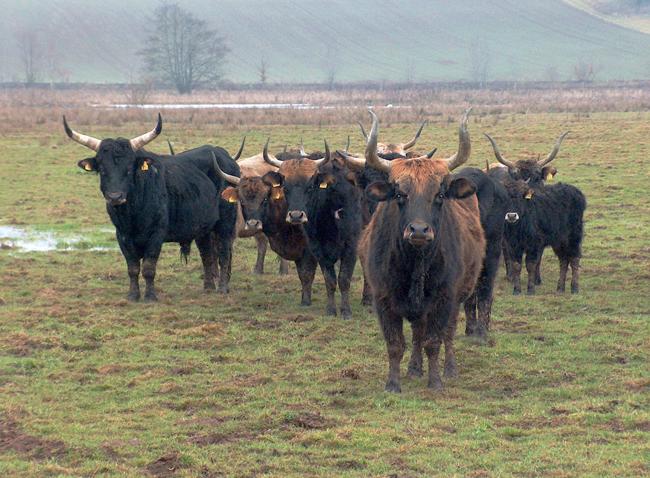
These Heck cattle from Hessen might be representative for the average of the breed
First of all, we have to find out what Heck cattle actually is. For this we have to look at the origin of this breed. It is well-known that Heck cattle was the result of the first breeding-back attempt, executed by the brothers Heinz and Lutz Heck in Germany during the 1920s and 1930s, but most people have no clear idea of which breeds actually were the base for modern Heck cattle. When the Hecks started their experiment, they had some disadvantages because of the time they lived in. There were no good aurochs reconstructions to work on and didn’t do some themselves, so they had no precise picture of what the aurochs looked like. Their impression of the colour, body, and horns of the aurochs was only very vague [1]. Furthermore, it was difficult to locate the most primitive cattle back this time, and they probably didn’t even know some of the most aurochs-like cattle. So it happened that their breed selection was far from ideal.
Heinz and Lutz executed their experiments separately and used a different set of breeds for their crossings. Fur us, Lutz’s stock is not that relevant because his cattle likely did not survive the Second World War and all modern Heck cattle descended from Heinz’s cattle in Munich (if they exchanged individuals and which ones remains unclear). This is a pity, since Lutz recognized the importance of southern European cattle for breeding-back, while Heinz included a number of very derived breeds. So the base of Heck cattle is [1,2]:

  • Black-pied lowland cattle (similar to Holstein-Frisian, but smaller and stubbier)
  • Angeln cattle
  • Allgäuer (Braunvieh)
  • Gray cattle
  • Scottish Highland cattle
  • Murnau-Werdenfelser
  • Corsican Cattle

Heck cattle in Ruhrgebiet, Germany
 It is impossible to say which cattle breeds had the largest influence on Heck cattle because Heinz ceased keeping track of the crossings after the first bull he considered a “new Aurochs” was born in 1932 (this individual was 75% Corsican, 17,5% Gray cattle and 17,5% a mix of Highland, Podolian Gray, Angeln and Black-pied Lowland cattle). In my opinion, Corsican cattle and Hungarian steppe cattle might be the most important founding breeds of Heck cattle, followed by the Scottish Highland and the Murnau-Werdenfelser. This assumption is based on the breed’s history and on the phenotype of contemporary Heck cattle. Some Corsican cows appear nearly identical to some Heck cows. From the modern view, Heinz Heck’s chosen breeds are far from ideal for breeding-back the appearance of the aurochs (hardiness and instincts are another story). Some important phenotypic features, such as large size, an athletic and slender body, long skull shape, or forwards-facing horns are simply missing in this selection, while the more derived breeds contributed a number of undesired and very domestic traits. But the experiment of the Hecks was only the start, the following decades of breeding were crucial to what Heck cattle is today.
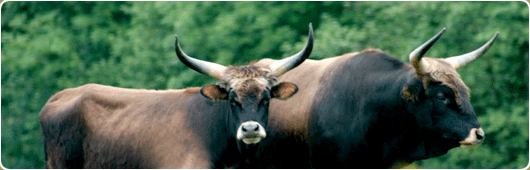
Heck cattle on http://www.artfarming.de

As time went by, our knowledge about the aurochs increased; the years 1942 and 1955 saw the publication of the first realistic aurochs reconstruction on paper by K. L. Hartig and Wolf Herre pointed out important physical characteristics in a paper in 1953 (and criticized Heck cattle for being too domestic). Heck cattle that survived the war were spread around in German zoos. Unfortunately the breed’s quantity increased much faster than its quality, partly because people were unaware of what the aurochs really looked like and there were no central selection criteria that dictate which features are desired and which are not. As a result Heck cattle became a very heterogeneous breed that was and is selected by only very loose criteria instead of being the consequent and coordinated attempt to rebreed the phenotype of the aurochs. But let’s have a look at which primitive features are present in the Heck cattle population and which are not:

Size

Heck cattle is 140-145 (bulls) and 130-135 cm (cows) tall at the shoulders on average. These numbers are my synthesis of data from Heck cattle from French reserves and German zoos, found in [1]. The largest pure Heck cattle (that is, without influence of the so-called Taurus cattle) measure up to 160 cm at the shoulders [EDIT: 150 cm after Guintard]. I am referring to the Steinberg/Wörth lineage, which are larger than most usual Heck cattle [EDIT: 160cm for Wörth bulls is in fact a dubious statement]. Therefore, most Heck cattle are considerably smaller than the aurochs, which measured around 170 cm (bulls) and 150 cm (cows) [EDIT: This is an arithmetic mean. In fact it was dependent from region and time]. The small size of Heck cattle is due to the founding breeds, of which none was really large.

Heck cattle in Bielefeld, Germany
 Colour

The colour of Heck cattle is very variable. The basic wild colour is present, but in the form of numerous deviations. You can find Heck bulls with a prominent saddle or lacking the eel stripe as much as you can find aurochs-coloured Heck bulls. The cows display a wide variety of colours, ranging from beige or grayish over the reddish-brown aurochs colour to dark brown or black. The cows are lighter than the bulls on average, but very dark cows are no rarity. Gray Heck cattle that look like Hungarian Steppe cattle can “pop out” on occasion. Some Heck cattle show white spots on the forehead or belly, some have completely piebald coat. Single individuals display the coat colour of Highland cattle. The mealy mouth is present in nearly all cases.

Heck cattle in Dorsten, Germany. Interestingly, it does not display
the wildtype colour but that of Highland and Angeln cattle instead 
 Body shape and proportions

The body shape of most Heck cattle is very similar to common dairy cattle and partly depends on the lifestyle of the cattle. In most cases the trunk is bulky and there is little to no hump (although some bulls have a shallow S-curve in their back). The leg length is variable, some Heck cattle have long legs that equal the trunk length but most of them have legs more or less shorter than the aurochs did. Some herds whose phenotype was abandoned are extremely short legged (f.e. in the German zoo Wildpark Frankfurt/Oder), but those are extreme cases.  The head is comparably small like in most domestic cattle.

Heck cattle in Chateau de Boutheon, France
Skull shape

The skull shape of Heck cattle usually shows a typical paedomorphic condition, with a broadened forehead, a short muzzle and a profile that is either straight or concave, resulting in a calve-like face compared to what the skull of the aurochs looked like. This retention of juvenile characters is typical for domestic animals.

Heck cattle in the Netherlands

Horns

The horns of Heck cattle are extremely variable. Their size can either be very small and thin to very large and thick, but the majority of Heck cattle has horn dimensions smaller than in usual aurochs specimen. The orientation relative to the snout usually is too upright, ranging from 90-125° (this is a personal observation based on many Heck cattle individuals) compared to 50-70° in the aurochs. The actual curvature varies as well and differs from the aurochs in being curved too much outwards and upwards on average. In some cows the horns curve outwards instead inwards and create the lyre-shaped horn type of Gray cattle.
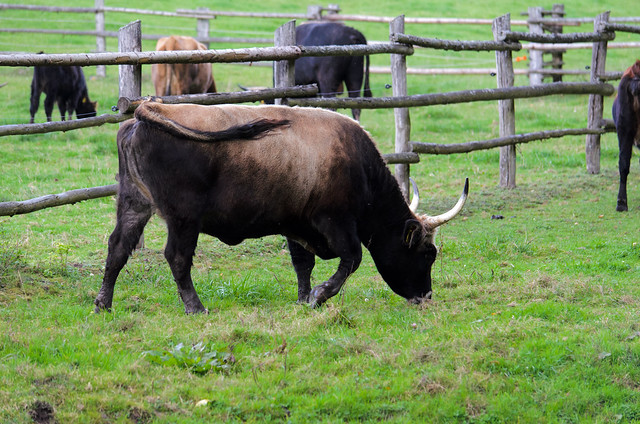
Heck cattle at the Wildpark Schloss Tambach, Germany
Udder and dewlap

The udders of Heck cows can be quite small in some cases, but many individuals have medium-sized to large udders. The dewlap is medium-sized in most Heck cattle, and therefore larger than in the aurochs. 

Heck cattle at Fröndenberg, Germany

Ecologic capacity

The fact that Heck cattle is a hardy breed without any significant sensitivity to certain diseases is well known. That is most likely due to the usage of robust landraces like Highland, Gray and Corsican cattle by the Heck brothers. Heck cattle are known to cope with the climate of central and northern Europe very well and flourished in Oostvaardersplassen without an supplementary food or medical care. Because of that, and the popularity of the breed, Heck cattle is common in conservational grazing projects in Germany, the Netherlands and also France. But we should keep in mind that these traits aren’t unique to Heck cattle at all. Hardiness and healthiness are common features of all landraces, and as we’ve learnt in the previous post, numerous cattle can survive absolutely abandoned in nature. Heck cattle are not the only cattle that are used successfully in conservational grazing projects in Central and Northern Europe; Hungarian Gray, Highland, Galloway, Tudanca, Sayaguesa, Maremmana cattle and several other breeds perform just as good.  

Heck cattle at the Wildpark Rheingönheim, Germany

Behaviour

The behaviour of Heck cattle (or any cattle breed) depends on the way they are kept. The Heck brothers noted that their behaviour became increasingly “wild”, but this is due the fact that any cattle that lives without close contact to humans gets difficult to handle. There are also some rumours that Heck cattle is an aggressive breed. This is not true, most breeders confirm that it is in fact a docile breed.

All in all, it is clear that Heck cattle is not a resurrected aurochs (neither it shows an identical phenotype), but saying it’s a total flop would be unfair as well. After being researching Heck cattle intensively for two years now and having seen hundreds of photos, perhaps even more, and also visiting several herds personally, I have reached the conclusion that Heck cattle is a very heterogeneous population of cattle displaying a number of aurochs-like features, generally lacking others, and also displaying undesired features inherited from its founding breeds. It is only fair to say Heck cattle is one of several aurochs-like breeds. It differs from other aurochs-like breeds in its heterogeneity while the others usually are comparatively homogeneous, though. Although Heck cattle still is far away from being a successful effigy breed, there is potential in the modern Heck breed (especially since the creation of Taurus cattle) and we will look into that in future posts.

P.S.: As you see, I included a lot of photos from different locations in this post, to give a fair idea of what Heck cattle looks like. Finding the balance between aurochs-like individuals and not aurochs-like individuals wasn't easy. Individuals with Taurus influence were excluded, because this post is about "usual" Heck cattle. 

Do you find this topic interesting? Check out my book on Amazon!

Literature


  • [1] van Vuure, Cis: Retracing the Aurochs - History, Morphology and Ecology of an extinct wild Ox. 2005
  • [2] Frisch, Walter: Der Auerochs – das europäische Rind. 2010.

Monday, 10 June 2013

The surviving capacity of horses and cattle


It is a common misconception that domestic animals lost much of their capability of surviving without man. Because of that, some people might conclude that breeding-back should not emphasize the appearance of the animals but their surviving capacity instead, otherwise the result is a population that looks like an extinct animal but cannot survive in nature. But, as we painfully have learned, domestic animals of any species, be it dogs, cats, sheep, goats, pigs, cattle, donkeys, horses, camels or rabbits successfully survived and adapted to a life outside man’s custody. Abandoned or escaped pets/livestock flourished not only in the native range of their respective species, but also in ecosystems their ancestors never inhabited. Let’s focus on cattle and horses because they are the relevant species here.

Feral horses

There is a number of free-roaming horse populations in North America, such as mustangs, the Sable island pony, Chincoteague pony, Cumberland island horse, Nokota, the feral horses in British Columbia and a few more. The mustang is even legally protected. Most people might be familiar with the fact that these free-ranging horses descend from Iberian horses that have been introduced into the Americas during the last few centuries. The largest population of feral horses is found in Australia, where they are called Brumby and number up to 400.000 individuals. Brumbies prefer grassland with rich water sources while feral Australian donkeys tend live in arid savannas [1] – they show the habitat preferences of their ancestors.

Feral Chincoteague horse
Brumbies in Australia
Some pacific islands are home to feral horses as well. On the Japanese island Kyushu there is the Misaki-uma, a pony that dwells mountain regions. New Zealand is inhabited by the Kaimanawa horse.

Misaki-uma in the Japanese upland
The most unexpected and unknown place for feral horses is Africa. Yet there are indeed free-roaming populations in the Kondudo (Ethiopia) and the Namib Desert. They seem to be related to Arab horses [2].

All these populations I mentioned above (and this list isn’t meant to be complete) are outside the range of their wildtype, and the environmental factors in some of these regions are drastically different from those of their species’ native range. Now let’s move to feral horses of Europe.
Britain once was inhabited by feral pony populations that were the base for many of the native British pony breeds. The Exmoor Pony is the last remnant of these feral horses (the earliest historic reference dates back to 1036) that now largely lives a domestic or a semi-feral life. Britain is home to several other semi-feral pony populations, such as the Dartmoor Pony, New Forest Pony or feral Welsh Ponies.

Feral Garrano in Portugal
Some Iberian horses are similar to these British ponies and are considered members of the “celtic pony type”. The Garrano is such a breed and lives feral in northern Portugal. Moving eastwards, we have the Marismeno horse, found in the Doñana National Park, and the Camargue horse. The Netherlands are inhabited Europe’s second largest feral pony population, as about 1000 Koniks live in Oostvaardersplassen without major human interference. Central Europe does not have a true feral horse population today, but until the 1840 there was a feral breed called the Emscherbrücher (its remaining individuals were integrated into the Dülmen Pony stock). The Letea forest in the Danube Delta in Romania is inhabited by the Danube Delta horse. During the last years, this feral population flourished and now they are Europe’s largest feral horse population counting about 3600 individuals.

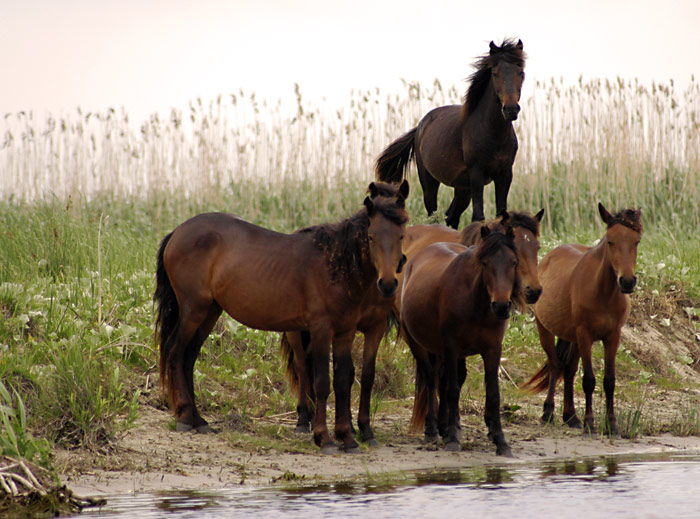
Feral horses in the Danube Delta, Romania (Image source: virtualdobrogea.com)
Interestingly, I realized that many feral horses have a brown/bay coat colour, but that doesn’t have to mean much.

Feral cattle

Just like in the case of horses, there are feral cattle on nearly each part of the world. In North America, you have feral Texas longhorn in the Wichita Mountains Wildlife Refuge, and feral herds of Florida Cracker live in the Paynes Prairie. On Sapelo Island (Georgia) and Kauai (Hawaii) the descendants of abandoned dairy cattle still live there.

Feral Corriente on Kauai
Australia is home to the so-called Shrub oxen which are used for commercial hunting, just like their relatives on New Zealand.

Feral cattle in Australia (Image source: huntaust.com.au)
Feral bull on New Zealand
On Amsterdam Island, an island in the south of the Indian Ocean, feral cattle have been running around since 1871 and their number grew to more than 2000. They descended from usual French dairy cattle such as Tarentaise or Jersiaise and have developed a remarkable “wild” body shape. There are feral herds on the Seychelles and the Falkland Islands as well.

Feral cattle on Amsterdam Island

It shouldn’t be all too surprising that there are feral cattle in Europe as well. The longest history as a feral breed has Chillingham cattle. The earliest written account is from 1645, they suffered from severe inbreeding during the last century.  

Chillingham cattle (Image source: deptfordpudding.com)
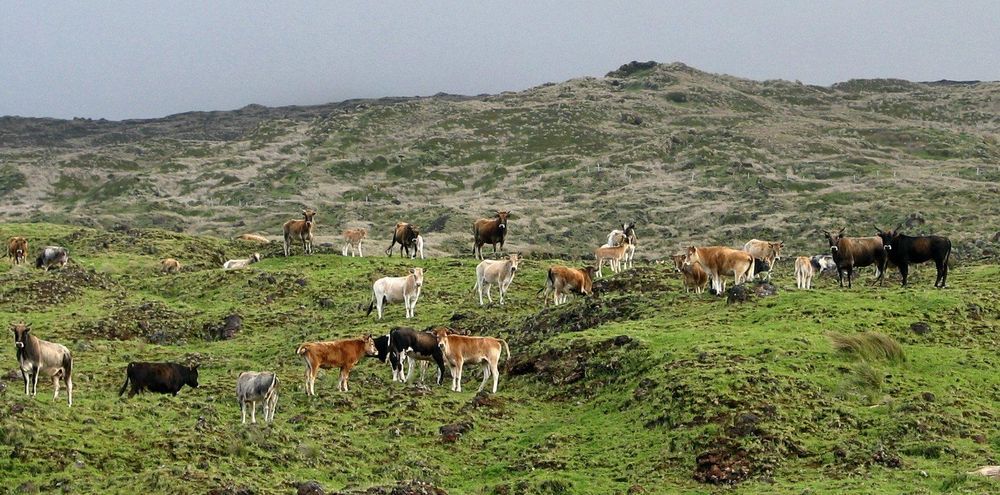
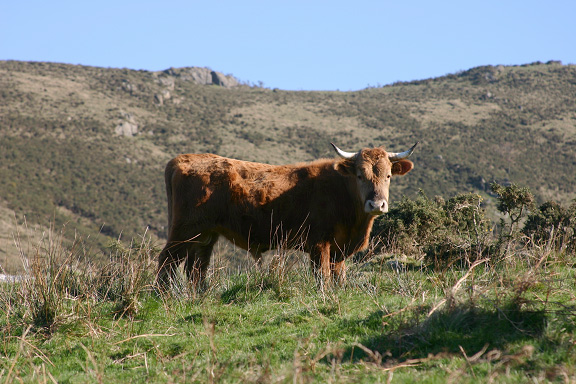
In Southern Europe, there are feral herds of the aurochs-like Maronesa breed, and semi-feral herds of Monstrenca in the Doñana National Park as well as semi-feral Camargue cattle. The Betizu breed is native to the Pyrenees and is very shy because it has been hunted for a long time [3]. Nowadays there is a reserve in Navarre to preserve that breed. And of course, there are the more than 500 Heck cattle living with little human interference in Oostvaardersplassen.

Feral Betizu bull (Image source: Wikipedia)
To put it in a nutshell, cattle and horses apparently do not have any big difficulties in surviving in nature – many of these feral populations descend from usual dairy cattle or riding and working horses that one wouldn’t expect to come across in the wild. They survive because domestic animals have not been pampered by a life exclusively in sheds and masses of food for millennia as you might imagine. In fact, one could say that natural selection still played a role in the origin of many domestic animals that we know today, because the economic situation of farmers often made it impossible to protect their animals to the largest possible extent. In less industrialised regions of Europe there still are less-productive forms of agriculture where the horses and cattle mostly have to take care of themselves and only get supplementary food on some occasions. The harsh conditions livestock has to cope with creates so-called landraces that are adapted to their home range. It wasn’t all too long ago when this form of breeding livestock was common the developed countries of Europe and North America as well. Therefore, it isn’t surprising that a lot of breeds are capable of surviving without human interference. Some certainly do better than others, and some highly-derived and inbreed breeds might not be capable of doing so, but the majority of cattle and horses apparently is.

What does this all tell us about breeding-back? It teaches us that phenotypic aspects do not have to be neglected because of concerns on the surviving capacity of the animals as long they are healthy and genetically diverse, especially since breeding-back attempts mostly work with landraces.

Literature


  • [1] Australian Government: Feral horse (Equus caballus) and feral donkey (Equus asinus)
  • [2] Cothran, van Dyk, can der Merwe: Genetic Variation in the feral horses of the Namib Desert, Namibia. 2001
  • [3] ABU info 06/07: Bunzel-Drüke, Scharf & Vierhaus: Lydias Ende - eine Tragikomödie            


Saturday, 8 June 2013

Aurochs-like traits in living cattle


This post focuses on phenotypic aspects, I’ll cover the survival capacities and natural behaviour in cattle (and horses) in other posts soon.

It is not surprising that actually a lot of domestic cattle all over the world have single features reminiscent of the aurochs since they descend from that animal. Even common and highly-derived cattle breeds like the Frisian or Brown Swiss may display an aurochs-like curvature of the horns or colour traits such as a so-called mealy mouth or light eel stripe along the back. But only a few breeds show many aurochs-like traits at once.

Having being researching so-called “primitive breeds” (primitive does not mean inferior of some kind, but simply less-derived) for over two years now, I recognized that there are a lot of breeds that still display aurochs-like coat colours and horns living in Southern Europe, mainly Iberia and Italy. Actually, Iberia is a hotspot for primitive cattle: Alistana-Sanabresa, Avilena, Axarquia, Barrosa, Castellana, Cachena, Caldela, Frieiresa, Limia, Maronesa, Monchina, Mirandesa, Pajuna, Raca Preta, Serrana, Sayaguesa, Terreña, Tudanca, and of course Lidia, the Spanish fighting bull. To name only a few. Also some Near-Eastern and North African cattle resemble the aurochs in several aspects. In other regions you can find single breeds with aurochs-like features as well, such as Jersey cattle, the Rhodopian shorthorn and some individuals of the Texas Longhorn (which are of Iberian origin).

Aurochs-like cattle from Iberia (various images from the web)
 
Aurochs-like cattle belonging to the "Steppe cattle group" (various images from the web)
Cattle belonging to the "Steppe cattle group", like Maremmana, Boskarin, Podolica or Hungarian Gray, often have long legs and a slender body with a well-pronounced shoulder area, some are even very large-sized. Steppe cattle members tend to have upright horns of varying sizes and a grayish coat.
The famous Spanish fighting cattle is the breed with the most aurochs-like body conformation: an athletic body with a slender waist and high shoulder spines with strong neck- and shoulder muscles attached. Other breeds with a more or less pronounced S-shaped back are Maronesa and some Steppe cattle members, for example.

All these cattle usually live under semi-natural circumstances and are used to poor forage and rough conditions. They have been living in this state for centuries, and in some of the more natural areas they also have to cope with predators. Therefore, hardy and aurochs-like cattle surely are the best animals to work on.

Of course, there is no universal mark that defines if cattle is aurochs-like or not. After all, even Austrian Fleckvieh is aurochs-like when being compared with a Water buffalo. And people might have different conceptions of an aurochs-like animal – some emphasize the coat colour, others the horns or proportions, others may look at the whole appearance. In order to judge and compare the primitiveness of cattle objectively, it’s best to asses these aspects separately:

  • Coat colour
  • Horns*
  • Proportions
  • Body shape
  • Skull shape
  • Body size
  • Appendages (Udder, dewlap)
  • Sexual dimorphism in colour, body conformation and size

* horn size (length and thickness), horn curvature and their orientation relative to the skull should be 3 separate criteria. Some cattle have horns that are way too small but have an aurochs-like curvature and orientation, others may have aurochs-sized horns but a derived curvature and so on.

Wild-coloured cattle is indicated by a black nose, dark tail tip and reddish colour in calves. It can display several derivations so that wild-coloured cattle do not necessarily have exactly the same coat colour as the aurochs. A lack of red pigment (phaeomelanin) in wild-coloured cattle results in the grayish colour of Steppe cattle. A lack of black pigment (eumelanin) results in light brown colours such as in Barrosa or Limousin. Wild-coloured cattle may also lack sexual dichromatism and therefore have the same or a very similar colour in both sexes, such as Sayaguesa.
As you saw in my previous post, an aurochs-like body shape is defined by a slender belly and tall shoulder spines creating an S-shaped back. Note that tall shoulder spines do not imply that the shoulder is higher than the pelvis (like in bison), which is unlikely for the aurochs. Hips and shoulders likely were even since most mounted aurochs skeletons have their knees flexioned too much.

By these characters, one could make a chart and score a number of cattle against each other. I will do that in a future post. The problem with such a method is that some cattle populations are very heterogenous, so that it’s safer to score individuals against each other than breeds.

We have looked at the phenotype exclusively now, but of course the ecologic capacities and, to a certain extent, behavioural traits are very important as well. An aurochs-like appearance does not necessarily imply hardiness and robustness, but usually the less-derived breeds live under harsh conditions compared to cattle in intensive agriculture and therefore are adapted to less-qualitative or limited food, living without a shed or barn all the year round, cope with weather extremes, or in some cases even defend themselves against predators.
Of course regional adaption should be taken into account. A Southern Iberian landrace can be very hardy and survive abandoned in their home range with ease, but may have problems in Denmark for example because it simply lies in a different climatic zone. But many Southern European primitive breeds do well in grazing projects in the Netherlands or Germany. More details on the surviving capacities of cattle in another post.

Do you find this topic interesting? Check out my book on Amazon! 


Thursday, 6 June 2013

The Tarpan that wasn't

EDIT: I no longer use the word "tarpan" as a synonym for the western wild horse. Tarpan was a term for horses of the southern Russian steppe that according to most recent research were hybrids of feral horses and the original wild horses. 
This photo is well-known as the only alleged photograph of a Tarpan and was taken in 1884, not long before its extinction:

Photo of the "Cherson Tarpan" taken in 1884 (Image source: Wikipedia)
Folks, this was not a Tarpan, at least no pure one. With a high probability it was just a feral horse, or one of the many hybrids between feral and wild horses that have been around in the Russian steppe during the 19th century. But let’s have a look at the history of that particular individual first.
It was nicknamed the “Cherson Tarpan” and had been caught as a newborn foal near the Russian city Novo-Voroncowka in 1866. It was moved to the Moscow Zoo and castrated because it displayed aggressive behaviour. The “Cherson Tarpan” died in 1887, eight years after the last free-roaming horse (be it a Tarpan, feral horse or hybrid) was shot. The “Cherson Tarpan” is one of at least two free-roaming horses that were caught and displayed at Moscow Zoo. The other one is the “Krim Tarpan”, which’s status as a wild horse was questioned even back those times. A third one, the alleged latest-surviving Tarpan is very dubious to me. There are several dates for when it died, some sources say 1908, 1909 or even 1918, and some sources even fuse it with the Cherson individual. Because of these discrepancies, I wouldn’t be surprised if that individual didn’t exist at all, but may be the “Cherson Tarpan” which’s date of death had been “pushed” into the 20th century by sloppy citing. And even if this third individual existed, no-one knows if it truly was a wild horse or not. I know some descriptions of this individual, but none of them is credible. But back to the “Cherson Tarpan”. It is well-known because it’s the only alleged Tarpan that was photographed. But just like the “Krim Tarpan” it most likely is no wild horse since it does not show any wild horse features: it has a long mane and tail (the opposite of what is described in historic references), and the body does not look very stocky with its very long legs and the not all too large head. Wild markings of whatever colour morph, like dark legs, a dark mouth (black dun), mealy mouth (bay and bay dun), leg or shoulder striping or an eel stripe (dun) all are absent. Ok, the eel stripe maybe was not visible from that view, and the coat is very dark overall. There is a lightly coloured belly at least. Maybe it’s colour was dark bay without pangare or a dark expression of black dun, but we can’t tell if it isn't just any domestic colour. It may have had white markings in its coat, but the quality of the photo simply is not high enough to tell. It was measured 133 cm at the withers, about the right size of a wild horse - but also many domestic horses/ponies are of this size. 

In conclusion, the “Cherson Tarpan” was very likely either just a feral horse or a of feral horse with a certain degree of Tarpan blood (what might explain its reportedly aggressive behaviour). It certainly does not resemble one of the five wild horse phenotypes closely enough to be considered a pure or nearly pure Tarpan – this is not only my opinion, but also that of the majority of authors. Although photos are more descriptive than reconstructions, if you want to show how the Tarpan most likely looked like, I do not recommend to use that photo.

Literature

  • Tadeusz Jezierski, Zbigniew Jaworski: Das Polnische Konik. 2008.
  • Bunzel-Drüke, Finck, Kämmer, Luick, Reisinger, Riecken, Riedl, Scharf & Zimball: „Wilde Weiden: Praxisleitfaden für Ganzjahresbeweidung in Naturschutz und Landschaftsentwicklung“. 2011 

Wednesday, 5 June 2013

Characteristics of the Aurochs


The colour traits of the Aurochs are familiar to many people, as is the fact that the aurochs had large horns and was considerable larger than most domestic cattle. But there is much more that defines its appearance, as there are some gross differences in morphology between the aurochs and usual domestic cattle. The current Wikipedia article on the aurochs provides a lot of information on these differences. I made a little table showing the most important characteristics of an aurochs at one glance:


We know about these traits because there are a) numerous well-preserved specimen of the aurochs, b) historic references describing and Palaeolithic paintings depicting the aurochs, c) close living relatives (Banteng, Gaur) and less-derived cattle that provide helpful analogues.


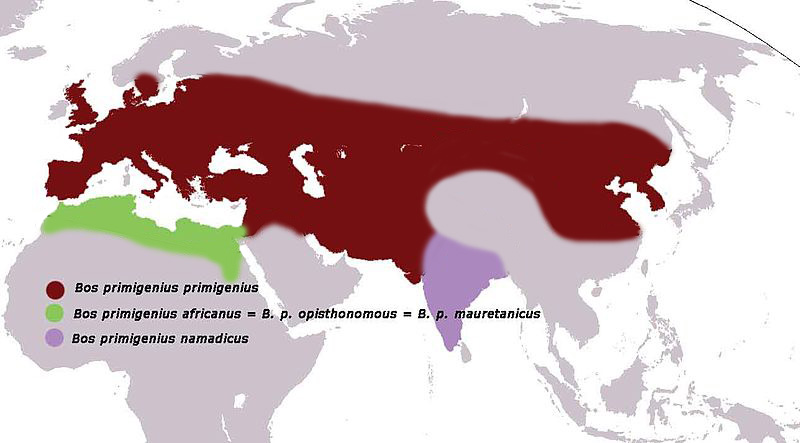
Reconstructed range of the subspecies of the wild Aurochs (Image source: Wikipedia)

Was the aurochs very variable in appearance? Most material, be it skeletal or historic, is from the western subspecies, Bos primigenius primigenius. It certainly was the most important subclade as it had the largest range and survived to most recent times. There also was an Indian subspecies, Bos primigenius namadicus, for which only fragmentary skeletal material and no historic references are known. The North African aurochs, Bos primigenius africanus, is less enigmatic, but still not as well-documented as the European Aurochs since it died out one or two millennia earlier.

Heck cattle breeders (but also some other people involved in breeding-back) claim the aurochs was very variable from region to region, what justifies the variability of breeding-back results and the presence of phenotypic features not supported by the data. But it seems that this wasn’t the case. Surely, most skeletal material of the aurochs is from Central and Northern Europe, but it seems that the North African and also the Near Eastern aurochs was nearly indistinguishable from the aurochs on the osteologic level.  When having a look at the many beautifully preserved skulls of this wild bovine, it becomes clear that there was considerable variation in relative size and thickness, but they always displayed the same basic curvature, with some differences in the exact expression of this curvature. Some specimen had more upright horns than others, but the angle between horns and snout nearly always varied between 70° and 50°. How about the colour of the aurochs? It’s true that historic references describing the colour of the aurochs all come from the northern part of Central and Eastern Europe, but the famous cave paintings of Lascaux and Chauvet (from Southern Europe of the late Pleistocene) show the same pelage characteristics. And this basic colour can be found in some subspecies of the Banteng and Gaur as well (albeit with reduced markings in the coat).  So there is little reason to believe the colour of the aurochs was very variable. However, there are engravings found in Libya showing aurochs with a light saddle on the back. Cis van Vuure identifies reddish cattle with white saddles and lyre-shaped horns illustrated on Egyptian tomb paintings as domestic cattle, but the engravings from Libya show aurochs-like animals (with typical aurochs horns) that are depicted being hunted, so this could be considered evidence for North African aurochs having had a light saddle on the back. Furthermore, Gloger’s rule states that animals (birds in particular, by the way) are less melanised in arid than in humid habitats. This could enhance the assumption that North African aurochs had less eumelanin in their pelage, and therefore a light saddle.

To put it in a nutshell, it is likely that the appearance of the aurochs probably was not all too variable over its range, at least concerning its bodily proportions, skull and horn shape (size may be another story). There is no evidence for the existence of aurochs populations not having long legs and skulls, a strongly developed shoulder region, or displaying a considerably different horn shape. However, there maybe were minor colour differences between the different subspecies. Therefore, the aurochs likely was not any more variable than other large herbivores with a large and continuous range. Breeding-back should focus on this stable appearance as long as there is no solid evidence for populations showing divergent physical traits.

Literature


  • van Vuure, Cis: Retracing the Aurochs - History, Morphology and Ecology of an extinct wild Ox. 2005.
  • van Vuure, Cis: History, Morphology and Ecology of the Aurochs (Bos primigenius). 2002.
  • Frisch, Walter: Der Auerochs – das europäische Rind. 2010.

Sunday, 2 June 2013

What the Tarpan looked like

EDIT: I no longer use the word "tarpan" as a synonym for the western wild horse. Tarpan was a term for horses of the southern Russian steppe that according to most recent research were hybrids of feral horses and the original wild horses. 
Having defined what we mean by “Tarpan”, we should have a look at the appearance of the Holocene wild horses of western Eurasia, since there is some confusion as well. Some believe the whole European wild horse population looked like wild Koniks based on a possibly biased interpretation of the literature and some references are based on Chinese whispers. The appearance of the wild horses of Europe and the Russian steppe is well-documented by historic reports and coat colour genetics and shows that their appearance was quite variable, but there were some common and fixed traits.

First of all, let’s see why I think that those historic accounts do in fact refer to genuine wild horses (in most cases). To get a good idea what the animals people described actually looked like, it is best to go as much as “ad fontes” as possible to avoid Chinese whispers. That means: do not use sources that are based on other sources that are themselves based on other sources and so on (that maybe even don’t refer to the actual historic references), but try to find out who gave those contemporaneous reports and what he wrote. Such references include Albertus Magnus, Belsazar Haquet, Kajetan Kozmian, Peter Pallas, Charles Hamilton Smith, Samuel Gottlieb Gmelin and others [1]. They all describe horses with features very likely for pre-domestic wild horses, such as a homogenous small stocky built, large thick head, small eyes, short ears, a short frizzy mane, dark eel stripe, and dark legs (sometimes striped). The coat colours most commonly described are tan or creamish, mouse-coloured and brown. One source (Gmelin) mentions that the belly was coloured lightly. The behaviour was described as very shy, intractable and untameable, defending themselves harshly against predators and killing concurring domestic stallions. In my opinion, this makes it very probable that the descriptions (which cover a period from the 12th to the 19th century) describe genuine wild horses [1,2]. Those references indicate that during the 18th and 19th century, there was increasing domestic influence in the late Eastern European herds, such as domestic mares included in wild herds, whitish animals, lightly coloured legs, grays (not mouse dun) and so on [1]. So my conclusion is that genuine wild horses existed until the end of the 19th century, but the few remaining populations got more and more mixed with domestic horses towards the very end of their existence.

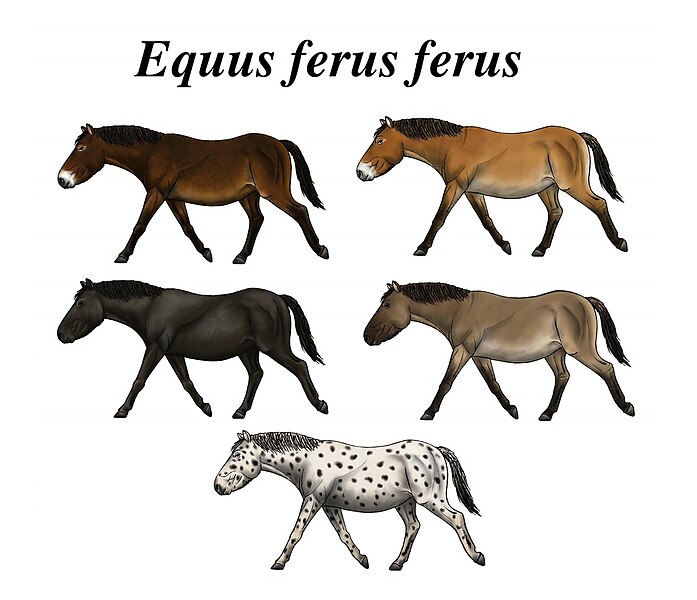
Historic references match genetic information which tell us that 3 colour genes were present in Holocene European wild horses: bay, black and leopard-spotted [3,4]. Considering that the dun factor likely was present as well (because it is found in all other extant wild equines), Tarpans might have displayed 5 possible colour morphs:

Bay: A colour that we find in many horse breeds.
Bay dun: This combination is the colour we see in Przewalski’s horses and other wild equines. Reports of tan or yellowish-brown wild horses (like C. H. Smith) most likely refer to this colour.
Black: Black is found in some primitive ponies such as the Fell Pony or the Garrano. C. H. Smith mentions a black wild horse in Eastern Europe that may have been a feral horse.
Black dun: Also called mouse-dun or Grullo. Its expressions vary between a very brownish mouse colour and a light grayish colour. Some primitive horse breeds have a Grullo coat, such as the Konik.
Leopard spotted: A white base colour with black spots. Looks similar to the pelage of a Dalmatian dog and nothing like a leopard. Why isn’t called Dalmatian-spotted instead? I really don’t know.

Except the latter, all these phenotypes are mentioned in at least some historic reports. I don’t know of any source mentioning leopard-spotted wild horses, but quite possibly such animals would have been mistaken for feral or hybrid horses by people who witnessed them. Another colour trait that is possible for the Tarpan is the so-called pangare, which is characterized by a light colour of the belly and around the mouth (mealy mouth). Many bay or bay dun horses have it, as much as all living wild equines. And, not to forget, some historic references describe a lightly coloured belly in the Tarpan. So the pangare trait is likely to be found in some Tarpans (note that black and black dun horses never display a mealy mouth).

So, putting everything together, Equus ferus ferus in all its variability might have looked like this:

Reconstruction of the Tarpan using historic and genetic
information, showing the five possible colour morphs

This is a reconstruction I did for Wikipedia. My personal opinion is that the bay dun phenotype (top, left) perhaps was the most common colour morph. Bay is dominant over black and dun is dominant over non-dun, and historic references mention them frequently. Black dun horses apparently were no rare sight either, although genetics indicate that they were far less common than horses with bay genes [3]. Without having the dun factor identified in Holocene wild horse remains, its impossible to tell whether there were Tarpans completely lacking the dun factor or not [4]. I think it is probable, at least for more closed environments like forests and marshes (where a darker pelage might be more advantageous). Some authors, like Sue Baker, think the same [5]. Was there regional variation regarding the frequency of the different phenotypes? Perhaps, but according to my knowledge the data isn’t sufficient for us to draw conclusions yet. What about the striping on the legs and shoulders? It’s quite possible that a number of wild horses displayed a certain degree of striping since many dun coloured horses do and some historic references, like C. H. Smith, mention striped legs in wild horses. Stripes are not actually caused by the dun factor, but it makes them more prominent because the rest of the coat has a lighter colour.

You might wonder why I portrayed those wild horses with a falling mane here. Well, there are no historic references that I am aware that mention upright manes in the Tarpan. “Short and frizzly” (some readers maybe only took note of “short”), as Tarpan manes are described in a lot of historic accounts, does not necessarily imply upright manes. Furthermore, there are frozen mummies of Siberian wild horses from the Pleistocene that display long falling manes [5]. Therefore falling manes are not a domestication-induced feature as it was believed. Apparently such a feature is advantageous in regions with a lot of rainfall, as it diverts water from the neck and head, as much as a bushy tail [5]. Under this assumption, the fact that the Przewalski’s Horse and all wild asses have an erect mane and a tail showing either just a tuft at the tip or short proximal hair just seems logical.

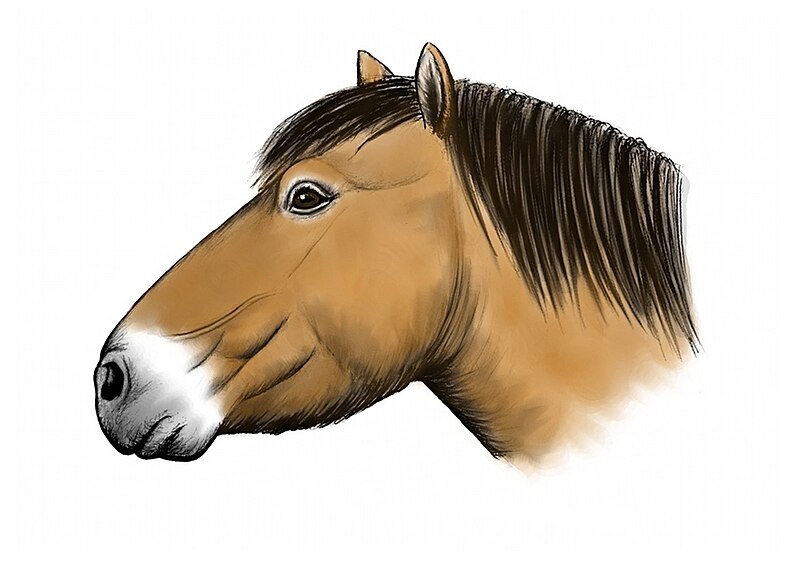
The head of the Tarpan was rather different from that of domestic horses and resembled that of other wild horses (living and extinct). According to my knowledge, only few skeletal material of the Tarpan is known, and some alleged Tarpan specimen may actually be feral horses. But historic references tell us something about the appearance of the head of the European wild horses. As I mentioned above, numerous sources say the head was large and thick with a robust lower jaw [1]. The Tarpan apparently had a “beard” under the jaw like living horses that grow a thick winter coat. Apparently the eyes were small [1,2]. Like all horses adapted to harsh conditions, the Tarpan likely had fleshy ridges above the eyes – as seen in Przewalski’s horses or Exmoor ponies (and numerous other robust ponies) – that protect the eyes from rain, snow or dust [5].
Down below you see another reconstruction I did for Wikipedia, a head of Equus ferus lambei* that is based directly on a skull of a specimen. A Tarpan’s skull perhaps was not very different.

Reconstruction of the head of Equus ferus lambei, a pleistocene wild horse  

*  Mitochondrial DNA suggests that Equus lambei and Equus ferus are conspecific according to an essay by J.F. Kirkpatrick and P. M. Fazio in 2005 [6].

In essence it seems that the European wild horse had different colour morphs but a homogenous stocky build similar to the Przewalski’s horse and primitive ponies. Having had a look at how the Tarpan probably looked and behaved like, we should go into the subject of Tarpan-like horse breeds in a following post.

Literature

[1] Tadeusz Jezierski, Zbigniew Jaworski: Das Polnische Konik. 2008.
[2] Smith, Charles Hamilton: The Natural history of Horses, with Memoir of Gesner. (1814/1866)
[3] Pruvost et al.: Genotypes of predomestic horses match phenotypes painted in paleolithic works of cave art. 2011
 [4] Ludwig et al.: Coat color variation at the beginning of horse domestication. 2009.
[5] Baker, Sue: Exmoor Ponies: Survival of the Fittest – A natural history. 2008.
[6] Kirkpatrik, Jay F.; Fazio, Patricia M.: Wild horses as Native North American Wildlife. 2005

Saturday, 1 June 2013

The various breeding-back efforts


There several breeding-back efforts concerning a number of species. Some are well-known and widely publicized, others are not. While some breeding-back results have a history of several decades, others are incipient since their project started only some years ago. In this post I am going to give an overview over the three species the most breeding-back efforts focus on. The history of breeding-back started in the 1920ies, when two zoo directors tried to revive the Aurochs that died out in 1627, although the polish zoologist Feliks Pawel Jarocki had a similar idea back in 1835 [1].

For readers who are familiar with breeding-back, this overview probably isn't anything new, but I want to show the main projects or breeds this blog is going to focus on. 

The Aurochs

Skeleton of an Aurochs bull from Germany (Image source: aueroxen.com)


There are multiple breeding-back efforts to reconstruct the (european) Aurochs, Bos primigenius primigenius. It was the first extinct species (actually, wild type of a species) to become the focus of a breeding-back effort – the well-known experiment of the brothers Heinz and Lutz Heck back in the 1920s, which will be the focus of another post. The result, Heck cattle, was considered to be a “new aurochs” by the Heck brothers and their followers, and is still by some breeders today [2]. However, this breed has been criticized early on and is in fact rather different from the aurochs in several aspects [1]. To improve the aurochs-likeness of some Heck cattle herds, the Arbeitsgemeinschaft Biologischer Umweltschutz (ABU) in Germany started to cross them with several aurochs-like breeds in 1996, such as Sayaguesa or the Spanish fighting bull in order to bring in what is missing in Heck cattle. These new herds are called Taurus cattle [ 1,2,3]. Taurus cattle are bred in Germany, Hungary and Denmark. They are slenderer, larger and more long-legged than Heck cattle; also their skulls are longer and the horns face forwards. Good Taurus cattle are much more aurochs-like than usual Heck cattle, although strict selection is yet needed to achieve the Aurochs phenotype completely. 
In 2008, the Tauros Programme (or TaurOs Project) was formed. It is, besides the Taurus cattle, another project that aims to breed an aurochs effigy that is hardy and robust like other landraces to fit a life in wilderness. They work cattle from Southern and Eastern Europe and Highland cattle.
Apart from these projects, there are also a few other initiatives that aim to breed cattle that is propagated as aurochs proxies by their advocates.

The Tarpan/ western wild horse

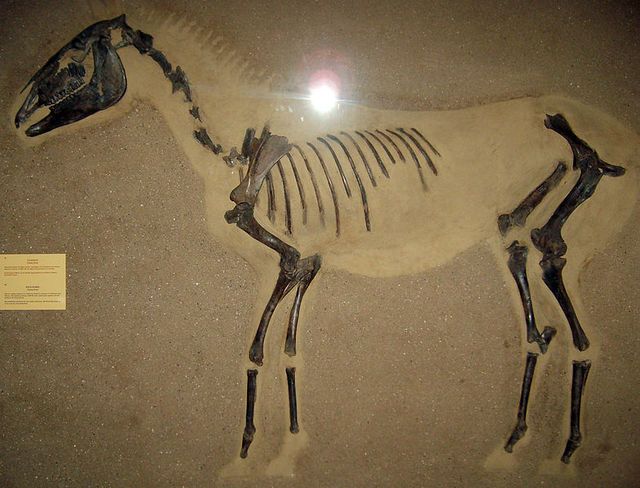
Pleistocene wild horse skeleton (Image source: photobucket.com)


The Tarpan, Equus ferus ferus, (= the western subspecies of the wild horse) once ranged from Portugal to the Russian steppe and apparently displayed a number of different phenotypes (I will go into further details in a later post) [3]. Several breeds are propagated as surviving or bred-back Tarpans, which is not supported by the data. There are landraces resembling the Tarpan, or its respective phenotypes, though. The Konik is certainly the most popular of them (but only one of many), possibly because it is promoted as the result of an effigy-breeding program (which is actually not true) [5]. The Heck horse is a derivation of the Konik that on the other hand is the result of effigy-breeding, but not necessarily more Tarpan-like. Beside those, a number of other less-derived ponies exist that are at least as authentic but do not get the same attention. In a later post, I will go into greater detail which horse breeds resemble the Tarpan, and it turns out that the wild horses actually left their traces all over Europe.

The Quagga

The last known living Quagga which died in 1883,
displayed the zoologic museum of Amsterdam (Image source: horse-today.de) 


Effigy breeding focusing on the Quagga is fundamentally different from effigy-breeding with domestic animals because there are no surviving descendants of this animal. The Quagga, Equus quagga quagga, was a distinct subspecies of the plains zebra that was wiped out around 1900. It is famous for its secondary reduction of striping in its coat, what distinguishes it from all other zebra species and subspecies. The Quagga Project started in 1987 which aims so rebred the pelage characteristics by selective breeding for stripe reduction in a population of modern plains zebras [6,7]. After 25 years of breeding, the resulting animals do bear resemblance to the Quagga, although the real Quagga will remain extinct. I will go into much greater detail on the Quagga Project’s guidelines, arguments and recent results in a later post.

There also were some claims about the rebreeding of the Barbary Lion, Panthera leo leo. This northern subspecies of the lion is extinct in the wild and disappeared in its pure form because of hybridization with other subspecies. There are lions that are considered possible descendants of pure Barbary lions, and the Barbary Lion Project does (or did, I don't know if it is still running) research in order to determine the presence and degree of influence of the true Barbary lion in these living cats. If it really turns out that its genes are still present in a population of lions, breeding-back using genetic screening might restore a pure lineage of this subspecies [8]. 

As you can see, there are numerous breeding-back projects and results, but none of these has produced final results yet that clearly show all the desired features. Effigy-breeding isn’t easy or to be done quick: there is a precise picture the breed has to match with AND they have to be genetically diverse AND ecologically potent at the same time in order to survive as a wild animal in nature. The reasons why until now there is no "perfect" effigy-breed is either that some projects have not been running long enough yet, or that the breeding was not efficient enough in other cases. And, not to forget, the final step cannot be made by Man's artificial breeding but takes place when the animals are exposed to natural selection and become wild animals with surviving strategies and adaptions to their habitat.

Literature

[1] van Vuure, Cis: Retracing the Aurochs - History, Morphology and Ecology of an extinct wild Ox.
[2] Frisch, Walter: Der Auerochs – das europäische Rind. 2010.
[3] Bunzel-Drüke, Finck, Kämmer, Luick, Reisinger, Riecken, Riedl, Scharf & Zimball: „Wilde Weiden: Praxisleitfaden für Ganzjahresbeweidung in Naturschutz und Landschaftsentwicklung“. 2010
[5] Tadeusz Jezierski, Zbigniew Jaworski: Das Polnische Konik. 2008.
[6] Leonard, Jennifer; Rohland, Nadin; Glaberman, Scott; Fleischer, Robert; Caccone, Adalgisa; Hofreiter, Michael: A rapid loss of stripes: the evolutionary history of the extinct quagga. 2005.
[7] http://www.quaggaproject.org
[8] Yamaguchi, Nobuyuki: Barbary and Cape lions: Their Phylogenetic places and Conservation