Sunday, 13 October 2013

The Rau Zebra of 2025?

Like I mentioned on my previous posts, some Rau Zebras of the Quagga Project already resemble the quagga quite well regarding their degree of stripe reduction. How would they look like if they had a more brownish coat? This question triggered me to do a little drawing of how the most advanced Rau Zebras of 2025 might look like. The youngest animals of the project are part of the fourth generation (F4), and since zebras have a generation span of about four years, there will be at least F6 individuals in 2025. This is what I imagine the most progressed results at that date to look like: 


As you see, I didn't reduce the striping much more than in the youngest Rau zebras up-to-date, I mainly added brown hair. Reducing the stripes turned out to be comparably easy by selective breeding, while increasing the brownish colour of the coat is the bigger challenge according to the project. Therefore they want to select more strongly on that feature in future breeding. 
Comparing my hypothetical future Rau zebra with stuffed Quagga specimens, I see some striking similarities, but also differences. 


Quagga specimen in Berlin
For example, the stripes on the head and neck area are broader in the Quagga than in contemporaneous Rau zebras. I am not sure if the stripes in Quaggas were deep black or very dark brown, because those old stuffed skins bleached over the time and most likely do not represent the true colour of the animals in life. 


Friday, 11 October 2013

The Spanish Fighting Bull


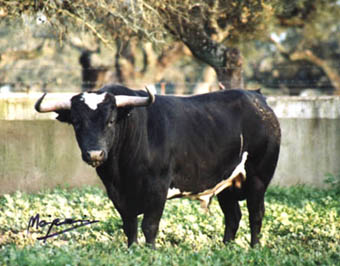
There is so much I want to write about, and so little time for it. This time, I finally completed my post on one of the most primitive cattle breeds in the world: Toro de lidia, the Spanish fighting bull. Fighting with bulls, as abominable as it is, has a long history in Southern Europe. Back in the antiquary, even wild aurochs bulls were used for arena fights in ancient Rome. It were always the most aggressive bulls that were chosen for bullfighting, and during the 18th century, systematic breeding with domestic bulls from various cattle populations that showed the feistiest behaviour was started in order to breed a cattle race used virtually exclusively for bullfighting. Today these cattle are known as Lidia or Toro de Lidia, the Spanish fighting bull. Because Lidia were selected primarily on their fighting spirit and originate from various cattle populations, it is a variable breed – variable in appearance, size and behaviour – and is divided into several lineages: Miura, Casta Navarra, Cabrera, Galardo and others. These lineages are reproductively isolated from each other, but taking Lidia as a whole, it is a genetically diverse breed. It is likely that the breed also has influence from African cattle [1].
What makes the fighting bull special? First of all, it is the only (non-feral) cattle breed that was not selected for meat or milk production, but for agility and feistiness. It is well-known that they range freely all the year round and the fact that bulls that win fights with other bulls are chosen as breeding bulls – a kind of man-made natural selection – helped to retain primitive traits that are not apparent in many other breeds. Fanciers of the breed claim it is the most aurochs-like cattle around today and also Cis van Vuure, author of themost comprehensive book on the aurochs up-to-date, is very enthusiastic about Lidia.

Lidia - the cattle breed with the most aurochs-like, muscular body
Appearance

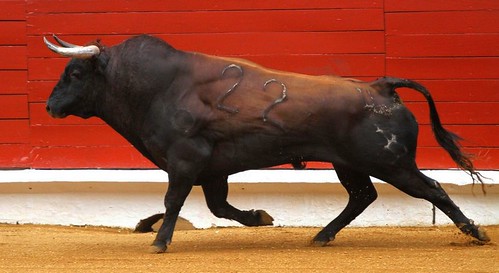
Lidia is remarkable for being the only domestic cattle breed in the world that has retained a very aurochs-like body conformation. It is true that the proportions are variable, some bulls are longish while others have a short trunk like in the aurochs, but nearly all of them have a very muscular body with a large shoulder hump. This hump (not to be confused with the fleshy hump of zebus or with the neck crest) is formed by tall processus spinosi at the shoulder area and large muscles like the M. trapezius attach to it. This is a skeletal trait and therefore coded genetically and not influenced by how you raise the cattle. Both bulls and cows have it, and it seems to be as prominent as in the aurochs; this is unique among most domestic cattle and a big plus for the Lidia breed. The waist is usually very slender (though not in all individuals), similar to wild bovines of similar build like Wisents and bison. Most Lidia bulls that we see are subadult, bulls get continuously more massive after their 6th year. Nevertheless, Lidia is still the most athletic cattle breed. The legs in fighting cattle tend to be a little shorter than in the aurochs, but some examples have just perfect proportions.

Well-proportioned athletic Lidia bulls
Lidia cow with correct coat colour and horn curvature

Lidia is one of the few large-headed cattle breeds and many have a really elongated skull shape. The frontals are long, the nasals are long, and the eye sockets are prominent. The head profile is either straight or more or less concave. Also Lidia has prominent curly hair between the horns, giving them the fierce appearance that is described for the aurochs [2]. If you want to know what a living aurochs looked like regarding body shape, proportions and head shape, some Lidia give you a perfectly accurate impression. The horns usually are medium-sized and nearly always direct forwards. The horn shape does either roughly or very closely resemble that of the aurochs, depending on the individual.
Unfortunately, Lidia is very variable concerning the coat colour and has many colour mutations that are undesirable for breeding-back. Many Lidia have the black allele Ed instead of the wild-type colour allele E+, resulting in a totally black colour in bulls, cows and calves (however, this allele is dominant and therefore easy to breed out). Additionally to that, many Lidia also carry genes for white spotting, resulting in a “Holstein colour”. You also find brindle and roan animals. Nevertheless, there are still enough wild-coloured Lidia and since wild-type colour is recessive under black, it should be relatively easy to fix. Then the next task would be to breed for a more-marked colour dimorphism since many wild type coloured Lidia bulls show the reddish colour of cows.

Some examples of domestic-coloured Lidia…

Roan coloured bull
 
Holstein coloured Lidia
Brindled bull (very good body shape though)
… and wild-type coloured Lidia.

Wildtype coloured Lidia cows
Wildtype coloured bull (the saddle shouldn't be present in the aurochs)
Another “problem” concerning the phenotype of Lidia is their small size. Spanish fighting bulls are bred for being small so that they are easier to fight with, and their current shoulder height varies from 110 to 140 cm, depending on the lineage, which is very small even considering that Southern European aurochs likely were slightly smaller than those in central and northern Europe. The relatively large bulls that sometimes do appear in the breed are usually selected out.
The udder size is varying, in some cows it is almost invisible from the side, as in wild bovines. The dewlap is either small or medium-sized.

Behaviour

The behaviour of Lidia is controversial in breeding-back. While the one side appreciates their deer-like shyness and agility, the other side criticises their high aggression when surprised or unable to flee. We know that it is possible to select on behavioural traits and those are laid down in the genome to a certain degree [3]. Both cows and bulls of the Lidia breed have been screened and selected on their fighting spirit for centuries, what certainly augmented their level of aggression and nervousness. But does that mean we have to exclude them categorically from breeding-back? In my opinion, not at all. First of all, if we describe the behaviour of Lidia as “unnatural”, we also have to attribute that to all gentle and docile breeds, because these are certainly no traits of wild bovines. Secondly, if you can select for a trait, you can also select against it. In fact, there are always Lidia bulls that get culled because they do not show enough aggressiveness for bullfighting. Certainly, very shy and aggressive cattle can be very difficult to handle, at least in grazing projects where most of the breeding-back takes place. Therefore, it is also of practical use to chose the less-aggressive Lidia for an aurochs project that is centred around this breed.

Ecology

Of course it’s time for my standard sentence now: Lidia is a very hardy breed that is used to poor foliage, lives freely all the year round and is used to all kinds of weather and so on. Like virtually all primitive Iberian cattle. But what is interesting is what I have been told by the ABU breeders: the only cattle that never seized the supplementary food in the Lippeaue during winter were Lidia cows. Perhaps they are, thanks to their semi-feral history, even more hardy than Sayaguesa or Heck cattle.


Predation

Lidia is one of the very, very few domestic cattle that are known to defend themselves successfully from – no, not just wolves – big cats. Fighting bulls defeated even lions in arena fights of the past [2], which is very impressing.

Correct colour, athletic body
In essence, I think the Spanish fighting bull is a precious breed for breeding-back. Their athletic body and high shoulder spines (“hump”) in combination with their aurochs-like proportions makes less-derived Lidia unique among (non-feral) domestic cattle. Their long snout is certainly very desirable as well. Some good Lidia individuals are more aurochs-like even than very aurochs-like breeds like Maronesa or Sayaguesa (or good Hecks), apart from their size. Since the global Lidia population contains almost all of the desired aurochs features, a project using only Spanish fighting cattle could bring interesting results. The idea for such a project was brought up first by Cis van Vuure in an article from 2003, and proposed by the same author again in 2005 [2]. The high number of aurochs features in Lidia, as much as their unique breeding history, makes it unlikely for me that their primitive phenotype is just a by-product of coincidental crossbreedings, very likely it is truly an ancient breed (I am looking forward until something on the genetic relationship to other cattle breeds and the aurochs is published) and therefore worth to play an important role in another breeding-back attempt. Their behavioural minus point – which is mainly a practical one because we don’t know the aggression level of the wild aurochs – probably can be reduced by selection and/or crossing-in of more docile breeds. Their long history of living nearly feral (ok, this is also true for other primitive breeds) and their ability to defend against predators also makes them very suitable for the creation of a new wild bovine.
For such a project, it would be wise to pick the largest and least-aggressive Lidia with wild colour, good horns and aurochs-like proportions. In order to gain a sufficient genetic diversity, not only dozens of individuals but also of various lineages should be chosen. They should be selected for:

  • Well marked colour dimorphism
  • Wild colour with eel stripe (in bulls) and mealy mouth
  • Short trunk, long legs
  • Elongated skull shape
  • Correctly curved, large-sized horns
  • Large body size
  • Less aggressiveness/nervousness


Perhaps after few generations already, a Lidia strain that looks and behaves almost like the aurochs would be established – but these Lidia primitivo (as I like to call this hypothetic breed, a hint to how Tauros Project calls the most-primitive Maremmana cattle) would still be much too small (probably about as small as Heck cattle) and their horn dimensions would probably not be really satisfying either. Supplementing them with Chianina to add size and leg length and a breed to add good horn dimensions without ruining the curvature (perhaps very large-horned Heck cattle or Watussi with useful horns) would insert these features into the population.

The time for such a project would be right – bullfighting is getting less popular and hopefully it will be prohibited in the near future. But the end of bullfighting also means the end of the fighting bull. Already today many Lidia show clear signs of intermixing with derived breeds to increase their economic productivity, resulting in a loss of aurochs-like features. It would be a big shame if the last primitive Lidia would diminish without being used in breeding-back, since no other breed contributes such an athletic, aurochs-like body shape and overall appearance. Lidia definitely has negative aspects as well (like any breed), but those could be reduced by selection.
A Lidia project would hopefully be fruitful within few years, it would save the most precious examples of that breed and unite their aurochs-like traits. It is also a perspective for animal welfare, because it provides a new future for the fighting bull: buying and collecting several dozens of fighting cattle (such numbers are necessary to build up a sufficient gene pool) and giving them a new and good future living in reserves and dying a natural death must sound appealing!

Do you find this topic interesting? Check out my book on Amazon!

Literature

[1] Cortes et al. 2011: Y chromosome genetic diversity in the Lidia bovine breed: a highly fragmented population
[3] van Vuure, Cis: Retracing the Aurochs - History, Morphology and Ecology of an extinct wild Ox. 2005.
 [3] Broucek et al. 2008: Genetics of behaviour in cattle.


Saturday, 5 October 2013

New photos from Tauros Project on the web

Tauros Project has two nearly adult bulls so far: "Manolo Uno", a Maremmana x Pajuna bull and "Rocky", a Maremmana x Limia bull. The new photos are of the latter one, I found them on flickR and want to share them here. 
The photos show him at the age of about 2,5 years: 

© Marcel Hubers on flickR
As you can see, there is still some grayish colour in the coat, while Manolo Uno, being half-Maremmana too, grew beautifully black. Rocky will continue to grow for about another 3 years, but the growing of the horns is nearly done at this age. The horns are medium-sized and do not curve as the aurochs' horns did. The skull seems large and longish, but maybe not quite as long as in the aurochs. I like the curly hair between the horns. The bull lacks a large hump and his rear seems to be higher than the shoulders on some photos. I haven't seen photos that tell enough about the proportions of the animal, but the leg length seems ok. Let's see how big he will get, Limia is a medium-sized breed while Maremmana is a quite large breed. 
But when looking at Rocky, we should not forget that this is an F1 result. It is not really relevant what the F1s exactly look like (or behave like etc.), because it is a heterozygoteous crossbreed that passes on its alleles per coincidence. What is relevant is the potential that lies within the founding breeds and their first crosses. 

Because both Manolo Uno and Rocky worked out well, Tauros Project produced a more cross individuals of these combinations. Here is a photo of a calf of an identity that is unknown to me, but might be of the same combination as one of the two bulls: 

© Marcel Huberts on flickR

Wednesday, 2 October 2013

Guess the pony!

As promised, here's the little game of guessing Exmoors and Koniks only by their body, proportions, head and mane. Those are sketches that only show the contours of the animals, done by tracking out photos of a number of members of both breeds, all of them in their summer coat. 

Which one is an Exmoor, which one a Konik Pony? 

What's the point of this? Mainly to show that the body of Koniks and Exmoors is not that different, and that colour (mealy mouth or dark mouth, grayish colour vs. pangare etc.) makes their aspect more difficult than they really are. However, the Konik's phenotype is more variable and contains both primitive-looking sturdy animals as much as more slender and lightly built horses on average than the Konik does. Therefore, if one wants to choose Koniks as a substitute for the wild horse, I think it is best to chose the right individuals if the picture to be provided is meant to be authentic. However, there is more in this subject than looks of course. 

Coming soon: a portrait of a breed that has not been appreciated on this blog enough yet. You can guess which one I mean if you like. 


Friday, 27 September 2013

Primitive Zebu cow from Sri Lanka

Like I wrote on this post, it is premature to think about which zebu breeds should be considered most reminiscent of their wild type, the Asian aurochs, and which should be used in a breeding-back project for this subspecies. I wrote that I think actually a lot of primitive zebu cattle yet unknown to us might be grazing around in southern Asia, waiting to be discovered and used in effigy breeding. 
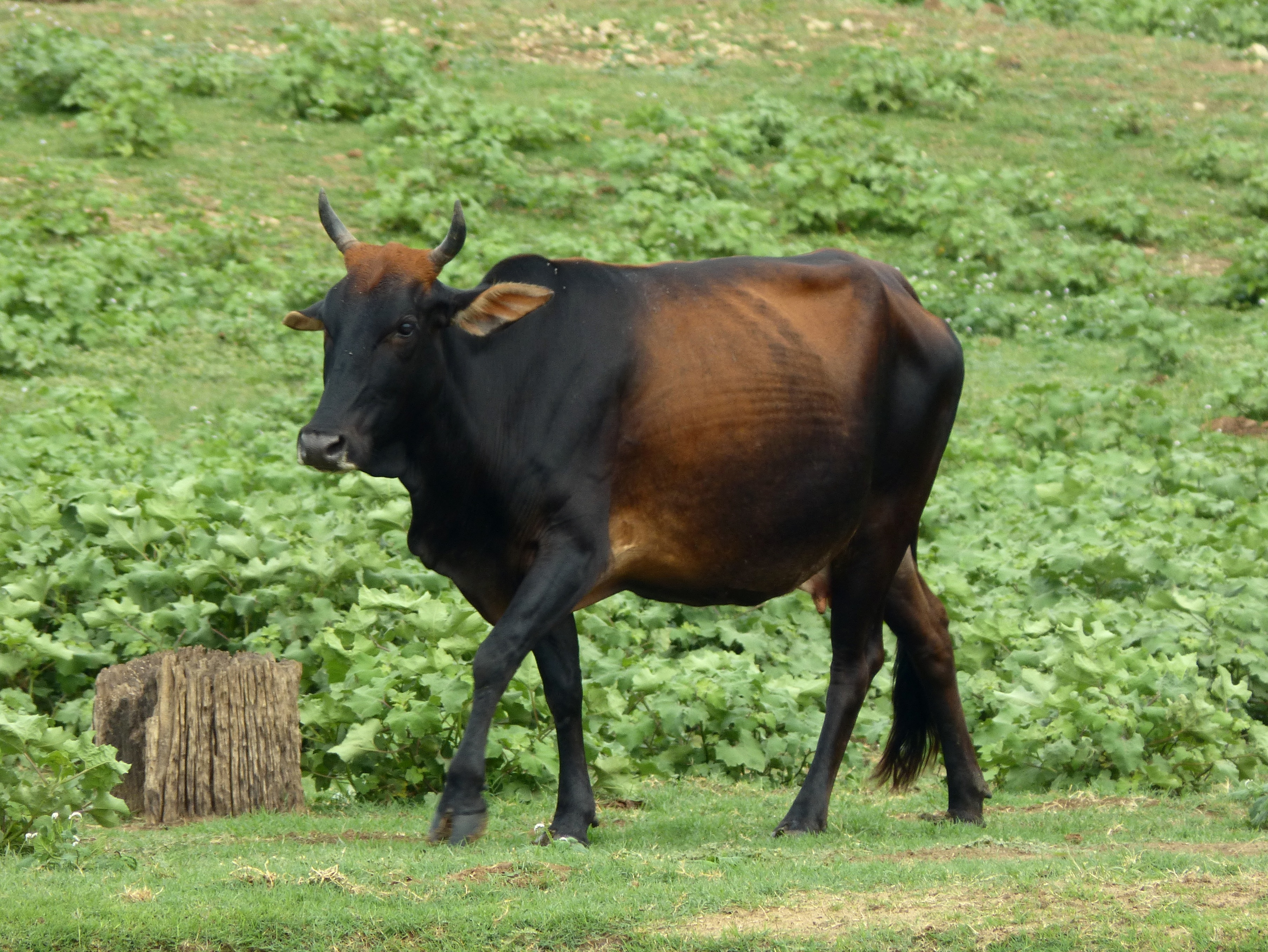
A photo provided by Jochen Ackermann, who recently came across a zebu herd on Sri Lanka, confirmed this. It shows a zebu cow with a perfect wild colour and - most notably - almost no "zebu hump". 


Primitive Zebu cow on Sri Lanka, photographed by Jochen Ackermann
This cow is seemingly free of taurine influence, at least there is no indication for it. I don't know the name of the breed or if it even belongs to a specific breed. The other cows in the herd were coloured similar but more "usual" for zebus, with a prominent dilution on the ventral side of the body and/or also white spots. The bulls were elusive, but their hump was considerably larger. Indeed there seems to be a trend for the hump to be sexually dimorphic in more primitive zebus in Asia, judging from other photos I have seen. A herd of zebu-gray cattle hybrids at the zoo of Haag, Austria, also had bulls displaying a zebu hump but cows virtually lacking it. Perhaps the size of this appendage is related to the testosterone level. I still think it is a domestic feature and effigy breeding should try to reduce it as much as possible, and cows like that above certainly would be very helpful. But also her perfect wild type colour, the long legs and snout make me optimistic for effigy breeding with zebu. Unlike the case of the European aurochs, it might not be possible to reconstruct the phenotype of the Indian aurochs completely because zebus are more phenotypically derived, but achieving zebus with wild type colour, small humps, long legs and skulls and large, aurochs-like horns is absolutely possible, and all the rest could be done by mother nature later on. I hope that some suited Indian wildlife reserves will have such "wild zebus" one day. 


Exmoor vs. Konik - which one is the better wild horse substitute


Of course neither the Konik nor the Exmoor are surviving wild horses, it is zoological commonsense that the western subspecies Equus ferus ferus is extinct in its wild type. Both breeds proved to be hardy and suited to the climate of central and northern Europe. But which of these two breeds is a better substitute for the wild horse in phenotypic and behavioural respect? The Exmoor and the Konik are the centre of two rivalling ideologies, and advocates of the Exmoor usually reject the Konik and vice versa. But the breeds do not rule out each other, and I want to take an objective look at this issue here.

Which one is a direct European wild horse descendant?

According to the current knowledge, none of them. All of the modern domestic horses apparently descend from one single domestication event in the Eurasian steppe, but they seemingly experienced female introgression on the continent. See here. This is true of any modern European domestic horse, and so also of the ancestors of the Konik and Exmoor.
The Konik is neither a hybrid population of the last Polish wild horses, as it is widely stated, nor is it a breeding-back attempt with such as a base. It is in fact a landrace descending from rural Polish ponies of mixed origin. According to Wikipedia, pre-domestic wild horses were present on Great Britain until at least 5500 years ago, so that domestic and wild horses might have met each other on Great Britain, there is still no evidence that the Exmoor directly descended from the last remaining wild horses because it shares the same limited Y chromosome diversity with many other domestic horses from around the world (see the previous entry). One could argue that domestic introgression and bottlenecks could have produced this result, but only through systematic culling of wild stallions and replacement with domestic ones in the moor, for what there is no evidence and what also would have greatly altered the population.
Although both the Exmoor and the Konik are no remnant population of the European wild horse, nothing rules out that they are themselves very original and do resemble the wild horses in several respects.

Which one has the more authentic phenotype?

To remind you, the European wild horses did not have a uniform but variable appearance, at least concerning their colour. I was basing myself on genetic and and historic evidence when I did this wild horse reconstruction:


As you see above, genetic and historic evidence suggests that 5 colour variants were present among the European wild horse: bay (like the Exmoor), bay dun (f.e. Przewalski), black (some single Koniks but also other “celtic ponies”), black dun (Konik). Dun is a dilution gene that makes the leg stripes and eel stripe more prominent and creates somatolysis in the open field. And indeed Koniks (and other dun horses) are perfectly camouflaged in such habitats. The lack of dun produces darker colours which are suited to more closed habitats, so it happens that Exmoors are wonderfully camouflaged in forested habitats. That is not to say that the Exmoor is a “forest type” pony and the Konik an “open field type” pony, because some Koniks also show darker expressions of their black dun colour which suit a forested habitat. Historic evidence suggests that the majority of Europe’s wild horses was dun coloured, but this gene has yet to be tested for the bone remains of the Holocene remains to be sure. Nevertheless, both the Exmoor and the Konik display one of five possible colour morphs within a wild population, respectively.
Because of their mixed origin, some Koniks still carry genes for a sorrel colour or white spots. White spots are also present in some Exmoor ponies, but rarer than in the Konik and breeders select against it.
Both the Exmoor and the Konik have a small, sturdy body with a robust head and a short mane, but there are also many Konik lineages with a more gracile built and long manes, resembling usual riding horses. The “beard” which is present in the Przewalski’s horse and also described for the European wild horses is prominent in the Exmoor, not so much in the Konik.

Which one has the more natural behaviour?

Because the domestication of the horse strongly focused on behavioural traits, no domestic horse has a truly “wild” behaviour; this is even evident under natural conditions. Wild horse behaviour, based on that of the Przewalski and what is described for the historic wild horses, includes shyness in the open field but aggressive behaviour against domestic horses and man in captivity, and defending themselves harshly against predators.
Koniks remain relatively tame under natural conditions, while Exmoors tend to be shyer because of their feral history. Koniks are reported to behave dominant over other horse breeds even if those are larger [1]. I don’t know about the dominance of Exmoors over other horse breeds.

Which one knows how to deal with predators?

We don’t know how much the rural ponies ancestral to the Konik had to deal with predators, but since they were husbanded, it is likely that they were largely protected. When Koniks were released in the Spanish Atapuerca mountains last year, five of them were killed from wolves.
Exmoors have been living feral in southern England for at least one millennium, and wolves did not disappear from the island before the 16th century, what suggests that they know how to deal with predators. They are also known to form a defensive circle around their foals, a common behaviour among ungulates. It was even reported that an Exmoor defended itself successfully in a puma attack in the moor [2].

How about the resistance against diseases?

Both the Exmoor and the Konik have one disease they are prone to, respectively. In the case of the Exmoor, it is a kind of horse mange (“Sommerräude” is the precise German term, I don’t know the English one). Some Koniks are prone to laminitis, especially when raised in a barn [1]. But all in all, both breeds are resistant against most other horse diseases.

Conclusion

The behaviour of the Konik seems to be more domestic than that of the Exmoor and they are less used to predators, but I hope that these traits will redevelop if a large enough population is released in a nature area. When the right Koniks are chosen (with a sturdy body and short mane), both Exmoor and Konik represent one of five phenotypes that likely appeared within the European wild horse, although the Konik is slightly more gracile and long-maned than the Exmoor. Doing tests for the dun gene in Holocene wild horse remains could reveal if there was a regional difference in the occurrence of dun and non-dun wild horses, and if there were non-dun wild horses at all. Genetic testing could also prevent getting animals with genes for white spots or sorrel colours into wilderness areas. Releasing Koniks and Exmoors side by side in one reserve would be no mistake in my opinion, because the breeds compensate each other: Koniks lack the bay gene but have black and dun, Exmoors have the bay gene but lack black and dun. Since the other phenotypic respects are about equally primitive if the right individuals are chosen and their ecologic capacities are about the same, and they would even compensate each other regarding the resistance against diseases, mixing them for rewilding purposes would only have positive effects (but I am suggesting to mix both breeds in general, not at all, both are unique breeds).  The majority of the animals within a Exmoor x Konik population would most likely be coloured bay dun, because bay is dominant over black and dun is dominant over non-dun – and historic and genetic evidence suggests in my opinion that bay dun wild horses were the most common within the populations.

A little game - recognizing Exmoors and Koniks only by drawings of their contours to see how different their phenotype beside the colour really is - will come soon. 

Literature

[1] Tadeusz Jezierski, Zbigniew Jaworski: Das Polnische Konik. 2008.
[2] Baker, Sue, 2008: Exmoor Ponies: Survival of the Fittest – A natural history.

Sunday, 22 September 2013

Visiting Chillingham cattle - was there a white Aurochs?


In September last year, I visited the Chillingham Park in Northumberland, England, to have a look at the main herd of Chillingham cattle. These cattle are a very rare and ancient cattle breed, remarkable for their feral history, genetic isolation for at least 300 years and a high degree of inbreeding. I talked to Richard Marsh, the Chillingham cattle warden, and he told me a lot of interesting facts about this herd that I am going to share here. It is often claimed that they are totally wild, undomesticated cattle, but how wild are they truly? Are they related to the aurochs in some way? Let’s dive a little deeper into the history and biology of that breed.


The aurochs died out in Great Britain 3500 years BP [1], before domestic cattle arrived. Claims that Chillingham cattle descended from the first cattle brought to England by the Celts or later the Romans are neither supported by historic [1] nor molecular data. Chillingham cattle belong to the T3 haplotype [2], which is characterized as the “typical modern European haplotype” by Beja-Pereira et al. 2006 [3]. Chillingham cattle is sometimes connected with the aurochs because Charles R. Darwin recognized similarities between the aurochs’ skull and that of Chillingham cattle, but this breed isn’t any more aurochs-like than primitive cattle landraces from Iberia, Italy, North Africa or the Near east.

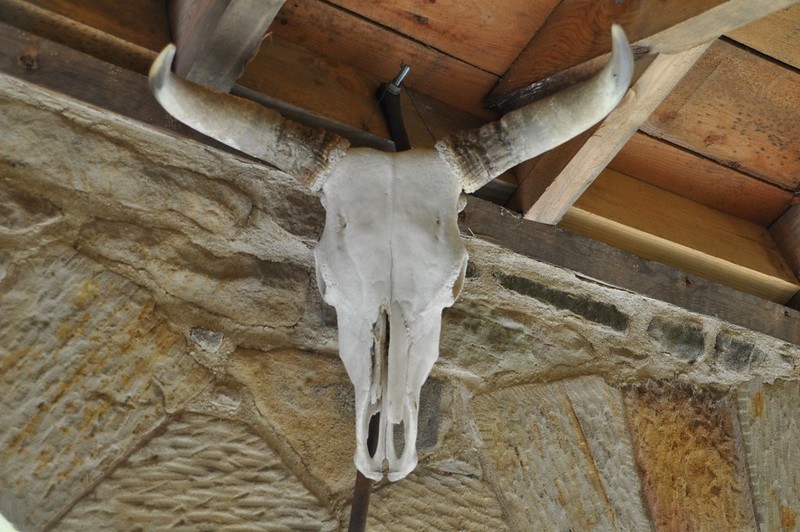
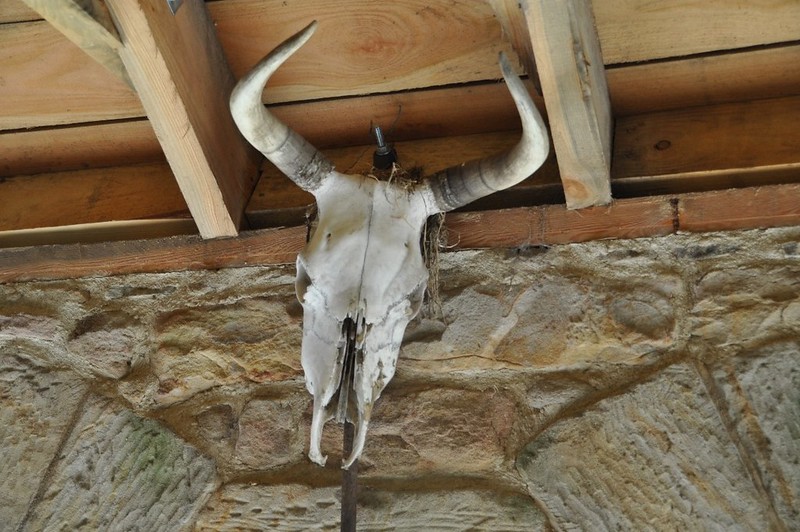
Chillingham skulls with more or less aurochs-like skulls
From the first half of the 13th century, British baronial hunting parks included also cattle for hunting [1]. These cattle also served as ornament, and the European nobility usually preferred white animals for such a purpose (f.e. see the Austrian white donkey). While many of the hunting park herds became strongly influenced by Highland and Longhorn cattle, resulting in the modern White English Park cattle [1], Chillingham was the only location to retain pure herds of these hunted cattle, which were probably founded by collecting medieval husbanded cattle between the 13th and 17th century [1].  In the 13th century, a wall around the Chillingham park was built and the cattle were now protected from Scottish poachers, and they survived in this enclosure until today. The cattle live in a feral state and were hunted by the nobility just like Britain’s feral ponies. When they were hunted in earlier days, they were known to be very aggressive and killed dogs, horses and humans involved in the hunt.

Historic engraving by Thomas Bewick, showing the hunt of a bull at Chillingham
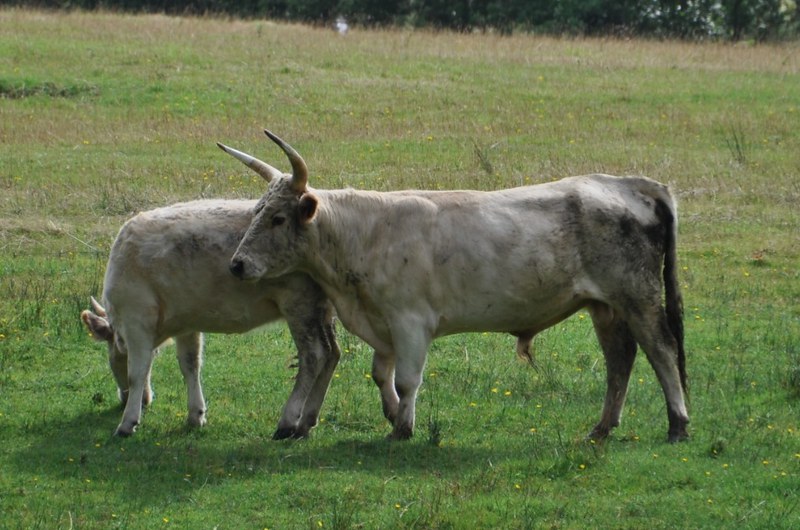
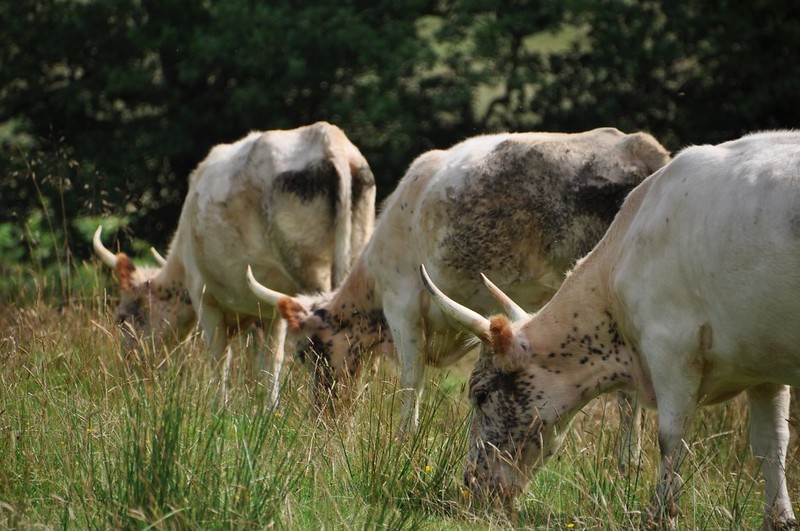
Chillingham cattle are, like most cattle back in the medieval times were, quite small, standing only 110 cm at the withers and weighting 300 kg (for bulls, cows are slightly smaller). However, we know through bone remains that there was a slight trend to size reduction in the population over the last centuries. Their body shape is, although comparably slender and firm, domestic in having no shoulder hump and a rear that is as heavy as the forehand. The udders of the cows are surprisingly large. Chillingham cattle have large heads (sometimes also with a long skull), but their body is comparably short-legged and longish. The horns are mostly upright (100° and more) but aurochs-like in curving inwards, with slightly upwards-inwards facing tips. Among the skulls on display, I found some specimen having even more aurochs-like horns than those in the current population have. Perhaps they stem from the times prior to the most dramatic bottleneck event in the 1940s. The colour of Chillingham cattle is interesting: the nasal mucosa are black and cows are coloured creamish (i.e. darker) on the neck area, what usually is indicative of the wild colour allele E+ (but the calves are completely white while wild-coloured calves are always born reddish). Even more surprising is that bulls are slightly darker (grayish) than the cows, what suggests that they retained some kind of colour dimorphism. Additionally, they have those numerous small black spots on the face, neck and shoulder area. I have no clue about the genetic background of the coat colour in Chillingham cattle. UPDATE: I found out that the colour of Chillingham cattle is caused by the colour-sided allele (Cs) on a base colour that is either black or wild type-coloured. No other breed in the world has the same colour except White Park cattle. The hair on the neck and face area is very dense and curly in Chillingham cattle. This “mane” is claimed to serve as a protection of the bull’s skin during a fight. Some Spanish cattle like the Fighting bull or Sayaguesa sometimes also show is feature, and it is apparent in single Oostvaardersplassen bulls as well. Therefore I wonder if aurochs also may have had it to a certain extent, but this is only speculation.  


Chillingham cattle are dedomesticated in the sense that they are free to breed themselve and the dominant bulls that cover the cows, and there has never been medical care or any other form of custody. Nowadays the cattle are supplementary fed during winter because the area they live on is too small to provide food for the whole herd, under natural conditions they would migrate. Predators are not present in the Chillingham Park and I don’t know if they ever were, since it was a guarded game park of the nobility. The numbers of Chillingham cattle probably were regulated by food availability, diseases and hunting. Artificial selection on Chillingham cattle was not totally absent. For example, individuals with black ears and light noses were selected out. Also, selection probably played a role in surviving the genetic bottleneck [1] (see below).
When Chillingham cattle, in spite of being feral for several centuries, still have a more or less domestic body, upright horns and small size, why is there a trend in Oostvaardersplassen for Heck cattle developing “wild” body shape and proportions and aurochs-like horns? I think the key to this question is that the Oostvaardersplassen cattle descend from a very variable founding population. Evolution works faster in a variable population than it does in a homogeneous population. And perhaps the selective pressure for saving energy never was that strong at Chillingham because of the supplementary feeding (I don’t know when they started to feed them). Regarding the horns, we should not forget that they are some kind of aurochs-like in Chillingham cattle. They curve inwards, what is functionally very advantageous in intraspecific competitions and was the case in every single aurochs specimen we know. It is possible that the horns of Chillingham cattle were more aurochs-like prior to the bottleneck event, based on the skulls which I saw.

The numbers of Chillingham cattle were documented from 1689 onwards, showing a peak number of 82 in 1913 before they started to decline [1]. The population crashed in the severe winter of 1947 to 13 individuals. Not only have they gone through this genetic bottleneck, but also 300 years of inbreeding, resulting in a highly uniform nuclear genome [2]. Based on mitochondrial DNA, the whole modern population descended from a single recent female founder [2]. It is theorized that Chillingham cattle avoided an inbreeding depression due to purging out deleterious alleles, which was executed by the wardens during the 19th century: weak bulls were castrated and weak cows shot for beef before they could reproduce [1]. Natural selection probably played a role as well, and nowadays there is no culling or castration anymore. Furthermore, cows allegedly kill their weak calves.

I was told that the sex ratio within the herd is 1:1. Having several adult bulls of any cattle breed on one restricted area can lead to trouble, and indeed Chillingham bulls often have severe fights, sometimes injure or even kill each other. The bulls are in constant alertness and have a considerably shorter life span than the cows (13 years). The often repeated concept of a “king bull” ruling the herd is probably too simplistic [1]. Chillingham bulls, like bulls of any other cattle breeds, live in groups of two or three, but are not territorial [1]. Adult bulls vocalize much, something that I also experienced when I visited the herd. It is remarkable that there is no rut and they mate all the year round – this has disadvantages for cow and calf during winter and usually free-roaming cattle redevelop a natural reproduction cycle. Perhaps this was not the case in this feral population because of the supplementary feeding in the cold season.
I was told that the cattle go into the deciduous forest for resting, but interestingly never go into the conifer forests.


In 2009, there were 85 individuals at the Chillingham Park, additionally to a reserve herd in the north-east of Scotland. I hope that in the future there are more breeding locations in order to conserve these remarkable cattle. It is uncertain whether they can resist diseases transferred from other cattle breeds because of their genetic uniformity, but only trying it will show.


The coat colour of Chillingham cattle as described above is also interesting when looking at some of the cave paintings in the Lascaux cave. Among aurochs depicted in the usual colour (red cows, black bulls), there are some individuals that are drawn only in contours, with prominent black spots on the face, neck and shoulder area. Could these represent Pleistocene aurochs having the coat colour of Chillingham cattle? 
"Spotted" aurochs bull at Lascaux
This is not totally implausible, as a 2011 study revealed that cave paintings showing white spotted horses were indeed authentic [4]. There are not any other artistic depictions than the Lascaux paintings showing such a colour, nor are there any written references of it. This colour variant, if it existed in wild aurochs, must have persisted at least until the domestication of taurine cattle 8.500 years BP. I do not consider it likely that there were aurochs displaying that coat colour, as the evidence for it is very weak. But it could be worth to investigate by identifying the genes responsible for the Chillingham colour and trying to find it in Pleistocene and Holocene aurochs remains, just like Pruvost et al. did in the case of the wild horse. UPDATE: The colour of Chillingham cattle is caused by the homozygous presence of the Cs allele on a usual base colour. If the colour-sided allele is present only heterozygous, this is the outcome with wild colour as basic colour. I don't consider piebald aurochs to be very likely, as most if not all wild animals are solid-coloured. 
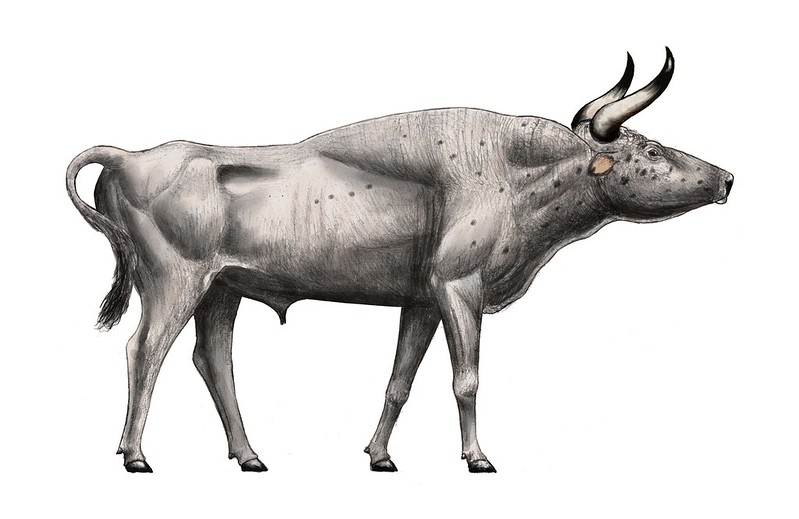
That’s a version of my reconstruction of the Braunschweig aurochs painted in Chillingham colour:


Literature:

[1] Stephen J. G. Hall: The white herd of Chillingham. Journal of the Royal Agricultural Society of England. 1989.
[2] Gavin Hudson et al.: Unique mitochondrial DNA in highly inbred feral cattle. 2012.
[3] Albano Beja-Pereira et al.: The origin of European cattle: Evidence from modern and ancient DNA. 2006.
[4] Melanie Pruvost et al.: Genotypes of predomestic horses match phenotypes painted in Paleolithic works of cave art. 2011.

Thursday, 19 September 2013

News from the Quagga Project 2013


According to their report of August 2013, the Quagga Project has 89 animals on 10 locations. Two foals have been born this year, which seemingly are of good quality:


One of the foals born in 2013 (photo by Quagga Project)

Another foal born in 2013 (photo by Quagga Project)
In their report they also show a genealogical tree of one of their F4 individuals called Mary, which has almost completely stripeless legs. According to the project, HN12 (F4 individual) is the most Quagga-like animal they have so far. As far as I can see, most Rau zebras born between 2010 and now are about as good as these two individuals. Zebras mature later than domestic horses (mares at about the age of 2, stallions 4 years), so we’ll have to wait a bit until we see the offspring of the animals linked down below. I’m really looking forward to see the Rau zebras of 2020!


HN12 (photo by Quagga Project)

"Mary", another F4 Rau zebra (photo by Quagga Project)
I’ll do some Quagga artwork soon, meanwhile here are photos of the Quagga specimen that I took at the Senkenberg museum, Germany (I have one from Berlin too, but that one is too dark):


Tuesday, 17 September 2013

Heck cattle at Oostvaardersplassen - A special population


In 1983, 32 Heck cattle were released in the Dutch reserve Oostvaardersplassen, an area of 5600 hectares. Oostvaardersplassen is the only place where Heck cattle live under natural conditions without much influence of man, such as no supplementary food during the first decades and no artificial selection. The cattle grew to 350 individuals in 2011 and evolved into a very heterogeneous population, making it a very interesting dedomestication experiment. It is cool to see some individuals with broken horn tips, split ears or even scars; that shows that they have a rough life and those which do best pass on their genes.
Keep in mind though that Heck cattle in Oostvaardersplassen are by far not the only free-ranging cattle population in Europe. Chillingham cattle and Betizu cattle have been living freely since centuries, and especially the last one is way more dedomesticated than the Oostvaardersplassen cattle. Sadly though, feral cattle (or feral domestic animals in general) are an ashamedly understudied field. Their social behaviour, reproduction cycle, habitat choice, food selection, species interaction and so on could tell us so much about their ancestral wild type, the aurochs. And if it is a very variable population (what makes the Oostvaardersplassen cattle so interesting here), a statistic evaluation of the changing frequency of certain phenotypic features over the time would provide a lucid example of evolution at work

Most of the Heck cattle at Oostvaardersplassen do barely resemble the aurochs. When people in the Netherlands started to buy Heck cattle from other countries in the 1980s, the breeders mostly sold their less good cattle (this is understandable, I would have done the same), and some individuals were bought as calves, so that their quality was not yet discernable. Therefore, most Dutch Heck herds, and the Oostvaardersplassen herd in particular because no artificial selection takes place, are less aurochs-like than many German herds, but there are also some good animals among them (more on other Dutch herds in a future post).

Nevertheless, the population at Oostvaardersplassen is very valuable because it has been exposed to intense natural selection over the past 30 years. Predators are still absent in the reserve, so the selective pressure mainly concerns the ability to survive harsh winters, resistance against injuries and competition for food, social dominance and breeding rights. I am not aware of any diseases in this population.
The ability to survive harsh winters and to live on poor forage is dependent on saving as much energy as possible. This requires a thick and insulating winter coat (Heck cattle, like other cold-resistant cattle breeds, have such a winter coat), but also a small, hairy udder, short dewlap and short scrotum in order to reduce the heath loss. Those individuals which loose too much energy during winter cannot keep up sufficient strength or fall ill and die, what favours the cattle that are more effective in saving energy and resist diseases. Storing fat during autumn is another factor that is important for cattle to survive strong winters. Also, seasonal adaption of the reproduction cycle is important for the cow and calf’s survival, because cows having calves during the cold season have difficulties in subsisting themselves and their offspring. Therefore, cattle should mate during August/September and give birth during spring, like it seemingly was the case in the aurochs [3], and is the case in Highland cattle under natural conditions [3][2]. Heck cattle usually give birth all the year round like most domestic cattle, unfortunately there is no information on the reproductive cycle of the Oostvaardersplassen population that I am aware of.
The competition for social dominance (which has advantages such as better feeding places and less stress) and breeding rights is directly connected to the animal’s superiority in intraspecific fights, which is dependent on the weight/size, horns and also the psyche of the individual [1][2]. Long-legged and agile animals also have a higher chance in succeeding in a fight. Intraspecific fights occur in both sexes, but especially the mating competition of bulls has a direct influence on the evolution within the population. High shoulder spines that allow large neck and shoulder muscles to develop provide another important advantage in combat; that’s the kind of “hump” that’s present in all wild bovines, aurochs included. Also the horns of the aurochs were shaped for a purpose: their curvature had a functional advantage in competitions, because large, forwards and inwards-facing horns made it possible for the animal to pull and push the opponent more effectively than other horn shapes would do. This is the reason why bovine species fighting in a similar manner also have very similar horns (Kouprey, Yak) and why the aurochs’ horns were relatively uniform, no matter which respective time and region.

© treverius on flickr
Having tried to make predictions on how the functional phenotype (among other aspects) of a released cattle population might change under such conditions, now lets have a look at how the present Oostvaardersplassen Heck cattle look like.
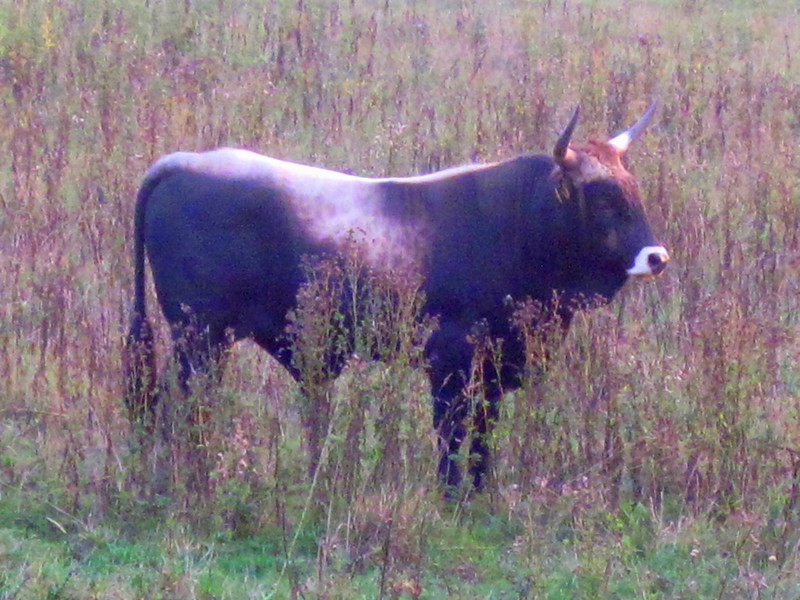
The body shape of many cows is still domestic in having a bulky rear, visible pelvic bones and no hump (thus, comparable to usual Heck cattle). However, single cows seem to develop a slight hump and a slender waist. This trend is even more apparent in bulls, some of which do really have an athletic body shape with a clear hump and a slender waist, resembling Spanish fighting bulls and wild bovines. Also, many bulls and cows have long legs as in the aurochs. Therefore, the prediction that body shape and proportions in a feral variable cattle population re-develops to an athletic, aurochs-like body seems to be confirmed, because such a body conformation is found in no other Heck cattle population. Down below you see screenshots of an Oostvaardersplassen bull (sadly with the wrong colour and horns) that has perfectly aurochs-like body shape and proportions. However, there are still some quite bulky and dachshund-proportioned Hecks in this reserve.

Slender, long-legged bulls
Perfectly "wild" proportions and body shape (Screenshot from youtube)
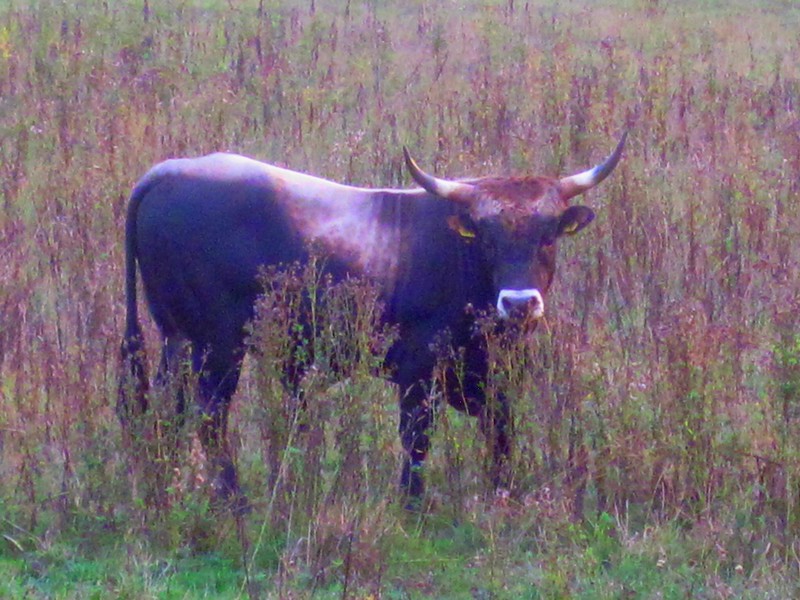
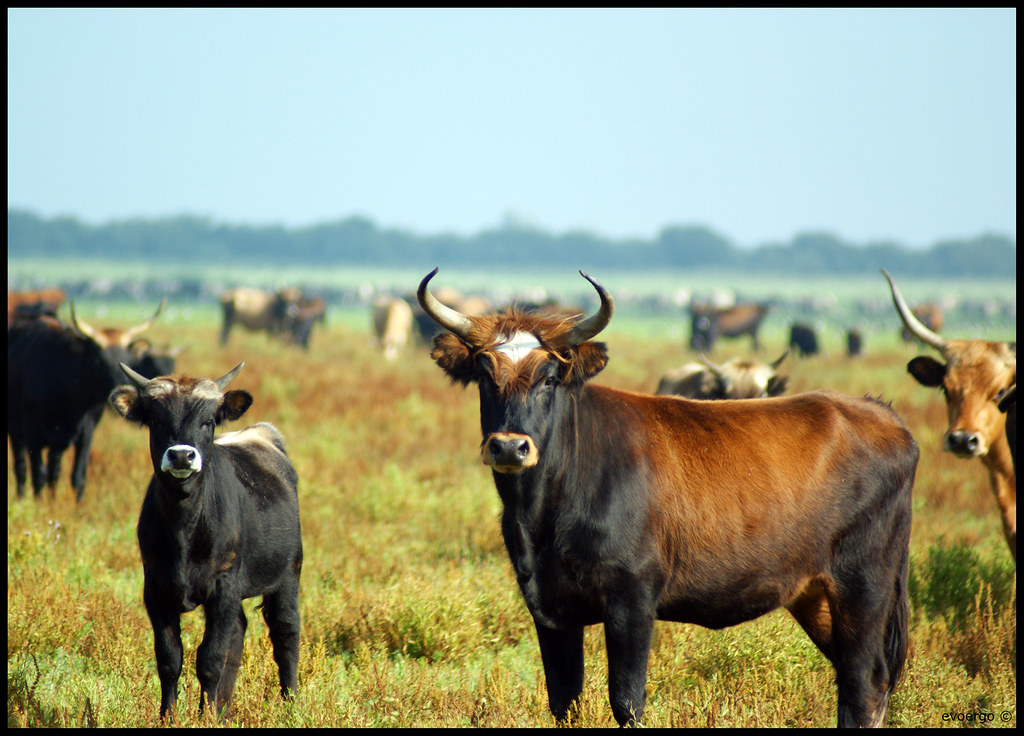
The horns within this population are mostly steppe cattle-like and thin, the length is varying and they are oriented very upright both in bulls and cows. However, I was surprised to discover cows with horns facing more forwards and inwards than in any other Heck cows. This is a strong hint that this horn shape developed in Oostvaardersplassen and therefore is a product of natural selection instead of artificial selection. In essence, the curvature of the horns in these two individuals is nearly perfect, except that they are oriented to vertical. I see the same tendency several in other cows and also bulls in Oostvaardersplassen.

(© evoergo on flickr)
(© Frits van Hout) Cows with aurochs-like inwards-facing horns, 
very likely a product of natural selection
The skull of the Oostvaardersplassen Heck cattle is short and paedomorphic like in most other representatives of the breed. However, surprisingly some cows show an elongated skull, similar to Sayaguesa. I wonder what causes this development and if a longer snout perhaps provides an advantage for grazing, or if it is influenced by environmental factors.
The colour of those cattle is extremely variable. Dark brown bulls with a kind of saddle and either dark or reddish-beige cows are most common, but black cows and black bulls, as much as reddish brown or beige bulls do appear. Gray individuals exist in both sexes and are a relatively common sight. The portion of spotted animals seems to be higher than in usual Heck herds, unfortunately. These spots either are limited to the forehead or cover the whole body.
Spotted bull calf (©Jaap Rouwenhorst)
There is no size data for the Heck cattle at Oostvaardersplassen, and also no useful photos from which the size of the animals could be extracted, so we can only speculate how large they are. Do the conditions in the reserve favour a size increase or decrease against the 140 cm shoulder height in bulls and 130 cm in cows? As discussed above, the natural selection created by the physical competition of the animals likely favours larger animals. But considering the small size of the reserve, the high density of herbivores and the limited amount of food, as much as the absence of predators, makes Oostvaardersplassen a kind of island. These island conditions favour a size decrease in larger animals, as numerous examples of insular tetrapod evolution have shown. After all, the aurochs itself “dwarfed” slightly on Sicily after it became isolated from the mainland. It makes sense that a smaller animal needs less energy than a larger one, and a healthy and strong small bull might succeed over a larger but emaciated one in a competition. Therefore, we have to assume that the Heck cattle at Oostvaardersplassen are as large/small as the average of the breed given above, or even slightly smaller.

If the conditions like they are now remain unchanged, how will the population in Oostvaardersplassen develop in future decades? I think that on a middle- and long-term sight, the portion of animals with an athletic body and aurochs-like proportions and horns will increase, while the bulky and domestic looking ones will get constantly fewer because these factors have a considerable impact on the fitness of the animals. Also, if the food situation does not change (f.e. by increasing the supplementary food that already is provided during winter), those with the smalles udders and shortest dewlaps and scrota, and most effective winter coat and resistance to diseases will become more common.  The island situation of the reserve will favour a size decrease more than a size increase. The colour of the animals has, as far as we know and in the absence of predators, no direct influence on the fitness of the cattle, so it will remain heterogeneous for a very, very long time. Perhaps sexual selection favours dark bulls and lightly coloured cows, but only on a very long term.
In essence, future Heck cattle in Oostvaardersplassen will be more adapted to their habitat and living as a wild animal than they are now. They probably will evolve into a population with aurochs-like horns and proportions/body shape, but varying colours and a small size. Probably it would also take a considerable time span until these alleles are fixed, and I am speaking perhaps of centuries. But what if man would “help” natural selection to speed up the process? Individuals with undesired features, such as grayish coat colour and steppe cattle-like horns, or many of the spotted individuals, could be culled, and a wild type colour with the right sexual dimorphism could be fixated. To compensate the loss of individuals, cows of herds that add what is lacking in the population can be added, such as from the Wörth herd (for the horn dimensions and curvature) and the Taurus cattle at Lippeaue (for the size, proportions/body shape and horn curvature). Later culling should focus on the bulls in order not to decrease the population too much, and because single bulls have a greater influence on the evolution within the population than single cows.
This plan could lead to a dedomesticated, wild cattle population that is adapted to their habitat and resembles the aurochs very well. However, it is up to the responsible people if this is turning into reality or not.

It seems that the next step in Oostvaardersplassen will be expanding the reserve. The plan of Oostvaardersland, a new 150 square kilometres large nature area that would be formed by the connection of Oostvaardersplassen to the reserve Hosterwold by a corridor named Oostvaarderswold, ran into political trouble. This is a shame, as Oostvaardersland would be one of the most precious nature areas in western Europe. Not only because of its rich avifauna and the wet zones which are very important for the amphibian fauna, but also because it is the only place in western Europe where large populations of cattle, deer and horses live side by side. Also, the cattle would have the chance to chose between forests and open grassland, what would tell us more about the habitat preference of this species. However, let’s stay tuned and see if Oostvaardersland is going to happen.


Literature

[1] Frisch, Walter: Der Auerochs – das europäische Rind. 2010.
[2] Julia Poettinger: Vergleichende Studie zur Haltung und zum Verhalten des Wisents und des Heckrinds. 2011.
[3] van Vuure, Cis: Retracing the Aurochs - History, Morphology and Ecology of an extinct wild Ox.