Thursday, 15 January 2015

Dedomestication series Pt.III: In which way feral cattle might evolve


Immunological adaptions would not be visible. Adaptions to climate would show in the structure of the fur – cold winters, no matter if dry or wet, require dense fur that isolates the animal to reduce heat loss. The overgrown long hair of Highland cattle, on the other hand, is known to be disadvantageous even in Central European summers, not to speak of Southern European summers. Usually, cattle winter fur is bilayered.


For part I, go here. For part II go here.


Body proportions and conformation probably would change dramatically. We know that the proportions and the body shape of domestic cattle are very different from the aurochs and other wild cattle. The trunk of cattle got longer and limbs and head shorter. This is not merely an aesthetic flaw but also a functional, because there is a reason why wild cattle have the proportions they have. The shorter the trunk and the longer the legs, the more manoeuvrable is the body. No need to say that longer limbs enable a higher running pace than shorter limbs. The trunk of domestic cattle in general is heavy and the “hump” is usually very reduced, so the centre of gravity is probably somewhere in the middle of the trunk or even a little bit posterior. In any (quadrupedal) mammal, the forelimbs are most important for changes in direction during running, so a more anterior centre of gravity makes the animal more agile. The so-called “hump” (actually we are talking about a shoulder area with high processi spinosi that attach well-developed dorsal and neck muscles) is also, or even more so, advantageous for intra- and interspecific fight. That’s exactly the function of this trait, and all wild bovines – including the aurochs – have it. Stronger back- and neck muscles are a direct advantage when pulling the opponent away, pushing or stabbing a conspecific or a predator.

Without question, cattle with those morphological traits should have a way higher evolutionary fitness than those who are proportionated and shaped like domestic cattle.


The size, shape and orientation of the horns likely also has a direct influence on evolutionary fitness. Horns and antlers evolved as a tool for intraspecific competition for dominance and breeding rights. In my view, the shape of the horns in cattle has a primarily mechanic function. Cattle fight by pulling and pushing the opponent in a head-to-head and horn-to-horn fight. Not only bulls but also cows fight this way. It is clear that horns need to have a certain shape and size for that. It is most advantageous when the horns curve outwards at first and then inwards and a little bit upwards, instead of being curled outwards or pointing directly outwards. Also it is probably advantageous when they do not have an either very high or very low orientation relative to the skull. And it might also make sense that larger horns are more useful than smaller horns in such a competition until a certain size. So it seems logical that intraspecific fights would affect horn shape, orientation and size. Other large bovines that do not have the same kind of horns also have different fighting modes, take bison for example. Horns are of course defensive weapons as well, but selection by predation probably tolerates more kinds of horn shapes than intraspecific competition does.


Large body size is favoured by predation and intraspecific fights. The larger and stronger the animal, the better the chances of succeeding.


Physical competition would likely require behavioural changes as well, as outlined above. Natural selection would definitely favour the alleles responsible for an energetic temper and the will to take risks. This might cause a kind of reversal of the hormonal, and therefore developmental, changes that took place during domestication. Perhaps the level of corticosteroids, responsible for the fight/flight reaction, and thyroid hormones (low levels of these cause shorter limbs and snouts, floppy ears and reduced body size in laboratory rats), would rise – the opposite apparently happens during domestication by selection for tameness (see Pt. I). Maybe it is not a coincidence that Lidia, bred for aggression, is one of the very few breeds that retained a very aurochs-like body conformation with a well-pronounced hump, tight muscles and an athletic posture. However, Lidia are small, but humans actively select them for that. Regardless of whether the Lidia example is correct, I consider it likely that natural selection for genes that regulate both behavioural traits and developmental traits might reduce or eradicate paedomorphism and other developmental changes that occurred during domestication.


Sexual selection certainly would increase sexual dimorphism, which had been drastically reduced during cattle domestication. Bulls with high levels of testosterone are more likely to win combats, and the larger the bull the higher the chance to win. The coat colour in wild-type coloured cattle is influenced by testosterone level: the higher, the stronger the melanisation of the fur, and therefore the darker the colour. Therefore sexual selection would probably favour larger, stronger and more hot-tempered bulls with a darker colour. Cows do fight as well, but these combats cannot be nowhere nearly as important for reproductive success as those of bulls in my opinion.

Large, black bulls might also be more attractive to cows than smaller, less melanised ones. And yes, cows do have a choice to a certain degree – in all harem-systems there are the so-called “sneakers” that cover cows in moments unwatched by the dominant bull, and cows do have a choice which one is allowed to mate with them.


Needless to say that environment also directly affects how the cattle are going to evolve. Apart from climatic factors, nutrition and the size of the area are important. As outlined in the first part of the Dedomestication series, the morphology of animals is plastic. Quality and quantity of the food supply affect overall body size and horn size. Theoretically, intraspecific competition would always prefer larger over smaller individuals, but on a restricted area with limited food supply it is harder for larger animals to find enough food than for smaller ones, and an ill-nourished bull might defeat against a smaller but well-nourished bull. To put it in a nutshell, the so-called island effect would take place, especially in the absence of predators.


Colouration


Colour probably has the weakest effect on the evolutionary fitness of large herbivores. If white spots are indeed correlated with neuronal deficiencies, then pleiotropy might work against the piebald pattern, but probably only on a very long-term sight. However, in a reserve with predators, solid-coloured calves are definitely better camouflaged than piebald ones when hiding in a shelter. As I wrote in the first post, a lack of melanisation in cattle skin increases the risk of developing eye lid cancer. Perhaps dilutions that also de-melanise the skin, f.e. the allele e “red” which causes lightly-coloured mucous membranes and eyelids are evolutionary disadvantageous. But the influence likely would be small, because cancer often develops after reaching reproductive age and it is not immediately fatal. The “black” mutation Ed results in a solid, uniform black coat colour. I do not see much disadvantages in this colour, except perhaps signal function. The dorsal stripe as much as the muzzle ring very likely evolved for that purpose (a white mouth area is actually widespread among bovids, and wild horses have it too). On the other hand, the frequency and intensity of muzzle rings in banteng and gaur are very variable too. In fact I have been speculating that “black” might have evolved in the aurochs already (just as an idea). Apart from that, we should not forget that female choice has a far weaker effect on reproductive success for bulls than combats with other males have, so we have to consider a very long time span if sexual selection would indeed disadvantage “black”.

So “red” and “black” will probably remain in the population for a pretty long time, and without predators white spots would probably too.

How about brindle, and all those dilution factors causing tan, beige and grey colours? I don’t know. Again, we can only speculate how large the effect of sexual selection on the reproductive success of bulls would be. If there is, it would probably be small, and take very long to wheedle them out of the population. I am talking of centuries or more. One factor might be predators again. Although the calves probably wouldn’t be affected since these dilutions show their affect only when growing their adult coats, single individuals with a lighter colour might be disadvantaged because they stand out for predators. Brindle probably would be less problematic.


If a cattle population living in the wild is exposed to predation to a sufficient extent, piebald patterns probably would disappear first. Perhaps sufficiently strong predative pressure would also affect greyish, tan or beige individuals. Sexual selection probably would take a very long time to affect colouration.

Nevertheless, sooner or later dedomesticated cattle would be more or less homogeneous in colour. But not necessarily in the most advantageous way, even if all wild-type colour traits are present in the founding population. I think so because colour seemingly is the least important trait for fitness in cattle (except for certain colours under strong predation pressure, as outlined above). Horns, morphology, weather tolerance, behaviour, immunology, seasonal mating and other traits are simply more important. And so it might happen that, coincidentally, some wild-type colour features get lost while some domestic variants become fixated. Genetic bottlenecks can have the same effect. So it might – note, might – happen that a dedomesticed cattle population that is otherwise well-adapted to its environment has a “red” or diluted coat colour instead of a fully wild-type colour. Also, it might turn out that selective pressure for a strongly marked sexual dichromatism is not that strong at all and both sexes would show a uniform colour. 


All in all, I think that wild, dedomesticated cattle would develop proportions, body shape and horns resembling the aurochs because they are functionally advantageous. Pleiotropic effects and developmental cascades would eradicate paedomorphic traits. Size would not only be dependent on intraspecific competition and predative pressure, but also on what the resources of the  environment allows. Sexual dimorphism would be increased, by developmental changes as much as sexual selection. Natural selection would affect colour the least. Pleiotropy might or might not affect white spots, but predation very likely would. If strong enough, predation might speed up the homogenization of the coat colour. Sexual selection might play a role, but much more important is pure coincidence because the other traits listened before are more effective and genetic bottlenecks might also be important. In the end, the dedomesticated population would be homogeneously coloured, but only after a very long time.

The behaviour would change as well. Their reproductive circle would adapt to the season.


All in all I think that “Does evolution take the same road twice?” is a bad question. Animals evolve according to what abiotic and biotic factors currently require and to what their possibilities are, and to a certain degree also coincidence. But traits that were advantageous in the wild type of a species might also be advantageous in feral domestic members of the same species because it was (mostly) not a coincidence that the wild type was the way it was. Especially when the domestic descendants live under the same or very similar conditions as the wild type did, which is the case in aurochs and domestic cattle. How fast these phenotypic changes will occur is dependent on how variable the starting population is (see Fisher’s fundamental theorem). Behavioural and developmental changes, as much as the transformation of traits like overall morphology would probably work without “original alleles” (if there are such) having to be present. Colour, being regulated by only a few loci, are another thing – the wild-type colour alleles have to be present in the population if you want that the cattle will show this type of colouration – it won’t evolve from new. I don’t know if it is necessary, but it would certainly be helpful and quicker if there were some cattle in the founding population already that have functionally advantageous (and therefore aurochs-like) horn traits for such a horn shape to evolve.


The next post will take a look at existing feral populations and see how far they confirm the predictions in this post.


Friday, 9 January 2015

Dedomestication series Pt. II: When domestic animals run wild


As I wrote in the previous post, I am neither an expert on developmental biology nor am I a geneticist, so I am just going to present my personal take-on to this subject here.


When domestic animals run wild, for whatever reason, they are opposed to the following selective pressures:


·      Climate

·      Food quality and quantity

·      Diseases and ability to recover from injuries

·      Predation (herbivores)

·      Intraspecific competition

o   Sexual selection

·      Interspecific competition


The ability to live on poor forage and to recover from injury as much as resistance to diseases are not visible traits. Adaptions to climate are not necessarily either, but some are. For example, the development of a sufficient winter fur, or the reduction of unnecessarily large appendages like large dewlaps, udders or ears. An interesting fact is that domestic pigs with sparse fur and pink skin are prone to sunburns [1].

There are behavioural adaptions too: Domestic animals tend to mate all the year round, which is not advantageous because both mother and juvenile may not find enough food during winter. Therefore, any wild animal exposed to such a climate has a seasonal mating circle.

Defending against predation requires morphological and behavioural changes as well. These chenges depend on the species and its defensive mechanisms. Herbivores living in groups show herding behaviour, taking the young individuals into the middle of the herd, and also form defensive circles around the youngsters. They must have the physical ability to defend themselves – that is the necessary strength, size, speed, manoeuvrability, and weapons (horns, antlers, kicks, tusks, whatever). Camouflage is a factor as well.

Intraspecific competition is basically about dominance and reproductive success. To be a  dominant animal in a herd means to have access to the best feeding and resting places, and not being chased by other, more dominant herd members (dominant individuals have to defend their status, on the other hand). Both the combats for dominance within a herd or mating rights should have an influence on the morphology, as I am going to outline later on. But also on behaviour – the more aggressive, energetic and more willingly to take risks should be in advantage. Free reproduction not influenced by man will also invoke sexual selection (of which the aforementioned mating combat is part), which is another important factor for certain traits.


So, what would happen if a population of domestic animals is released into the wild? Of course the same that evolution does with any population: shape it to fit the requirements given by nature (= intra- and interspecific, abiotic and biotic factors). How this is going to happen certainly depends on the area they are released on, but let’s assume it is the same evolutionary adaptive environment the wild type of these domestic animals inhabited. It probably sounds logical that those traits that were present in the wild type and were advantageous adaptions to live in this ecosystem will be fixated and united in these domestic animals as far as they are retained in the population. It is unlikely that the whole genome of the wild type is preserved within a domestic species, and that the released population contains all the wild type traits present in the domestic species itself, but they probably would still have such traits.  Furthermore, the animal’s genetic and developmental potential might enable them to evolve traits equivalent to an original wild trait that is lost but now needed again.   

Nevertheless, the transformative selection that would take place certainly would not just be pure regression towards the retained wild type traits. The requirements of the biome might have changed since the time the wild type has disappeared – some other species might have vanished, or new been introduced and the landscape might have been modified and the space restricted by man. The population has to adapt to these circumstances as well.


Many typical traits of domestic animals are useless or hindering: floppy ears, reducing the acuteness of the auditory sense and affecting their social behaviour (dogs); over-grown fur that felts or soaks full of water, dirt or parasites; or unnecessarily large appendages such as large dewlaps, udders, fat bumps, hypertrophied muscles, ears et cetera. Those would probably be eradicated by natural selection as far as possible.

As anybody familiar with the basic principles of population genetics will know, mutations are not always fitness-reducing or deleterious. They can also be advantageous  or at least be neutral. Perhaps some of the new mutations that occurred since the domestication event would now be advantageous to overcome the genetic bottlenecks they domestic lineages went through. Probably a number of new traits acquired since domestication would be neutral and disappear only slowly or only with the help of genetic drift, especially colour traits.

Natural selection would likely also influence the genes that were responsible for the developmental changes during domestication (outlined in the previous post) and change them in an evolutionary advantageous way, therefore removing some domestic artefacts such as paedomorphism.

Eventually the whole population would become more and more uniform. Wild animals usually are very uniform, and this is not only because of stabilizing selection that purges out traits that are “not as fit” as the others, but also due to genetic drift, which purely depends on coincidence concerning neutral traits. It would probably take a very long time until a variable population of domestic animals reaches the uniformity of wild animals (without severe bottlenecks).

Phenotypic plasticity probably changes the appearance of the animals in just the reverse way it does when taking place in husbandry: the animals should look more “trained”.


Based on these thoughts, I worked out the following hypotheses:


1. Domestic animals change under selective pressure in nature. These changes are

            a) a regression towards wild-type traits because they provide an immediate fitness advantage

            b) a response to the new and/or new old selective pressures, that might also enforce traits that are not necessarily wild-type traits

2. Mechanisms that cause morphological and behavioural changes in domestication, such as relaxed selection, alteration of developmental cascades and pleiotropy do the reverse during dedomestication

3. Not all new traits that emerged during domestication are necessarily fitness-reducing. Those will remain in the population for a long time or even become fixed per coincidence.

4. Eventually, the population gets as uniform or nearly as uniform as wild animals usually are through stabilizing selection and genetic bottlenecks, however long that process will be.


Now I am going to give a number of examples of dedomestication that might be models for what we can expect to see in a released population of cattle:


Feral rabbits


It is well-known that the native range of the common Rabbit, Oryctolagus cunniculus, was restricted to Iberia, North Africa and southern France before it was expanded by humans from the antiquity onwards. Now they inhabit great parts of Europe, Australia, New Zealand and also a bit of South America. Those outside their original range are very uniform in appearance and I do not know of any differences to those rabbits within the original range. I do not know how many of the rabbits that were originally released in non-native regions were wild or domestic, but there surely must have been domestic rabbits among them. Heinz Heck claimed all of them were of domestic origin (does anybody know further sources for that?).[2] Rabbits are small animals and have many predators, they cannot effort any deviant, eye-catching colour variants, floppy ears and so on.


Feral pigs


Pigs had escaped or been released on a lot of places on this earth. The most famous examples are Australia and the Americas. The North American “razorbacks” will be in the focus here. If you do a google search, you will find some specimen that resemble European wild boars very closely – that is because those have been introduced to several regions as game animals and hybridized with the feral pigs. But there are, luckily, still regions with un-hybridized feral hogs. Texas, for example. Have a look at these two videos showing Texan feral hogs: video 1, video 2. Although not identical, they bear a considerable resemblance to wild boars in looks, behaviour and movement. They have a body build for agility and strength, and that's how they move. Their tusks are well-pronounced as they have a social and defensive function. The skull is very elongated, as much as in the wild boar – perhaps this is an example of a “reversal” of paedomorphism as described above through developmental cascades [UPDATE: I was pointed out to a paper that suggests that the elongated snout of feral pigs is a result of phenotypic plasticity due to the chewing mechanism]. What is also striking is their (with a few exceptions) uniform fur colour, beautiful mud-coloured brown or very dark, almost black, brown (not as greyish as in the European wild boar) – very likely camouflage in forested environment.


Feral Horses


There are a lot of feral horse populations as well. But in this case I wasn’t able to trace down a population that was originally of a diverse origin (in which the effect of selection would be easier to spot than in a population that was rather homogeneous right from the start*), fully exposed to natural selection and without further influx by domestic horses. So I do not know of any feral horses that serve as a good role model. And as far as I can see, there are no populations that are homogeneous but not inbred at the same time. One of the reasons might be that horses, being large herbivores that do not have any natural enemies in most of the areas they run wild, do not have the same predative pressure than feral rabbits or pigs have (adult feral hogs may be untouched by native American predators, but juveniles and subadults probably not). Furthermore, I think that horses are far less domesticated in terms of morphology than (derived) cattle or pigs are. 


*The feral horses of the Namib Desert are very homogeneous. But I would explain that with their very low genetic diversity [3] and ancestral breeds that were much alike.


My dedomestication concept has empirical problems that am going to outline in a following post. But for now I am going to use it as a working hypothesis for the next post, which is going to explore what might happen in a cattle population becoming dedomesticated.


For the next part, go here. 


Literature


[1] Margret Bunzel-Drüke, Carsten Böhm, Peter Finck, Gerd Kämmer, Rainer Luick, Edgar Reisinger, Uwe Riecken, Johannes Riedl, Matthias Scharf, Olaf Zimball: ''„Wilde Weiden“. Praxisleitfaden für Ganzjahresbeweidung in Naturschutz und Landschaftsentwicklung.'' 2. Auflage. Arbeitsgemeinschaft Biologischer Umweltschutz im Kreis Soest, Bad Sassendorf-Lohne 2009, ISBN 978-3-00-024385-1.

[2] Heinz Heck: “Der neue Auerochse”, Internationales Zuchtbuch für Auerochsen, 1980.

[3] Cothran EG, van Dyk E, and van der Merwe FJ (March 2001). "Genetic Variation in the feral horses of the Namib Desert, Namibia". Journal of the South African Veterinary Association (J S Afr Vet Assoc) 72 (1): 18–22. PMID 11563711. R


Thursday, 1 January 2015

Dedomestication series Pt. I: From wild to domestic

About eight months ago, I intended to do a dedomestication series on how domestication works per se, what happens when domestic animals run wild, and how this is relevant for “breeding-back”. But I never got to it, and actually I am happy about that because I gathered much more information in the meantime. Also, the drafts for the articles were unnecessarily long, so I am going to do more succinct versions here, which are easier to read for you and quicker to write for me.

So the subject of the first part is going to be how a wild animal becomes a domestic animal with all its morphologic and behavioural changes. My post from April 2014 covered this question already (http://breedingback.blogspot.co.at/2014/04/breeding-back-and-dedomestication-pt-i.html), but IMO not sufficiently, so I decided to write another, more inclusive and handier one.
Domestication has a strong developmental background. I am an amateur on developmental biology as much as I am not a geneticist, so feel free to point me to conceptual errors in this text if you spot some.

Per definition, domestication is the process that occurs when man shapes wild animals for his purpose by artificial selection. This process always results in similar morphologic and behavioural traits, regardless of which species or domestication event, suggesting that there are universal underling mechanisms that are always the same. These mechanisms are very likely part of these factors:

Genetic drift: This is the very first effect of domestication. Man snatches out a small population out of a larger wild population and and starts breeding with it. But that factor is of minor importance here.  
 
A normal and a hypothyroidic mouse. The latter shows
floppy ears, smaller body size and shorter limbs and
snout. Taken from [2].  
Developmental delay: This is way more important. The famous Farm fox experiment which selected captive silver foxes for tameness over decades, the results are human-friendly foxes with juvenile behavioural and morphological characters, as well as novel traits. The retention of juvenile characters, known as neoteny or paedomorphy, is common to all domestic mammals and is the result of a developmental cascade due to the selection on tameness [1,2]. The reason for that is that behaviour is regulated by hormones, and selection on certain behavioural traits changes the endocrinology. And selection on tameness, or in other words, a reduction of the so-called fight/flight reaction, seemingly has a dramatic effect. Main hormone groups involved are corticosteroids and those produced by the thyroid gland [1,2]. The former play a role in the animals reaction to stress, and indeed the level of corticosteroids in the domestic foxes dropped to a quarter compared to the control group [1]. Also, the surge of this hormone group during postnatal development got delayed, suggesting that the hormonal change that causes the behavioural change also results in neoteny.
The thyroid hormones have an even greater impact. They play a crucial role in postnatal growth, pigmentation, brain development, adrenal gland function and development of the gonads [2]. Hypothyroid rats are smaller than the average, have a shorter snout and floppy ears, which are typical domestic traits [2]. Neoteny in amphibians is the result of hypothyroidism as well, and so is the so-called cretinism in humans. Symptoms of cretinism are shortened extremities, reduced body size and lowered cognitive abilities. I don’t know if we can connect the reduced brain volume we see in domestic animals with these reduced cognitive abilities, but the parallels between typical traits of domestic animals and the effects these hormones have in humans and rats are obvious.
The reduced sexual dimorphism has to have a hormonal cause as well. Probably – and this is now my presumption – the selection for tameness and the change in the endocrinological activity also affected the production of steroids that are responsible for the development of secondary sex characteristics, androgens and oestrogens. Distorted production of these hormones in humans results in syndromes such as virilism. Indeed the farm foxes show reduced sexual dimorphism in cranial morphology.
Another result of the Farm fox experiment and of domestication in general is earlier maturity. The domesticated foxes mature one year earlier and give rise to one more pup. This was achieved by selecting for tameness only, while the efforts by fur breeders by selecting on earlier maturity directly for decades remained fruitless [1].

Pleiotropy: (forgive me that I just recycle this paragraph from my earlier post) Pleiotropy
takes place when genes do not affect one single trait but have a number of functions. This can also be the case in genes for discrete, monofactorial traits like coat colours – these “colour genes” actually have more than one function. A prime example is the KITLG locus that produces the ligand for tyrosine-kinase (coded by the KIT-locus), which has a function in germ cell, neural cell and blood cell development. Mutations on these two loci are either hyperpigmentation or leucisms [3], responsible for many of the spotted patterns we see in domestic animals [4].  KIT mutations are the cause of the typical white streak along or the “star” on the face of many domestic animals, and is also displayed by humans having similar mutations (“piebaldism”). The spots are the result of a disordered migration of the melanoblasts from the neural crest where they are produced. White-faced cattle like Hereford have a greater susceptibility to Cancer Eye or Bovine Squamous Cell Carcinoma [4], and depigmentation in general increases the risk of cancer because melanin is an important barrier for mutagenic UV radiation, which is evident in basically every animal. The Agouti-locus has a role in pigmentation (responsible for colour dilutions in many mammal species), but also in regulating lipid metabolism in adipocytes [5]. The Dun-locus, a dilution locus as well, has functions in the nervous system and metabolism. Mutations on this locus cause neuromuscular disorders which can result f.e. in arched tails (see dogs and pigs) because of myelin degeneration [6]. The phenylalanine metabolism might be disturbed as well [6]. Not all mutations on these loci are necessarily disastrous, otherwise all domestic animals with deviant colours would regularly be born with serious disorders. Pleiotropy certainly is the cause of some other traits displayed in domestic animals as well, perhaps such as over- and under-bite in dogs.

Relaxed Selection: This refers to the loss or reduction of adaptions that are otherwise required by living in nature in its ecological niche. For example resistance to diseases, seasonal mating, climatic adaptions, certain behavioural or morphological traits. 

Phenotypic plasticity: The genotype alone does not determine what an organism will be like. Rather, the actual phenotype is the outcome of the products of the genotype interacting with the environment. Phenotypes of the same genotype can differ under different environmental conditions. This is called phenotypic plasticity. Limited food for example restricts individual growth, or that of horns and antlers. Muscles grow or shrink by being trained or not trained – if an animal is able to live and move freely, it should be well-muscled. If it has to live in a small confined place, it will have a rather hypotrophic musculature. The impact that the environment can have on the phenotype depends on how much is permitted by the genotype. This is called the reaction norm. Muscle size depends on training, yes, but there is a genetic basis for what is possible and what is not (influenced by hormones such as steroids or the protein myostatin and its antagonist follistatin). In the same way, you can’t make a Chianina grow horns as big as in Watussi by supplying them with extra-calcium-rich food, and vice versa. Phenotypic plasticity is not inheritable and therefore not really a part of domestication mechanisms, but determines what these animals look like in the end, and so it is relevant for the subject too, as you will see in the subsequent posts.

To sum it up: artificial selection for behaviour alone alters the hormonal cocktail responsible for development and behaviour, what not only results in tameness but also paedomorphism, shorter limbs and snouts, smaller size, reduced sexual dimorphism and affects brain development and pigmentation. Other domestic traits arise through pleiotropy, when genes that play a role in the nervous system (and therefore also behaviour) are altered, what also affects pigmentation or causes curled tails. Relaxed selection dilutes adaptions of the wildtype to required by living in the wild. Other traits seen in domestic animals might be the result of pleiotropy as well. Phenotypic plasticity influences the phenotype as well, but depends on environment and is not inheritable.

The next part is going to be on what happens when domestic animals run wild. 

Literature

[1] Trut, 1999: Early Canid Domestication: The Farm fox experiment.
[2] Dobney & Larson, 2005: Genetics and animal domestication: new windows on an elusive process. Zoological Society of London. 
[3] http://ghr.nlm.nih.gov/gene/KITLG
[5] https://en.wikipedia.org/wiki/Agouti_signalling_peptide
[6] http://www.informatics.jax.org/wksilvers/frames/frameRST.shtml


Friday, 26 December 2014

News from the Uruz Project

For those who haven't read it on their Facebook page already. 

The True Nature Foundation has now granted rights to set up breeding herds in all the nature reserves of the Dutch municipality of Boxmer along the river Maas, which means a considerable expansion for the project. The Uruz Project now also has access to more Chianina from a large herd in the Netherlands.

One or two bulls of those Chianina will be put on their Watussi cows near Breda. The Watussi at Kloster Lorsch, Germany, is still not mature. Meanwhile the Chianina there will be inseminated with the semen of Lidia bulls. Lidia-Chianina is a interesting combination, and in my opinion could result in really nice individuals in the second or third generation. And Watussi will compensate the small horns.
To make it easer, crossbred embryos will produced and implanted to local cattle in their sites in Romania and the Ukraine. As far as I understand, this saves them the efforts of importing cattle there.

They will move the cattle in early spring, and Exmoor ponies will be introduced into the reserves as well. In Spain, the TNF also plans to build up pure Lidia herds and select them for the desired traits. I am really happy about that, I always considered that a good ideal - imagine a Lidia herd that regularly has the right colour with the right dimorphism and good, aurochs-like horns.


One of their Chianina cows

UPDATE: It's not the Chianina at Kloster Lorsch that will be insemited by Lidia, but those in the Netherlands. 

Wednesday, 24 December 2014

Skeletons, Skulls and horn sheaths: Photos by Markus Bühler

Markus Bühler from the Bestiarium (I highly recommend you this blog - you'll find a loads of info and photos on various fields of zoology there, and also on some extinct animals) kindly provided me with a lot of photos of aurochs material from a number of museums that he visited. Perhaps some of you already know some of these, because a few of them have been published either on the web or Walter Frisch's "Der Auerochs - das europäische Rind". The material includes complete skeletons, (partial) skulls and also horn sheaths. 

One particular interesting skull is this one from museum of natural history of Stuttgart: 

(Before anyone gets confused, the two lower photos show Bison schoetensacki, Bubalus murrensis and once again, I presume, Bison schoetensacki) As you see the horns of this skull are remarkable in their curvature, i.e. because their tips do not really face inwards and they are rather wide-ranging. Their shape resembles that of many Heck and Highland cattle, but do not forget that this is only the bony core - with the keratinous sheath, their curvature would certainly be more pronounced. Because of the comparably gracile eye sockets and preorbital skull I suppose that this aurochs was a female. 
This skull below is located at Stuttgart as well and shows a curvature that is more typical of the aurochs: 
These two skulls are displayed in the Vivarium Karlsruhe: 
The - in my opinion - coolest horns those of that partial cranium that is displayed at the natural history museum of Mainz: 
These horns remind me of those of some individuals of the Wörth/Steinberg lineage and their relatives (f.e. this and this cow). I can't say with certainity whether this individual was a female or a male aurochs, but I think the massiveness of the horns and the frontal portion suggest it was a bull. 
This partial skull from the palaeontological museum of Tübingen: 
I suspect this one was a female, because of the gracile frontal and eye sockets. 

The next photo shows two different specimen. The upper left skull with the darker colour is, according to the sign next to it (not visible) the oldest and largest aurochs skull found in Scandinavia. The other individual is that skeleton that was found on Prejlerup and is displayed at the Zoological Museum of Kopenhagen and, in my opinion, resembles a fighting bull with its strong, energetic stature: 

The knees are flexioned slightly too much, but it is apparent that the processi spinosi are rather long and the "hump" therefore pretty large. Probably the maximum of what is seen in Lidia, or perhaps even a bit more. The skull is more compact overall than is the dark one, and also its horns are smaller and curve more stringently inwards. Both individuals are very likely to be bulls, as the broad frontals, prominent eye-sockets, small eyes and, in the case of the dark one, very elongated snout show. 

These two skulls are on display in the Museum for Hunt in Hørsholm, Denmark. I cannot say much on the upper skull, but the other one is interesting for me because of its - by bull standards, and that one is very likely a male - rather elevated horns. I am sure this one was the reference for this life-sized reconstruction, located at the same Museum:
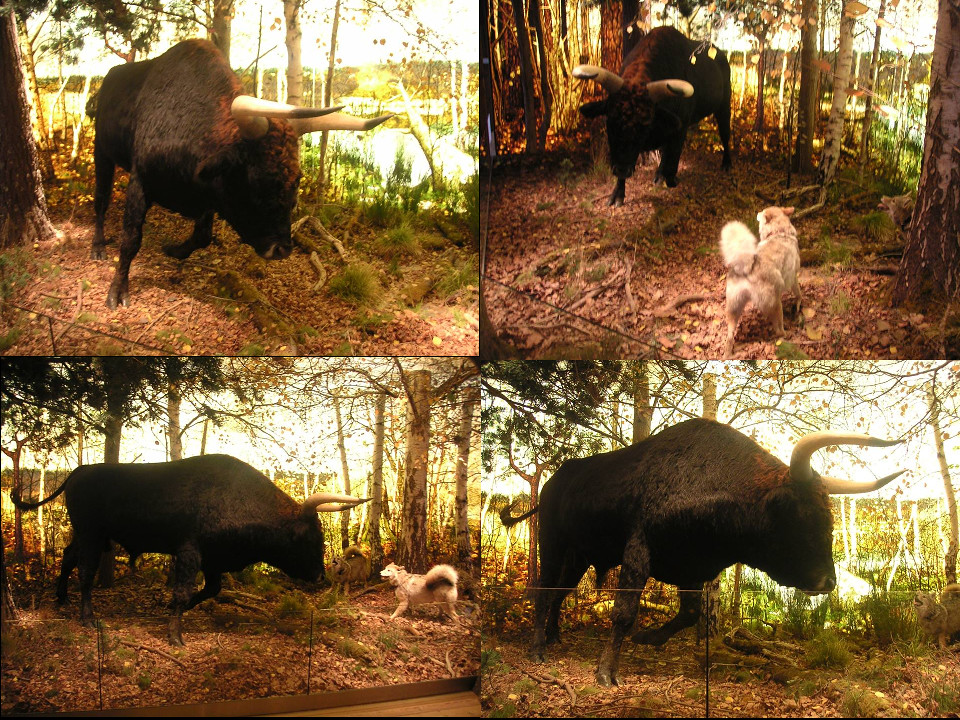
This reconstruction is awesome. The hump could be more pronounced, but still awesome. Its coat is longer and rougher than in typical domestic cattle, the forelocks are prominent, the proportions as much as head and horns are correct. Maybe not easily visible, it has a reddish dorsal stripe. And the posture is dynamic and lively. Someone has done a really, really good job here! I'd love to see this great piece of work in real, it would give a good impression of what an aurochs would look like if you'd encounter it on a forest edge during fall. 

The last skeleton I present here is the famous Vig specimen: 
Markus took more than those four shots of course, and some of them already are on the internet. This specimen is remarkable for 1) its size, 2) the visible spear-caused damages (the Prejlerup bull has such as well). More on that specimen in a later post. I only want to give away that Markus provided me with a photo that enabled me to calculate the size of this specimen by using the platform from which I extrapolated the projection point and used a person with a known size of 192 cm as reference. It resulted that the skeleton should be 182 cm tall at the end of the processi spinosi. 

The last photo shows a number of ornamented horn sheaths at the Livrustkammaren in Stockholm: 
Each royal family in Europe has drinking horns, and some colleges, universities and museums do so as well. Ornamented horns are not necessarily of the aurochs - bison horns were used as well, or those of domestic cattle -, but I think that these horns or at least most of them are of aurochs for sure. Curvature, thickness, size and colour fit. I was told that they are not extremely large, but late aurochs had ever smaller horns due to anthropogenic influence such as environment limitation or trophy hunt. But of course it is possible that some drinking horns out there may actually be from domestic cattle with a very similar horn shape.