Wednesday, 9 September 2020

Przewalski's horse cloned for genetic diversity

In 2015 I proposed cloning as a chance for the wisent's survival. Cloning pre-bottleneck wisents would greatly increase the genetic diversity of the species, since the modern population descends from a population of only about 50 individuals which itself descended from only 12 individuals. Adding the genetic diversity of wisents that lived before the dramatic bottleneck event in the 20th century would help the species to overcome its inbreeding depression. And if cloning is not possible, genome editing with CRISPR-Cas9 is a viable alternative. 

It seems that there are people who had the same idea for the Przewalski's horse, which descends from only 12 individuals as well. A stallion has been cloned from an individual that has been cryopreserved since 1980. For details, you can have a look at the article from Revive & Restore. 

I hope that cloning for conservation will not be restricted to this one individual. I hope this idea will be put into practice for other species as well, including the wisent. 

Tuesday, 8 September 2020

Reconstruction of aurochs cow horns

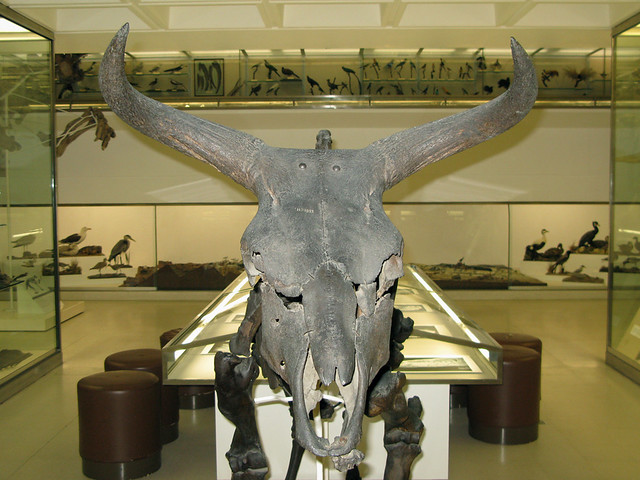
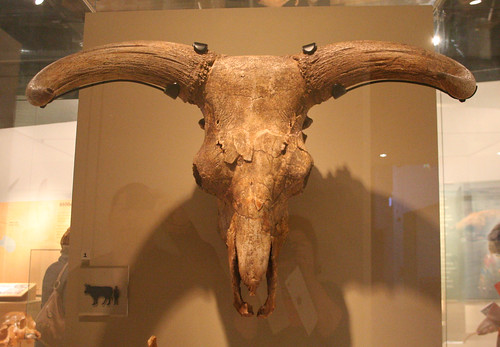
Recently I did a reconstruction of the horns of the Asti specimen at the Museo paleontologico territoriale dell'Astiagiano. 

Reconstructing the horn sheaths on the bony cores always requires speculation to a certain degree. The horn sheath continues the curvature of the bone, but there is no rule of thumb on how much the sheath increases length and thickness of the horn. Especially the length of the sheath may vary greatly in comparison to the bony core (see van Vuure 2005). So we can only guess how much the sheath added to the horns in the individual specimen. I usually reconstruct the horn sheath with 133% of the length of the bony core. 

Here is the result: 


Please do not use without permission. 


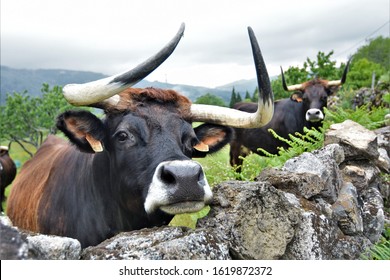
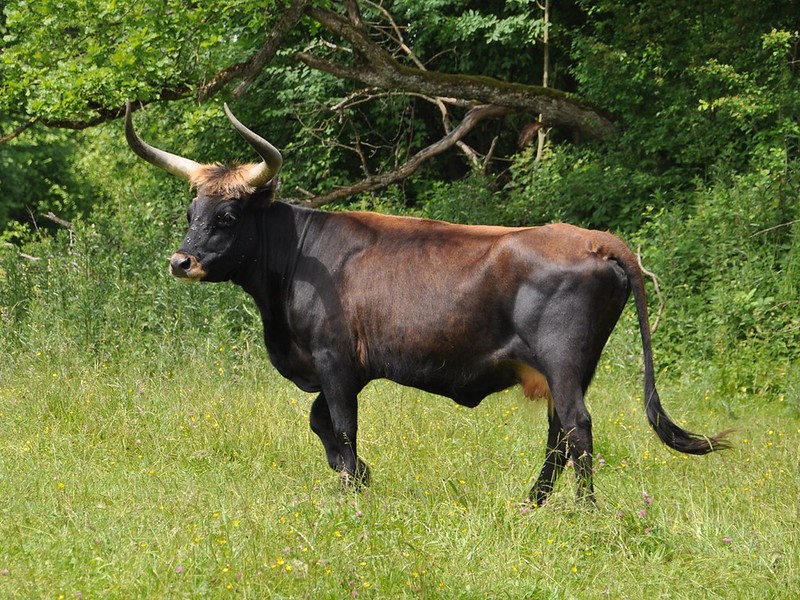
In modern cattle, Watussi, Heck cattle of the Wörth lineage and Maronesa may have horns similar to those above. A mix of all three might reach the goal both in curvature and dimensions. 

Another reconstruction of the Asti specimen is about to come. 

Wednesday, 2 September 2020

Tauros cattle arrived in Velebit, Croatia

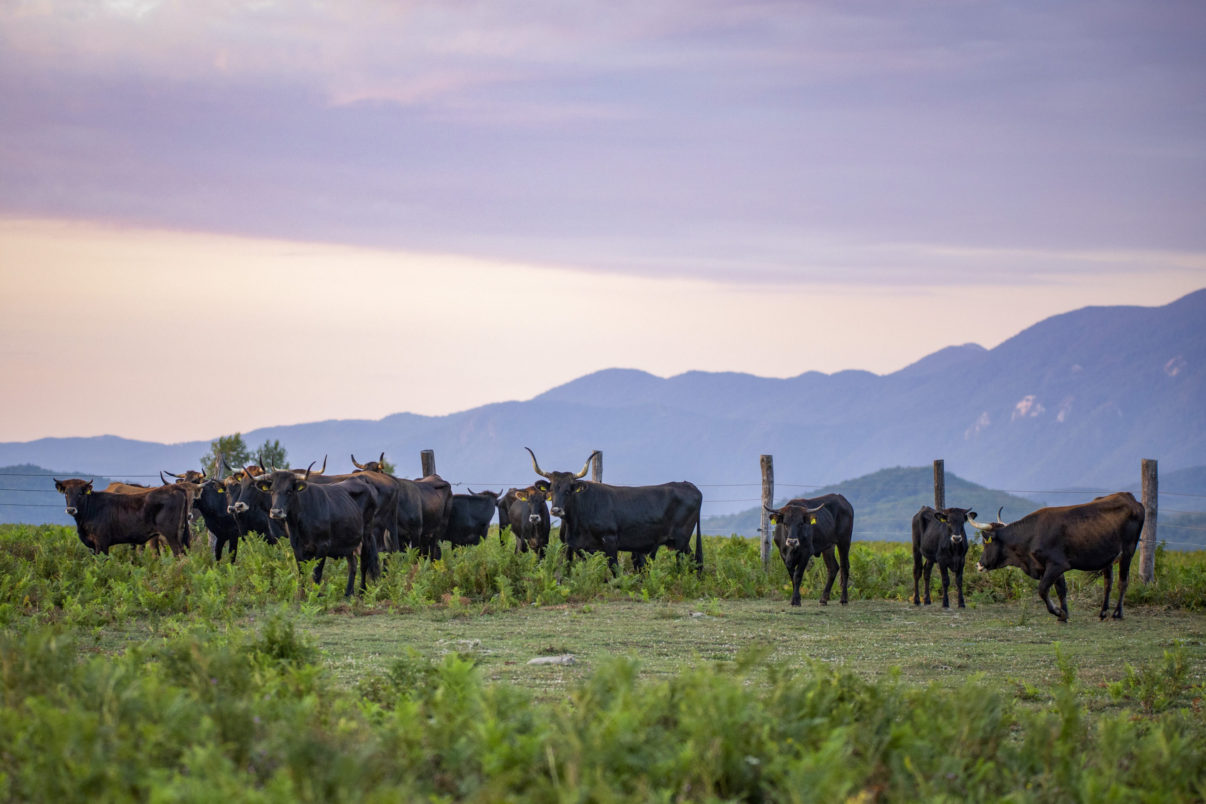
As Rewilding Europe recently announced, 20 Tauros cattle (18 cows, two bulls) have been moved to Velebit, Croatia. They will join a herd of 120 individuals that consist of pure Sayaguesa and Maremmana as well as crosses of Sayaguesa, Maremmana and Tudanca that have been grazing there since 2016. The purebred bulls will be removed in turn if I understand correctly.
You can see photos of the herd here and here

Based on their looks, the herd might include Maremmana x Sayaguesa, Limia x Maremmana and Pajuna x Maremmana individuals. But that is only a guess. I doubt that these fully grown individuals are fifth-generation. First of all, the Tauros Programme counts the parental generation as first-generation, what means that their second-generation animals are actually the first cross generation. So that means they mean fourth-generation. Also that seems a far stretch for a breeding period of 11 years. Body shape and proportions are OK, they are pretty much the standard we see in Taurus cattle and primitive cattle breeds. So is the skull shape. The horns, however, are not that impressing, as in most Tauros cattle. They are to small and the curvature is not aurochs-like either. What I also noticed is that the cows are mostly pretty dark, what is true for most Tauros cattle. I wonder why. Surely, Sayaguesa contributes dark colour shades in cows but other projects achieve a nice reddish-brown coat colour even in half-Sayaguesas. Maremmana, Limia, Tudanca and Pajuna also have lightly coloured cows. So I wonder why most Tauros cows are that dark. 

The Tauros Programme, after 11 years of breeding, now has reached a level of good quantity. They have a total animal count in the three-figure range. What the programme needs is to improve the sexual dichromatism (i.e. achieve more lighter-coloured cows) and to improve the horns in both size and curvature. There are no size measurements for Tauros cattle (at least none that have been published) but the cattle at Keent (NL) do not look large. So they also might want to improve the size of the animals, considering that they are using a number of small breeds (Pajuna, Highland cattle, Maronesa). While selection can improve the sexual dichromatism and if they pay attention on only using bulls with good horns also the horn shape, I doubt that they can achieve the improvement of the horns and body size with the breeds they are currently using. The horn size of many Maremmana (the largest-horned breed they are using) is actually smaller than in the aurochs (see here, for example). Maremmana is also the largest breed they are using, and Maremmana does reach sizes of 170cm and allegedly more, but their Maremmana individuals don't look large (one of their Maremmana bulls was barely larger than the Pajuna bull, and the other one didn't look much taller than the Highland individuals). 
Summa summarum, I think the Tauros Programme needs breeds that add large size, truly large horn volume, and also a good horn curvature when starting the quality-building phase otherwise Tauros cattle might end up deficient in terms of horns and body size. 

Friday, 28 August 2020

A Watussi steer with perfectly aurochs-like horns

Recently I found a video of a Watussi individual with very aurochs-like horns. Normally, Watussi bulls' horns look more like that. This individual however has horns that have a perfectly aurochs-like curvature (yes the horns are very large, though there were Pleistocene aurochs bulls with horns only a little smaller). I was not surprised that this individual is obviously a steer. Steers often tend to have more aurochs-like horns. Why is that? I explain this in this post. Horn length and consequently shape is determined by developmental factors. Development is deeply changed in domestic animals, usually there is a premature stop in development, causing the animals to display paedomorphic features. Thus it is not far-fetched to assume that horns tend to stop growing earlier in domestic animals, producing the horn shapes they have (usually less curved than in the aurochs). Steers, however, have an atypical development as their gonads are removed. The body does not know when to stop development and thus they grow larger, taller and also the horns grow longer (for another example, go here). Coincidentally, this developmental elongation compensates the developmental delay that results from domestication, resulting in a wildtype-like outcome. This is what we see in the Watussi steer. 

This has two implications for "breeding-back". For once, it means that bulls with banana-shaped forwards-facing horns (as we see it in many primitive breeds and "breeding-back" cattle) actually have the right genes for an aurochs-like horn curvature (the horns would also end up longer). It are developmental factors that result in the domestic condition. Furthermore, the big question is then: can "breeding-back", with the cattle that we have, produce perfectly aurochs-like horns at all? Selecting just on the phenotype that we want would not reverse the developmental changes from wildtype to domestic that we have in cattle. However, there are occasionally bulls with horns very close to the original aurochs horn shape, such as some Maronesa bulls (and also cows). And maybe it is not a coincidence that this breed has also retained a substantial degree of colour dimorphism. 

Tuesday, 25 August 2020

Two Tauros bulls with good horns

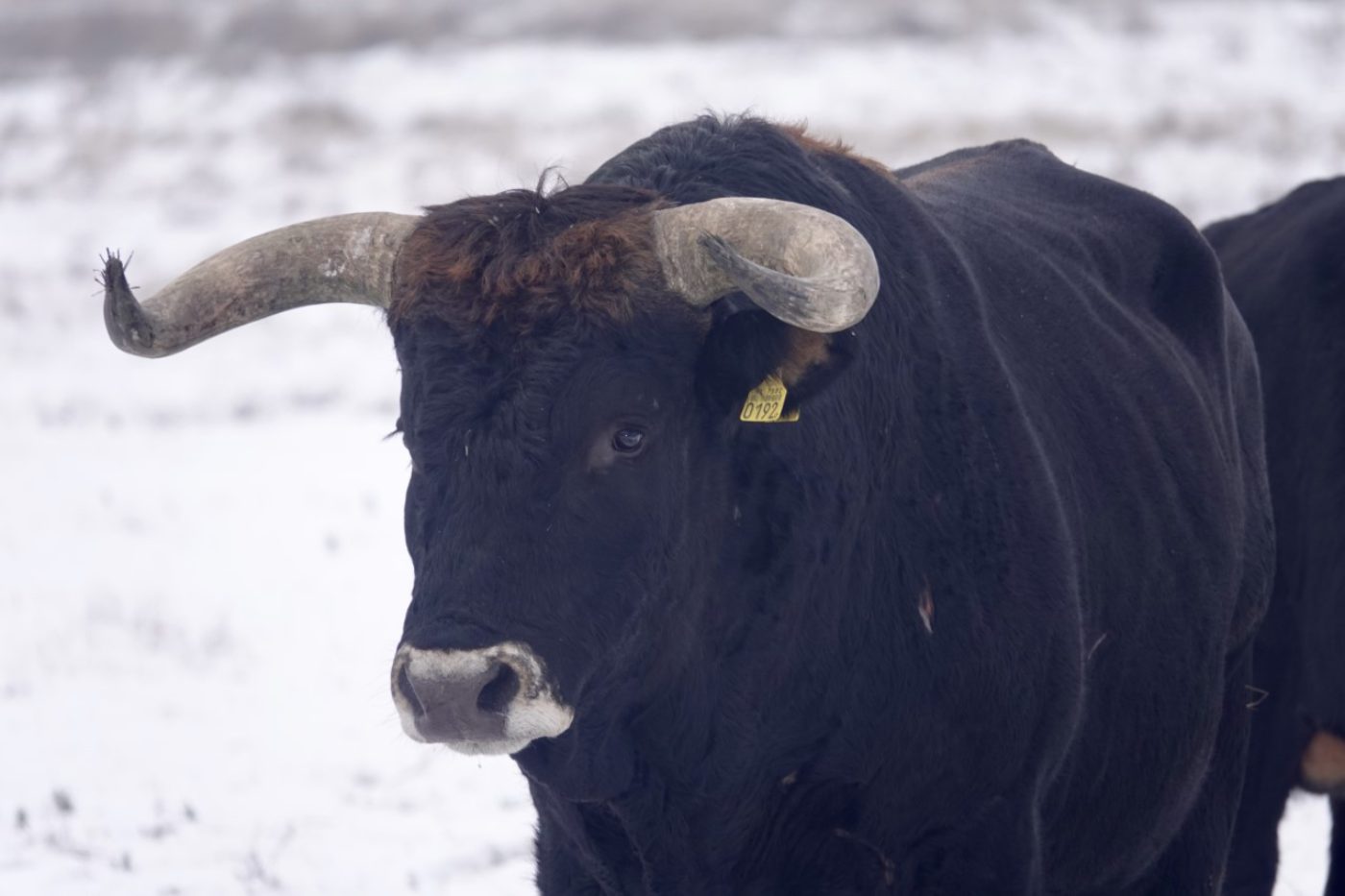
Most examples of Tauros cattle from the Tauros Programme don't have that good horns. Mostly they face outwards too much and lack the inwards curve. This goes for cows as much as for bulls. However, today I was addressed to two photos of two Tauros bulls with comparably good horns from the Loozerheide, Netherlands. 

Go here and here. The head of the first bull resembles some Taurus bulls quite closely. The second bull might have Maronesa ancestry but I could be wrong on that. 

It's really good to see Tauros bulls with such nice horns, it makes me hope that future Tauros cattle will develop better horns than the current majority. However, I think the project still needs a breed that reliably and truly adds slenderness, long legs and large size. Maremmana alone probably will not do it. 


Friday, 10 July 2020

New photos from the Auerrind project

Claus Kropp recently sent me interesting photos of some of the Auerrind crosses, which I am going to present today. 
© Claus Kropp
This is the Chianina x Watussi cow born in 2019. Her horns are developing well. She will be covered in 2021. Here is another photo of her, next to a Sayaguesa x Chianina cow: 
© Claus Kropp
In sum, there are three Chianina x Watussi cows, two calves have been born this year: 
© Claus Kropp
I wonder what would be the ideal combination to cross them with. Claus Kropp told me one option is the Sayaguesa x Maremmana bull. There are also Sayaguesa x Maremmana cow calves, one of them down below: 
© Claus Kropp
It apparently inherited the colour of a Sayaguesa cow.  Here is a new photo of the Maremmana x Watussi bull: 
© Claus Kropp
There is no plan yet as to which combination it could be crossed with. 

More Sayaguesa x Chianina calves have been born: 
© Claus Kropp
© Claus Kropp
The cow Maxima on the upper photo has a very good and useful horn curvature. The cow in the back at the lower photo with the asymmetric horns (I think it is La Nova) is interesting as well; the question is which horn shape gets passed on. If she passes on the horn shape of her left horn it would be perfect. 

It is very exciting to see those interesting combinations growing up and I am looking forward to the second-generation animals they will produce. The second generation is also where the selection starts. Since both Leo the Sayaguesa bull and Luca the Maremmana bull are about 170cm tall, many Auerrind crosses might end up being on the larger side. 

Monday, 6 July 2020

Tauros bulls, a Taurus birth and a new Auerrind calf

Today I have news from all three main aurochs breeding back projects. 

Tauros bulls 
I found some photos of Tauros bulls on the web that I haven't posted here yet. Here, here and here. The first bull is from Herpeduin, the other two photos are from Maashorst. On the last photo, I particularly like the bull in the front. The colour is perfect and the horns look pretty good as well. They have the best curvature I have seen so far in a Tauros bull. 

Birth of a Taurus calf 
I found three videos showing the birth of a Taurus bull calf. Here, here and here. It is interesting that the cow gave birth in the open field. Normally they would look for a shelter and give birth there, but not all cows have the instinct to do that. 

A new Auerrind calf 
Claus Kropp posted a new photo of a second-generation cow calf today: 
© Claus Kropp
Its name is Doro, and it is (Sayaguesa x Watussi) x (Sayaguesa x Grey cattle). I am looking forward to see it growing, it has the potential to look very good. Claus Kropp also told me that they recently measured Leo the Sayaguesa bull. It is 171cm tall at the withers, which is a very good size. In about two weeks, Alvarez the Sayaguesa x Watussi bull is going to be moved to the herd with the Sayaguesa x Chianina cows. 


Saturday, 4 July 2020

Aurochs cow artwork


This is a reconstruction of the female skull at the Gramsberg Museum in the Netherlands. I particularly like the horn shape of this specimen. A mix of Sayaguesa, Watussi and Maronesa might have the potential to result in horns like these. And Chianina for the body shape. Although they do not use Maronesa, let's see if the Auerrind project will achieve cows like that. Cows of the combination (Chianina x Watussi) x (Sayaguesa x Watussi) might have the potential to get close. 

Sunday, 28 June 2020

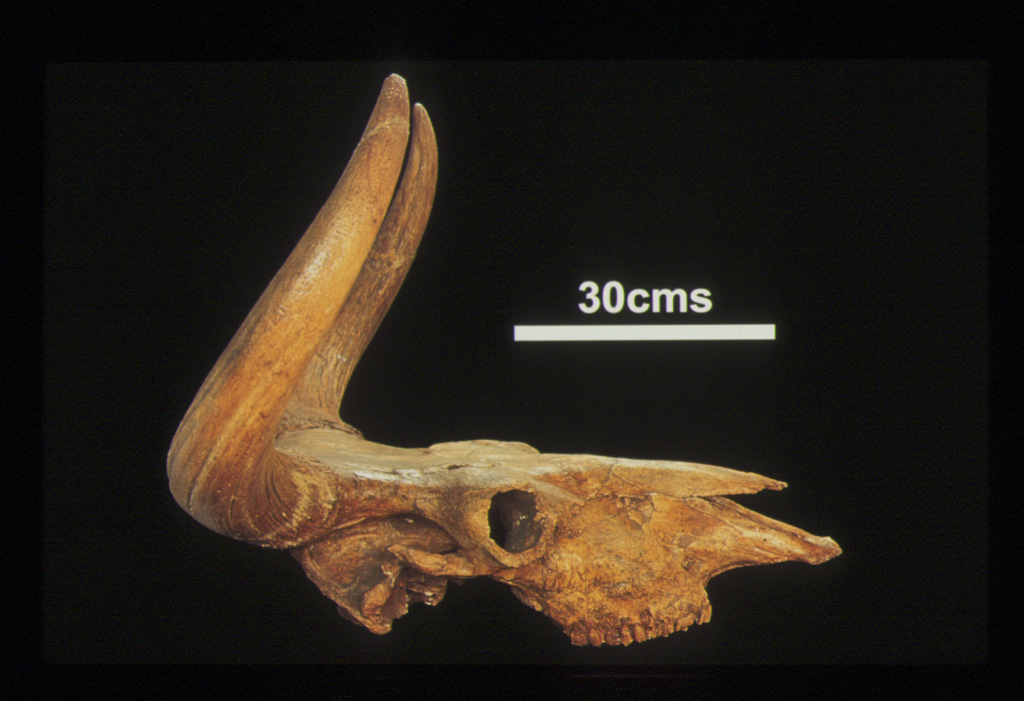
Bos primigenius suxianensis

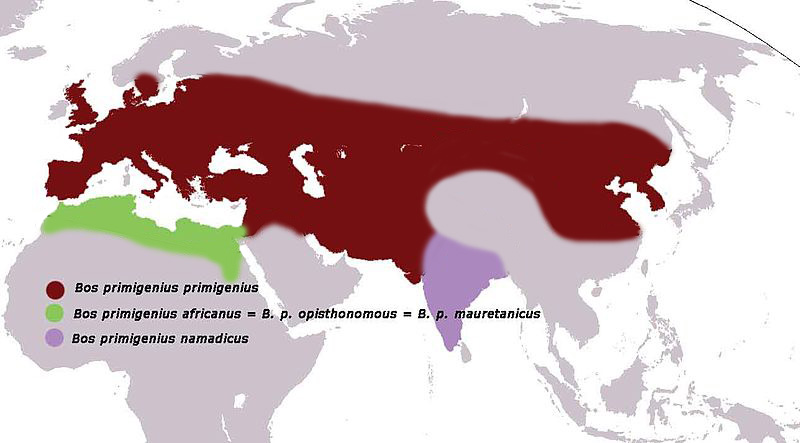
The classic convention is that there are three subspecies of aurochs – Bos primigenius primigenius, the European one, Bos primigenius namadicus, the Indian one and Bos primigenius africanus, the African one. Here is a chart for the distribution of the subspecies: 

As you see, material from Central and East Asia are included in the European subspecies primigenius. In western literature, the East Asian aurochs material is described as very similar to that of Europe (van Vuure, 2005). 
However, there is Asian literature that is barely recognized in the western scientific community that assigns the material to its own subspecies, Bos primigenius suxianensis [1]. A 2018 study found that aurochs remains were pretty abundant in Neolithic China, and that much of the material has been wrongly assigned to Bison previously. It was also found that East Asian aurochs belonged to a unique haplotype (haplotype C) and therefore were genetically distinct from other aurochs populations [2]. Chinese aurochs were probably hunted, and most likely also hunted to extinction as were the European populations. 
Not only were those East Asian populations genetically distinct, the bone material that is available on the web shows some morphological differences to the European subspecies. The horns are always long and more upright than what is average in the European population, and the shape is slightly different as well. They do not curve inwards that strongly, and they curve more upwards at the base. You see that in this and these specimen. Also, the nasal bones are somewhat raised and more convex than in the European subspecies. You see that in this Chinese specimen and the Baikal skull

I did a life reconstruction of the specimen linked above: 
 
Life reconstruction of Bos primigenius suxianensis
Note the different horn shape and the convex snout. Nothing is known about the coat colouration of East Asian aurochs, but for this drawing I assumed it had the same colour as the European subspecies. 

So it seems that Central and East Asian aurochs were genetically and also morphologically distinct populations, justifying its subspecies status. Therefore, there actually were four wild aurochs subspecies. The reason why the Asiatic subspecies is not part of the “basic aurochs knowledge” is probably that the Chinese literature is less recognized in the western scientific community, and that the bone material (which even includes nicely preserved complete specimen) is less noticed compared to the plentiful European material, except for the Baikal skull. It would be interesting to know if there was a continuum between primigenius and suxianensis, as the distribution area apparently was continuous at least some of the time of their existence. The Kiev specimen, which is the Easternmost specimen of the European subspecies that I know of, does have some similarities in horn shape. 

The aurochs apparently was a species with a wide geographical range and regional variations. The European subspecies which is the “standard” when we think of an aurochs, the African subspecies that apparently had a colour saddle, the Indian aurochs with its slender cranium and the long wide-ranging horns, and the East Asian aurochs with the slightly different horns and the convex snout. When we look at other bovines with a wide geographical range such as the Banteng or the Cape buffalo, there might have been more local colour variants that we do not know of. 

Literature 

[1] Xie: A skull of Bos primigenius suxianensis from Anhui. 1988.  
[2] Cai et al.: Ancient DNA reveals evidence of abundant aurochs (Bos primigenius) in Neolithic Northeast China. 2018. 

Wednesday, 24 June 2020

Quagga life restoration

Today I did another Quagga life restoration, based on the Amsterdam skin

I drew it in the same posture as this zebra of the Quagga Project so that both can be easily compared. 

The stripe pattern on the Quagga is different from those of the zebras of the project. The stripes are broader, with a much smaller space in between, especially on the head. Also, the brownish background colour of the trunk is not quite achieved yet. Furthermore, I suspect that there are more differences between Quaggas and Burchell's zebras. For example, the mane seems to be shorter in each of the skins and the photos of the London mare. Also, it might be that the ears are smaller. Although being nested within the Burchell's zebra, the quagga has unique haplotypes identifying the subspecies. 
The zebras of the Quagga project, on the other hand, are simply Burchell's zebras with a reduced stripe pattern, not more than that. This is why I wrote Please don't call it Quagga

Friday, 19 June 2020

Aurochs horn variation

I described the horns of the aurochs in a 2013 post already. The basic curvature of the horns was always the same in the aurochs, but there was considerable variation on the actual length, thickness, shape and orientation of the horns within a certain range. 

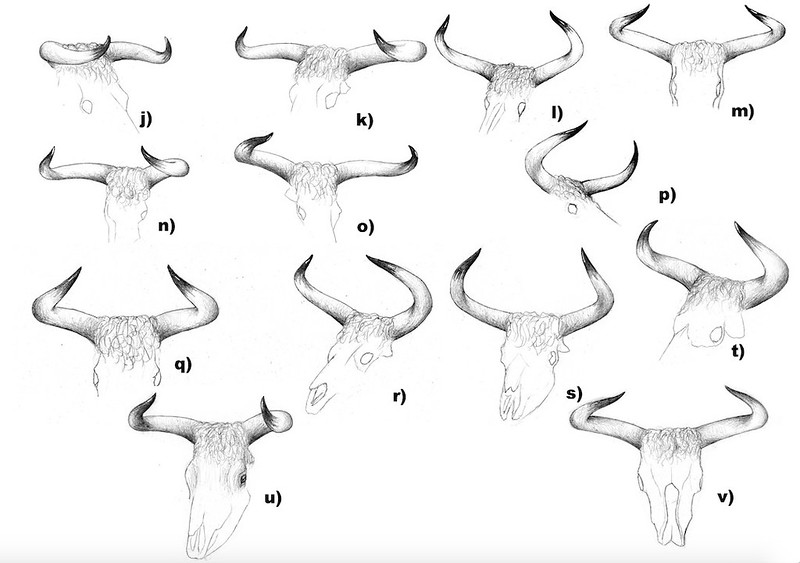
I tried to capture this variation on two drawings in 2015 where I reconstructed the horn sheaths onto 22 skulls in order to see what the horns might have looked like in life. I am going to repost them down below. We cannot be absolutely sure on the life appearance of the sheaths as there was no general rule of thumb of how much the sheath adds to length and thickness of the horn cure. There was quite some variation (van Vuure, 2005). So the reconstructions down below are an approximation. 
For the identity of the skulls, go to the 2015 post

Recently I did some more sketches, also including skulls that I already reconstructed in 2015: 
From left to right top down: Berlin skull, a skull of a location unknown to me, the Cambridge cow, Gramsberger Museum skull, Himmelev specimen, Horsholm specimen, a cow skull from Italy, the Stuttgart skull and the Vig bull. 

Having reconstructed about 30 specimen, I think this is a fairly representative sample for the variation of the horns of the European subspecies Bos primigenius primigenius

Orientation relative to the skull 

The literature states that the orientation of the horns relative to the skull varied from 50 to 70° (van Vuure, 2005). However, having had a look at so many skulls I find that the range is actually larger. The oldest aurochs skull which was discovered in 2014 had an orientation of 40°. The Vig specimen has an orientation of 90°, and the Horsholm specimen probably an even larger angle. 

Geographic variation

I see some sort of geographic correlation in the variation of the horn types. For example, the more Southern the skulls, the sharper is the angle between the horns and the snout. The more Northern and Eastern, the higher is the orientation of the horns. You see that very clearly in the Kiev specimen and the Eastern Asian aurochs Bos primigenius suxianensis (yes, apparently Eastern Asian aurochs were a distinct subspecies, more on that in an upcoming post). Small-horned aurochs seemingly only appeared in Northern Europe, all other locations (Southern Europe, Africa, Asia) had pretty large-horned aurochs. 

Tuesday, 16 June 2020

Aurochs bull and cow portrait

Recently I did a new portrait of a European aurochs bull and cow. I was inspired by the photo of Murnau-Werdenfelsers. 
The horns of the bull are based on the Berlin specimen, those of the cow are based on the cow at Gramsberger Museum, Netherlands. 


Saturday, 9 May 2020

The Cambridge specimen

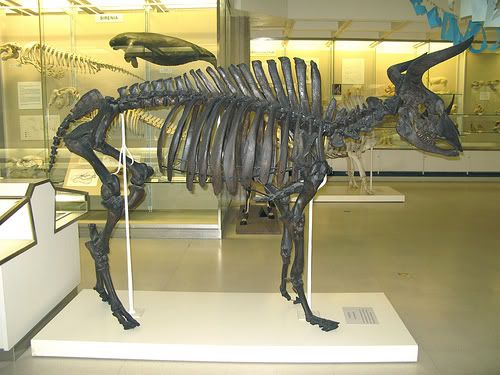
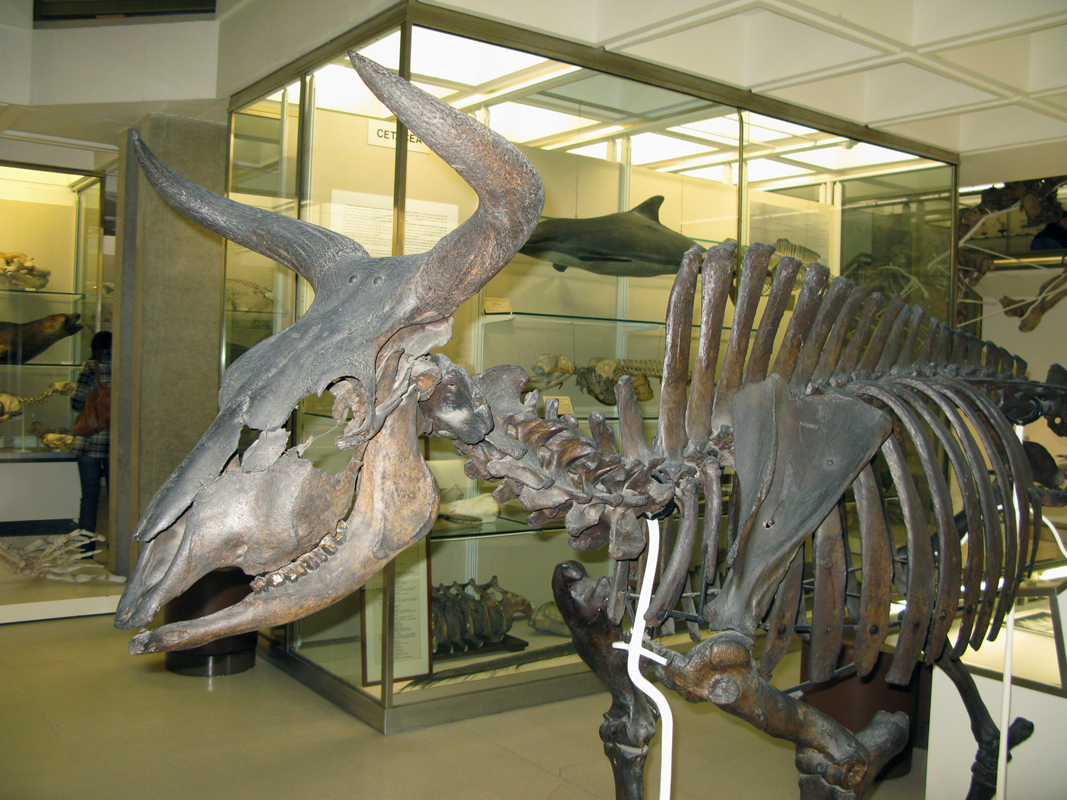
The Cambridge aurochs is one of the complete aurochs skeletons that are on display. It was found in Burwell, England, and is mounted at the Museum of Zoology in Cambridge. It is the best-preserved British aurochs specimen, and of unknown age. For photos of the specimen, go here or here

The museum itself claims it was a bull. Indeed the postcranial skeleton looks masculine, with its robust bones and high shoulder spines. However, the skull reveals it was definitely a cow. The eye sockets are not very prominent, and the distance of the end of the frontal bone between the horns is considerably shorter than the distance between from eye socket to eye socket, while in male skulls the distance is about the same. A comparison between the skull of the Cambridge specimen (here) and skulls that are definitely male (f.e. here) shows its female nature. Furthermore, the withers height of the skeleton is only 145 cm (therefore the live animal must have been between 150 and 155 cm tall), see Frisch 2010. 

I did a reconstruction of the head of the specimen based on this photo: 


The horns resemble those of some Heck cattle from the Wörth lineage, go here and here for a comparison. The head of the specimen bears some resemblance to Sayaguesa and other primitive cattle. 

Wednesday, 6 May 2020

The white muzzle ring of the aurochs

The white or lightly coloured muzzle ring around the mouth (“mealy mouth”) of the aurochs in both sexes is a standard element when reconstructing the aurochs’ colour scheme. In this post, I am going to have a look at what the evidence actually says. 

First of all, the lightly coloured muzzle ring is part of the E+ wildtype colour in domestic cattle. Yet, written sources never mention the muzzle ring. Not even Anton Schneeberger’s precise description of the looks of the last aurochs at Jaktorow in Gesner 1602. 
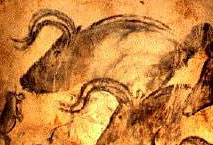
Looking at contemporaneous artistic depictions, there is evidence for the muzzle ring in aurochs. Some cow depictions in cave paintings show a muzzle ring (see here and here), and also the bull depictions in Lascaux. The bull heads in Chauvet, on the other hand, definitely do not show it although the artist paid attention to the dorsal stripe. The oil painting from the 16th century that Charles Hamilton Smith based his famous “Augsburg aurochs” drawing on and that could have been based on a life aurochs, showed, according to Smith, wholly black colour except for a white chin (van Vuure, 2005). 

In domestic cattle with a wildtype colour scheme, you sometimes see a reduced muzzle ring, particularly in aging bulls. The white area on the snout becomes smaller and darker, it may even completely disappear except for the lightly coloured chin. Apparently this also was the case in the individual the Augsburg painting was based on. In Bantengs and Gaurs, there is individual variation on the degree of the white muzzle ring. It may be fully expressed or reduced to lips and chin, or completely absent. 

Considering that some cave paintings do show the muzzle ring and that others do not, and that the original Augsburg painting showed a very reduced one, aurochs probably also were variable on this trait. It might have been reduced or virtually absent in quite a lot of bulls, particularly old ones, while it probably was present in cows and young individuals on a regular basis.  
Here you have a reconstruction of the Sassenberg bull with a reduced muzzle ring, the way many grown aurochs bulls might have looked like: 

Regarding the actual colour of the muzzle ring, whether it was plain white or just lightly coloured (beige, orangish, reddish, yellow), we have the same situation with the dorsal stripe. It might have varied from individual to individual and historic sources are not precise enough on that. 

Monday, 4 May 2020

The snout of the aurochs

The snout of the aurochs was much longer than in most domestic cattle (shortening of the skull is a typical trait of domestic animals). But this post is not about the length of the snout, but on the actual shape of the snout and nose. 

Literature describes the snout of the aurochs as straight (van Vuure, 2005). And for about half of the skulls I have seen so far this is true. But in the other half of the skulls, the snout looks different. Let us have a look at the male skulls first. While in the Vig specimen and the Sassenberg bull specimen the snout profile is rather straight, in the Baikal specimen, London specimen and Kopenhagen specimen, the nasal bone (the bone at the top of the snout) is actually slightly convex. You see that very clearly in the Baikal specimen. Furthermore, and this is a very interesting detail, the tip of the nasal bone is down-turned in the London specimen, Kopenhagen specimen and the Himmelev specimen, possibly also the Önarp specimen. This has implications for the nasal cartilage and thus the life appearance of the aurochs’ snout and nose. 
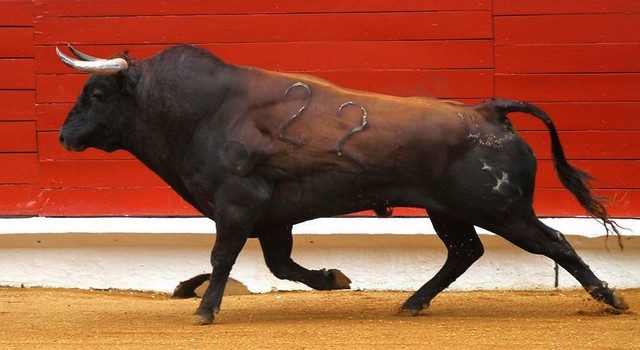
In some Lidia bulls, the tip of the snout is down-turned and the nose is rounded. You see that very clearly in this and this bull. The fact that the tip of the nasal bone in a number of aurochs specimen might indicate that those specimen also looked like that in life. You see that in my reconstruction of the Kopenhagen bull that I did recently: 

I am not completely sure about that as it is pretty hard to guess the soft-tissue by the bones only, but it could be that a down-turned snout tip is part of the original aurochs’ genetic diversity. If so, this apparently has been preserved in Lidia, the perhaps least-derived cattle breed on this world. I am not completely sure about that, but it is a possibility how some aurochs may have looked like. 


A convex snout profile is also found in female skulls. While the snout is straight in the Sassenberg cow specimen, the nasal bone of the Cambridge specimen is very convex and down-turned, visible on this photo. I did a life reconstruction based on that photo. Interestingly, the snout appears straight in the life reconstruction once the soft tissue is added.  


Friday, 1 May 2020

The Kopenhagen bull

The Kopenhagen specimen is a more or less complete and well-preserved aurochs specimen exhibited at the Zoological Museum of Copenhagen. Its overall morphology suggests that it was a bull and it measures 180 cm tall at the withers. This means that in life it must have been between 185 and 190 cm tall. I recently did a life reconstruction based on a photo I was sent by Markus Bühler. 
© Markus Bühler
When doing reconstructions, I always take photos of the original bone material. In the case of skeletons, mounts at museums have to be taken with caution. Many of them are not mounted correctly. Often the knees are flexioned too much or too little, the position of the scapula is wrong or the spine is mounted in an unnatural manner. Therefore, before starting the reconstruction, I do a check if the skeleton is mounted correctly. In the case of the Kopenhagen skeleton, the mount is quite correct, the only thing I changed was the orientation of the humerus, I flexioned it a bit more than in the mount using GIMP on the original photo. Something that also has to be taken into account is the soft tissue between the bones in the living animal. There would be spinal discs between the vertebrae, elongating the spine compared to the mount, and there also would be cartilage between the leg elements. All in all, the live animal would appear bigger than the skeleton. Therefore I slightly elongated the spine on the photo. I also rotated the trunk slightly, so that its rear end is less lowered. Then I started the reconstruction. As usual I took living wild bovines as an anatomical analogue. This is the result: 

It basically looks like a large Iberian fighting bull, just with a shorter trunk and longer legs. To me, this is yet another reason to regard Lidia cattle as the least-derived cattle breed on this world. At least I do not know of any other cattle breed that bears that much resemblance to the aurochs. 
The Kopenhagen bull is one of the smaller-horned individuals, many have larger horns, but there are also some with smaller horns. 

Comparing an aurochs skeleton to a domestic bull

When comparing aurochs and cattle, we usually compare aurochs bone material to living cattle, what is basically comparing apples to bananas and bears the danger of wrong conclusions. Comparing bones to bones would be the most precise way to discern the differences between aurochs and cattle and to draw conclusions about the aurochs’ life appearance. 

There are plenty of mounted aurochs skeletons available on the web, but not so many of domestic cattle. I found a photo of a Holstein bull skeleton and will compare it to the Kopenhagen bull in this post. It is important to compare individuals of the same sex in order to eradicate the factor of sexual dimorphism. 
Photo © Markus Bühler
The Holstein bull skeleton I took for comparison can be found here

What is the most interesting difference between both skeletons to me are not the different proportions (the fact that aurochs and cattle differ quite drastically in proportions should be widely known by now) but the anatomy of the bones themselves. The aurochs’ skeleton is much more robust and the areas for muscle attachment are way more pronounced. The fact that the aurochs’ skeleton is more robust has also been noticed in the literature (see Frisch 2010). You see that very clearly in the neck and lumbar spine, the humerus and the head of the ulna. This means that the aurochs was more muscular and stronger than this domestic bull. The limb bones appear to be thicker and also the processes of the shoulder spines are more robust and also longer. It is not surprising that the neck, trunk and forelegs were stronger in the aurochs as these body parts are involved the most during intraspecific fights and fighting off predators. Thus, you see in the skeleton that the aurochs was like that of other wild bovines concerning muscling. Gaurs, for example, look like bodybuilders compared to domestic cattle. 

However, comparing only two individuals is not enough for a solid conclusion. A number of aurochs specimen and domestic specimen would have to be compared in order to rule out individual variation. Furthermore, it would be interesting to compare several breeds. Lidia might be closer to the aurochs in these respects than Holstein, as Lidia is a breed that is bred for fighting and has a less domestic physique. A true osteologic/osteometric study would be very interesting. It could be that there were also differences in the relative length of the leg elements. I have the suspicion that the humerus is slightly longer in the aurochs, which would allow larger muscles to attach. I did measurements using photos of the Holstein bull as well as the Kopenhagen, Lund and Braunschweig specimen. In the Holstein bull, the radius is 90% the length of the humerus, while in the aurochs specimen it was about 75% on average. So the aurochs’ humerus might be larger in relation. I have the same suspicion of the scapula. This would mean that the whole shoulder and upper arm region was more developed in the aurochs, what makes functionally sense and thus is plausible. However, I do not have the possibility to confirm this suspicion as I don’t have access to the specimen to measure them directly, only photos. 

A life reconstruction of the Kopenhagen bull is about to come. 

Wednesday, 15 April 2020

New photos of Alvarez the Auerrind bull

Claus Kropp recently released new photos of Alvarez, the Sayaguesa x Watussi bull of the Auerrind project, on facebook. Go here, here and here for the photos. 
© Claus Kropp
Alvarez is developing well. The horns seem to grow large - the bull is not even nearly fully grown yet. He will be moved to the three Sayaguesa x Chianina cows this year. 
That means we can expect (Sayaguesa x Watussi) x (Sayaguesa x Chianina) individuals for next year. I am extremely looking forward to this combination. It might be the most promising combination of the project as it has the potential to unite all needed traits in the right quantity. It will have many Sayaguesa genes, and with Chianina size and Watussi horn size genes this cross product would look almost ideal. That requires luck of course, it could also be that the small horns of Chianina and small body size of Watussi get passed on, most individuals might have a phenotype somewhere in between. That's why I hope that Alvarez will stay with the cows for more than one year. I think that producing at least two good individuals of this combination that can be bred to each other would be a major step forward for the project. 


Thursday, 9 April 2020

Did aurochs and wisent hybridize?

Hybridization is very common in the animal kingdom and takes place everywhere closely related species meet each other. There are plenty of examples where hybridization played a role in speciation, not only in amphibians and fish but also mammals, including us humans. For a post on hybridization, go here
In recent years, it has been suggested that the wisent is a species hybrid of aurochs and steppe bison because the wisent clusters with domestic cattle on mitochondrial level. For details, go here. This theory has recently been questioned by a 2016 paper that suggests the affiliation of wisent and cattle mitogenomes are more likely a result of incomplete lineage sorting. It also suggests an early split from the steppe bison, from which it differs in head orientation associated with food choice. While the American bison and Steppe bison have a lower head orientation than the wisent as they are primarly grazers, the wisent has a higher head orientation and is a mixed feeder, which is probably the result of living in a more forested habitat [1]. A 2017 study indeed suggests that Bison schoetensacki was the immediate ancestor of the wisent [2].  

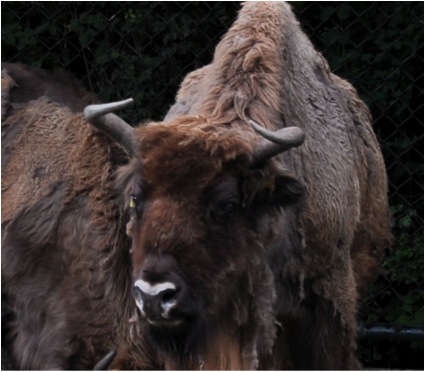
However, the wisent does show signs of admixture with Bos in its nuclear genome [3]. The study compared both modern and pre-bottleneck wisents to cattle and the 8.000 year old British aurochs with the fully resolved genome and found signs of interbreeding with domestic cattle. The authors also emphasize that it is possible that these genes are not from domestic cattle but from aurochs closer to domestic cattle than the British aurochs. Either domestic cattle or aurochs or both left their track in the genome of the wisent. However, the very small portion of Bos DNA suggests that this introgression did not happen in recent times. Hybridization may indeed explain the diverging horn shapes sometimes found in wisent, like in this individual at Hellabrunn Zoo I photographed in 2011: 

It is important to note though that wisent and cattle do not interbreed spontaneously. Not a single case of hybridization between both species in the wild has been reported even if they share the same habitat [4]. All wisent-cattle hybrids were created in human custody. However, it might have happened that domestic cattle genes found their way into the wisent genome over those hybrids. If they escaped and joined wild wisent herds, they might have been more likely to interbreed than pure cattle. 
Another possibility would be that both species interbred more easily than today when aurochs arrived in Europe during the middle Pleistocene and later further diverged due to the so-called Wallace effect or reinforcement. In this case, hybrids between aurochs and wisent would have a lower evolutive fitness than pure individuals, thus decreasing the likelihood that both species interbreed. This is just a thought-experiment of mine. 
Another possibility if aurochs and wisent indeed interbred in the past could be that the influence from wisents helped the newly arriving aurochs, which migrated from subtropical areas, to cope with the European climate. I would not be surprised if the curly hair on the forehead that can also extend to the entire neck, dewlap and shoulders which are found in taurine cattle and European aurochs, were in fact vestiges of hybridization with wisents, as those curly hair is very opulent in bison but completely absent in zebus and other Bos cattle. 

Because of the fact that bison and Bos cattle can interbreed, some authors tend to list them all as one genus Bosin recent years. I tend not to. There are no objective measures to determine what is one genus or more than one, it entirely subjective just as all systematic ranks. Hybrids between genera are not that uncommon, for example in chicken, whales (see “Wholphin”) and there is even one case in elephants (see “Motty”). Paleonotological evidence suggests that bison descend from Leptobos, and genetic evidence also suggests that yaks are in fact part of the bison branch and might descend from Leptobos as well. Bos, on the other hand, might descend from Pelorovis. In this case it could well be that all Leptobos and Pelorovis species could interbreed with cattle and bison if they were alive today. Thus they would have to be included into Bos as well, making it an extremely variable super-genus based solely on the fact that they can interbred. And, to be consequent, other genera would have to be lumped as well. Pseudorca and Tursiops and all related genera would have to be listed as one genus, and one might even go that far to synonymize Loxodonta with Elephas. The ability to interbreed alone might not be the best criterion for synonymizing genera, especially as it is gradual from fully infertile offspring to only one sex being fertile to fully fertile offspring. 

Literature 

[1] Massilani et al.: Past climate changes, population dynamics and the origin of Bison in Europe. 2016.
[2] Palacio et al.: Genome data on the extinct Bison schoetensacki establish it as a sister species of the extant European bison. 2017.
[3] Wecek et al.: Complex admixture preceded and followed the extinction of wisent in the wild
[4] Vera: Do European bison and domestic cattle cross spontaneously? 2002. Vakblad Natuurbeheer 

Sunday, 5 April 2020

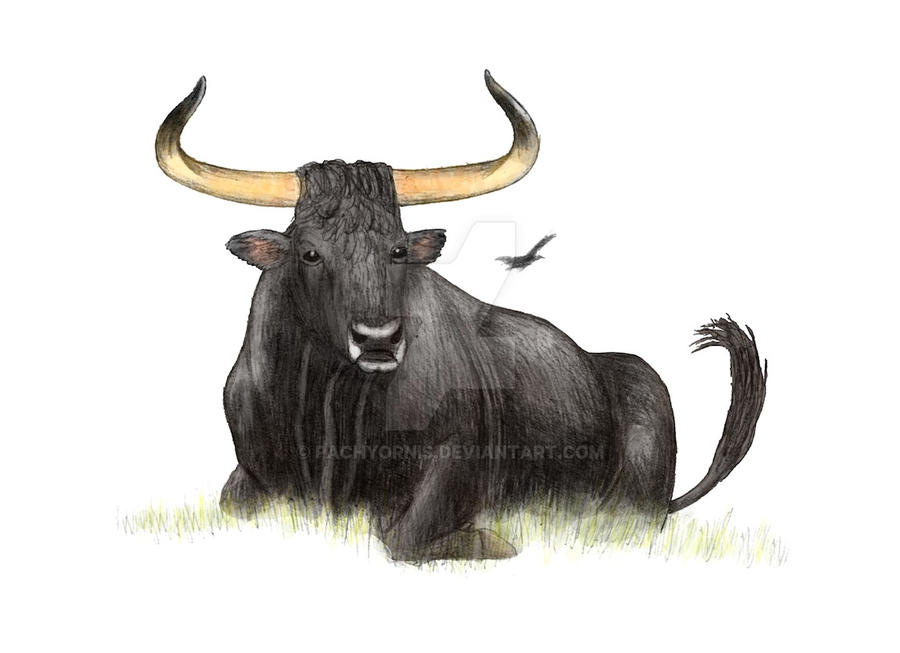
Resting aurochs bull portrait

The putative Pajuna crossbreed of the TaurOs Programme inspired me to do a portrait of a resting aurochs bull: 
The horn shape is based on a skull from Germany. Some might wonder why I tend to draw large-horned aurochs. This is simply because this horn size is very common in European aurochs bull fossils. But my next aurochs is going to be a short-horned individual like this one, I promise.