Monday, 28 October 2019

Breeding-back and domestication: A summary

Last summer, I did some posts on domestication in general, the exact organismic differences between wild and domestic, between cattle and aurochs, and how this might impact the topic of “breeding-back”. The posts are the following: 


It is really a lot of content but truly relevant for the understanding of this topic and a lot of my posts, which is why I thought it would be nice to provide a little handy overview by summarizing the posts in one. 


The real differences between aurochs and cattle

All aspects of a living organism are interconnected via pleiotropic effects (when genes influence more than one trait) and developmental cascades. Hormonal activity, which is regulated by development, influences behaviour as much as morphology. Colour genes also play a role in metabolism and neurology. Not only there was massive directive selection executed upon the animals by humans, also many of the natural and sexual selective factors were eliminated by human custody. So it happens that domestication dramatically altered the whole organism in nearly every aspect: genomic, developmental, neurological, morphological, behavioural and ecological. 

Domestication affected all domesticated mammals in a very similar manner, a phenomenon which is called the domestication syndrome. Cattle are a perfect example of the domestication syndrome. The “symptoms” include reduced fight/flight reaction, increased agreeableness and docility, lethargic behaviour, reduced sexual dimorphism, paedomorphy (retention of juvenile characters, f.e. in skull shape), reduced body size, reduced limb size, reduced brain volume, elongated appendages such as skin flaps, hanging ears (in zebuine cattle), many deviant colour variants, changes in horn shape and size or loss of horns, loss of seasonal adaptions in the reproduction circle. 
The effects on developmental biology in cattle might be responsible for many of the morphological changeswe see. In particular, it was a developmental delay that causes ontogeny to stop earlier, leading to paedomorphy and probably also affecting horn size and shape (see the Latino example) as well as body size. Endocrinology (hormonal activity) might be the key for the classic domestic cattle phenotype. Especially the thyroid and corticosteroid activity might result in the reduced muscling, enlarged belly, hanging spine, shorter body size and reduced limb length and brain volume we see in domestic cattle. Since neurological genes also affect colour cells, selection on behavioural traits might have also caused the classic domestic piebald pattern. Artificial selection and a lack of natural and sexual selection probably also led to a considerable loss of physiological fitness. If the physiological differences between cattle and aurochs are comparable to what happened in yaks, domestication must have affected endurance, respiration, digestion and other factors, increasing the death rate in winter. As in horses, it might have also affected skeletal articulation, locomotion and the cardiac system. Domestication also causes a loss of genetic fitness, called the costs of domestication. Lacking selection, inbreeding and mutation accumulation leads to an increase of deleterious alleles, affecting various organismic factors. In the post From aurochs to cattle: step by step you can see a stepwise illustration of the changes from aurochs to cattle. 

Summing up all those differences made me conclude: 
these dramatic differences [...] make “the aurochs was larger, had a specific colour and different horns” rapidly loose meaning and almost sound like Kindergarden stuff to me. And judging on a total organismic level it actually is. 
This, in turn, means that just a similarity in horns and colour are not even a tiny bit of the whole story. 
Considering the complex interplay of all the factors concerning morphology, behaviour, endocrinology, development and the genetic base underneath it is very unlikely that traditional breeding can simply reverse domestication. This is why some modern projects now claim to execute “breeding-back” on a genetic level. A claim that will be covered in the next section. 


Is “genetic breeding-back” possible

The basic argument of “genetic breeding-back” is that no original wildtype alleles (“genes”) would have been lost during domestication but simply been split up among modern domestic cattle, and that “genetic breeding-back” aims to trace down those alleles and unite them back in one population. 
This scenario, communicated in press releases, faces two problems: 1) Are truly all aurochs alleles still present in the modern cattle population? 2) have those alleles been traced down in modern cattle? 
In order to answer the first question we have to focus exclusively on the defining key aurochs genes. Not haplotypes or other phylogenetic markers, but those genes that regulate the defining differences between aurochs and cattle described above. Considering the complexity of most of those factors, I concluded: “So my personal estimate that the number of genes regulating all the developmental, endocrinologic, neurologic, and morphologic differences between domestic and wildtype, cattle and aurochs, might be hundreds, or even thousands of loci“
Most important to note is that it has not been identified what those particular genes involved are. Not in the aurochs, and not in any mammal. 

The evolutionary process cattle underwent at the beginning of their domestication makes it very unlikely that all of the wildtype alleles survived this process. A very small population of aurochs was snatched out and put under massive directive selective pressure. Nowadays not all cattle are domesticated to the same extent, some are more some are less derived, but some basic organismic changes (see above) are universal to all of them, and so must be the genetic changes causing them, which makes it very likely that some of the wildtype alleles on the loci controlling these changes must have been lost completely in all strains of cattle, otherwise those changes would not be universal. The population genetic process cattle underwent during the last 8000 years – a very small population that was put under massive directive selective pressure and millennia of more or less strict reproductive isolation – leave little room for a survival of all wildtype alleles. 
Even if all the original genetic material of the aurochs was still present and split up among modern domestic cattle, the particular loci of the key genes must have been identified (which is not the case yet) and the specific alleles, wildtype and domestic, must have been identified and traced down in modern cattle (which is not the case either). Thus it is not known which breeds carry which aurochs alleles and to which extent because the necessary scientific framework has not been done yet. Consequently, as the necessary information is not there yet, no current “breeding-back” project is able to carry out breeding on a “genetic level”. Studies on phylogenetic markers and SNPs are nice but do not investigate the key genes responsible for the differences between domestic cattle and their wildtype. Therefore, “genetic breeding-back” exists only in press releases. 


Cattle are “designer aurochs” 

“Cattle and aurochs” is actually a wrong dichotomy. There is no distinctive, definite line between those two animal types as the transition from a wild bull to a Fleckvieh bull was fluent and aurochs and cattle probably hybridized without any obstacles on occasion wherever they neighboured. Actually, cattle are man-made modified designer aurochs – “cattle” is just the term we use to refer them to. Therefore, it is helpful to describe cattle simply as modified aurochs instead of creating a separate category of animal, and for my post Cattle are designer aurochs I chose individuals of three breeds: Maronesa, a less-derived one; Fleckvieh, a derived one; and Heck cattle, a mosaic of derived and less-derived breeds. It shows that the Maronesa and the Heck bull are less derived in aspects like colour and horns, but that the morphological changes (reduced body, limb and head size, elongated trunk, reduced muscling, enlarged intestinum, reduced brain volume, changes in horn curvature and volume, enlarged appendages) as well as behavioural (trainability, reduced stress response, docility and lethargy compared to the wildtype) and probably the developmental changes causing them (changes in corticosteroid and thyroid metabolism, developmental delay and other factors) are universal to all three cattle exanimated, and possible all taurine cattle on this world as this is a look at both derived and less-derived cattle. There is the physiologic and genomic level as well, which cannot be tested based on photos. 


The looks vs behaviour problem and the Spanish fighting bull 

When looking at the breed Lidia, the Spanish fighting bull, however, it shows that Lidia is the least-derived breed in this respect. Lidia do have reduced body size, limb size and brain volume, but they are the one cattle breed in the world with the most wild cattle-like body shape. Especially young individuals have a muscular body with a slender waist, and they are the cattle breed with the largest hump. In essence, they look like more like hypothyreoditic aurochs rather than normal domestic cattle, which might indicate that the effects on hormone activity are not as intensive in Lidia as in other domestic cattle. However, whereas most domestic cattle have a drastically reduced fight/flight reaction, that of Lidia is very intense. The argument that the behaviour of Lidia is “unnatural” is baseless as we have no living aurochs to compare with and the very tame and docile nature of most other cattle breeds is not the wildtype state either. It might be that the aggression level of Lidia is intensified compared to aurochs but their aware behaviour is certainly more wildtype-like than lethargic docility. 

Considering that behaviour and morphology are interconnected via pleiotropy and developmental cascades, it would be an interesting question if it is no coincidence that the least-tame breed in the world is also the one with the most aurochs-like morphology. The farm fox experiment shows that most of the symptoms of the domestication syndrome go hand in hand with a selection on tame behaviour. This provokes the question whether a long-legged, athletic, long-snouted bull or cow that is shaped and coloured like an aurochs but still is more or less tameable and relaxed and not explosive in behaviour is a contradiction in itself. Maybe it is indeed impossible to remove all morphological vestiges of domestication (especially regarding body morphology and skull shape) by selective breeding on optical traits alone. In foxes, for example, conscious breeding for earlier maturity and larger litter size was unsuccessful, while selection on tameness resulted in exactly that. 

An interesting question that rises is whether Lidia always have looked and behaved like that since the domestication of cattle or if their ancestors were ordinary primitive cattle like other Iberian breeds that acquired this wild cattle-like morphology in the course of selection for aggression. 
Even more interesting would be the reverse test of the farm fox experiment with cattle: taking already aurochs-like cattle and selecting them on wildtype behaviour (more intense fight/flight reaction, shyness, explosiveness and other aspects) in order to see if they indeed re-evolve a wild type-like morphology. Such a project would require a different way of keeping them compared to grazing projects, but it would definitely be worth a try. 


A test for breeding-back: the Tamaskan dog

Since we cannot directly compare “breeding-back” cattle with the aurochs as it is extinct, it would be an interesting test for “breeding-back” to do the same with a domestic species whose wildtype is still extant in order to see if it is an efficient way to achieve the goal at all. This has basically been done with wolves and dogs in the form of the Tamaskan breed. The breed was bred using sled dogs, malamutes, huskies and German shepherd dogs in order to create a wolf-like appearance without any crossing-in of wolf dogs or wolves. The overall appearance of a Tamaskan is very similar to a Holarctic grey wolf, the matches in body size, proportions and body shape as well as colour are very wide-ranging. However, a closer look shows that it is clearly a dog. Especially head is larger and paedomorphic (snout, teeth size, eye size). The Tamaskan also has all other symptoms of the domestication syndrome: loss of acuteness of senses, earlier maturity and loss of seasonal reproduction, tame and trainable behaviour with greatly reduced fight/flight reaction. Wolfdogs, on the other hand, which are hybrid breeds of German shepherds and wolves, have a recognizable different behaviour. Tamaskan dogs display a usual domestic dog behaviour. Czechoslovakian and Saarloos wolfdogs are more independent than usual dogs, shy to strangers, easier to scare, need early socialization, have a strong hunting instinct, are more enduring and remarkably good at tracing. So there are morphologic, physiologic and behavioural domestic traits that breeding exclusively domestic individuals for a wildtype-like appearance could not eradicate. This leads to the question what “breeding-back” can achieve at all. 


What breeding-back can achieve 

Since wild and domestic animals differ dramatically on many levels (morphology, genetics, physiology, behaviour, development, endocrinology), and some basic key alleles of the aurochs probably went lost during domestication and thus “genetic breeding-back” is probably not feasible and the scientific framework is not done for it yet, and since classic breeding with domestic animals alone cannot produce a true reconstruction of the wildtype that lacks universal domestic traits, what can “breeding-back” achieve anyway? 
Looking at one of the best breeding-back results that have been achieved so far, the Taurus bull Lamarck, reveals the borders of breeding-back: It matches the aurochs in size and colour, the horns are good, the skull is OK, the proportions and body shape are good. However, it still has all the symptoms of the domestication syndromes: The muscling is still reduced and the intestines are enlarged, the skull is paedomorphic compared to a wild aurochs, the hump is reduced, as is the sexual dimorphism and seasonality of the reproduction circle in the population. Also its behaviour is comparably tame and relaxed. Therefore Lamarck is, albeit being rather aurochs-like in appearance, domestic cattle. The horn shape, body shape and skull shape could be improved by breeding, but the animals would remain domestic. 

The symptoms of the domestication syndrome have a millennia long history in the genetic architecture of the animals and cannot simply be reversed by selective breeding with these domestic animals alone. All in all, the maximum that can be achieved is a “bovine Tamaskan”. This might sound disillusioning, but a bovine Tamaskan would be more aurochs-like than it sounds at first and absolutely sufficient for the basic goal that is filling the niche of the aurochs with something very alike. Aurochs and cattle probably fulfilled the same ecologic niche (aurochs were probably better at digesting food and seizing the nutrients, but the food choice probably stayed the same). The social behaviour of aurochs and cattle probably is the same, as what we know of the aurochs is congruent with that of cattle and cattle have the same behaviour as living wild bovines, so the aurochs must have been the same in this respect. Cattle did loose a lot of fitness during their domestic evolution, but there are numerous examples of self-sustaining feral cattle populations that descended from rather derived breeds, so establishing wild populations of these bovine Tamaskans should be no problem as well. 

Thus, breeding-back results will always remain domestic, but they would be very much like the aurochs in many respect and would fill the niche of the aurochs successfully and authentically. And after many generations of dedomestication in the wild, they would become a new, post-domestic wildtype that resembles the pre-domestic wildtype to a large extent. 
And if we can genetically reconstruct an aurochs by cloning or CRISPR-Cas9, even better. What to do with a genetically reconstructed aurochs is covered here


Thursday, 24 October 2019

White spots in breeding-back cattle

Along with the Hornless allele, the alleles for white spots are among the gene variants definitely not wanted in “breeding-back” as white spots are a trademark sign for domestic animals of any species. However, the genes are in the pool for breeding-back. With this post, I want to have a look at how common they are and where they come from. 

The genetic background for white spots is complicated in cattle. It is important to note that the so-called colour-sided variant present for example in Texas Longhorn is caused by another locus named Colour sided and is different from the piebald pattern we see f.e. Fleckvieh or Frisian and breeding back cattle. The white streak on the face or forehead is caused by the KIT locus. A Spotted allele was coined which is claimed to be responsible for the piebald pattern, but the inheritance for white spots does not suggest a mere Mendelian trait. First of all, white spots seem to cumulate – many individuals might have just a few tiny white spots on the ventral side of their body, but when bred to another individual with white spots they get larger and more widespread, until the individuals are completely piebald. Furthermore, the inheritance of the spots is complicated and might also be influenced by sex (see the next section). 

Heck cattle (and Taurus cattle)

The number of Heck cattle individuals showing white spots on the belly or a streak along the face/forehead is not inconsiderable. You find a number of individuals with these traits on google. In Oostvaardersplassen, where no phenotypic selection occurs, such individuals are particularly widespread. There was at least one completely piebald individual reported (van Vuure 2005). I saw a piebald individual myself in the Lainzer Tiergarten herd in Vienna. Heck cattle has many colour alleles from its ancestral breeds, and white spots are among them. They were probably inherited from the one Black-pied bull Heinz Heck used (perhaps also Corsican cattle which carry the genes on occasion). 

Taurus cattle also may have white spots seldomly, for example the otherwise very good cows 42 508 and Lisette. Margret Bunzel-Drüke reports that the inheritance of white spots in the Lippeaue is curious – female offspring of cows with spots often have them too, while males tend not to. So the particular genes they have might be sex-dependent. White spots are comparably rare in the Lippeaue population, only a handful of individuals have or had them. In the Lippeaue, these might be inherited from all four ancestral breeds: Heck cattle, Lidia and Sayaguesa all may have the genes, and even Chianina where it would be masked due to the dilution alleles that make their coat completely white. 
Taurus cattle in Hortobagy, Hungary, also might have spots on occasion. This is because red-pied and black-pied bulls were used right before they were able to acquire Heck and Taurus bulls, and there is still a good-looking half-Holstein cow in the herd. The otherwise rather good-looking breeding bull Zseuz was selected out because it has white spots on the belly that transferred to its offspring. 

Tauros cattle 

Of the founding breeds of Tauros cattle, at least Sayaguesa have the genes for white spots, and at least one cow that I know of has one on its belly. A number of the Sayaguesa x Tudanca individuals has spots on the belly (go here). 

Auerrind

I have not seen any individuals with white spots in the Auerrind project so far, and it might be that there are none. However, the herd the Sayaguesa are from is the same as those of the Taurus and Tauros cattle project (Peter van Geneijgen), so it might be possible that the genes are in the Auerrind mix, but only future can tell. 

What does this mean for breeding-back? Actually only that white spots are simply widespread among domestic cattle in general. They are present in all groups and types of cattle and so also in breeding-back cattle. It is, however, the question whether individuals with spots should always be selected out or not. Surely no project wants that their cattle would end up piebald in the wilderness, such as the Heck cattle in Oostvaardersplassen. This is a complicated question as the genetic background of those spots seems tricky and unresolved and it is probably up to the individual breeder. However, if someone does not want white spots in any individual, they of course can select out each individual showing them. 

Monday, 21 October 2019

Controlled hybridization for saving the wisent?

For an update of my take on to this subject, go here

Long-term readers of this blog will know that the second large wild bovine of Europe, the wisent, is an animal that is not only very spectacular to look at but is also immediately threatened by its extremely low genetic diversity. I covered this topic in several posts already (Overpurity as a danger for the wisentDonate for the Wisents in the Caucasus and What to do with the wisents in the Caucasus). 
I also repeatedly emphasized why I see the hybrid wisents in the Caucasus as a chance instead of a threat, and I also already introduced the idea of controlled hybridization with American bison in order to increase the genetic of the wisent. This is of course a provocative idea that sounds risky, but I have my reasons and I consider a careful way how to put it into practise worth a try. This is what I want to explain thoroughly with this post. 

The problem 

Inbreeding basically leads to a reduction of genetic diversity, which in turn leads to an increase of homozygosity in the genome. As long as the genome is purged off deleterious (harmful) alleles in the process a high level of homozygosity does not necessarily affect the healthiness of the population (such as in Chillingham cattle), but when the fixation of the alleles is coincidental, such as in the case of a population crash, the consequence is that a lot of deleterious alleles suddenly have a high chance of becoming fixated homozygously in the population, causing them to express their effects in the phenotype and thus leading to a so-called inbreeding depression. The consequences are increased frequency of diseases or distortions that can pose a long-term threat for the survival of the population. This phenomenon is well-known, not only to geneticists, and is a problem in the conservation of animal breeds and species.
The wisent is such a case. Due to habitat destruction and hunting, the population crashed at the beginning of the 20th century, and all living individuals descend from only 12 individuals. Nowadays, the inbreeding coefficient in the population is very high in both lines (the Lowland line and the Lowland-Caucasian line; the latter one partly descends from the last bull of the B. b. caucasicus subspecies). The inbreeding depression affects skeletal growth leading to skull asymmetry, deformation of the male gonads, increased rate of stillbirths, decreased female fertility and a reduced resistance against diseases and parasites. Wisents are particularly vulnerable to posthitis and balanoposthitis, foot-and-mouth disease, cattle tuberculosis, bluetongue disease and others [1]. Epidemics are an acute danger to wisent populations, both in the wild (in Bialowieza, 20% of the mortalities are caused by diseases) and captivity (few years ago, the stocks at German zoos crashed because of foot-and-mouth disease). Often, reintroduction efforts fails or experience painful set-backs because the animals are too sensitive to diseases (see the herd in the Romanian Carpathians). This is why the action plan for the conservation of the wisent still sees it in the danger of extinction [1]. The genetic basis is simply too narrow to ensure a long-term survival for the species. 

Possible solutions 

The current conservation strategy for the wisent is to continue line breeding without loosing diversity any further. This will not overcome the inbreeding depression but is an attempt not to make it worse. The only way to overcome the inbreeding depression is to increase genetic diversity by introducing more alleles to the population. Except from “constructing” artificial genetic diversity by altering the nucleotide sequence of extant wisents with genetic engineering (which I do not know of genetically feasible), I see only two possible ways to achieve that: acquiring genetic material from wisents that lived prior to the population crash (pre-bottleneck) and reintroducing it into the modern gene pool, or controlled hybridization with the closest living relative, the American bison. 

            Pre-bottleneck wisents 

The genetic material of any wisent that lived prior to the bottleneck event would probably increase the genetic diversity within the modern population greatly, even if it is only one individual, be it from the 19th century or anywhere else during the Holocene. It should not be impossible to acquire the full genome of such pre-bottleneck individuals. There are probably plenty of hides, trophies or skeletons gained from wisents during the most recent centuries that should all still contain enough genetic material. Also any skeletal remains from the latest millennia might be well-preserved enough for this purpose. Since it was possible to resolve the full genome from 8000 year old aurochs bones, the same might be possible with wisent remains. Once the full genome of one or more pre-bottleneck wisents is resolved, it would be possible to introduce the differing alleles into the genome of a recent wisent using CRISPR-Cas9 (the same method has been suggested to revive the woolly mammoth based on an elephants’ DNA). One or few individuals from prior to the end of the 19th century would probably (re)introduce enough “new” (or actually old) alleles into the populations to greatly reduce the effects of the inbreeding depression. The downside of this idea is: a lot of research work has to be done that is expensive and the technique is effortful as well. At the moment all the resources of these “de-extinction” techniques are concentrated on more prestigious animals such as the woolly mammoth, and it is pretty unlikely that anyone would spend a lot of money and effort on reconstructing old individuals of a species that still exists, even tough it would be a crucial step to saving the species. 

            Controlled hybridization with bison  

The second method, crossbreeding with its closest living relative, the American bison, would definitely be less costly and could be started immediately. It has to be said that both species are very closely related, they hybridize readily without any barriers or limitations and there are many authors that list them as one species. I am not suggesting to just rampantly cross all wisents on this world with bison and to swamp the whole population with bison genes. Not at all, this would be a huge mistake that would lead to the extermination of genuine wisents on a genetic level. What I am suggesting is wise and moderate hybridization followed by selective absorptive breeding on a separate, new breeding line with a separate herd book. The ancestry of each of these individuals would be documented just as that of the pure individuals. By this way, the population of the pure but inbred wisents on this world would not be affected or threatened in their genetic integrity in the least, only a few starting individuals would have to be “sacrificed” (if you would start with say, only 100 individuals, I bet this number would be still less than all the losses in the global population caused by inbreeding effects each year). 

The ultimate goal of the hybridization and subsequent breeding would be a population where the frequency of the deleterious alleles has been considerably reduced without affecting the biological integrity of the species too much by bison alleles. The deleterious wisent alleles affect development and other health factors and are probably not crucial for defining wisent characters. Thus, replacing them with alleles from bison would have a beneficial effect on the development and health of the individuals without affecting their nature as Bison bonasus. Of course hybridization will introduce any alleles of the American bison, which is why some sort of controlled breeding is necessary.  In the end, the animals would have to be indistinguishable from other wisents in morphology and looks, behaviour and ecology but at the same time not suffer from the same effects of the inbreeding depression as their conspecifics do. 

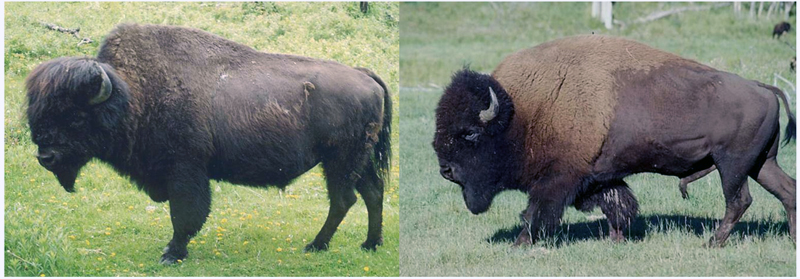
The American bison is subdivided into two subspecies, the plains bison Bison bison bison, and the wood bison Bison bison athabascae. Both subspecies are different ecotypes and have different phenotypes. The wood bison is more adapted to woody habitat, is better adapted to cold and is phenotypically not a far removed from the Wisent as the plains bison. So it would probably be wiser to take wood bison for the hybrid project. 

See here for a comparison between wood bison (left) and plains bison (right). As you see, the wood bison also morphologically resembles the wisent better than the plains bison. 

How to execute such a project 

The larger the initial gene pool the better of course. It would be easiest to start with a herd of bison cows and put a wisent bull on it, but the purpose of the project would be to gather as much wisent diversity as possible, so it would be wiser to start with a herd of wisent cows (20 would be minimum I would say, 100 would be ideal) and put a bison bull on it for the first round. After that and when all cows produced 50% bison and 50% wisent individuals, the American bull would have to be replaced with a wisent bull. The half-wisent individuals would be backcrossed with a pure wisent, which is called absorptive breeding. In order to gain maximum diversity it would be best to replace the wisent bull in each round, although this would be incredibly effortful and costly. This would have to be continued until 1/8 or 1/16 bison individuals are born. Depending on how strongly the bison influence shows, one of these advanced hybrid individuals could be chosen for breeding. I would only take bulls where the hybrid influence is phenotypically as much as undetectable. This is now where the real deal is going to happen: breeding between individuals that both have hybrid ancestry. Only the mating of two wisent that both have hybrid ancestry can enable the true purge of deleterious alleles from the population and the fixation of healthy alleles. The hybrid wisent bull would mate with the pure wisent, half-wisent, quarter wisent et cetera that are present in the herd. Personally I would phase out the individuals with a high bison percentage in this stage. When there is a good mix in the population with all individuals having a high wisent percentage in their genome, phenotypic selection can begin. It would be necessary to remove well-mixed individuals that have a clearly visible hybrid mark in their morphology and external appearance, or show bison behaviour such as head-butting in combat fights (wisent fight horn to horn like cattle). Factors such as food choice could also be evaluated, as bison are more heavy grass eaters than wisent, while wisent also like to browse and peel trees. Another round of pure wisent backcrossing might be necessary in order to get the wisent percentage in the individuals as high as 95% and higher. 
 
A schematic illustration of absorptive breeding
After couple of generations, the wisent would hopefully be virtually indistinguishable or even completely indistinguishable from pure conspecifics (there would be some individuals with bison traits popping out on occasion as usual in breeding, selection would have to wheedle that out in the long term run). What would be crucial now is actually the main purpose of the project after all: studying whether these wisent with bison introgression are truly more healthy and evolutionary fit than their inbred conspecifics. If my expectation is right, symptoms of the inbreeding depression such as stillbirths, infertility, developmental disorders and asymmetries must have decreased in frequency or maybe completely disappeared. Also, they would hopefully be less prone to the typical inbred wisent diseases. If kept under semi-natural or natural conditions, it would be very interesting to see if the survival rate in winter is higher than in Bialowieza, where most of the wisent die of the usual diseases that are plaguing the species. 
If the wisent with the controlled and selected bison introgression are truly healthier and more evolutionary fit than the pure but inbred ones, and indistinguishable from pure ones at the same time, the project could be called a success and the wisent would finally have a perspective for an ensured healthy long-term survival. 

A herd book 

Setting up a herd book would be essential in order to carry out the project in a professional and transparent manner. It would be separate from the international herd book for pure wisents, and it should mark not only the genealogy of the individuals themselves but also their genetic composition, f.e. 25% Bison 75% Wisent. Perhaps also if both parental sides have hybrid ancestry or if it is merely a back-cross. In this way, the introgression project would be absolutely transparent, controlled and documented, and there has to be no fear of a rampant, irreversible swamping of the wisent pool with bison genes. Especially since all evidently pure wisents are listed in the official breeding book for the species anyway. 

A breeding book for wisents with introgression from bison also opens possibilities for the Caucasus population, which descend from hybrids with plains bison. While there are voices that want to cull them all (f.e. such as the international wisent conservation action plan), the population could be regarded as being of considerable worth as it is the only large wisent population with a long history of living in the wild under natural selection on this world at the moment, and the bison hybridization increased their genetic diversity and probably also evolutive fitness.  A few herds of these individuals could be taken and bred in European conservation projects, but registered in a breeding book. That is where the hybrid project’s breeding book could be an option for the recognizing of this population as something of worth for conservation. A second section in the hybrid breeding book could be set up for this particular genetic line (the plains bison hybrids from the Caucasus), and the largest concern of the opponents of introgression in order to safe the wisent, the danger of confusion with pure wisents, would be refuted as everything is transparent thanks to the herd books. As the Caucasus wisent still show phenotypic vestiges of hybridization (if you take a close look, you see that they are somewhere intermediate between bison and wisent), they could be back-crossed with wisent again. In the long term run, it could even be considered to fuse both the wood bison hybrids and the plains bison hybrids in order to gain maximum genetic diversity. 

A hybrid herd book would also be a prospect for those wisent not registered in the official purebred herd book. There are about 700 individuals not registered because their pedigree is not proven or documented. A number of them might have hybrids with bison or cattle in their ancestry, a number might be pure but not documented. Anyway, conservation acts as if those 700 wisent would not exist, despite it is a considerable number and some of them might be more healthy than those in the official herd book. Ignoring them completely is maybe not wise. They could be included into the hybrid herd book as well, in the form of a third section. 

References 

[1] Mammal Research Institute, Polish Academy of Science: European Bison Bison bonasus: Current state of the species and an action plan for its conservation. 2002


Sunday, 20 October 2019

Second-generation Auerrind crosses underway!

After my portrait of the two subadult Auerrind bulls, Claus Kropp told me that Alvarez the Sayaguesa x Watussi bull has already inseminated the Sayaguesa x Grey cattle cow and soon will be brought to the herd of Chianina x Sayaguesa crosses. I am extremely happy to hear this as this not only means that next year we will see the birth of the first second generation Auerrind, but also that the very promising combination (Sayaguesa x Chianina ) x (Sayaguesa x Watussi) will be realized. 

The (Sayaguesa x Watussi) x (Sayaguesa x Grey) sounds promising too. It surely will have a lot of Sayaguesa characteristics, and also the potential for long and large horns on both parental sides. Thanks to Grey cattle, the winter coat has the potential to be rather good. 

I was also told that the first Chianina x Watussi have been born. This combination will also be used as a partner for Alvarez in the future once the newborn individuals are sexually mature. I am looking forward to see how this combination will turn out, and true F2 Chianina x Watussi would certainly be also worth a try (they would even have the potential for a perfectly aurochs-like colour: Watussi removes the dilutions, Chianina contributes the allele for E+ and black pigment, possibly even some degree of dichromatism masked under the dilutions). 

Now the project is really coming on, it is great to see it progressing with each year. A herd book exists since 2015, which is important for keeping track of the offspring. 

Wednesday, 16 October 2019

Two Auerrind bulls

Today I want to cover two of the most significant Auerrind bulls that are around so far: the Maremmana x Watussi bull Apollo and the Sayaguesa x Watussi bull Alvarez. Both are now old enough to deliver an idea what their body shape and horn shape is going to be like when fully grown, and their coat colour is final as well. 
 
© Auerrind Projekt
Apollo 
© Auerrind Projekt
The Maremmana x Watussi bull is exactly intermediate between its both parental breeds in looks. Alternatively, it looks like a red Maremmana bull with really thick horns. The body shape does show Watussi traits, but the zebuine hump is only very small. The horn shape is elegant with pointed tips and looks a lot like those of some Heck cattle of the Wörth lineage, which is not surprising as both share Watussi ancestry. It is larger than the grown pure Pajuna bull, but Pajuna is a small breed. 

Alvarez 
© Auerrind Projekt
© Auerrind Projekt
The Sayaguesa x Watussi bull is one of the combinations I was looking forward the most and it is very exciting to see this guy grow. The colour turned out perfect, it seems to have no zebuine hump or at least a very small one, the body shape is Watussi-influenced but not as sausage-like as in Apollo. The big question is how its horns will turn out – how large they will get and which curvature they will have. As the bull is still quite young but the horns have a large diameter at the base, I guess they might grow large to very large. 

Having had a look at these bulls it is of course fun and exciting to think about what kind of cows they could be bred into in order to produce good results. If Alvarez would be bred to a pure Sayaguesa cow, with look the result (75% Sayaguesa, 25% Watussi) would be very satisfying already. Bred into another one of its kind, the resulting true F2 has at least a chance to be stable for the desirable traits. One could also breed Alvarez to one of the Chianina x Sayaguesa cows, in order to have more genes for large size and long legs in the mix. Producing true F2 with this combination ((Sayaguesa x Watussi) x (Sayaguesa x Chianina)) might be promising. 
For Appollo, finding the right combination for promising offspring in the first generation is more tricky. One of the Sayaguesa x Chianina cows might be a worth a try concerning body size, horns and overall shape, although there is a high chance that the colour would be diluted (what would not be that much of a problem to me as colour is comparably easy to breed because it is controlled by only a few genes). 

The Auerrind project’s aim is to produce more stable results by using true F crossings (for the F-terminology, go here). I don’t know if this means that they would strictly cross only the breed A x B crosses with the same of their kind, or of they would also allow (A x B) x (C x D) and continue line breeding with true F of these combinations. I think this might be more efficient, as none of the cattle breeds selected would combine all aurochs traits in a two-way-combination. 

On the photo below you see Apollo, Alvarez and the fully grown Pajuna bull that joined the Auerrind project last year. I am happy that Pajuna has been included in the programme, although I do not know any efficient cross combinations with Pajuna in this selection. Maybe it can help to increase volume at a later stage of the project. 
© Auerrind Projekt

Friday, 11 October 2019

Indian vs. European aurochs portrait

I have done a couple of posts trying to investigate what the Indian aurochs looked like, including illustrations (go here fore the latest). The problem is that it is rather speculative as there is not a single more or less complete postcranial skeleton nor are there any sources concerning its fur colour. However, at least concerning the head we can be sure as there are a couple of complete crania preserved. Using one of the rare photos of a cranium of Bos primigenius namadicusI did a head portrait compared to that of a European aurochs bull based on the Berlin skull. 

You can clearly see the cranial differences that are evidenced by the bones. The Indian skull is much more sleek and narrow, while the European one is more massive. The Indian skull has a frontal area that is broader than the distance between the orbitals. The horns are way more longer and more wide-ranging, not necessarily more upright than in the Berlin specimen. These are the hard facts dictated by the bones. 
All the other differences between both aurochs on my drawing are inferred from deductive reasoning and comparison with primitive taurine and zebuine cattle. For example, curly forelocks are proven by historic evidence for the European subspecies and most domestic taurine cattle have them, at least the bulls. For the Indian aurochs, there is no evidence on its pelage, but there are not any zebuine cattle on this world that have curly forelocks (at least no purebred ones). In many wild bovids, those living in temperate climate have some kind of ornamenting fur traits such as manes and beards (see bison and many goat and sheep species), while those in tropical climates have short coat and fleshy appendages such as a dewlap instead. This is why my Indian aurochs has no curly forelocks but a slightly larger dewlap than the European one – thermoregulation being another reason to consider a larger dewlap and a bit more wrinkled skin for the Indian subspecies. 
Also, I chose to give my Indian aurochs the ear shape of zebu cattle, and used a Watussi individual for reconstructing the face shape, so that the aurochs looks “zebuine” (but not domestic, f.e. I consider the hanging ears of zebu cattle a classic domestic trait). 

I think those drawings are plausible reconstructions for subspecies inhabiting tropical and temperate climate, respectively. 


Sunday, 29 September 2019

Watussi-influence in Heck cattle: Fact or myth?

After a couple of months of silence here, I am back with a number of posts in preparation. For now, I want to look into the Watussi influence in modern Heck cattle. 

Many large-horned Heck cattle have their long and thick horns thanks to the influence of the half-zebuine breed Watussi, which is remarkable its the huge horns with a remotely aurochs-like curvature. This is a note I have made many times on my blog, and is also found in numerous literature sources. However, some Heck breeders deny (or have been denying) the influence of this rather exotic breed in the otherwise exclusively European breed that aims to mimic the extinct European aurochs. With this post I want to look into the historic evidence for Watussi influence in the Heck cattle pool and also into the arguments against it raised by Heck cattle breeders, and finally why I am 100% convinced of the truth of Watussi influence for the large-horned Heck cattle lineages. 

Comparison: large-horned Heck cattle vs. standard Heck cattle 

Heck cattle descending from the putative Watussi cross are found in the Neandertal herd and the Frisch breeding line (which is derived from the former) plus all their descendants. As both were and are rather influential for other herds, this also goes for a large portion of the Heck cattle population in central Europe. All those herds have horns with a volume (and also curvature) more aurochs-like than others on average. This is especially true for the Frisch line (Insel Wörth being the former breeding locality), as the breeders put a special focus on improving the horns in this herd. 
There are also Heck cattle herds that have no influence from these two lines, and their horns are never spectacular, neither in volume nor curvature. Here is a comparison of one of the best Heck bulls from Wörth, Aretto (Photo by Walter Frisch, I hope it is ok for him that I use his photo), and a standard Heck bull from Hellabrunn, which resembles the original Heck cattle bred by the Heck brothers very much: 


You clearly see differences, not only in the horns. I will cover that later on. 

Documentation of Watussi influence in the herd book 

The international herd book of Heck cattle lists a cow named “Antje”, born in 1952 in the Duisburg Zoo, for which a father is remarked as “Watussi” and a mother remarked as “Aurochs” in the herd book. Some Heck breeders claim that those names listed in the Herd book were just names for the individuals themselves, and not the breed identities. Thus, the father would have been a Heck bull named “Watussi”. But it is important to note that “aurochs” was (and still is) being used as the breed name for Heck cattle by Heck cattle breeders, also in the herd book. If those terms were just individual names, it would be like listing father and mother in a Golden retriever breed book as “Golden retriever” and “German Shepherd”. This would be rather unlikely. 

Regardless of the identity of the individual Antje, whether it was a pure Heck cow or half-Watussi, it was sold to the Wildgehege Neandertal, where it produced three cows and one bull named “Nuck”, which was subsequently used as a breeding bull in the herd. Assuming that “Watussi” in the breeding book was indeed a Watussi, Nuck and its sisters would have been 25% Watussi. Together they would produce F2 of this combination, and with its mother it would have produced 1/3 Watussi Heck individuals. This would be plenty of genetic influence in the herd – if just consistent back-crossing with Heck cattle happened, the Watussi-influence would have been reduced to nil rather quickly. By using the quarter Watussi bull as a breeding-bull, it could be the case that many individuals of the herd during the 1970s and 1980s still had a influence by Watussi that was not undetectable in phenotype and considerable in percentage – one would have to research precisely in the breeding book. The Neandertal herd, due to its quality in colour and horns, influenced many other herds in Central Europe during the 20thcentury, including the Frisch herd, which was formed mainly by individuals from the Munich zoo and the Neandertal. The Frisch lineage is the Heck cattle lineage with the mightiest and best-curved horns (see here). The absolute and relative dimensions are very satisfying and surpass all other Heck cattle herds on this world, thanks to intense selection and the good basis from the Neandertal herd. Its influence on many other Heck cattle herds, especially in Southern Germany, is easily detectable when looking at the horns.

Considering that the original set of breeds chosen by the Heck brothers does not show any focus on large and thick horns but is rather dominated by breeds with medium-sized to small sized horns (Angeln, Werdenfelser, Corsicana etc.) and that even those with the largest horns of this selection (Grey cattle and Highland) never have such spectacular horns, and – more importantly – Heck cattle outside of these lineages never have really large, thick horns, it is rather suspicious that one important founding cow of these two exclusively large-horned lineages has a father listed as “Watussi” in the herd book. If indeed “Watussi” was just an individual name chosen for a pure Heck bull, which would be a rather curious name choice, the coincidence is huge that its descendants turn out to be Heck cattle with considerably larger horns than Heck cattle not descending from it. 

This makes it very likely that the bull named “Watussi” in the breeding book was indeed a Watussi bull. Therefore, the influence of the large-horned Watussi breed in Heck cattle is documented in the breeding book and probably responsible for the increased horn volume in the breed lines descending from it. 


The phenotype 

Apart from the horn size, there are other morphological traits that support a Watussi ancestry for the large-horned Heck cattle lineages. Comparing the photos of the two bulls above, the bull from Wörth, with the documented Watussi ancestry, also has a trunk that is slightly more sloping than the rather rectangular trunk of the classic Heck bull, resembling the “sausage-like” body shape that is typical of zebuine breeds, formed by a sloping back and a more down-turned pelvis. The differences in trunk shape are not due to perspective, it is visible on many photos. Also, some Heck cattle of the Neandertal-Wörth lineage and their descendants have slightly hanging ears (f.e. the bull Nestor used in the Lippeaue), which is also probably inherited from Watussi. The horn shape of Aretto is 100% identical to that of many Watussi individuals. Also, the skull shape and shape of the face is somehow reminiscent of Watussi (zebuine breeds have a somehow different face than taurine cattle, it is hard to describe it, but the differences concern the nose, eyes and snout shape). 
All in all Aretto indeed looks as if it was a cross between a normal Heck bull like the one above and 1/8 or 1/4 Watussi. 

There are also a lot of other large-horned individuals descending either from the Wörth lineage or the Neandertal herd that show traits very reminiscent of Watussi. The faces of this bull and this cow, for example. There is also a bull kept in Baden-Würtemberg that has all the vestiges of Watussi ancestry in one (face shape, hanging ears, sloping pelvis, colour), it is unfortunately not online anymore. The zebuine/Watussi influence in this cow at the Schwarzwald, which is probably from the Neandertal herd, is very obvious right from the first glimpse. Also, some of the very large-horned Heck cattle have an interesting colour with a slightly purple shine and a very orange colour between the horns. As Watussi have a very rich wine-red colour, this too might be a result of Watussi alleles. All individuals that show this colour also have other suspiciously Watussi-like morphological traits. 

In my opinion, the influence from Watussi cattle in large-horned Heck cattle is historically documented and very obvious from unambiguous morphological traits. Take a look at the bull at 0:53 and 1:51 in this video: with the shape of its face and trunk, the slightly hanging ears, the wine-red shade in its colour and of course the very thick horns this bull cannot deny its Watussi ancestry. 

However, I do not think this is a bad thing per se. Watussi obviously helped to improve the horns greatly, and it would have been difficult to achieve that with a taurine breed. The fact that zebus are a different subspecies is, in this case, only a nomenclatural problem to me because I am looking only at the genes. And those vestiges of zebuine ancestry (ears, sloping body) are undesired domestic traits that just have to be bred out like any other trait (f.e. see the many different colour variants found in taurine cattle, that would have been added to the pool if Texas Longhorn would have been used instead of Watussi). Summa summarum, it does not lower the quality of large-horned Heck cattle as a “breeding-back” result in my opinion. I would use the good individuals like Aretto or Erni at any time for a breeding project. 

But there are voices against using Watussi for horn volume in “breeding-back” because it is a half-zebuine breed with obvious zebuine traits that would leave a strong mark in the otherwise taurine populations. My argument against this concern is that Heck cattle is an example for using Watussi for horn volume without altering the taurine nature of the breed. Apparently this was not 100% correct as there are some zebuine vestiges visible on occasion in the breed. However, I still do think that my argument is valid, and that there will not be much if any visible zebuine influence in breeding projects using Watussi, such as the Auerrind project or Hungarian Taurus cattle, if bred carefully because the breeding mode there is different: in Heck cattle, we had a herd with a part-Watussi breeding bull that had backcrossing with part-Watussi individuals. In the other projects you still have active crossbreeding with several different breeds, where there can be a constant supply with new genetic material and selection would have to focus on keeping the alleles that contribute the large horn volume and loose the alleles typical for zebuine breeds or Watussi. 

On the other hand, there still is genetic linkage – maybe this kind of fractioning the alleles is not entirely possible because the alleles are linked on the same chromosomes, and this could even be the reason why Watussi influence is still visible in large-horned Heck cattle – the genes might be linked. Nevertheless, only practical breeding can show what the results are going to look like, I am still very fond of carefully using Watussi in “breeding-back” and am looking forward to see more results of that. 

Sunday, 7 July 2019

New Auerrind herd, with photos!

The Auerrind project announced the start of a new breeding herd in Frankenstein, Germany (yes, there is a village called Frankenstein) this week. It is composed of the Watussi x Maremmana cow, a young Sayaguesa x Chianina bull, and two Tauros cows from the Netherlands. 

Here are some photos: 
© Auerrind project
Watussi x Maremmana cow © Auerind project
Sayaguesa x Chianina + the half-Watussi cow © Auerrind project
It is very interesting to see these two individuals growing. The Watussi influence in the cow shows rather strongly (which is not a bad thing considering it is an F1), partly possibly also because Podolian cattle have massive zebuine influence anyway. The colour is good and the horns will surely grow very large. The Sayaguesa x Chianina bull seems to have a diluted colour (the phenotype of an F1 is, from the technical view, not relevant for further breeding on qualitative traits). Bulls of this combinations show all possible colour variants between almost white and perfectly aurochs-like, which is peculiar considering that both parental breeds have a uniform phenotype (my possible explanation is that Chianina might not be all homozygous on the diluting loci despite its uniform phenotype, but that is only a suspicion). 

A robust aurochs

It often happens that my aurochs reconstructions might turn out a bit too lightweight. I always use original skeletons for the proportions, but I think it is possible that I underestimate the amount of soft tissue on the skeleton for fully grown adult aurochs. So also in my new aurochs model. It should be anatomically correct as it is based on multiple specimen, but it might be a bit too gracile on the soft tissue anatomy for a fully grown bull. 

So I took one of the photos of the model, tracked it out and finally did a truly massive aurochs specimen as far as the skeleton allows, and used extant wild bovines, especially wisent, as an analogue. This is the result: 

I think that fully grown, old and solitary aurochs bulls might have looked like this. There is an Italian cro-magnon stone carving that might show such a bull, which is portrayed as a pretty robust specimen (here). 

I think that an aurochs skeleton does not allow much more mass. The model is based mainly on the Sassenberg bull, which is described as an almost senile specimen because of its extensive tooth wear. So fully grown aurochs probably did not get much more massive than that, it simply was a comparably gracile species apparently.