The colour is phenotypically perfect, the body shape is quite good as well, as much as the horns. The trunk should be shorter, however.

Sunday, 29 August 2021
A new video of Darth Vader III
Recently a new video of Darth Vader III, breeding bull of the Taurus cattle herd at Disselmersch, Lippeaue, has been posted:

Thursday, 26 August 2021
The past 10 years in "breeding-back"
I have been researching on the aurochs, wild horse and “breeding-back” for exactly ten years now. It was in 2011, when I worked on a drawing of Europe’s large mammals that I looked at the Wikipedia page in order to get some knowledge on the aurochs’ physical appearance. I had been aware of “breeding-back” previously, but did not pay much attention to it. The photograph of the Heck bull “Ari” from the Wörth/Steinberg lineage immediately created my fascination for this subject.

This was in a time when Heck cattle had a kind of monopoly for being an aurochs-like cattle breed, as the primitive landraces from Southern Europe were barely known outside the Iberian peninsular. But I learned of these breeds quite early because I joined the aurochs thread in the old Carnivora Forum, where a lot of photos of primitive Iberian breeds were shared. In the same year, I visited the Hellabrunn Zoo in Munich, which is where modern Heck cattle originated. The Hellabrunn Heck cattle herd is remarkable for its perfectly aurochs-like colour with a good sexual dimorphism. Being aware of the fact that Heck cattle is only one of many aurochs-like breeds, I enjoyed seeing living cattle with the colouration of an actually extinct animal very much. Thanks to the Carnivora thread, I also learned about the Tauros Project (today: Tauros Programme), which had only one crossbred individual at that time that was actually still a calf (the bull Manolo Uno). There also was barely any information on Taurus cattle on the web, with only two PDFs showing first-generation crosses at young age. I had no idea that by that time, animals like the bull Lamarck were thriving in the Lippeaue reserve. So there was Heck cattle, by many considered to be the only aurochs-like breed, Taurus cattle which were pretty much incognito back this time and the Tauros Project which only had one calf.
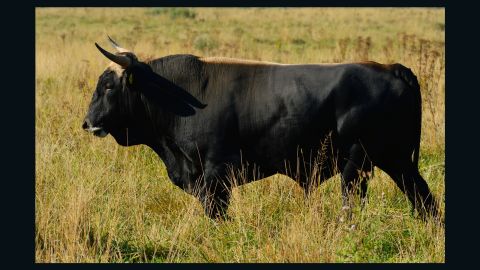
I felt that the monopoly of Heck cattle was unjustified, and the Wikipedia articles in German and English were pretty “pro-Heck cattle” back this time, with little well-grounded information and unempirical claims. The Wikipedia article on the aurochs was not satisfying either, with some inaccuracies and no precise information on the aurochs’ physical appearance. And it was extremely difficult to find information and photos of the primitive Southern European breeds. So I started to rewrite the Heck cattle and aurochs articles in both the German and English Wikipedia, mainly using Cis van Vuure’s 2005 work as a reference. Also, I created Wikipedia articles for some of the primitive European aurochs-like landraces, with photos, because I thought this would be the most effective way to make the knowledge on these valuable breeds more accessible to a larger-scale audience. Also, I thought that by precisely describing the aurochs’ physical characteristics on Wikipedia that the differences between Heck cattle and the aurochs would become apparent.
In 2013, I started the Breeding-back Blog. Back this time, there were not many people interested in the aurochs and “breeding-back” on the web. There was the Carnivora thread, which was mainly attended by four or five users on a regular basis. In the following years, the situation began to change.
For once, “breeding-back” itself began to grow. The Tauros Project expanded to multiple countries and acquired quantity quite fast, and a new project, the Auerrind project came into existence. Taurus cattle finally found their way into the internet, also because – excuse my self-praise here – I went to the Lippeaue reserve several times and covered them on my blog, with many photos (now Taurus cattle also have a very good web presence on the webpage of the ABU). Also, the number of rewilding projects increased, and both practices got considerable media-coverage (compared to the years before 2011). And the number of people interested in “breeding-back” and the aurochs and also of course rewilding multiplied and multiplied.
I see that every time I look at my blog’s statistics. My blog has a total of more than 900.000 clicks, with 200-400 clicks per day, some posts have over 1000 clicks and it has 2000 comments in sum (a big thanks to all my readers by the way!). I would have never expected this to happen, as “breeding-back” and the aurochs is a very small niche, so to say. But the number of people interested in this subject is constantly increasing. I see a lot of people who are not only interested in the aurochs, but also know a lot about this subject. They precisely know what an aurochs looked like, know all the projects and special herds/lineages in great detail. Also, the primitive aurochs-like breeds are now well-known to a lot of people. Back in 2011, all of this was not the case.
I think that of all the animals killed off by mankind in historical times, the aurochs is perhaps the species that currently gets the most attention. The Thylacine also has a huge fan club (a fan club that also has a longer history), but I get the feeling that the “aurochs fan community” got ahead of that of the Thylacine. The mere fact that there is such a community now is worth noticing, because it did not exist back in 2011.
Why did that change so dramatically? I think this has two main reasons: a) there are now more “breeding-back” projects than back then, with a lot more animals and also media-coverage b) the information on “breeding-back” and the aurochs is now easily accessible. The Wikipedia articles are pretty good (I just initiated the changes, a lot of people have helped to progress the pages since 2011), you can easily learn about the life appearance and biology of the aurochs, learn about the primitive aurochs-like breeds and learn about the “breeding-back” projects on the web. I hope that my blog contributes to that as well.
The fact that people are increasingly aware of the anatomy and biology of the aurochs also has a kind of positive feedback effect on “breeding-back”. I get the impression that Heck cattle has slowly increased in quality during the last 10 years because breeders are increasingly aware of the anatomy of the aurochs. The slow process of improvement is not true for all Heck herds, but for some. Also, Heck cattle lost its monopoly on being “the” aurochs-like breed. This was necessary to seize the potential we have in modern day cattle.
While the myth that Heck cattle are “recreated aurochs” is a thing of the past now, the acceptance of the myths concerning the European wild horse and its purported descendants has not changed yet. Still a lot of people believe the “the Konik is the Tarpan descendant” myth, the Sorraia myth and the Exmoor pony myth (go here for a review of these stories). These stories sometimes are even repeated in technical, peer-reviewed papers, which is concerning. But maybe this might change in the future, as fact-based information on these three breeds and on the European wild horse are at least available in the internet now.
I think that we live in the prime time of “breeding-back” today. There are several projects, people now are aware of the anatomy of the aurochs and of suitable breeds (which was not the case, f.e., when the Heck brothers did their breeding experiments) and they have more attention than ever since there is a large number of people interested in this subject. “Breeding-back” already has produced a number of great animals, and there will be much more in the future. I am looking forward to that, and I am also looking forward to cover them on my blog as I always try to do.
Wednesday, 25 August 2021
Differences between the quagga and other zebras
It has been established that the quagga is a subspecies of the plains zebra because it clusters genetically within this clade. This, however, does not imply that it does not differ considerably from other zebra species or subspecies. It diverged from the other plains zebra subspecies between 290 000 or 120 000 years ago [1], what is considerably longer ago than the differentiation between the lineage leading to domestic horses and Przewalski’s horse and definitely long enough to develop its own distinct traits.
The most obvious difference between the quagga and other zebras is the fact that only the anterior part of the body was striped, while the posterior half was stripeless and of a brownish colour. The coat colour, or rather the extent of the striping, varies considerably in the 24 individuals of which the skin was preserved. I illustrated and described this variation in this post. Alas, the locality of the specimen has not been documented, so that the claim that the stripe reduction of the quagga represented a cline cannot be verified for at least within the quagga itself.
Also, the quagga apparently had an idiosyncratic call (sounding like “kwa-ha-ha”, other variations are documented as well), of which the name of the animal is said to be an onomatopoeic derivation (Wikipedia). EDIT: It is possible that the quagga's call was identical with that of other plains zebras.
Another very important distinct trait of the quagga is its sexual dimorphism. Preserved quagga skins suggest that the mares were longer and taller and thus larger than the males, which is the opposite of what we see in other zebras, including the plains zebra, where the males are larger than the females [2]. This is unique among extant equines.
Another possible difference between the quagga and other plains zebra subspecies is the mane length. Looking at photographs of the 24 quagga skins preserved plus the photos of the only living mare to be photographed in the 19th century, it appears to me that the mane is shorter than in other plains zebras. Of course this has to be verified by actually measuring the mane hair and comparing it to the other subspecies, but it seems rather apparent to me.
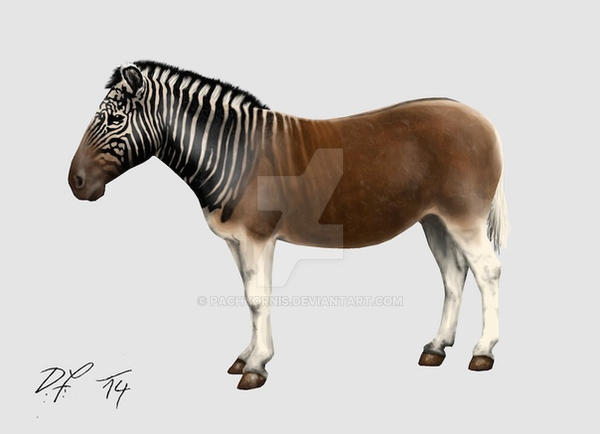 |
| My coloured version of the photo of the only quagga to be photographed, drawn with GIMP |
Thus, it has to be concluded that the quagga was, despite being nested genetically within the plains zebra species, a distinct type of zebra with unique autapomorphies. This has consequences for the guideline of the Quagga Project. The quagga is evidently more than a colour variant, even though its range might have been continuous with that of other plains zebra subspecies (we find this also in species that form a hybrid zone, such as species within Bombina, Corvus, or Loxodonta to name a few). The similarity between the quagga and the zebras of the Quagga Project will merely be superficial. But, so claims the Quagga Project, the quagga was defined only based on external features, thus making that argument invalid. However, the overwhelming majority of animal (and plant) species on this planet is described on a phenotypic basis, it’s part of the requirements of the ICZN for a valid species description. Furthermore, the differences in the fur colour are not the only defining quagga characters, as outlined above. The zebras of the Quagga Project do not exhibit the idiosyncratic call of the quagga, they do not have the reverse sexual dimorphism and the (possibly) shorter mane. Apart from the phenotype, there are genetic differences as well. The quagga has unique mitochondrial haplotypes and does not share any haplotypes with the plains zebra [1], indicating reproductive isolation for a considerable time span. Thus, the quagga was also genetically distinct and the zebras of the Quagga Project will necessarily differ also genetically.
Another problem is that the zebras of the quagga project only have a raw similarity to the quagga based on the coat colouration. While the amount of stripe reduction that was achieved is impressive, the animals lack the deep brown base colour on the trunk and also the stripe pattern is different: the white space between the stripes on the face and neck is rather white because the stripes are comparably thin, sometimes with faint brown stripes between the black stripes, while in all the preserved quagga skins the stripes on face and neck are rather broad, with a narrow white space between them and no faint stripes between the solid stripes. Therefore, the only similarity between the zebras of the quagga project is that the stripes are reduced on trunk and legs. Everything else is different. That is why I wrote the article Please don’t call it quagga in 2015, suggesting that these zebras should neither be called “quagga” nor “Rau quagga”.
Perhaps the quagga project is not even a “breeding-back” project in the strict sense, since it does not work with living descendants of the quagga but merely more or less related animals of a completely different subspecies.
Nevertheless, I am happy that there is the Quagga Project. While they cannot recreate the quagga, they have produced animals that could be useful for outbreeding a genetically resurrected quagga, for the case that the quagga one day will be recreated by using genome editing.
Literature
[1] Hofreiter et al.: A rapid loss of stripes: the evolutionary history of the extinct quagga. 2005.
[2] Heywood: Sexual dimorphism of body size in taxidermy specimens of Equus quagga quagga Boddeart (Equidae).2019.
Saturday, 21 August 2021
A Pleistocene wild horse from Denmark
A few years ago, I did a life restoration of this wild horse skeleton from Denmark. But it wasn't that good, I found. So I did a new one, and finally had the time to finish it:  In order to be as precise as possible, I tracked the original horse skeletons out using a pencil and paper. For the reconstruction of the horse, I used genetic information and the horse depictions from the Ekain cave. Genetic information tells us that most Pleistocene wild horses had the bay allele A+ [1], and both the dun allele and the wildtype non-dun (nondun1) allele was present in the population [2]. The horse therefore was either bay or bay dun. I chose bay dun, because it probably was more common as non-dun is recessive. The horse depictions at Ekain tell us that the striping was pretty pronounced, more so than in extant Przewalski's horses and domestic horses. The mane of all Pleistocene wild horses was erect. All in all, the Pleistocene wild horse was rather similar to the Przewalski's horse in appearance, although the head not quite as large, apparently.

Horses like this one probably were the ancestors of Holocene European wild horses, according to a 2019 study [3]. They their colour shifted from mostly bay dun to mostly black (or maybe additionally black dun) during the Holocene [2]. For a reconstruction of the Holocene wild horse, go here.
Literature
[1] Ludwig et al.: Coat color variation at the beginning of horse domestication. 2009.
[2] Sandoval-Castellanos et al.: Coat colour adaption of post-glacial horses to increasing forest vegetation. 2017
[3] Fages et al.: Tracking five millennia of horse managment with extensive ancient genome time series. 2019.
Monday, 16 August 2021
The skeleton of a Heck bull
When comparing living cattle to the aurochs, there is the danger of comparing apples with bananas when examining skeletons versus living animals. We do not know the aurochs' life appearance for sure, we only know the skeletons for sure. Thus, a fruitful approach could be comparing the skeletons of aurochs-like cattle to that of aurochs. I have seen some Heck bull skulls previously, but never a complete skeleton. Recently, I found the photo of a Heck bull skeleton mounted in France. It is from the publication Remaques sur l'osteometrie de l'aurochs-reconstitue: interet pour la selection de la race (code 30) en vue de se rapprocher du Bos primigenius by Claude Guintard and Quentin Blond.
Guintard has done a number of publications on Heck cattle, comparing it to the aurochs. The paper in particular looks at this skeleton plus a skull of the Heck bull Axis from the Wörth/Steinberg lineage.
 |
| © Claude Guintard |
Go here for a skeleton of an aurochs bull. As you see, the trunk of the Heck bull is longer. If the trunk was shorter, the legs would be longer in relation to the overall size and would fit the aurochs better. The Heck bull has a hump, but smaller as in the aurochs. Also, the skull is shorter but not much compared to that particular specimen. There are aurochs bulls with much longer snouts (such as the Sassenberg bull), and also comparably short-snouted individuals (such as the Torsac dirac bull skeleton) which are comparable to average domestic cattle in skull shape.
Besides the differences in proportions, there are also differences in the horn shape. The horns of the Heck bull would have to curve inwards more strongly in order to fit the aurochs. The dimensions of the horns are within the European aurochs' range of variation.
References
Claude Guintard, Quentin Blond: Remaques sur l'osteometrie de l'aurochs-reconstitue: interet pour la selection de la race (code 30) en vue de se rapprocher du Bos primigenius. 2018.
Saturday, 31 July 2021
The Store Damme aurochs
The Store Damme specimen from Denmark is a nearly complete skeleton of a male aurochs. The mount has a withers height of 175 cm [1], what means that in life the bull might have been 180 or 185 cm tall at the withers.
As so many aurochs skeletons, it is mounted anatomically incorrect. The hind legs are bent too much, also the spine is mounted in a straight line, while in a living bovine the spine is curved on the anterior part of the trunk. Also, the front legs are not mounted entirely life-like. Using GIMP, I corrected the position of the bone elements, including the spine, front legs and hind legs. The result is about as tall as the wrongly mounted skeleton, and looks much more natural and anatomically plausible to me:

Seeing the corrected version, I could not resist doing a life restoration of it, using GIMP. Here is the result:
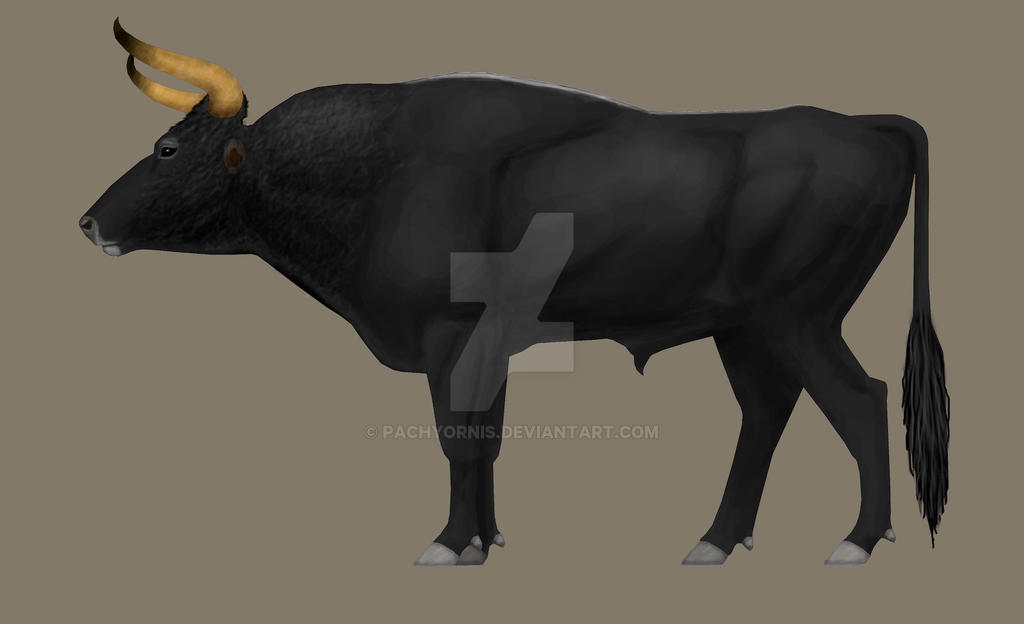
I will use it as a basis for a couple of new aurochs models that I am planning at the moment but do not have the time to build them right now.
Literature
Pucher, Erich: Wie kam der Auerochse auf die Alm? 2019.
Sunday, 18 July 2021
New video from the Lippeaue
The youtube channel Auerochsen Weidelandschaften just posted a new video of Taurus cattle in the Lippeaue:
I have to say that I really like most of the individuals in the video. Many of them have inwards-facing horns, a good overal body shape and the colour is right as well.
Is "breeding-back" necessary?
Originally, “breeding-back” as it was invented by the Heck brothers, aimed to recreate extinct species. We now know that this is not possible working with domestic descendants only, as the subject is much more complicated than just uniting visible traits found in primitive breeds. Therefore, the goal of “breeding-back” changed. Nowadays the main purpose of this method is to authentically replace the extinct wildtypes in the wild, filling the empty ecologic niche. In order to accomplish that, the set of criteria now also includes ecologic traits. The cattle (or horses, if there were “breeding-back” projects for horses) not only have to look like their extinct wildtype, but they also have to be capable of surviving in nature. Achieving that is not a big problem, was most primitive breeds already are very hardy landraces.
But is “breeding-back” really necessary to fill the ecologic gap?
For this question, the answer is pretty clear: no, it is not necessary. Releasing a couple of hardy landraces back into the wild would do the job as well, no elaborate selection on wildtype traits is actually necessary for these animals to survive in nature. While it is true that large, long-legged, athletic cattle with large horns will have a much easier time to defend themselves against predators than small, short-legged cattle without horns, natural selection will probably enforce wildtype traits anyway. Also, many landraces are already quite aurochs-like, such as Sayaguesa for example. They are large, have a comparably aurochs-like morphology and horns, and the colour is right as well (except for the very reduced sexual dichromatism). Add Maronesa genes by releasing both breeds in the same area and most aurochs fans will be satisfied. The same goes for Spanish fighting cattle (Lidia). The probability that they survive in nature and function like their extinct ancestor is very high, as there are feral cattle populations that descended from derived breeds that were not landraces (such as on the Ile Amsterdam or New Zealand). So just releasing a number of cattle from several primitive landraces and letting them breed for themselves and do their thing in natural areas will do the job sufficiently in any case. I have the suspicion that this is the plan the Tauros Programme. So far, they have done exactly that and nothing more (at least nothing that they have published).
If that is the case, why doing “breeding-back” in that intensity at all? I see three main reasons:
- to see how much similarity to the extinct wildtype can be achieved by selective breeding
- educational purpose: by showing what an aurochs (or European wild horse) looked like and was like you educate people zoologically
- a homogeneously wildtype-like phenotype is important for the public acceptance as a wild animal. If the cattle are heterogeneous in appearance they would look more like a bunch of escaped farm cattle, while the phenotype of the aurochs was undoubtedly that of a wild animal. There are indeed people who are against using cattle (or horses) in rewilding because they consider it animal cruelty to let domestic animals live in the wild. It is thus important for the public acceptance of the projects to communicate these are “special” animals bred to live in the wild.
So from a purely ecological point of view “breeding-back” is not necessary. But having a breed of cattle that is as aurochs-like as possible certainly has some advantages. In the end, it is about authenticity. An authentic proxy for the aurochs is more satisfying for nature lovers, has a higher chance of being accepted as a wild animal in the public eye, is more educative, and probably has a higher ecologic fitness compared to randomly chosen landraces due to the selective advantages a wildtype-like phenotype likely has. It is also a matter of opinion. Surely there are more pragmatic people that do not care that much about authenticity, but there are also (perhaps more idealistic) people that do want to replace the aurochs as authentically as possible. And there is enough of the latter category that there are “breeding-back” projects, and even several of them.
Saturday, 10 July 2021
That "tarpan" photo
I am very averse to using the term "tarpan" for the western form of the wild horse, Equus ferus ferus, for a number of reasons. First of all, "tarpan" was actually only a local term from Southern Russia referring to free-ranging horses from the 18th and 19th century whose status was and is unclear. It is not known whether those horses were wild or feral domestic horses, or hybrids. Some contemporaneous authors who saw those horses in real considered them escaped domestic horses, such as Peter Pallas in 1771. A few single individuals are reported because they were kept at zoos, three to be precise. These three individuals are known today as the Dubrowka tarpan, the Krim tarpan and the Cherson tarpan. The status of the Krim tarpan was questioned already back in its lifetime [1] and the Dubrowka tarpan had a semi-erect mane [2] as a hybrid between a domestic horse and a horse with an erect mane would have, suggesting it may have been a hybrid. And then there is the Cherson tarpan. It was the only individual considered a "tarpan" to be photographed.
 |
| The Cherson tarpan |
Wikipedia uses the word "tarpan" as a synonym for the western type of the wild horse, Equus ferus ferus. That is, considering the uncertainties of what the horses actually called tarpan were, not a good idea and also arbitrary. Wikipedia also presents the photo above as the only photo of a "tarpan", although the Wiki authors admit it may not have been "pure" (what is a pure "tarpan" anyway?). Let us analyse this individual in detail.
The Cherson tarpan was caught as a foal in 1866. First it might be interesting which colour the animal had. Judging from the photo, it likely was of a very dark expression of black dun, as found in some Koniks and other black dun horses (like this mare). Black dun is one of the five possible colour phenotypes found in the western wild horse (black dun, bay dun, black, bay, leopard spotted). It has a pretty long and thick mane, what does not fit any of the historic reports of other free-ranging horses (which may or may not have been wild horses, I tend to regard them as feral domestic horses or at least hybrids). Also, its proportions, with the small head and long legs, are like those of normal riding horses and nothing like a wild horse or sturdy pony type. Looking at this animal it is actually easier to conclude it is a feral domestic horse rather than a wild horse. What would qualify this individual as a wild horse, apart from the fact that it was born in a free-ranging herd (which would also go for a feral individual)? And, as mentioned above, some authors considered all those free-ranging horses of Southern Russia in the 18th and 19th century feral horses, what is also suggested by domestic colour variants such as grey or white found in the herds [1].

Furthermore, if the western wild horse had indeed an erect mane as all other extant wild equines do, which is not unlikely, all those reports of horses with falling manes and especially the Cherson tarpan with its long and thick falling mane, can safely be considered feral horses or at least hybrids of feral horses and some type of wild horse (we don't know how far westwards the original range of the Przewalski's horse extended).
Literature
[1] Tadeusz Jezierski, Zbigniew Jaworski: Das Polnische Konik. 2008.
[2] Hardy Oelke: Wild horses then and now. Kierdorf-Verlag.
Friday, 9 July 2021
Using zebus to achieve the trunk to shoulder height ratio?
I make no secret of the fact that I am not averse to using zebuine or zebuine-influenced cattle for “breeding-back” the European aurochs, Bos primigenius primigenius. Surely, zebus have undesired traits, such as the zebuine hump, hanging ears or the adaption to hot, arid climate and hence a coat that would be insufficient for European climate. But, on the other hand, they also have traits useful for “breeding-back” the European aurochs. And what is very interesting is that zebus seemingly share wildtype alleles with the European aurochs that taurine cattle have lost [1]. This could be the result of genetic drift (hence “coincidence”), or maybe zebus did indeed preserve some primitive organismic traits that taurine cattle have lost. I also consider the reverse possible, that taurine cattle have aurochs alleles that zebus lost, but that has not been proven genetically yet.
Thinking of useful traits that zebuine or zebuine-influenced breeds can contribute to “breeding-back” the European aurochs, the first trait that comes to mind are large horns. Watussi is or was used in some projects/breeds to achieve an aurochs-like horn volume. But there is an even more important trait that zebus could contribute that was not considered yet: an aurochs-like ratio of trunk length to shoulder height ratio (note: not withers height, that parameter is influenced by the height of the spines). In male aurochs the ratio was 1:1, in cows the trunk was even a little shorter. “Breeding-back” struggles to achieve that ratio – in Heck cattle the trunk is generally too long and the legs too short (with very few exceptions), I have also not seen a Tauros cattle individual with the right ratio yet, and also in Taurus cattle the ratio is not entirely as in the aurochs. For example, in the otherwise rather nice bull Darth Vader III, the legs are not long enough respectively the trunk is too long. In Lamarck, the best Taurus bull so far, the ratio comes closer to the aurochs. I used two photos to determine the ratio, one resulted in 1:1,07 and the other one in 1:1,16. In the cows, the trunk is usually longer than the shoulder height too although it should be slightly shorter.
 |
| The Taurus bull Lamarck - the shoulder height to trunk length ratio is not completely there yet |
This is not surprising, considering that many of the primitive taurine breeds from Europe are imperfect in this regard. Sayaguesa, a heavily used breed that has many qualities, often has rather longish or short-legged bulls. Also, in Chianina, some bulls have indeed the 1:1 ratio, others do not, it depends on the individual. Lidia bulls are generally too short-legged, with a few exceptions. Maronesa, a breed that is wonderfully aurochs-like in many respects, usually has rather heavy and longish bulls too. The ratio is not perfect in Maremmana either, the same goes for their Hungarian sister breed Grey cattle. An aurochs-like 1:1 ratio for bulls and shorter for cows is simply hard to find even in primitive taurine cattle.
 |
| A Deoni zebu bull, photo by Pavanaja on Wikimedia Commons |
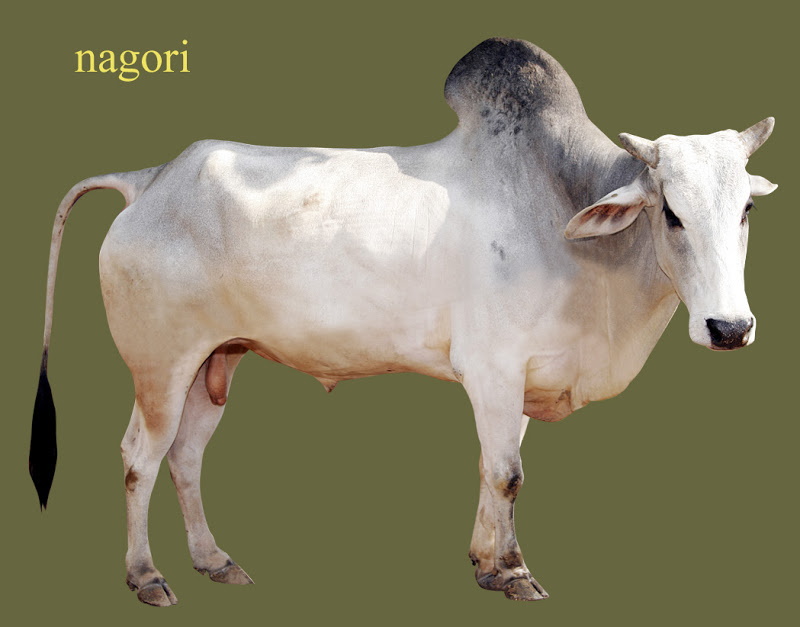
But there are zebus with a very short trunk and pretty long legs, such as the breeds Deoni, Hallikar, Haryana, Kenkhatha, Nagori and others. I am aware of the fact that these breeds cannot be considered “aurochs-like” in the strict sense: they have the zebuine hump, a diluted coat colour, wrong horn shape, hanging ears and are of the wrong ecotype. But I am not suggesting to using these breeds on a large scale. Rather, it would be interesting to see a F2 crossed with Maronesa (or Sayaguesa or Taurus/Tauros). With luck, the right trunk to shoulder height ratio gets passed on in the F2 while maintaining a more or less aurochs-like overall habitus. An individual like that could be useful for further breeding. Undesired zebu traits would have to be bred out just as any undesired trait.


The only real problem would be to get hands on these zebus. I guess importing them from India would be way too effortful and perhaps impossible due to the official disease requirements. But perhaps there are zebu breeders in Europe already that have useful individuals. One would have to look for them.
References
[1] Orlando et al.: The first aurochs genome reveals the breeding history of British and European cattle. 2015.
Thursday, 8 July 2021
Two new videos of Tauros cattle at Milovice
The Tauros cattle herd at Milovice, Czech Republic, is so far the only Tauros cattle herd in Central Europe. It is composed of cows, several bulls and calves.
Recently I found two new videos of the cattle on youtube:
The breed combination of the animals is, as usual, "top secret". But two of the bulls look like they have Pajuna influence, the cows have Maremmana influence for sure and possibly also Sayaguesa. Perhaps this herd is a mix of those three breeds. Regarding their quality from a "breeding-back" perspective, I would say they are somewhere between Heck cattle and Taurus cattle.
Monday, 5 July 2021
The Heck/Taurus cattle of the NP Unteres Odertal, Germany
Heck cattle and Taurus cattle can be considered two different breeds, but it has to be kept in mind that both gene pools are connected and there is a seamless continuum between both types. This is because Taurus cattle individuals often become sold to Heck herds in order to improve their aurochs-likeness, and consequently there are herds that are actually a mix of Taurus and Heck cattle. One of those herds is the population at the National Park Unteres Odertal in Germany.
This bull is a son of Lamarck (Sayaguesa x (Heck x Chianina)) and Leier ((Sayaguesa x Heck) x (Chianina x Heck)), consequently a total mix of the three main Taurus breeds. Noticeable about this bull are its cream white forelocks, possibly caused by Chianina dilution alleles.
What is particularly interesting about this herd is that Taurus cattle individuals from the Lippeaue and are bred to, among usual Heck cattle, Heck cattle from the Wörth/Steinberg line, which are noticeable for their aurochs-like horn dimensions and sometimes also curvature. That means the alleles for large body size and longer legs and snouts as well as aurochs-like horn curvature (coming from Taurus cattle) and aurochs-like horn dimensions (coming from the Wörth/Steinberg Heck cattle), are mixed in one pool. That is a pretty good potential that needs stringent selection in order to produce good results.
Here you have some of the individuals.
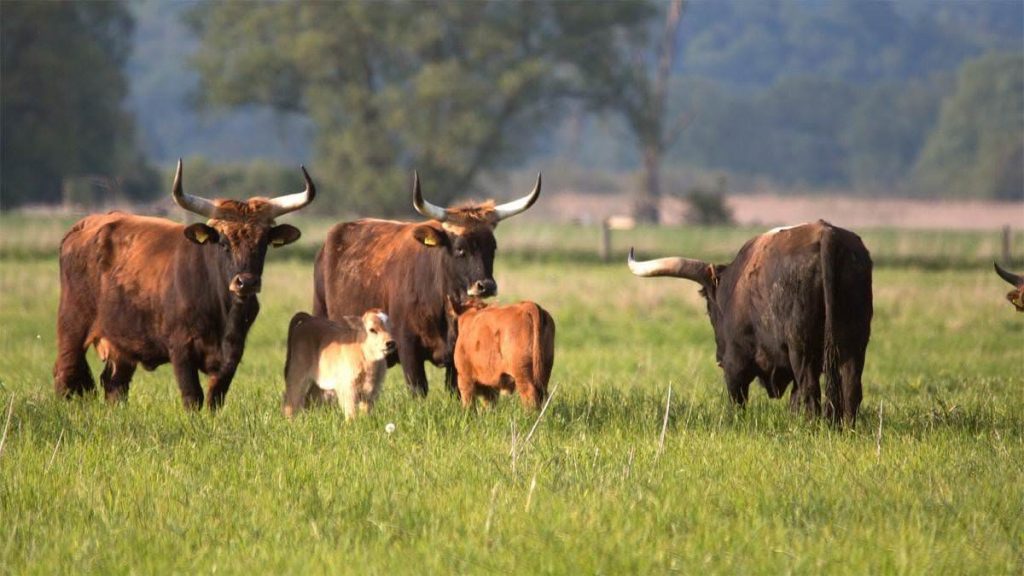
A bull that is definitely from the Wörth/Steinberg line can be found here.
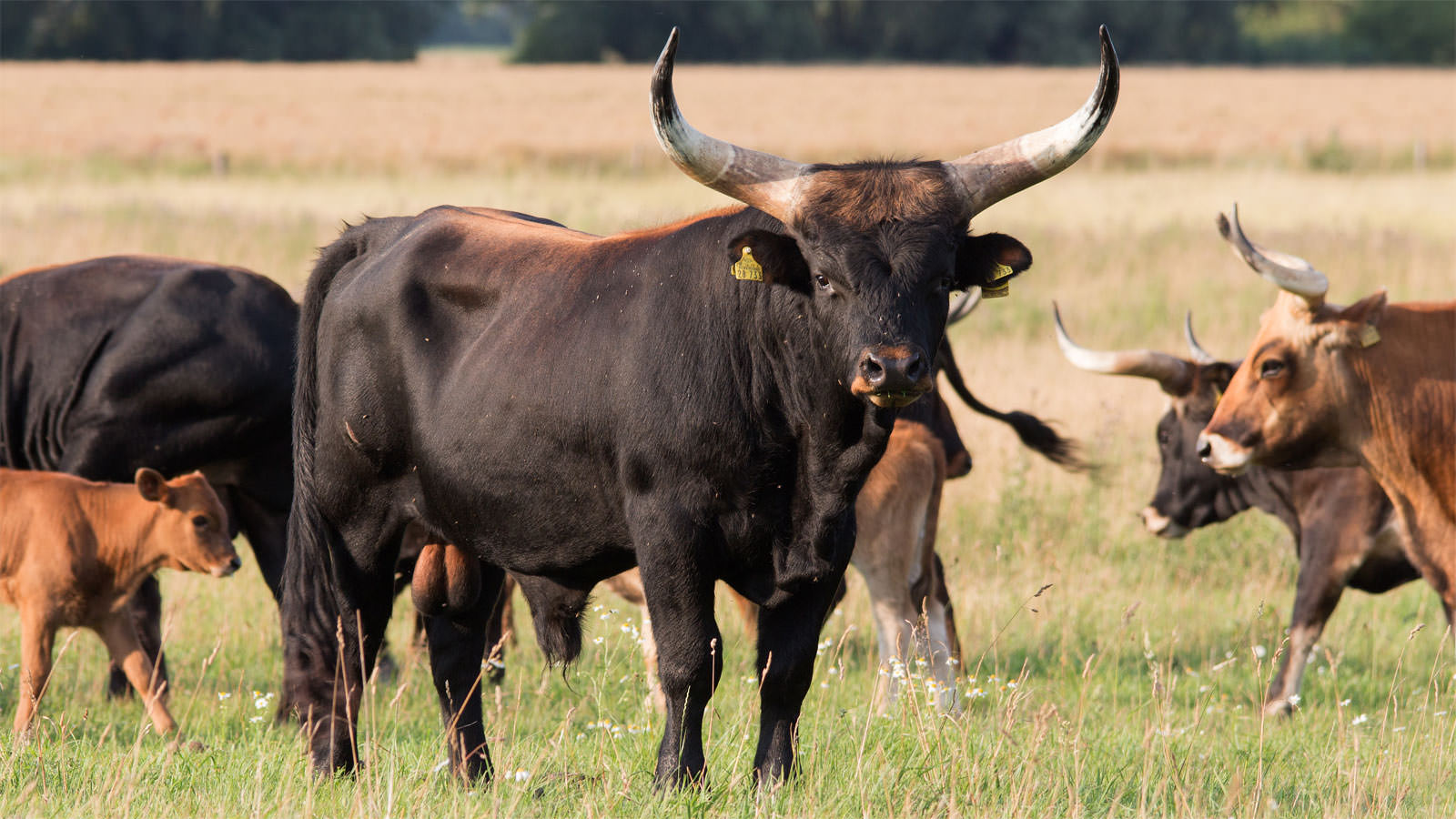
Some cows are here.

A rather "classic" Heck bull is found here.
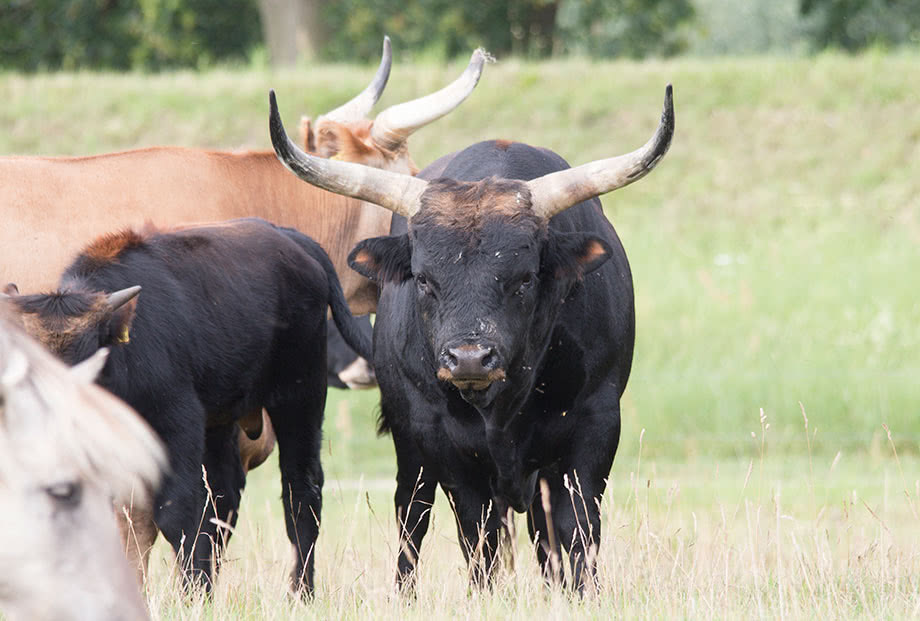
And a Taurus bull most likely from the Lippeaue can be found here.
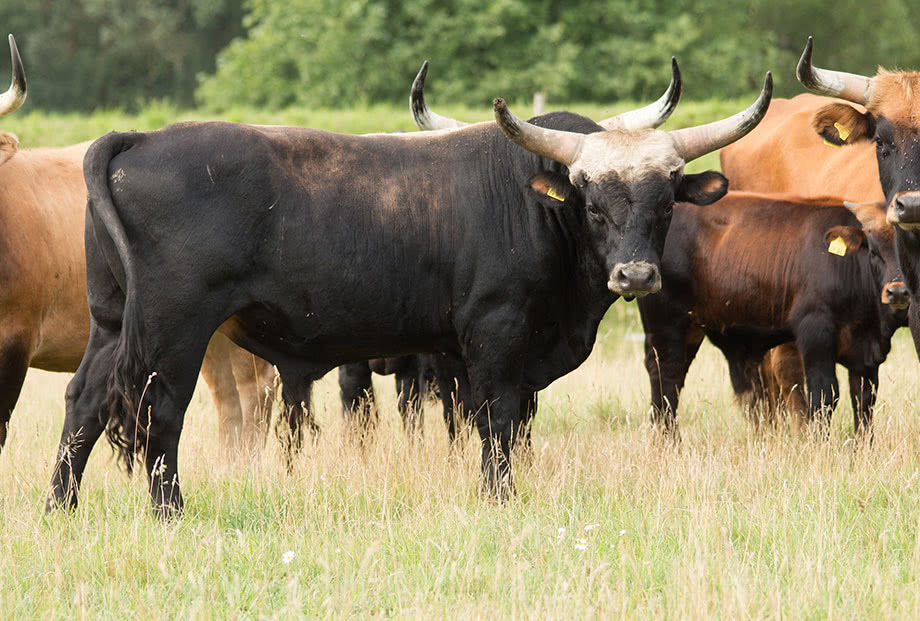
I suspect that this Taurus bull is 42 632 (down below a photo in young years), which I saw in the Lippeaue as a bull calf in 2013.
 |
| © Matthias Scharf |
Sunday, 4 July 2021
Botai horses were not domestic, study says
According to a widely publicised study by Gaunitz et al., the modern Przewalski’s horse descends from the horses associated with the Botai culture from Kazakhstan about 5.500 years ago. These horses were believed to be the earliest domesticated horses. Consequently, the authors write, the modern Przewalski’s horse is not a wild horse but a feral horse [1].
In a very recent post on this blog, I discussed the discrepancy that, although now classified as a feral animal descending from domesticated horses, the Przewalski’s horse does not show a single typical domestic trait (f.e. paedomorphy, piebald colour or a reduced brain volume). I came to the conclusion that the Przewalski’s horse is a fully dedomesticated, post-domestic wild animal that can easily be distinguished from feral horses that have been living in the wild for a considerably shorter time (such as mustangs or brumbies).
This year, however, a study came out that calls the Botai domestication theory into question. The main argument for a the Botai horses being domestic is dental damage believed to be caused by bridle mouthpieces. A study by Taylor and Barron-Ortiz 2021 found that this dental damage was more likely caused by natural tooth wear [2]. Furthermore, the mortality patterns of the Botai horses are not consistent with pastoral management [2]. Early ridden horses also show damage in the lower back area, which is not found in the Botai horses. And even more importantly, arrowheads were found in association with some of the specimen, which indicates that they were hunted. This is definitely not in line with the theory that the Botai horses were domesticated [2]. The authors write that the archaeozoological record instead suggests regularized mass harvesting of wild Przewalski’s horses and not domestic pastoring [2].
Consequently, it seems that the Przewalski’s horse never was domesticated. This is perfectly in line with the fact that the Przewalski’s horse does not show any domestic animal traits and is clearly distinguishable from feral domestic horses in behaviour [3]. This news makes me feel rather comfortable, I always had a hard time believing the Przewalski’s horse descended from domesticated horses. So it seems that the Przewalski’s horse now has its old status back again, being worlds last predomestic wild horse. I hope this study gets as much attention as the Gaunitz et al. paper. Adding it to Wikipedia might help.
These new insights are meaningful as they emphasize the importance of the conservation of the Przewalski’s horse as a true wild animal.
What is also interesting is that the time and place of the domestication of the horse is still unknown. The earliest unambiguous evidence of domestic horses is from the early decades of the second millennium BC [2].
References
[1] Gaunitz et al.: Ancient genomes revisit the ancestry of domestic and Przewalski's horses. 2018.
[2] Taylor, Barron-Ortiz: Rethinking the evidence for early horse domestication at Botai. 2021.
[3] Bunzel-Drüke, Finck, Kämmer, Luick, Reisinger, Riecken, Riedl, Scharf & Zimball: „Wilde Weiden: Praxisleitfaden für Ganzjahresbeweidung in Naturschutz und Landschaftsentwicklung“. 2011
Wednesday, 30 June 2021
Primitive traits found in the anatomy of the Konik - is there truth behind the myth?
The very popular anecdote for the origin of the Konik is that it descends from the last Polish wild horses kept in a game park in the 19th century. This story is very common and even repeated in some scientific papers, although the evidence for this scenario is very weak. I called it the “Konik myth”, and describe in this post why that story is actually very unlikely. Based on the historic and also genetic evidence, it seems that the Konik is nothing but a robust landrace with no close affiliation to alleged late-surviving Polish wild horses.
There are, however, four papers that exanimate morphological details in several wild equines and domestic breeds that provide some clues that, it may seem, there is some truth behind the myth of the Konik because it displays several primitive morphological traits that many other domestic horse breeds do not. Is it maybe not a myth after all? Let’s dive into these morphological studies.
Two of those papers concern the neck anatomy. The nuchal ligament lamellae attach to the cervical vertebrae C2 to C7 in equines such as the Przewalski’s horse, the donkey and the Grant’s zebra, and also in tapirs, suggesting that this is the basal condition for Equus [1,2]. In most domestic horse breeds observed the nuchal ligament lamellae attach from cervicals C2 to C5, with no attachments to C6 and C7. However, in two of four Konik individuals examined and one of one Bosnian Mountain horse, the lamellae attach also to C6 and C7 as in other equine species [1]. The authors consider both the Konik and the Bosnian Mountain horse “tarpan descendants”. As a reference for the “tarpan” ancestry of the Bosnian a book is listed, which I do not have access to. So I did google search on the alleged affiliations of the Bosnian to the European wild horse. It seems that there is the story that the Bosnian mountain horse descends from a mix of the “tarpan” (= the European wild horse, not those nebulous horses of the Russian steppe in the 18th and 19th century that were in fact called tarpan) and Mongolian horses. I do not know if there is any evidence for this story. Anyway, the authors conclude that the attachment of the nuchal ligament lamellae found only in those two breeds endorse the idea that these two breeds recently descended from European wild horses [1,2]. Later it was found that this condition is also present in the Australian Stock horse [2], therefore it is not limited to the two alleged “tarpan descendants”.
The other anatomical detail that is supposed to link the Konik to wild horses is found in the distal limb. The interosseous muscles II and IV are thin ligamentous structures in most domestic horses, while in the Konik and Bosnian Mountain horse they are strong chord-like bands. It has been found that this is also the case in all donkeys, Przewalski’s horses and Grant’s zebras examined, what suggests it is a primitive trait and the anatomy makes it likely that it serves a function [3,4].
Does this mean that there is truth behind the alleged recent wild horse ancestry of the Konik and the Bosnian Mountain horse? At first glance it may indeed suggest that. But this is not necessarily the case. Regarding the neck anatomy, the primitive condition was found only in half of the Koniks observed, while the other half had the domestic condition. Furthermore, the presence in the Australian Stock horse shows that it is not limited to the Konik and Bosnian Mountain horse. It might also be found other horse breeds that were not examined. About 20 domestic horse breeds were examined (the Exmoor pony and Icelandic horse among them), but other breeds that might be interesting in this context were not. I am particularly thinking of landraces such as the Mongolian horse or the Finnhorse and Latvian horse (which were recently found to partially descend from the Przewalski’s horse [5] and therefore might have some primitive anatomic traits), or the Vyatka horse or the Hucule (one study suggests the Konik and Hucule might be related [6]). Consequently, these primitive traits might be found in more landraces than just the Konik and Bosnian Mountain horse.
It also should not be forgotten that there is a chance that some or perhaps even all modern Konik lineages have introgression from the Przewalski’s horse. When Lutz and Heinz Heck carried out their “breeding-back” experiments, they crossed several pony breeds, also Koniks from Poland, with a Przewalski’s stallion [7]. After the Second World War, many Koniks from Poland were returned to Poland, including horses from the Heck brothers, which may have been part Przewalski’s horse. A rather strong hint for the Przewalski’s influence in Polish Koniks is the fact that some of them have short, erect manes (see here). I think the only explanation for that is Przewalski’s introgression. Koniks with upright manes are, among other locations, found at Popielno, the most important Polish Konik breeding site where most Koniks imported to other countries come from [8], including Dutch Koniks used in the studies cited above. A genetic test could bring clarification. In Germany, the situation is even more intransparent. On breeding sites such as the Wildpark Hardehausen, Heck horses were crossed with Przewalski’s horses once again to achieve upright manes, and since many breeders in Germany do not differentiate between Koniks and Heck horses, the situation is rather unclear. Now there are several herds of either Koniks or Heck horses in Germany with upright manes and a nebulous history, such as these here.

So introgression from the Przewalski’s horse might explain the primitive traits seen in the Konik. The fact that the primitive condition of the neck ligaments was found in only half of the Koniks examined might endorse this explanation.
Another possibility is, since the strong distal limb ligaments apparently serve a function according to the authors, that this primitive trait was never lost in the ancestors of Konik, Bosnian Mountain horse and whatever other landraces that might have them. So that this trait was retained rather than the result of recent wild horse introgression.
All in all, those studies do not necessarily suggest a recent wild horse ancestry for the Konik and the Bosnian Mountain horse. These primitive traits might also be found in other landraces that were not examined, and partly it might be explained by Przewalski’s horse introgression in the case of the Konik.
The Konik myth can only be true if 1. the horses kept at the Zamoyski game park were indeed wild horses (for which there is no direct evidence), 2. if those horses were indeed donated to the local farmers (for which there is only one dubious historic source and which is unlikely for historic reasons), 3. if there was still wild horse influence in the local farm horses after more than 100 years of breeding (which is unlikely as well). So the Konik myth is actually a less likely scenario than Przewalski’s introgression or other landraces/horse breeds which were not examined having the same primitive traits. More research including other landraces would have to be done in order to clarify that.
References
[1] May-Davis et al.: The disappearing lamellae: implications of new findings in the family Equidae suggest the loss of nuchal ligament lamellae on C6 and C7 occurred after domestication. 2018.
[2] May-Davis et al.: Rare finding of a full nuchal ligament lamellae with attachment points from C2-C7 in one Australian stock horse. 2019.
[3] May-Davis et al.: A primitive trait in two breeds of Equus caballus revealed by comparative anatomy of the distal limb. 2019.
[4] May-Davis et al.: Comparative distal limb anatomy reveals a primitive trait in 2 breeds of Equus caballus. 2019.
[5] Kvist & Niskanen: Modern Northern domestic horses carry mitochondrial DNA similar to Przewalski’s horse. 2020.
[6] Cieslak et al.: Origin and history of mitochondrial DNA linages in domestic horses. 2011.
[7] Heck: The Breeding-back of the Tarpan.
[8] Tadeusz Jezierski, Zbigniew Jaworski: Das Polnische Konik. 2008.
Monday, 28 June 2021
The post-domestic wildtype: Is the Przewalski's horse wild or feral?
EDIT: A 2021 study found that the Botai horses were not domestic, therefore the Przewalski's horse is still a predomestic, never domesticated wild horse. That explains why it has no domestic traits.
 |
| The Przewalski's horse - wild or feral? |
The Przewalski’s horse was long considered the last strain of wild horses that remained undomesticated, while all other populations have been wiped out by man. But as most of my readers will know, this view has been challenged in recent years. A study by Gaunitz et al. 2018 found that the modern Przewalski’s horse descends from the domesticated horses of the Botai culture, the earliest domesticated horses known so far [5]. As it seems, these domesticated horses were not of the caballus/ferus subspecies, but of the przewalskii subspecies. Assuming this is correct, the modern Przewalski’s horse has to be considered a feral form of horse, and not a genuine wild horse, according to the authors of the study. I, however, think that there is still a way to consider the Przewalski’s horse a wild animal.
Domestic animals all show similar traits as a result of domestication. This is called the “domestication syndrome”, which I covered here several times on my blog (go here or here). Classic symptoms of the domestication syndrome are a spotted/piebald coat colour, paedomorphy (the retention of juvenile traits into adulthood), less intense fight-or-flight reaction (i.e. the animals become more tame and agreeable, even trainable), reduced sexual dimorphism, earlier maturity, loss of seasonal adaptions and a reduced brain volume [1,2]. You find these traits in all currently domesticated mammals, be it dogs, cats, sheep, goats, domesticated silver foxes or domestic horses of the ferus/caballus subspecies. Even feral domestic horses, such as mustangs in North America or brumbies in Australia, show vestiges of domestication (f.e. piebald coat colour). Does the Przewalski’s horse show any of these typically domestic traits, being a once-domesticated horse?
Although the coat colour variation of the Przewalski’s horse was greater before the genetic bottleneck event (f.e. more different nuances of brown), piebald individuals have never been documented. All known individuals seem and seemed to be of the bay dun base colour, which is also found in other equine species such as the kiang or onager.
 |
| Skull of a Pleistocene wild horse from Denmark (left), a Przewalski's horse (middle) and an Exmoor pony (right) |
Also, the Przewalski’s horse cannot be considered paedomorphic. A comparison between the skull of a Przewalski’s horse, a wild Pleistocene horse that surely was undomesticated and a robust domestic breed, the Exmoor pony, shows that the Pleistocene skull and the Przewalski’s horse’s skull look very similar while the Exmoor pony skull clearly has a shorter snout, larger eyes and a less massive lower jaw. The Exmoor pony’s skull has to be considered paedomorphic, while the Przewalski’s horse’s skull shows no signs of paedomorphy (it has smaller eyes, a longer snout, a massive lower jaw).
Do Przewalski’s horses have a reduced brain volume? The brain volume of Przewalski’s horses has never been compared to that of an older wild horse, but domestic horses have 14% less brain case capacity and 16% less brain weight than wild-living Przewalski’s horses [3]. The brains of Przewalski’s horses therefore are larger than those of domesticated horses (it has to be noted that Przewalski’s horses living in zoos have smaller brains though [3]). The brain volume of wild-living Przewalski’s horses are therefore probably not smaller than those of predomestic wild horses, or at least not significantly otherwise it would be comparable to that of the domestic horse.
Przewalski’s horses reach maturity later than domestic horses. While domestic stallions reach maturity between the 12. and 20. month, mares reach it after 12 to 18 month. Przewalski’s horses reach maturity after two years (Wikipedia). This is not that much of a difference, but it is later. It is not known how long it took predomestic horses to reach maturity. According to Wikipedia, other wild equines such as the onager also reach maturity at the age of two years.
Sexual dimorphism is not as considerable in equines as in, for example, wild bovines. In all species and subspecies of extant equines, including both the Przewalski’s horse and the domestic horse, the males are slightly larger than the females.
Both the Przewalski’s horse and the domestic horse have retained some degree of seasonality in their reproductive circle, most foals are born in spring. Therefore it cannot be claimed that the Przewalski’s horse lost seasonal reproductive adaptions as many domestic animals did.
Regarding the behaviour of the Przewalski’s horse, it can be said that there are noticeable differences to the domestic horse in temperament and trainability (while the social behaviour is more or less identical). Przewalski’s horses are considerably more aggressive, especially the stallions. These often fight very harshly in a herd, sometimes to death [4]. They react very aggressively to other equines in their range and may even attack their mares, and humans (while free-ranging domestic horses do not attack humans) [4]. While free-ranging domestic horses can be transported without sedating, Przewalski’s horses have to be sedated [4]. Because of their aggressive and mostly untameable behaviour, Przewalski’s horses are much more difficult to handle than feral domestic horses. Nothing in their behaviour would suggest that the Przewalski’s horse is not a wild but a feral horse. Bunzel-Drüke et al. write in 2011: “Keeping Przewalski’s horses should be left to specialists. These animals are not just another horse breed, but a genuine wild animal, which is to be handled totally different than feral domestic horses due to the aggressiveness of the stallions”[4]. In rare cases, Przewalski’s mares have been trained, such as the individual Vaska, which was trained to be ridden. This can also be done with zebras (go here for a video), which are undomesticated, so it is possible to do this with a wild equine and hence the (limited) trainability of single Przewalski’s horses is not an argument for a domestic nature. As outlined above, the behaviour of Przewalski’s horses differs from that of feral domestic horses by the high level of aggression and the difficulty to handle it.
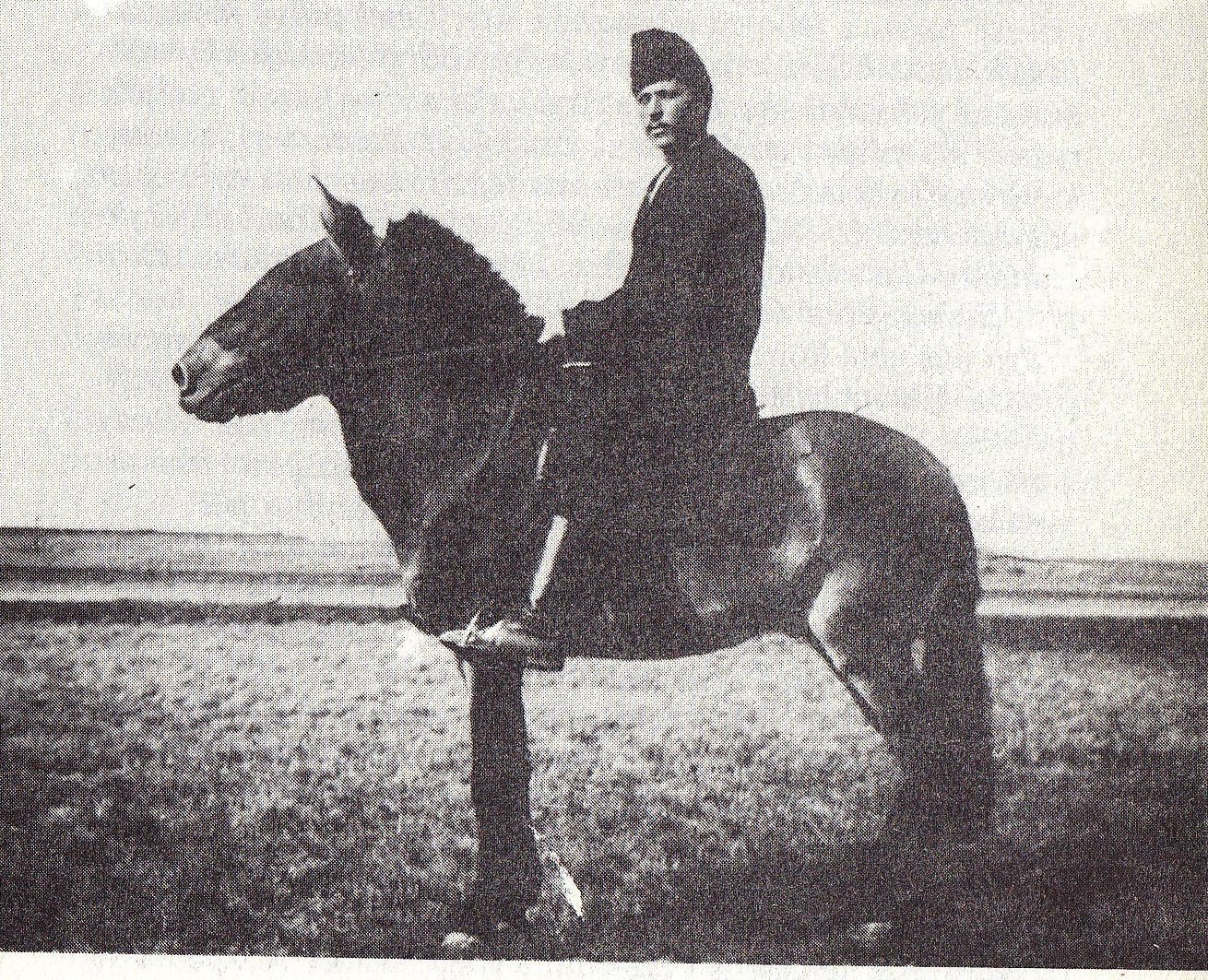
All in all, when taking a close look at the Przewalski’s horses’ biology, it becomes evident that it does not possess any of the typically domestic traits found in domesticated animals. On the basis of behaviour, the Przewalski’s horse is clearly distinguishable from feral domestic horses. The Przewalski’s horse was, ever since its discovery, always viewed as the wildtype of horse and nobody had the suspicion it might be feral instead of genuinely wild before the Gaunitz et al. study came up. There is only one morphologic difference to the domestic Botai horses the modern Przewalski’s horses are supposed to descend from: the limb elements seemingly became less robust than in their ancestors. This is not necessarily a typically domestic trait and could also be the result of genetic drift. The modern Przewalski’s horses may descend from a domesticated population, but this domestication process obviously could not have been very intense, otherwise the modern Przewalski’s horse would have clear domestic traits. And not to forget, the Botai horses were from 5500 years ago. These ancestors must have run wild again at some point since the Przewalski’s horse was exclusively known in its free-ranging state. Assuming this happened not long ago after the domestication event, the modern Przewalski’s horse was exposed to natural selection for – at maximum – 5500 years. It seems that the Przewalski’s horse became fully dedomesticated during these millennia, after being in a domesticated stage that was not intensely domestic in the first place.
How to categorize the Przewalski’s horse, then? It seemingly never was very intensely domesticated, it must have become fully dedomesticated after millennia in the wild and consequently does not possess any domestic traits today. Yet, it is not predomestic as it has a domestic history.
In my Dedomestication series, I coined the term “post-domestic” (as opposed to predomestic) for a fully dedomesticated animal population. It would be a wildtype, but a new, secondary wildtype – shaped by nature, just as the predomestic wildtype. My concept of the post-domestic wildtype was theoretical, as I did not have any unambiguous examples for this state – feral cattle, feral pigs or feral domestic horses living today are not there yet, and it is questionable if the dingo can be truly considered a post-domestic wildtype or just a feral dog. But now that we have the Przewalski’s horse as probably the only once-domesticated animal that became fully dedomesticated during millennia of natural selection, there is a very good candidate for a post-domestic wildtype.
Regardless of whether the concept of a dedomesticated, post-domestic wildtype will ever become established in the zoological community, I consider the Przewalski’s horse a wild animal. Not a predomestic, but a post-domestic one. The establishing of these terms is only paperwork, dedomestication is undoubtedly a real evolutionary process that is sadly under-studied.
References
[1] Trut, 1999: Early Canid Domestication: The Farm fox experiment.
[2] Dobney & Larson, 2005: Genetics and animal domestication: new windows on an elusive process.
[3] Röhrs & Ebinger, 1998: Are zoo Przewalski horses domesticated horses?
[4] Bunzel-Drüke, Finck, Kämmer, Luick, Reisinger, Riecken, Riedl, Scharf & Zimball: „Wilde Weiden: Praxisleitfaden für Ganzjahresbeweidung in Naturschutz und Landschaftsentwicklung“. 2011
[5] Gaunitz et al.: Ancient genomes revisit the ancestry of domestic and Przewalski's horses. 2018.
Wednesday, 23 June 2021
Bulls from Oostvaardersplassen and Slikken van Flakkee
The Oostvaardersplassen Heck cattle population has been covered multiple times on this blog. It is an interesting population because the cattle have been living there free of human influence since the 1980s and therefore would serve as an important case study for dedomestication if they would only be studied.
The bull at 0:57 is very interesting. Not only do its horns face more forward than usual for Heck cattle (especially for the founding individuals of this population), but also its legs are longer and the trunk shorter and less massive. Also the skull is not as short as in usual Heck cattle. All in all it is more aurochs-like than usual Heck bulls. It is well possible that this is an actual result of natural selection, as the proportions and horn orientation are probably not the result of phenotypic plasticity.
The bulls in this video are less long-legged, but their horn orientation is interesting as well. It approaches the aurochs-like 70-60° relative to the snout. When you look at older photos of Heck bulls from the OVP, you see bulls with much more upright and straightly curved horns. To me, this is another hint that evolution is at work at the OVP, and resulting in a regression towards wildtype-like phenotypes.
The Heck cattle population in Slikken van Flakkee is interesting as well. As the cattle at OVP, they are free to breed for themselves without any artificial selection. This means there are some selective pressures working on the cattle. And just like the Heck cattle at OVP, they are more slender and more long-legged than usual Heck cattle.
The video shows some bulls fighting. They have more aurochs-like proportions than usual Heck cattle, and also have a hump, which is rare in Heck cattle. I particularly like the bull at 3:53, the curly hair gives it a kind of wild appearance.
Both the populations at OVP and Slikken van Flakkee are very interesting and valuable populations. A study could be done that documents the phenotypic changes in the herd over the decades in order to have an empirical support for the regression towards the wildtype. A pity that nobody that has the possibilities seems to be interested in such a study (dedomestication is definitely under-studied).
Subscribe to:
Posts (Atom)