For an update of my take on to this subject, go here.
Long-term readers of this blog will know that the second large wild bovine of Europe, the wisent, is an animal that is not only very spectacular to look at but is also immediately threatened by its extremely low genetic diversity. I covered this topic in several posts already (Overpurity as a danger for the wisent, Donate for the Wisents in the Caucasus and What to do with the wisents in the Caucasus).
I also repeatedly emphasized why I see the hybrid wisents in the Caucasus as a chance instead of a threat, and I also already introduced the idea of controlled hybridization with American bison in order to increase the genetic of the wisent. This is of course a provocative idea that sounds risky, but I have my reasons and I consider a careful way how to put it into practise worth a try. This is what I want to explain thoroughly with this post.
The problem
Inbreeding basically leads to a reduction of genetic diversity, which in turn leads to an increase of homozygosity in the genome. As long as the genome is purged off deleterious (harmful) alleles in the process a high level of homozygosity does not necessarily affect the healthiness of the population (such as in Chillingham cattle), but when the fixation of the alleles is coincidental, such as in the case of a population crash, the consequence is that a lot of deleterious alleles suddenly have a high chance of becoming fixated homozygously in the population, causing them to express their effects in the phenotype and thus leading to a so-called inbreeding depression. The consequences are increased frequency of diseases or distortions that can pose a long-term threat for the survival of the population. This phenomenon is well-known, not only to geneticists, and is a problem in the conservation of animal breeds and species.
The wisent is such a case. Due to habitat destruction and hunting, the population crashed at the beginning of the 20th century, and all living individuals descend from only 12 individuals. Nowadays, the inbreeding coefficient in the population is very high in both lines (the Lowland line and the Lowland-Caucasian line; the latter one partly descends from the last bull of the B. b. caucasicus subspecies). The inbreeding depression affects skeletal growth leading to skull asymmetry, deformation of the male gonads, increased rate of stillbirths, decreased female fertility and a reduced resistance against diseases and parasites. Wisents are particularly vulnerable to posthitis and balanoposthitis, foot-and-mouth disease, cattle tuberculosis, bluetongue disease and others [1]. Epidemics are an acute danger to wisent populations, both in the wild (in Bialowieza, 20% of the mortalities are caused by diseases) and captivity (few years ago, the stocks at German zoos crashed because of foot-and-mouth disease). Often, reintroduction efforts fails or experience painful set-backs because the animals are too sensitive to diseases (see the herd in the Romanian Carpathians). This is why the action plan for the conservation of the wisent still sees it in the danger of extinction [1]. The genetic basis is simply too narrow to ensure a long-term survival for the species.
Possible solutions
The current conservation strategy for the wisent is to continue line breeding without loosing diversity any further. This will not overcome the inbreeding depression but is an attempt not to make it worse. The only way to overcome the inbreeding depression is to increase genetic diversity by introducing more alleles to the population. Except from “constructing” artificial genetic diversity by altering the nucleotide sequence of extant wisents with genetic engineering (which I do not know of genetically feasible), I see only two possible ways to achieve that: acquiring genetic material from wisents that lived prior to the population crash (pre-bottleneck) and reintroducing it into the modern gene pool, or controlled hybridization with the closest living relative, the American bison.
Pre-bottleneck wisents
The genetic material of any wisent that lived prior to the bottleneck event would probably increase the genetic diversity within the modern population greatly, even if it is only one individual, be it from the 19th century or anywhere else during the Holocene. It should not be impossible to acquire the full genome of such pre-bottleneck individuals. There are probably plenty of hides, trophies or skeletons gained from wisents during the most recent centuries that should all still contain enough genetic material. Also any skeletal remains from the latest millennia might be well-preserved enough for this purpose. Since it was possible to resolve the full genome from 8000 year old aurochs bones, the same might be possible with wisent remains. Once the full genome of one or more pre-bottleneck wisents is resolved, it would be possible to introduce the differing alleles into the genome of a recent wisent using CRISPR-Cas9 (the same method has been suggested to revive the woolly mammoth based on an elephants’ DNA). One or few individuals from prior to the end of the 19th century would probably (re)introduce enough “new” (or actually old) alleles into the populations to greatly reduce the effects of the inbreeding depression. The downside of this idea is: a lot of research work has to be done that is expensive and the technique is effortful as well. At the moment all the resources of these “de-extinction” techniques are concentrated on more prestigious animals such as the woolly mammoth, and it is pretty unlikely that anyone would spend a lot of money and effort on reconstructing old individuals of a species that still exists, even tough it would be a crucial step to saving the species.
Controlled hybridization with bison
The second method, crossbreeding with its closest living relative, the American bison, would definitely be less costly and could be started immediately. It has to be said that both species are very closely related, they hybridize readily without any barriers or limitations and there are many authors that list them as one species. I am not suggesting to just rampantly cross all wisents on this world with bison and to swamp the whole population with bison genes. Not at all, this would be a huge mistake that would lead to the extermination of genuine wisents on a genetic level. What I am suggesting is wise and moderate hybridization followed by selective absorptive breeding on a separate, new breeding line with a separate herd book. The ancestry of each of these individuals would be documented just as that of the pure individuals. By this way, the population of the pure but inbred wisents on this world would not be affected or threatened in their genetic integrity in the least, only a few starting individuals would have to be “sacrificed” (if you would start with say, only 100 individuals, I bet this number would be still less than all the losses in the global population caused by inbreeding effects each year).
The ultimate goal of the hybridization and subsequent breeding would be a population where the frequency of the deleterious alleles has been considerably reduced without affecting the biological integrity of the species too much by bison alleles. The deleterious wisent alleles affect development and other health factors and are probably not crucial for defining wisent characters. Thus, replacing them with alleles from bison would have a beneficial effect on the development and health of the individuals without affecting their nature as Bison bonasus. Of course hybridization will introduce any alleles of the American bison, which is why some sort of controlled breeding is necessary. In the end, the animals would have to be indistinguishable from other wisents in morphology and looks, behaviour and ecology but at the same time not suffer from the same effects of the inbreeding depression as their conspecifics do.
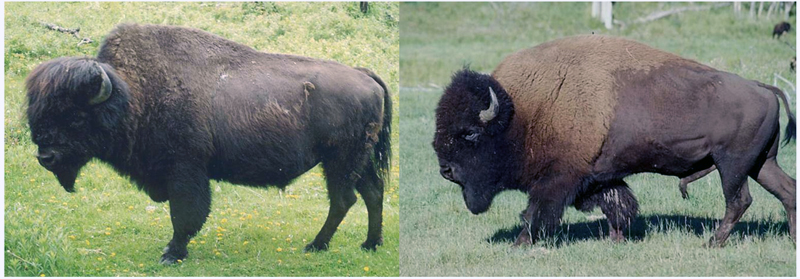
The American bison is subdivided into two subspecies, the plains bison Bison bison bison, and the wood bison Bison bison athabascae. Both subspecies are different ecotypes and have different phenotypes. The wood bison is more adapted to woody habitat, is better adapted to cold and is phenotypically not a far removed from the Wisent as the plains bison. So it would probably be wiser to take wood bison for the hybrid project.
See here for a comparison between wood bison (left) and plains bison (right). As you see, the wood bison also morphologically resembles the wisent better than the plains bison.
See here for a comparison between wood bison (left) and plains bison (right). As you see, the wood bison also morphologically resembles the wisent better than the plains bison.
How to execute such a project
The larger the initial gene pool the better of course. It would be easiest to start with a herd of bison cows and put a wisent bull on it, but the purpose of the project would be to gather as much wisent diversity as possible, so it would be wiser to start with a herd of wisent cows (20 would be minimum I would say, 100 would be ideal) and put a bison bull on it for the first round. After that and when all cows produced 50% bison and 50% wisent individuals, the American bull would have to be replaced with a wisent bull. The half-wisent individuals would be backcrossed with a pure wisent, which is called absorptive breeding. In order to gain maximum diversity it would be best to replace the wisent bull in each round, although this would be incredibly effortful and costly. This would have to be continued until 1/8 or 1/16 bison individuals are born. Depending on how strongly the bison influence shows, one of these advanced hybrid individuals could be chosen for breeding. I would only take bulls where the hybrid influence is phenotypically as much as undetectable. This is now where the real deal is going to happen: breeding between individuals that both have hybrid ancestry. Only the mating of two wisent that both have hybrid ancestry can enable the true purge of deleterious alleles from the population and the fixation of healthy alleles. The hybrid wisent bull would mate with the pure wisent, half-wisent, quarter wisent et cetera that are present in the herd. Personally I would phase out the individuals with a high bison percentage in this stage. When there is a good mix in the population with all individuals having a high wisent percentage in their genome, phenotypic selection can begin. It would be necessary to remove well-mixed individuals that have a clearly visible hybrid mark in their morphology and external appearance, or show bison behaviour such as head-butting in combat fights (wisent fight horn to horn like cattle). Factors such as food choice could also be evaluated, as bison are more heavy grass eaters than wisent, while wisent also like to browse and peel trees. Another round of pure wisent backcrossing might be necessary in order to get the wisent percentage in the individuals as high as 95% and higher.
 |
| A schematic illustration of absorptive breeding |
After couple of generations, the wisent would hopefully be virtually indistinguishable or even completely indistinguishable from pure conspecifics (there would be some individuals with bison traits popping out on occasion as usual in breeding, selection would have to wheedle that out in the long term run). What would be crucial now is actually the main purpose of the project after all: studying whether these wisent with bison introgression are truly more healthy and evolutionary fit than their inbred conspecifics. If my expectation is right, symptoms of the inbreeding depression such as stillbirths, infertility, developmental disorders and asymmetries must have decreased in frequency or maybe completely disappeared. Also, they would hopefully be less prone to the typical inbred wisent diseases. If kept under semi-natural or natural conditions, it would be very interesting to see if the survival rate in winter is higher than in Bialowieza, where most of the wisent die of the usual diseases that are plaguing the species.
If the wisent with the controlled and selected bison introgression are truly healthier and more evolutionary fit than the pure but inbred ones, and indistinguishable from pure ones at the same time, the project could be called a success and the wisent would finally have a perspective for an ensured healthy long-term survival.
A herd book
Setting up a herd book would be essential in order to carry out the project in a professional and transparent manner. It would be separate from the international herd book for pure wisents, and it should mark not only the genealogy of the individuals themselves but also their genetic composition, f.e. 25% Bison 75% Wisent. Perhaps also if both parental sides have hybrid ancestry or if it is merely a back-cross. In this way, the introgression project would be absolutely transparent, controlled and documented, and there has to be no fear of a rampant, irreversible swamping of the wisent pool with bison genes. Especially since all evidently pure wisents are listed in the official breeding book for the species anyway.
A breeding book for wisents with introgression from bison also opens possibilities for the Caucasus population, which descend from hybrids with plains bison. While there are voices that want to cull them all (f.e. such as the international wisent conservation action plan), the population could be regarded as being of considerable worth as it is the only large wisent population with a long history of living in the wild under natural selection on this world at the moment, and the bison hybridization increased their genetic diversity and probably also evolutive fitness. A few herds of these individuals could be taken and bred in European conservation projects, but registered in a breeding book. That is where the hybrid project’s breeding book could be an option for the recognizing of this population as something of worth for conservation. A second section in the hybrid breeding book could be set up for this particular genetic line (the plains bison hybrids from the Caucasus), and the largest concern of the opponents of introgression in order to safe the wisent, the danger of confusion with pure wisents, would be refuted as everything is transparent thanks to the herd books. As the Caucasus wisent still show phenotypic vestiges of hybridization (if you take a close look, you see that they are somewhere intermediate between bison and wisent), they could be back-crossed with wisent again. In the long term run, it could even be considered to fuse both the wood bison hybrids and the plains bison hybrids in order to gain maximum genetic diversity.
A hybrid herd book would also be a prospect for those wisent not registered in the official purebred herd book. There are about 700 individuals not registered because their pedigree is not proven or documented. A number of them might have hybrids with bison or cattle in their ancestry, a number might be pure but not documented. Anyway, conservation acts as if those 700 wisent would not exist, despite it is a considerable number and some of them might be more healthy than those in the official herd book. Ignoring them completely is maybe not wise. They could be included into the hybrid herd book as well, in the form of a third section.
References
[1] Mammal Research Institute, Polish Academy of Science: European Bison Bison bonasus: Current state of the species and an action plan for its conservation. 2002