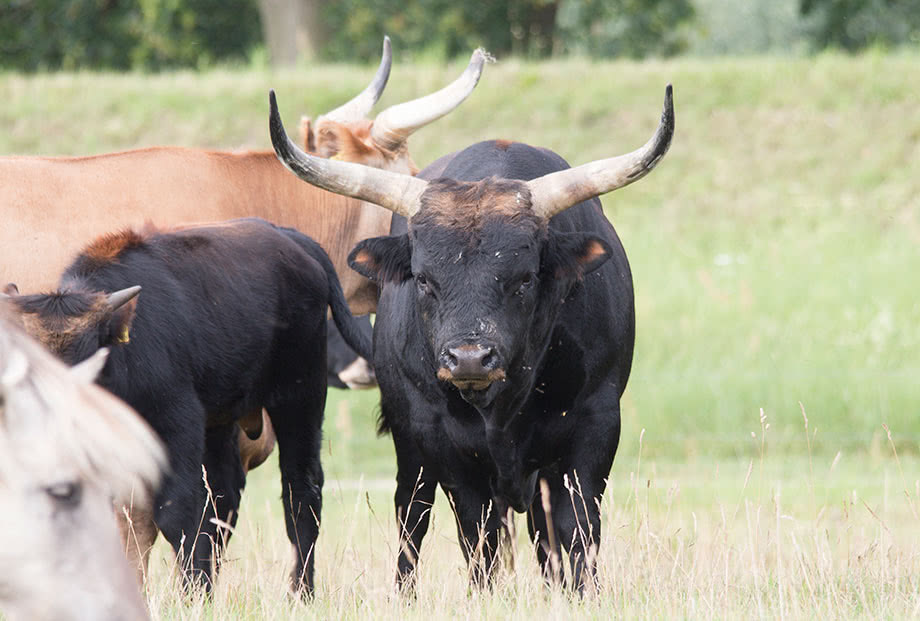
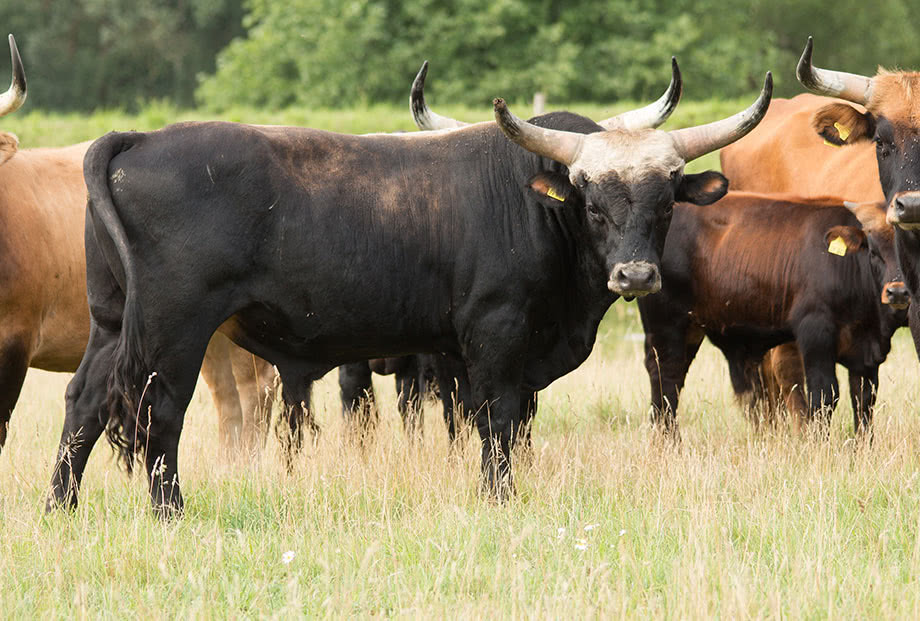
"Breeding-back" aims to restore or immitate extinct animals by selective breeding. This blog provides general information, the facts behind myths and news from various projects. instagram: @daniel.foidl
Saturday, 21 August 2021
A Pleistocene wild horse from Denmark
Monday, 16 August 2021
The skeleton of a Heck bull
![]() |
| © Claude Guintard |
Saturday, 31 July 2021
The Store Damme aurochs
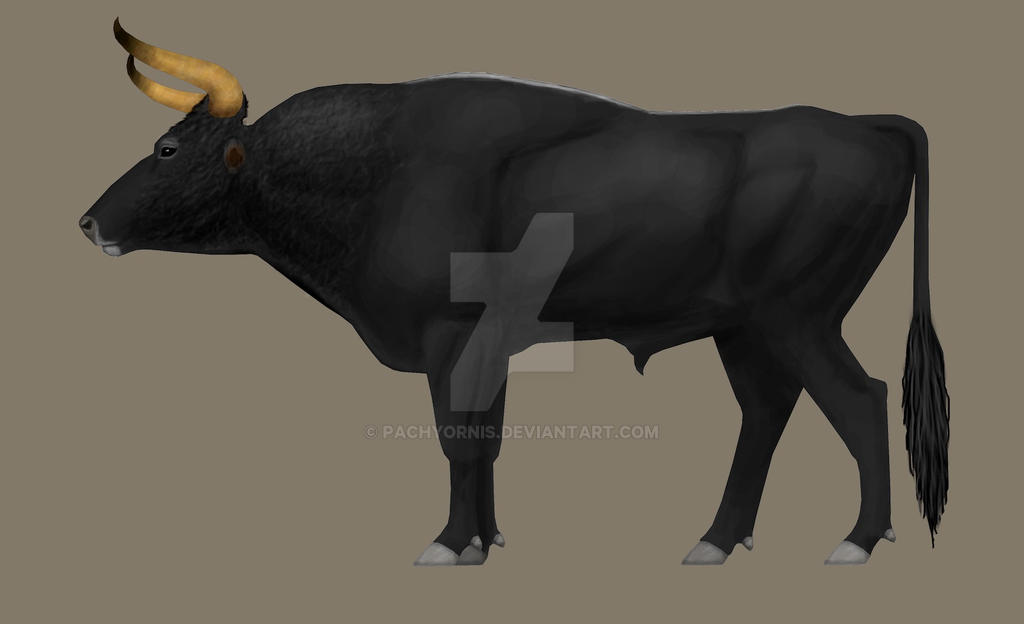
The Store Damme specimen from Denmark is a nearly complete skeleton of a male aurochs. The mount has a withers height of 175 cm [1], what means that in life the bull might have been 180 or 185 cm tall at the withers.
As so many aurochs skeletons, it is mounted anatomically incorrect. The hind legs are bent too much, also the spine is mounted in a straight line, while in a living bovine the spine is curved on the anterior part of the trunk. Also, the front legs are not mounted entirely life-like. Using GIMP, I corrected the position of the bone elements, including the spine, front legs and hind legs. The result is about as tall as the wrongly mounted skeleton, and looks much more natural and anatomically plausible to me:
Seeing the corrected version, I could not resist doing a life restoration of it, using GIMP. Here is the result:
I will use it as a basis for a couple of new aurochs models that I am planning at the moment but do not have the time to build them right now.
Literature
Pucher, Erich: Wie kam der Auerochse auf die Alm? 2019.
Sunday, 18 July 2021
New video from the Lippeaue
Is "breeding-back" necessary?
Originally, “breeding-back” as it was invented by the Heck brothers, aimed to recreate extinct species. We now know that this is not possible working with domestic descendants only, as the subject is much more complicated than just uniting visible traits found in primitive breeds. Therefore, the goal of “breeding-back” changed. Nowadays the main purpose of this method is to authentically replace the extinct wildtypes in the wild, filling the empty ecologic niche. In order to accomplish that, the set of criteria now also includes ecologic traits. The cattle (or horses, if there were “breeding-back” projects for horses) not only have to look like their extinct wildtype, but they also have to be capable of surviving in nature. Achieving that is not a big problem, was most primitive breeds already are very hardy landraces.
But is “breeding-back” really necessary to fill the ecologic gap?
For this question, the answer is pretty clear: no, it is not necessary. Releasing a couple of hardy landraces back into the wild would do the job as well, no elaborate selection on wildtype traits is actually necessary for these animals to survive in nature. While it is true that large, long-legged, athletic cattle with large horns will have a much easier time to defend themselves against predators than small, short-legged cattle without horns, natural selection will probably enforce wildtype traits anyway. Also, many landraces are already quite aurochs-like, such as Sayaguesa for example. They are large, have a comparably aurochs-like morphology and horns, and the colour is right as well (except for the very reduced sexual dichromatism). Add Maronesa genes by releasing both breeds in the same area and most aurochs fans will be satisfied. The same goes for Spanish fighting cattle (Lidia). The probability that they survive in nature and function like their extinct ancestor is very high, as there are feral cattle populations that descended from derived breeds that were not landraces (such as on the Ile Amsterdam or New Zealand). So just releasing a number of cattle from several primitive landraces and letting them breed for themselves and do their thing in natural areas will do the job sufficiently in any case. I have the suspicion that this is the plan the Tauros Programme. So far, they have done exactly that and nothing more (at least nothing that they have published).
If that is the case, why doing “breeding-back” in that intensity at all? I see three main reasons:
- to see how much similarity to the extinct wildtype can be achieved by selective breeding
- educational purpose: by showing what an aurochs (or European wild horse) looked like and was like you educate people zoologically
- a homogeneously wildtype-like phenotype is important for the public acceptance as a wild animal. If the cattle are heterogeneous in appearance they would look more like a bunch of escaped farm cattle, while the phenotype of the aurochs was undoubtedly that of a wild animal. There are indeed people who are against using cattle (or horses) in rewilding because they consider it animal cruelty to let domestic animals live in the wild. It is thus important for the public acceptance of the projects to communicate these are “special” animals bred to live in the wild.
So from a purely ecological point of view “breeding-back” is not necessary. But having a breed of cattle that is as aurochs-like as possible certainly has some advantages. In the end, it is about authenticity. An authentic proxy for the aurochs is more satisfying for nature lovers, has a higher chance of being accepted as a wild animal in the public eye, is more educative, and probably has a higher ecologic fitness compared to randomly chosen landraces due to the selective advantages a wildtype-like phenotype likely has. It is also a matter of opinion. Surely there are more pragmatic people that do not care that much about authenticity, but there are also (perhaps more idealistic) people that do want to replace the aurochs as authentically as possible. And there is enough of the latter category that there are “breeding-back” projects, and even several of them.
Saturday, 10 July 2021
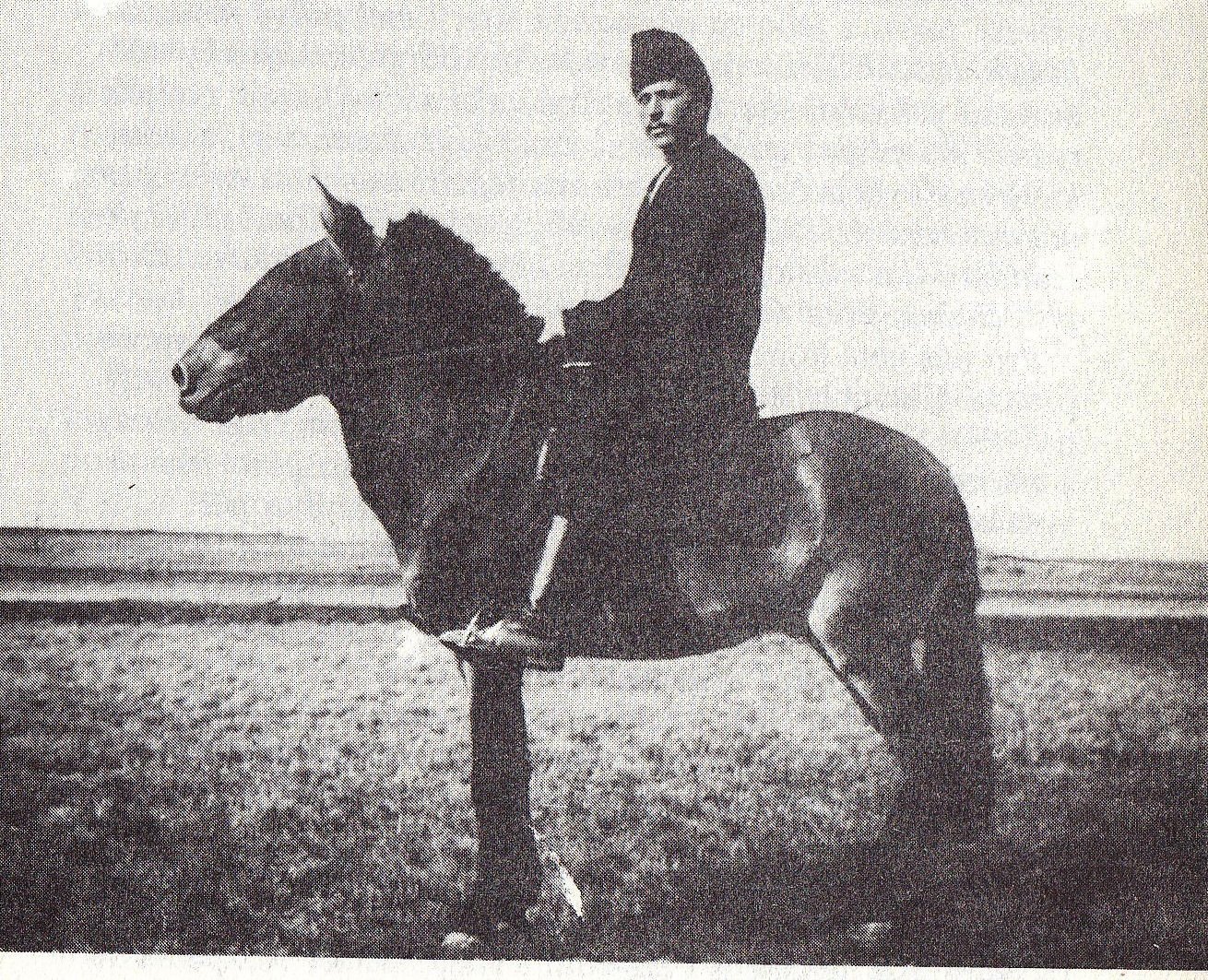
That "tarpan" photo
![]() |
| The Cherson tarpan |
Friday, 9 July 2021
Using zebus to achieve the trunk to shoulder height ratio?
I make no secret of the fact that I am not averse to using zebuine or zebuine-influenced cattle for “breeding-back” the European aurochs, Bos primigenius primigenius. Surely, zebus have undesired traits, such as the zebuine hump, hanging ears or the adaption to hot, arid climate and hence a coat that would be insufficient for European climate. But, on the other hand, they also have traits useful for “breeding-back” the European aurochs. And what is very interesting is that zebus seemingly share wildtype alleles with the European aurochs that taurine cattle have lost [1]. This could be the result of genetic drift (hence “coincidence”), or maybe zebus did indeed preserve some primitive organismic traits that taurine cattle have lost. I also consider the reverse possible, that taurine cattle have aurochs alleles that zebus lost, but that has not been proven genetically yet.
Thinking of useful traits that zebuine or zebuine-influenced breeds can contribute to “breeding-back” the European aurochs, the first trait that comes to mind are large horns. Watussi is or was used in some projects/breeds to achieve an aurochs-like horn volume. But there is an even more important trait that zebus could contribute that was not considered yet: an aurochs-like ratio of trunk length to shoulder height ratio (note: not withers height, that parameter is influenced by the height of the spines). In male aurochs the ratio was 1:1, in cows the trunk was even a little shorter. “Breeding-back” struggles to achieve that ratio – in Heck cattle the trunk is generally too long and the legs too short (with very few exceptions), I have also not seen a Tauros cattle individual with the right ratio yet, and also in Taurus cattle the ratio is not entirely as in the aurochs. For example, in the otherwise rather nice bull Darth Vader III, the legs are not long enough respectively the trunk is too long. In Lamarck, the best Taurus bull so far, the ratio comes closer to the aurochs. I used two photos to determine the ratio, one resulted in 1:1,07 and the other one in 1:1,16. In the cows, the trunk is usually longer than the shoulder height too although it should be slightly shorter.
![]() |
| The Taurus bull Lamarck - the shoulder height to trunk length ratio is not completely there yet |
This is not surprising, considering that many of the primitive taurine breeds from Europe are imperfect in this regard. Sayaguesa, a heavily used breed that has many qualities, often has rather longish or short-legged bulls. Also, in Chianina, some bulls have indeed the 1:1 ratio, others do not, it depends on the individual. Lidia bulls are generally too short-legged, with a few exceptions. Maronesa, a breed that is wonderfully aurochs-like in many respects, usually has rather heavy and longish bulls too. The ratio is not perfect in Maremmana either, the same goes for their Hungarian sister breed Grey cattle. An aurochs-like 1:1 ratio for bulls and shorter for cows is simply hard to find even in primitive taurine cattle.
| A Deoni zebu bull, photo by Pavanaja on Wikimedia Commons |
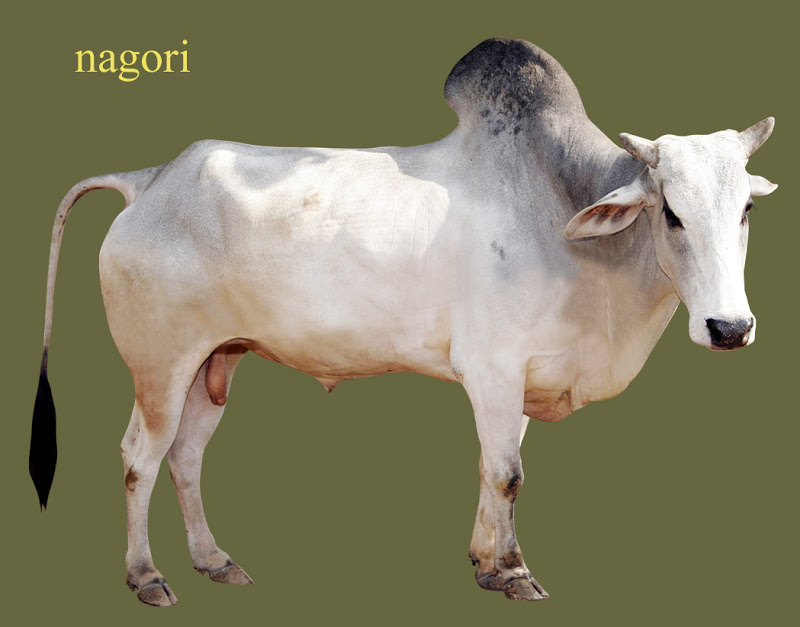
But there are zebus with a very short trunk and pretty long legs, such as the breeds Deoni, Hallikar, Haryana, Kenkhatha, Nagori and others. I am aware of the fact that these breeds cannot be considered “aurochs-like” in the strict sense: they have the zebuine hump, a diluted coat colour, wrong horn shape, hanging ears and are of the wrong ecotype. But I am not suggesting to using these breeds on a large scale. Rather, it would be interesting to see a F2 crossed with Maronesa (or Sayaguesa or Taurus/Tauros). With luck, the right trunk to shoulder height ratio gets passed on in the F2 while maintaining a more or less aurochs-like overall habitus. An individual like that could be useful for further breeding. Undesired zebu traits would have to be bred out just as any undesired trait.
The only real problem would be to get hands on these zebus. I guess importing them from India would be way too effortful and perhaps impossible due to the official disease requirements. But perhaps there are zebu breeders in Europe already that have useful individuals. One would have to look for them.
References
[1] Orlando et al.: The first aurochs genome reveals the breeding history of British and European cattle. 2015.
Thursday, 8 July 2021
Two new videos of Tauros cattle at Milovice
Monday, 5 July 2021
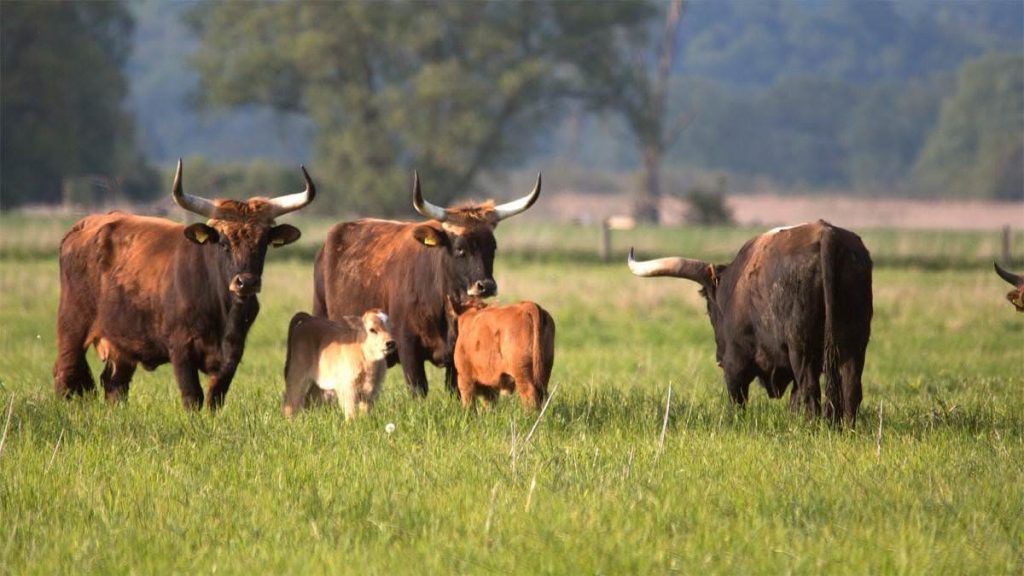
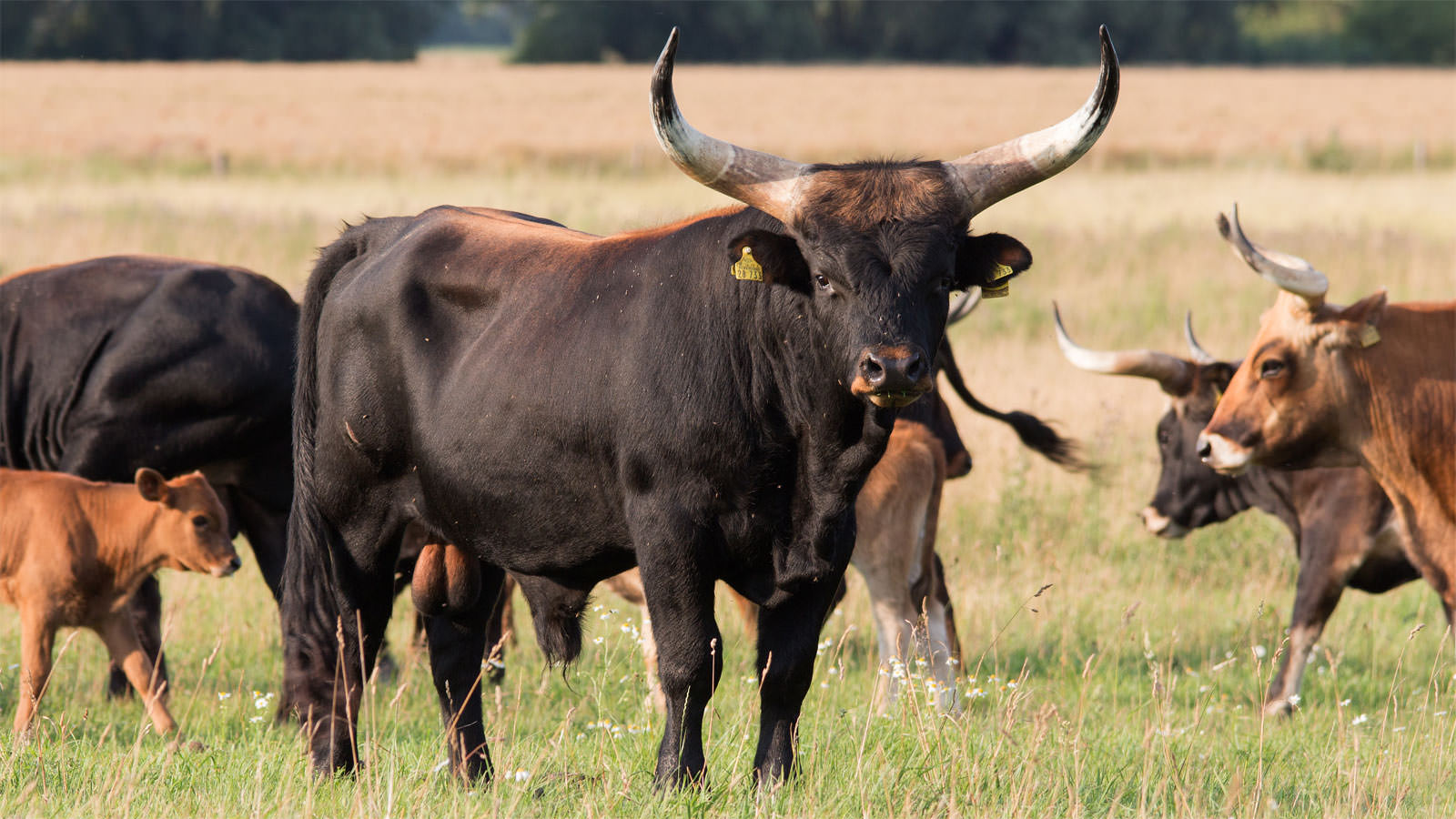
The Heck/Taurus cattle of the NP Unteres Odertal, Germany
![]() |
| © Matthias Scharf |
Sunday, 4 July 2021
Botai horses were not domestic, study says
According to a widely publicised study by Gaunitz et al., the modern Przewalski’s horse descends from the horses associated with the Botai culture from Kazakhstan about 5.500 years ago. These horses were believed to be the earliest domesticated horses. Consequently, the authors write, the modern Przewalski’s horse is not a wild horse but a feral horse [1].
In a very recent post on this blog, I discussed the discrepancy that, although now classified as a feral animal descending from domesticated horses, the Przewalski’s horse does not show a single typical domestic trait (f.e. paedomorphy, piebald colour or a reduced brain volume). I came to the conclusion that the Przewalski’s horse is a fully dedomesticated, post-domestic wild animal that can easily be distinguished from feral horses that have been living in the wild for a considerably shorter time (such as mustangs or brumbies).
This year, however, a study came out that calls the Botai domestication theory into question. The main argument for a the Botai horses being domestic is dental damage believed to be caused by bridle mouthpieces. A study by Taylor and Barron-Ortiz 2021 found that this dental damage was more likely caused by natural tooth wear [2]. Furthermore, the mortality patterns of the Botai horses are not consistent with pastoral management [2]. Early ridden horses also show damage in the lower back area, which is not found in the Botai horses. And even more importantly, arrowheads were found in association with some of the specimen, which indicates that they were hunted. This is definitely not in line with the theory that the Botai horses were domesticated [2]. The authors write that the archaeozoological record instead suggests regularized mass harvesting of wild Przewalski’s horses and not domestic pastoring [2].
Consequently, it seems that the Przewalski’s horse never was domesticated. This is perfectly in line with the fact that the Przewalski’s horse does not show any domestic animal traits and is clearly distinguishable from feral domestic horses in behaviour [3]. This news makes me feel rather comfortable, I always had a hard time believing the Przewalski’s horse descended from domesticated horses. So it seems that the Przewalski’s horse now has its old status back again, being worlds last predomestic wild horse. I hope this study gets as much attention as the Gaunitz et al. paper. Adding it to Wikipedia might help.
These new insights are meaningful as they emphasize the importance of the conservation of the Przewalski’s horse as a true wild animal.
What is also interesting is that the time and place of the domestication of the horse is still unknown. The earliest unambiguous evidence of domestic horses is from the early decades of the second millennium BC [2].
References
[1] Gaunitz et al.: Ancient genomes revisit the ancestry of domestic and Przewalski's horses. 2018.
[2] Taylor, Barron-Ortiz: Rethinking the evidence for early horse domestication at Botai. 2021.
[3] Bunzel-Drüke, Finck, Kämmer, Luick, Reisinger, Riecken, Riedl, Scharf & Zimball: „Wilde Weiden: Praxisleitfaden für Ganzjahresbeweidung in Naturschutz und Landschaftsentwicklung“. 2011
Wednesday, 30 June 2021
Primitive traits found in the anatomy of the Konik - is there truth behind the myth?
The very popular anecdote for the origin of the Konik is that it descends from the last Polish wild horses kept in a game park in the 19th century. This story is very common and even repeated in some scientific papers, although the evidence for this scenario is very weak. I called it the “Konik myth”, and describe in this post why that story is actually very unlikely. Based on the historic and also genetic evidence, it seems that the Konik is nothing but a robust landrace with no close affiliation to alleged late-surviving Polish wild horses.
There are, however, four papers that exanimate morphological details in several wild equines and domestic breeds that provide some clues that, it may seem, there is some truth behind the myth of the Konik because it displays several primitive morphological traits that many other domestic horse breeds do not. Is it maybe not a myth after all? Let’s dive into these morphological studies.
Two of those papers concern the neck anatomy. The nuchal ligament lamellae attach to the cervical vertebrae C2 to C7 in equines such as the Przewalski’s horse, the donkey and the Grant’s zebra, and also in tapirs, suggesting that this is the basal condition for Equus [1,2]. In most domestic horse breeds observed the nuchal ligament lamellae attach from cervicals C2 to C5, with no attachments to C6 and C7. However, in two of four Konik individuals examined and one of one Bosnian Mountain horse, the lamellae attach also to C6 and C7 as in other equine species [1]. The authors consider both the Konik and the Bosnian Mountain horse “tarpan descendants”. As a reference for the “tarpan” ancestry of the Bosnian a book is listed, which I do not have access to. So I did google search on the alleged affiliations of the Bosnian to the European wild horse. It seems that there is the story that the Bosnian mountain horse descends from a mix of the “tarpan” (= the European wild horse, not those nebulous horses of the Russian steppe in the 18th and 19th century that were in fact called tarpan) and Mongolian horses. I do not know if there is any evidence for this story. Anyway, the authors conclude that the attachment of the nuchal ligament lamellae found only in those two breeds endorse the idea that these two breeds recently descended from European wild horses [1,2]. Later it was found that this condition is also present in the Australian Stock horse [2], therefore it is not limited to the two alleged “tarpan descendants”.
The other anatomical detail that is supposed to link the Konik to wild horses is found in the distal limb. The interosseous muscles II and IV are thin ligamentous structures in most domestic horses, while in the Konik and Bosnian Mountain horse they are strong chord-like bands. It has been found that this is also the case in all donkeys, Przewalski’s horses and Grant’s zebras examined, what suggests it is a primitive trait and the anatomy makes it likely that it serves a function [3,4].
Does this mean that there is truth behind the alleged recent wild horse ancestry of the Konik and the Bosnian Mountain horse? At first glance it may indeed suggest that. But this is not necessarily the case. Regarding the neck anatomy, the primitive condition was found only in half of the Koniks observed, while the other half had the domestic condition. Furthermore, the presence in the Australian Stock horse shows that it is not limited to the Konik and Bosnian Mountain horse. It might also be found other horse breeds that were not examined. About 20 domestic horse breeds were examined (the Exmoor pony and Icelandic horse among them), but other breeds that might be interesting in this context were not. I am particularly thinking of landraces such as the Mongolian horse or the Finnhorse and Latvian horse (which were recently found to partially descend from the Przewalski’s horse [5] and therefore might have some primitive anatomic traits), or the Vyatka horse or the Hucule (one study suggests the Konik and Hucule might be related [6]). Consequently, these primitive traits might be found in more landraces than just the Konik and Bosnian Mountain horse.
It also should not be forgotten that there is a chance that some or perhaps even all modern Konik lineages have introgression from the Przewalski’s horse. When Lutz and Heinz Heck carried out their “breeding-back” experiments, they crossed several pony breeds, also Koniks from Poland, with a Przewalski’s stallion [7]. After the Second World War, many Koniks from Poland were returned to Poland, including horses from the Heck brothers, which may have been part Przewalski’s horse. A rather strong hint for the Przewalski’s influence in Polish Koniks is the fact that some of them have short, erect manes (see here). I think the only explanation for that is Przewalski’s introgression. Koniks with upright manes are, among other locations, found at Popielno, the most important Polish Konik breeding site where most Koniks imported to other countries come from [8], including Dutch Koniks used in the studies cited above. A genetic test could bring clarification. In Germany, the situation is even more intransparent. On breeding sites such as the Wildpark Hardehausen, Heck horses were crossed with Przewalski’s horses once again to achieve upright manes, and since many breeders in Germany do not differentiate between Koniks and Heck horses, the situation is rather unclear. Now there are several herds of either Koniks or Heck horses in Germany with upright manes and a nebulous history, such as these here.
So introgression from the Przewalski’s horse might explain the primitive traits seen in the Konik. The fact that the primitive condition of the neck ligaments was found in only half of the Koniks examined might endorse this explanation.
Another possibility is, since the strong distal limb ligaments apparently serve a function according to the authors, that this primitive trait was never lost in the ancestors of Konik, Bosnian Mountain horse and whatever other landraces that might have them. So that this trait was retained rather than the result of recent wild horse introgression.
All in all, those studies do not necessarily suggest a recent wild horse ancestry for the Konik and the Bosnian Mountain horse. These primitive traits might also be found in other landraces that were not examined, and partly it might be explained by Przewalski’s horse introgression in the case of the Konik.
The Konik myth can only be true if 1. the horses kept at the Zamoyski game park were indeed wild horses (for which there is no direct evidence), 2. if those horses were indeed donated to the local farmers (for which there is only one dubious historic source and which is unlikely for historic reasons), 3. if there was still wild horse influence in the local farm horses after more than 100 years of breeding (which is unlikely as well). So the Konik myth is actually a less likely scenario than Przewalski’s introgression or other landraces/horse breeds which were not examined having the same primitive traits. More research including other landraces would have to be done in order to clarify that.
References
[1] May-Davis et al.: The disappearing lamellae: implications of new findings in the family Equidae suggest the loss of nuchal ligament lamellae on C6 and C7 occurred after domestication. 2018.
[2] May-Davis et al.: Rare finding of a full nuchal ligament lamellae with attachment points from C2-C7 in one Australian stock horse. 2019.
[3] May-Davis et al.: A primitive trait in two breeds of Equus caballus revealed by comparative anatomy of the distal limb. 2019.
[4] May-Davis et al.: Comparative distal limb anatomy reveals a primitive trait in 2 breeds of Equus caballus. 2019.
[5] Kvist & Niskanen: Modern Northern domestic horses carry mitochondrial DNA similar to Przewalski’s horse. 2020.
[6] Cieslak et al.: Origin and history of mitochondrial DNA linages in domestic horses. 2011.
[7] Heck: The Breeding-back of the Tarpan.
[8] Tadeusz Jezierski, Zbigniew Jaworski: Das Polnische Konik. 2008.
Monday, 28 June 2021
The post-domestic wildtype: Is the Przewalski's horse wild or feral?
EDIT: A 2021 study found that the Botai horses were not domestic, therefore the Przewalski's horse is still a predomestic, never domesticated wild horse. That explains why it has no domestic traits.
![]() |
| The Przewalski's horse - wild or feral? |
The Przewalski’s horse was long considered the last strain of wild horses that remained undomesticated, while all other populations have been wiped out by man. But as most of my readers will know, this view has been challenged in recent years. A study by Gaunitz et al. 2018 found that the modern Przewalski’s horse descends from the domesticated horses of the Botai culture, the earliest domesticated horses known so far [5]. As it seems, these domesticated horses were not of the caballus/ferus subspecies, but of the przewalskii subspecies. Assuming this is correct, the modern Przewalski’s horse has to be considered a feral form of horse, and not a genuine wild horse, according to the authors of the study. I, however, think that there is still a way to consider the Przewalski’s horse a wild animal.
Domestic animals all show similar traits as a result of domestication. This is called the “domestication syndrome”, which I covered here several times on my blog (go here or here). Classic symptoms of the domestication syndrome are a spotted/piebald coat colour, paedomorphy (the retention of juvenile traits into adulthood), less intense fight-or-flight reaction (i.e. the animals become more tame and agreeable, even trainable), reduced sexual dimorphism, earlier maturity, loss of seasonal adaptions and a reduced brain volume [1,2]. You find these traits in all currently domesticated mammals, be it dogs, cats, sheep, goats, domesticated silver foxes or domestic horses of the ferus/caballus subspecies. Even feral domestic horses, such as mustangs in North America or brumbies in Australia, show vestiges of domestication (f.e. piebald coat colour). Does the Przewalski’s horse show any of these typically domestic traits, being a once-domesticated horse?
Although the coat colour variation of the Przewalski’s horse was greater before the genetic bottleneck event (f.e. more different nuances of brown), piebald individuals have never been documented. All known individuals seem and seemed to be of the bay dun base colour, which is also found in other equine species such as the kiang or onager.
![]() |
| Skull of a Pleistocene wild horse from Denmark (left), a Przewalski's horse (middle) and an Exmoor pony (right) |
Also, the Przewalski’s horse cannot be considered paedomorphic. A comparison between the skull of a Przewalski’s horse, a wild Pleistocene horse that surely was undomesticated and a robust domestic breed, the Exmoor pony, shows that the Pleistocene skull and the Przewalski’s horse’s skull look very similar while the Exmoor pony skull clearly has a shorter snout, larger eyes and a less massive lower jaw. The Exmoor pony’s skull has to be considered paedomorphic, while the Przewalski’s horse’s skull shows no signs of paedomorphy (it has smaller eyes, a longer snout, a massive lower jaw).
Do Przewalski’s horses have a reduced brain volume? The brain volume of Przewalski’s horses has never been compared to that of an older wild horse, but domestic horses have 14% less brain case capacity and 16% less brain weight than wild-living Przewalski’s horses [3]. The brains of Przewalski’s horses therefore are larger than those of domesticated horses (it has to be noted that Przewalski’s horses living in zoos have smaller brains though [3]). The brain volume of wild-living Przewalski’s horses are therefore probably not smaller than those of predomestic wild horses, or at least not significantly otherwise it would be comparable to that of the domestic horse.
Przewalski’s horses reach maturity later than domestic horses. While domestic stallions reach maturity between the 12. and 20. month, mares reach it after 12 to 18 month. Przewalski’s horses reach maturity after two years (Wikipedia). This is not that much of a difference, but it is later. It is not known how long it took predomestic horses to reach maturity. According to Wikipedia, other wild equines such as the onager also reach maturity at the age of two years.
Sexual dimorphism is not as considerable in equines as in, for example, wild bovines. In all species and subspecies of extant equines, including both the Przewalski’s horse and the domestic horse, the males are slightly larger than the females.
Both the Przewalski’s horse and the domestic horse have retained some degree of seasonality in their reproductive circle, most foals are born in spring. Therefore it cannot be claimed that the Przewalski’s horse lost seasonal reproductive adaptions as many domestic animals did.
Regarding the behaviour of the Przewalski’s horse, it can be said that there are noticeable differences to the domestic horse in temperament and trainability (while the social behaviour is more or less identical). Przewalski’s horses are considerably more aggressive, especially the stallions. These often fight very harshly in a herd, sometimes to death [4]. They react very aggressively to other equines in their range and may even attack their mares, and humans (while free-ranging domestic horses do not attack humans) [4]. While free-ranging domestic horses can be transported without sedating, Przewalski’s horses have to be sedated [4]. Because of their aggressive and mostly untameable behaviour, Przewalski’s horses are much more difficult to handle than feral domestic horses. Nothing in their behaviour would suggest that the Przewalski’s horse is not a wild but a feral horse. Bunzel-Drüke et al. write in 2011: “Keeping Przewalski’s horses should be left to specialists. These animals are not just another horse breed, but a genuine wild animal, which is to be handled totally different than feral domestic horses due to the aggressiveness of the stallions”[4]. In rare cases, Przewalski’s mares have been trained, such as the individual Vaska, which was trained to be ridden. This can also be done with zebras (go here for a video), which are undomesticated, so it is possible to do this with a wild equine and hence the (limited) trainability of single Przewalski’s horses is not an argument for a domestic nature. As outlined above, the behaviour of Przewalski’s horses differs from that of feral domestic horses by the high level of aggression and the difficulty to handle it.
All in all, when taking a close look at the Przewalski’s horses’ biology, it becomes evident that it does not possess any of the typically domestic traits found in domesticated animals. On the basis of behaviour, the Przewalski’s horse is clearly distinguishable from feral domestic horses. The Przewalski’s horse was, ever since its discovery, always viewed as the wildtype of horse and nobody had the suspicion it might be feral instead of genuinely wild before the Gaunitz et al. study came up. There is only one morphologic difference to the domestic Botai horses the modern Przewalski’s horses are supposed to descend from: the limb elements seemingly became less robust than in their ancestors. This is not necessarily a typically domestic trait and could also be the result of genetic drift. The modern Przewalski’s horses may descend from a domesticated population, but this domestication process obviously could not have been very intense, otherwise the modern Przewalski’s horse would have clear domestic traits. And not to forget, the Botai horses were from 5500 years ago. These ancestors must have run wild again at some point since the Przewalski’s horse was exclusively known in its free-ranging state. Assuming this happened not long ago after the domestication event, the modern Przewalski’s horse was exposed to natural selection for – at maximum – 5500 years. It seems that the Przewalski’s horse became fully dedomesticated during these millennia, after being in a domesticated stage that was not intensely domestic in the first place.
How to categorize the Przewalski’s horse, then? It seemingly never was very intensely domesticated, it must have become fully dedomesticated after millennia in the wild and consequently does not possess any domestic traits today. Yet, it is not predomestic as it has a domestic history.
In my Dedomestication series, I coined the term “post-domestic” (as opposed to predomestic) for a fully dedomesticated animal population. It would be a wildtype, but a new, secondary wildtype – shaped by nature, just as the predomestic wildtype. My concept of the post-domestic wildtype was theoretical, as I did not have any unambiguous examples for this state – feral cattle, feral pigs or feral domestic horses living today are not there yet, and it is questionable if the dingo can be truly considered a post-domestic wildtype or just a feral dog. But now that we have the Przewalski’s horse as probably the only once-domesticated animal that became fully dedomesticated during millennia of natural selection, there is a very good candidate for a post-domestic wildtype.
Regardless of whether the concept of a dedomesticated, post-domestic wildtype will ever become established in the zoological community, I consider the Przewalski’s horse a wild animal. Not a predomestic, but a post-domestic one. The establishing of these terms is only paperwork, dedomestication is undoubtedly a real evolutionary process that is sadly under-studied.
References
[1] Trut, 1999: Early Canid Domestication: The Farm fox experiment.
[2] Dobney & Larson, 2005: Genetics and animal domestication: new windows on an elusive process.
[3] Röhrs & Ebinger, 1998: Are zoo Przewalski horses domesticated horses?
[4] Bunzel-Drüke, Finck, Kämmer, Luick, Reisinger, Riecken, Riedl, Scharf & Zimball: „Wilde Weiden: Praxisleitfaden für Ganzjahresbeweidung in Naturschutz und Landschaftsentwicklung“. 2011
[5] Gaunitz et al.: Ancient genomes revisit the ancestry of domestic and Przewalski's horses. 2018.
Wednesday, 23 June 2021
Bulls from Oostvaardersplassen and Slikken van Flakkee
Friday, 18 June 2021
A Tauros cow at Milovice, Czech Republic
![]() |
| Photo by Michal Köpping |
Cattle, aurochs and brain volume
Domestication goes hand in hand with certain changes in morphology, physiology, genetics and other aspects. These changes are very similar in all domesticated mammals, and therefore called the “domestication syndrome”. Typical symptoms of the domestication syndrome are paedomorphy, changes in colour, endocrinology, physiology, a loss of genetic fitness, reduction in sexual dimorphism and also brain volume. Cattle are a prime example for the domestication syndrome. They are paedomorphic compared to the aurochs, changed in morphology, colouration, body size and show a reduced sexual dimorphism. Whether or not the brain volume also declined during domestication was not tested previously, but is very likely as this has been found in all other domesticated mammal species and cattle show all the other symptoms of the domestication syndrome as well.
Recently, the brain volume of aurochs has been compared to cattle of multiple breeds using well-preserved skulls. The results have been presented in a paper by Balcarcel et al. 2021. They looked at the brain volume of aurochs and compared them to very derived (dairy and beef) cattle breeds, Chillingham and White park cattle, Lidia (= bullfighting cattle in the paper) and also Heck cattle.
What they found is that domestic cattle do have smaller brains than the aurochs. Very derived breeds show the greatest reduction in brain size (from 30,6% to 24,9%), Chillingham and White park cattle 18,2% and Lidia only a 15,3% reduction. [1] The authors hypothesize that the less human contact the cattle have the larger is the brain volume. The reduction of brain size of Lidia is considerably lower not only than that of the other cattle breeds but also than that of other domesticated species (f.e. cats 24%, pigs 34%, dogs 29%) [1].
This supports my assumption that Lidia, Spanish fighting cattle, are the least derived taurine cattle breed on this world. Heck cattle showed no outstanding pattern in the study [1]. To me this is not surprising considering the breeds it descends from – some of them were derived breeds like Angeln or Murnau-Werdenfelser.
What does this mean for “breeding-back”? For once, it confirms that it would be a waste if Spanish fighting cattle would not play a role in “breeding-back”, considering the obvious value of the breed (go here for my idea in which form the breed could contribute). It would be interesting to know the reduction of brain size of breeds heavily used in “breeding-back” such as Sayaguesa and other Iberian primitive breeds. Perhaps those are similar to Chillingham and White Park cattle. Podolian cattle (including Maremmana and Hungarian grey which are used in “breeding-back”) show a reduction of 21-31%. All in all I do not expect the other “breeding-back” cattle (that means Taurus, Tauros and Auerrind) to have a reduction of brain size as small as Lidia. Perhaps they would be closer to Chillingham cattle or somewhere between Chillingham cattle and more derived breeds, or maybe in the same range as Podolian cattle. It would have to be tested.
Should brain size become another criterion for “breeding-back”? Well, theoretically, yes, it would be beneficial. But without having Lidia in the mix, which has a drastically smaller reduction of brain size than the other breeds, selection for larger brains would probably not be that fruitful since the difference between the other breeds is not that large. Apart from that, what makes it basically impossible, is the fact that the brain volume cannot be measured in the living animal. Thus, it is not possible to pick a bull with a particularly large brain and use it for breeding, as the large brain can only be diagnosed post mortem. At least I cannot think of a method to measure brain volume in a living cattle individual.
An important question is whether the original brain size of the aurochs is a requirement for living in the wild. I do not think so. While there would certainly be a selective pressure towards larger brains in a cattle population in the wild, it is certainly not a vital requirement for the cattle to have the same encephalization as the aurochs in order to survive. This is proven by the many feral cattle populations on this world, which often descend from usual farm cattle. Furthermore, it is very likely that selection would lead to a secondary enlargement of the brain in a feral cattle population, as the dingo has a larger encephalization than (other) domestic dogs [2]. Thus, it is not really a problem that “breeding-back” cannot actively breed for larger brain size. I am still fond of the idea of practising selection on a neurologic/behavioural level though, by selecting those cattle that exhibit a wildtype-like behaviour (go here for the post). This might perhaps also influence brain size.
By the way, I am credited for the silhouette of my aurochs cow drawing they use in the paper, which is the first time that my name is mentioned in a peer-reviewed scientific paper.
Literature
[1] Balcarcel et al.: Intensive human contact correlates with smaller brains: differential brain size reduction in cattle types. 2021.
[2] Smith et al.: Brain size/body weight in the dingo (Canis dingo): comparisons with domestic and wild canids. 2018.
Tuesday, 15 June 2021
Another aurochs drawing
Sunday, 13 June 2021
New photos of Auerrind bulls
![]() |
| Apollo (Maremmana x Watussi) © Felix Hohmeyer |
![]() |
| © Felix Hohmeyer |
![]() |
| © Felix Hohmeyer |
![]() |
| Benito (Sayaguesa x Maremmana) next to a Sayaguesa x Chianina cow © Claus Kropp |