Species change over time, evolution is inevitable. Apparently the European aurochs, Bos primigenius primigenius, on which the guideline of “breeding-back” is based on, also changed over time. It got continuously smaller towards the end of its existence, and also its horns became smaller and less curved. Basically, these changes made the last European aurochs less impressive than those of the early Holocene. But why is that, and which type of aurochs (the impressive Early Holocene aurochs or the not so impressive aurochs of the Jaktorow forest) should “breeding-back” focus on?
The size decrease
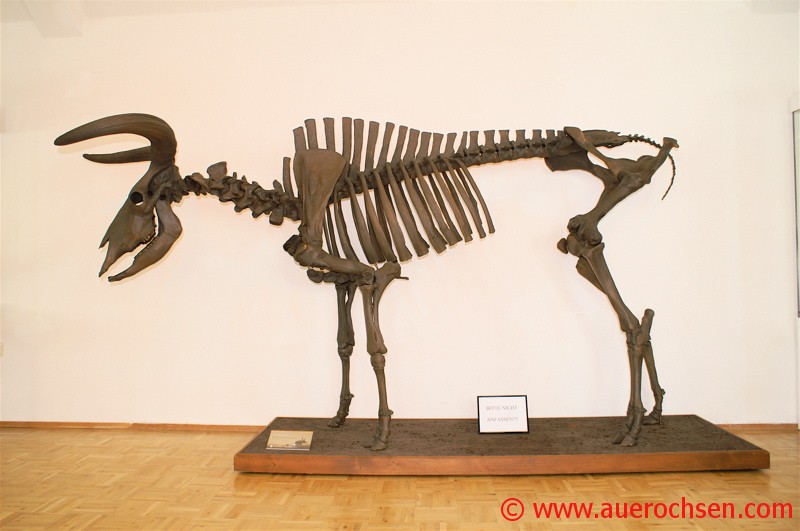
Late Holocene aurochs were smaller than Pleistocene and Early Holocene aurochs. Some authors assumed a dramatic size decrease so that the last aurochs were merely as large as domestic cattle [1]. This is certainly incorrect. There is no evidence for aurochs bulls considerably below a withers height of 160 cm. The shortest withers height for a male aurochs described in the literature is 154 cm [2]. Considering the fact that soft tissue and hooves would add to the height in the living specimen, it might have been 159 to 165 cm tall in life. There are several Holocene aurochs specimen that exceeded a height of 170 and 180 cm in bulls and reach 165 cm in cows [2], and also historic reports from the 16th century describe the aurochs as “much larger than cattle” (Schneeberger) or “huge” (Swiecicki) [3]. Van Vuure (2005) summed up all credible references for aurochs size and concluded that Holocene bulls were 160 to 180 cm tall at the withers, and cows 150 cm, and Pleistocene specimen were on average 10 cm taller [3].
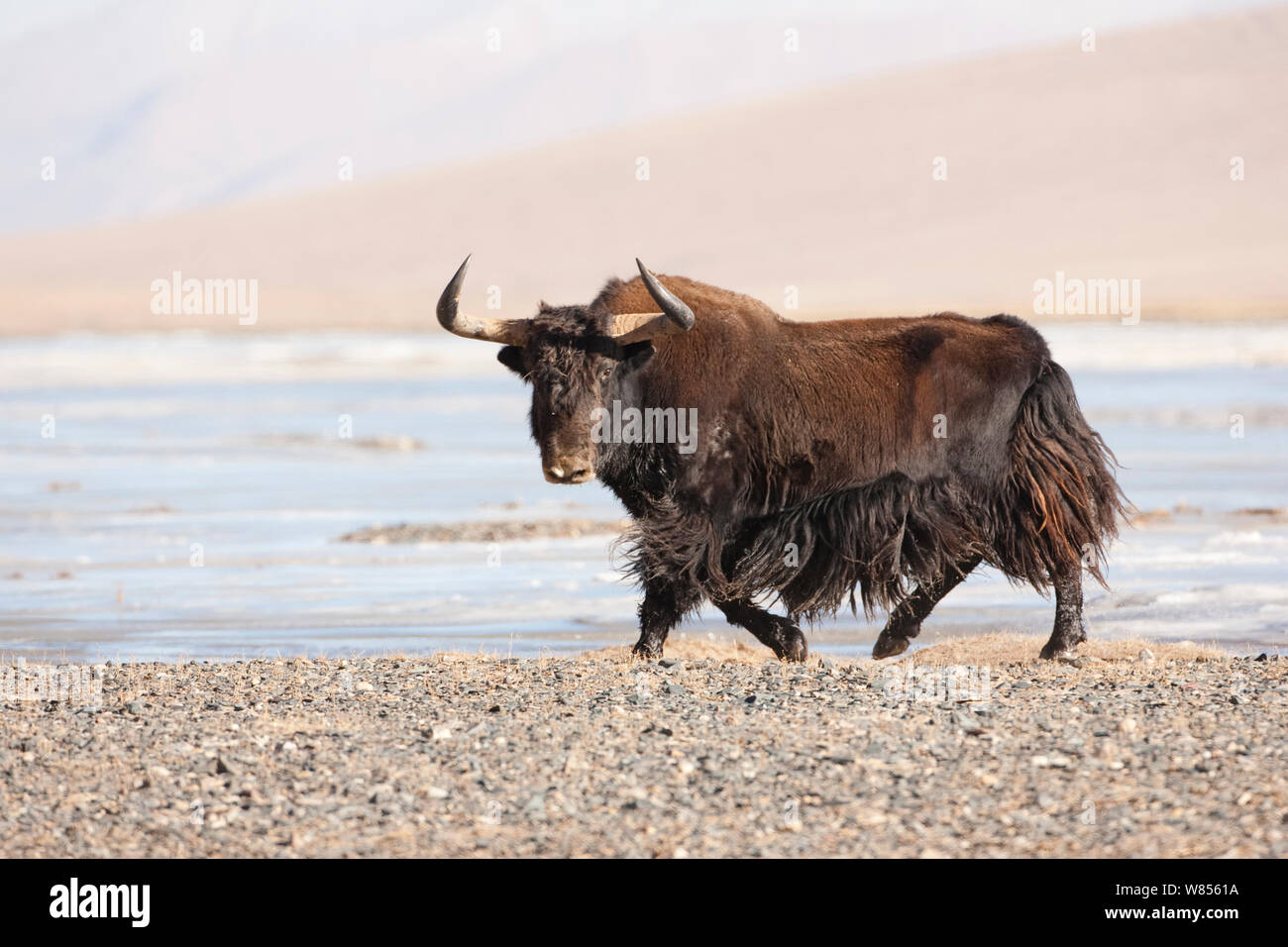
Nevertheless, aurochs got smaller during the Holocene. Pleistocene remains suggest aurochs of a very large size, such as the oldest aurochs skull found or a huge skull with a length of 91,2 cm [4], which suggests a specimen that easily surpassed 200 cm withers height (sounds huge, but some wild yaks also reach 205 cm). The Prejlerup bull skeleton from Denmark from the early Holocene reaches 190 cm withers height, what means that in life the bull probably was between 195 to 200 cm tall. That means that early Holocene northern European aurochs at least occasionally reached heights this large. Later finds do not reach this size anymore.
How large the last aurochs at Jaktorow were is unknown, since there is no height data for them. But Schneeberger mentioned that they were still much larger than domestic cattle.
The decrease in horn size
Pleistocene aurochs not rarely had huge horns. The earliest aurochs skull found has horn cores of a length of 112 cm (external length of the horn core) [5]. In the living animal, the horn sheath would add to the length, a few centimetres at least, a few decimetres maximum. A Pleistocene skull from Germany has a horn core length of 92 cm, another skull from Italy a horn core length of 120 [4]. Again, the sheath would have added to the horn length. Holocene bulls still had occasionally large horns, such as the Sassenberg specimen, but smaller-horned bulls began to appear, such as the Prejlerup, Himmelev or Önnarp specimen.
The horn of the last reported aurochs bull which died in 1620, however, is rather meagre in comparison. It measures only 46 cm, is slim and not as curved as earlier horn sheaths. The age of the bull is not recorded, so that it could have been not fully grown at the time of its death, but to me it looks like a fully grown horn (horns that are not fully grown yet often look a bit compressed in length, while that horn is very slim and stretched).
So the horns diminished from lengths of possibly 1,5 metres maximum to not even half a metre at the very end of its existence.
So it seems that the very last aurochs from the 16th and 17th century were much less impressive than Pleistocene and early Holocene specimen. They were smaller, and their horns not even nearly as huge. It is not unlikely that the trend would have continued till today, so should “breeding-back” focus on the less impressive aurochs, since the aurochs of today would not be 2 metres tall with one meter long horns but much smaller and with comparably meagre horns? Well, let’s have a look at the reasons for why the aurochs got less impressive in historical times.
The reasons for the decrease of body and horn size
When animals change in body size, climatic changes are often the first explanation that comes to mind. The controversial Bergmann’s rule proposes that animals in colder regions are larger than those of warmer regions, because the surface to mass ratio allows larger animals to preserve energy easier than smaller animals. However, the Bergmann’s rule is not undisputed, there are as many examples against this “rule” as there are in favour of it [6]. Nevertheless, the Pleistocene was colder than the Holocene, so maybe this (assuming the Bergmann’s rule is correct) is the reason why Pleistocene aurochs were that large. However, this is not a valid argument, because the distribution of the aurochs changed with the climate. During the cold glacials, the aurochs retreated to the south and was mainly found in Southern Europe and North Africa. Large aurochs were found there, f.e. the large-horned large skull of the oldest aurochs found so far is from Tunisia. Pleistocene Tunisia probably was not colder than Holocene Denmark, for example. Also, climate cannot explain why the size of the aurochs’ horns decreased.
EDIT: I did not address the role of predators enough. The aurochs evolved under the pressure of predators such as big cats and hyenas in the Pleistocene. These predators died out in Europe at the end of the Pleistocene. It is thus tempting to assume that the lack of large predators that could take down adult aurochs was a factor in the decrease of body and horn size. However, aurochs in North Africa and India were smaller than those of Northern Europe, despite being preyed on by big cats in these ecosystems. Thus it is not likely that the lack of big cats and hyenas was an important factor in the size decrease of the European aurochs.
If climate did not cause the decrease of the aurochs’ body and horn size, it is important to look at other factors that might have influenced a large European herbivore in the last 10.000 years. These factors are caused by man: habitat limitation and hunting.
It is likely that hunting might have negatively influenced the horn size of the aurochs. Julius Caesar mentions in De bello gallico that the Germanic people hunted aurochs for their horns. Probably trophy hunting was not restricted to ancient Germanic people. Aurochs horns were often used as ornament or drinking horns for the nobility. The larger the horns, the more impressive the trophy. Therefore, it is possible that large-horned aurochs were hunted more intensely than smaller-horned aurochs. It is also known that trophy hunting has lead to a considerable size decrease of the size of tusks of African elephants [7]. The so-called “great tuskers” have become rare, and the portion of tuskless African elephants has increased significantly.
Habitat limitation also very likely influenced the body size and horn size of aurochs. The habitat of the aurochs was increasingly replaced by agricultural fields and pastures for domestic cattle. The aurochs had less space to live the more the human population grew. The habitat of the aurochs was lessened and fragmented. This leads to the island effect: large species shrink in size because less space and food is available, what increases the evolutionary fitness of smaller individuals. Go here for my post on the aurochs and insular dwarfism. Aurochs were pushed into hideaway regions which were not ideal for the species. Also, the lack of space for the aurochs to thrive might have further increased the reduction of horn size. Growing horns costs energy and minerals, and while horns certainly have a fitness advantage, on a confined space were food and minerals are scarce, smaller horns are more economic than large horns.
Another factor that might have influenced the genetic structure of the aurochs that should not be forgotten is hybridization with domestic cattle. As the habitat for the aurochs became increasingly limited by pastures for cattle and horses, the wild bovine and its domesticated descendants lived side by side. Recently it has been found that the last aurochs bull had a domestic mitochondrial haplotype, what shows that there was maternal introgression from domestic cows into the last aurochs population [8]. Seemingly, domestic cows either escaped or were stolen from the pastures by wild aurochs bulls, and reproduced with aurochs in the wild. This might have contributed to a decrease of body and horn size, and could have also influenced the horn curvature (what might explain why the horn of the last bull is only weakly curved).
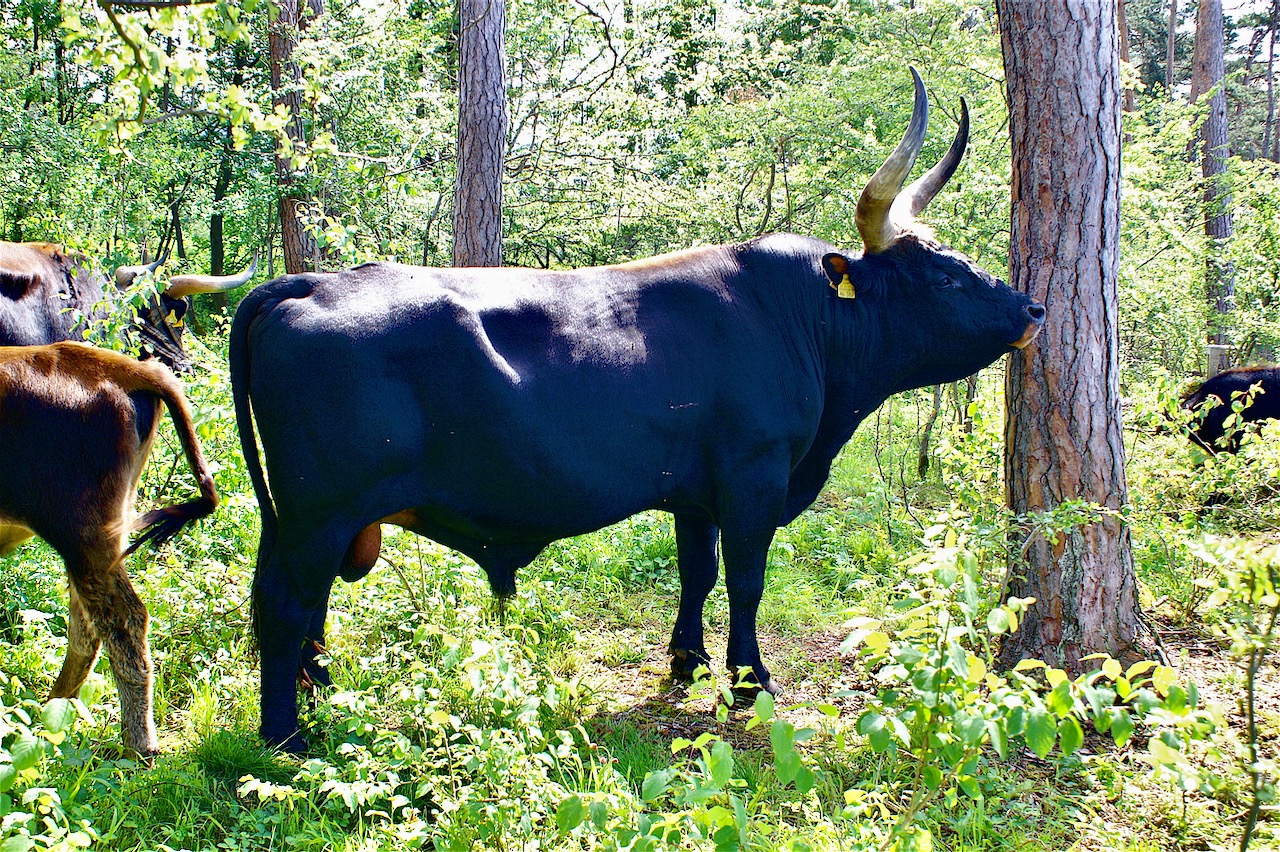
To sum it up, trophy hunting as well as habitat limitation and hybridisation with domestic cattle likely are the cause for the aurochs becoming less impressive, i.e. smaller and with only comparably meagre horns. As to the question on which type of aurochs “breeding-back” should focus, the answer is clear to me: “breeding-back” wants to mimic the extinct ancestor of domestic cattle in its original form as it would exist today if it had not been for human influence. Hunting, habitat limitation and hybridisation with cattle are clearly anthropogenic factors. Without human influence, the aurochs probably would not have changed that much during the 9.000 years since the Prejlerup aurochs died, just as the difference between an aurochs from 100.000 years and one from 110.000 years ago would not have been dramatic if even noticeable in the morphology that is accessible to us. Therefore, I think it is definitely legitimate if “breeding-back” aims for 1,9 or even 2 metre tall cattle with 1,2 meter long or larger horns (if that goal is achievable with domestic cattle only is another story). The size goal for the bulls in the Auerrind project, for example, is 170 to 180 cm as Claus Kropp stated on Facebook, and that is perfectly in line with the evidence.
Literature
[1] Poettinger, J.: Vergleichende Studie zur Haltung und zum Verhalten des Wisents und des Heckrinds. 2011.
[2] Rene Kysely: Aurochs and potential crossbreeding with domestic cattle in Central Europe in the Eneolithic period: A metric analysis of bones from the archaeological site of Kutna Hora-Denemark (Czech Republic). 2008.
[3] van Vuure: Retracing the aurochs – history, morphology and ecology of an extinct wild ox. 2005.
[4] Frisch: Der Auerochs – Das Europäische Rind. 2010.
[5] Martinez-Navarro et al.: The early middle Pleistocene archaeopaleontological site of Wadi Sarrat (Tunisia) and the earliest record of Bos primigenius. 2014.
[6] Wright: The history of the European aurochs (Bos primigenius) from the Middle Pleisotcene to its extinction: an archaeological investigation of ist evolution, morphological variability and response to human exploitation. 2013.
[7] Nowak et al.: Trophy hunting: bans create opening for change. 2019.
[8] Bro-Jorgensen et al.: Ancient DNA analysis of Scandinavian medieval drinking horns and the horn of the last aurochs bull. 2018.