Friday, 6 September 2013

Why doing breeding-back at all?


While my previous posts here focused on the breeding-back projects in general and primitive, suited domestic breeds of cattle and horses in detail, one might ask the question: why doing, or even trying, breeding back at all?

First of all, the loss of every species because of man is tragic. Therefore conservation tries to reduce destructive human influence to a minimum, and thereby preserves and reintroduces endangered species. The Przewalski’s horse, Wisent, Mauritius hawk, the Oryxes or the Milu have been saved in the last second, and big cats and other large game are being reintroduced in areas in which they have been extirpated. It is obvious that it is a very important, if not the goal of zoological conservation to preserve or reintroduce endangered species in their natural habitat, because they belong there and fill a niche in their ecosystem.
The Aurochs, the Tarpan and the Quagga are animals just like these I mentioned above. They have been extirpated by habitat destruction and excessive hunting only centuries ago, but had been integral parts of their respective ecosystems for millennia. Without anthropogenic influence these species still would be around in the wild, and probably in more or less high numbers. The only difference between those animals which are in the focus of modern conservation programmes is that they are already lost. But breeding-back or effigy breeding is a way to create adequate substitutes for these animals in the wild that are also satisfying for interested people; effigy breeding, in my opinion, can be seen as a tool for conservation instead of merely something for fanciers.
The Plains Zebra once was very common in South Africa in form of the Quagga. Regardless of the validity of the megaherbivore hypothesis*, Europe was home to several species of large herbivores. Three of these species are still left (Wisent, Elk, Red deer), and it’s my heart’s desire that these will roam the wilderness on most of the continent again. But these three species are more browsers than grazers (with the exception of the wisent, which seems to be a semi-intermediary grazer [1][2]), so the grazing niche is virtually vacant without wild cattle and horses. We know that Bos primigenius and Equus ferus were present in Europe during the Holocene, and the former was a particularly common animal. Reintroducing them is just as legitimate as reintroducing wisents and elk, although their wild type is lost.

* The controversial megaherbivore hypothesis suggests that large herbivores play a more or less important role in shaping their environment by feeding.

Regardless of the merely nomenclatorial issue if you consider domestic animals as part of the species they derived from or not, domestic cattle and horses very likely are ecologically and behaviourial very similar, if not identical, to their wild types. But certainly not all breeds of these two animals would do well in the wild or present an authentic picture, and that’s where breeding-back comes in.

One way to create a substitute for the aurochs is to choose a number of suitable, hardy landraces for a specific region and to release them and build up a feral population. Natural selection would start to work on this population and certainly you can expect to see phenotypic and behavioural changes after some time. The population would get increasingly adapted to their habitat, but as several examples of feral cattle show, they do not necessarily resemble the aurochs in all known features, and it would take natural selection a very long time to create a homogenous strain of cattle that looks like a genuine wild bovine instead of a bunch of feral domestic animals that is considered a pest in other regions of the world (see Amsterdam Island). Furthermore, it would be much easier to communicate deaths of wild-looking cattle and horses to the public (“they are wild animals, that’s what happens in nature”) than explaining why conservation watches cute dairy cows or ponies starving during winter. Imagine the public outcry to a photo of wolves hunting down an adorable Shetland pony!
Moreover, ancient-looking cattle and horses, or Plains zebras at least resembling the Quagga, are probably more satisfying for zoologists and visitors, who both want to get an authentic impression of what wilderness was like before man started to diminish it. In my opinion, people and nature deserve authenticity. And if there are authentic and very hardy breeds suited to live in the wild, why choosing any other breed for rewilding?
In the case of the Quagga, it is even easier to argue in favour of the selective breeding project. It is not a novelty that a different subspecies is reintroduced into the area where another subspecies has been exterminated earlier, and in this case the Rau zebras are clearly more desirable than “usual” Burchell’s zebras.  

Another reason why breeding back is not pointless is it’s value for zoological education. This was one of the reasons why the Heck brothers started their aurochs experiment and is probably still valid today. Thanks to breeding-back, the aurochs escaped oblivion; people learn about its existence at zoos and several books (it is even listed in an English guide to British mammals), and the constant confusion with the wisent is now quite rare in the German language at least. Effigy breeding, if executed carefully and with the necessary background knowledge, can deliver a good impression of what these extinct animals looked like. They also serve as a reminder against the careless destruction of nature and persecution of species, because it always has to be made clear that an actual return of extinct animals is impossible without having enough viable genetic material of it left and therefore we should take care of the species that are left.

Some people may be sceptical because they think breeding-back or effigy breeding tries to revive an “ancient beast” from lost worlds that has no place in modern times. But this is clearly a wrong impression. As I explained above, effigy breeding focuses on animals that have been wiped out by man and would be still around today without hunting and habitat destruction.
The argument that breeding-back results compete with existing, endangered species also can be discarded because they all occupy different ecologic niches. For example, the aurochs tended to inhabit lower and wetter regions than the wisent did and grasses probably made up a higher percentage of their food than in the wisent. Oostvaardersplassen, for example, would be much to wet to be suitable for the wisent. It must be clear, though, that the conservation of still existing species is clearly more important and must be priority; at least in my opinion.

Literature

[1] van Vuure, Cis: Retracing the Aurochs - History, Morphology and Ecology of an extinct wild Ox. 2005.
[2] Julia Pöttinger: Vergleichende Studie zur Haltung und zum Verhalten des Wisents und des Heckrinds. 2011. 

Wednesday, 4 September 2013

C. H. Smith's description of the Tarpan


Charles Hamilton Smith (1776-1859), an English artist and naturalist, delivered one of the most important and extensive descriptions of the wild horses inhabiting the Russian steppe during the 19th century. He also is the artist of the famous “Augsburg Aurochs”.
In The Natural History of horses, with Memoir of Gesner, published in 1841, Smith describes not only the appearance, but also social behaviour and seasonal migrations of the animals considered to be Tarpans. He also distinguishes between pure Tarpans and mixed feral domestic herds. He apparently obtained his information from local people and soldiers, and also argues against other naturalists saying that all free-roaming horses of western Eurasia are feral and not wild. Moreover, Smith also mentions wild or feral horses in western Europe that seem to be largely similar to those of the steppes. Down below you find the most interesting passages on the Tarpan which I typed from the digitalized version of his work on google, from page 148 to 166:

But doubts may be entertained respecting the real source of the wild horses roaming of the Ukraine, in Europe, eastwards to the northern extremity of Chinese Tahtary: those about the Don, it is asserted, are sprung from domesticated animals sent to grass during the siege of Azof in 1696 (or, as in other authorities, 1657), which could not again be entirely recaptured. Forster was disposed to consider all the wild horses in Asia descendants from strayed animals belonging to the inhabitants; and Pallas, who had likewise travelled in Asiatic Russia, inclined to the same conclusions. He thought the horses from the Volga to the Oural the progeny of domestic animals; and again, that all from the Jaik and Don, and in Bokhara, where of the Kalmuck and Kurguise breed, remarking, that they are mostly fulvous, rufous and Isabella; while, on the Volga, he noticed them as usually brown, dark brown, silver-gray, some having white legs and other signs of intermixture. […] Now, if we examine the extent of the travellers’ own immediate means of judgment, we find that they have occasionally seen troops of wild Equidae at a distance, and been enabled to give one drawing of a living colt recently captured, besides two or three more species from living specimens or stuffed skins: surely a sweeping conclusion upon such scanty data may be convenient, but is scarcely deserving of acquiescence; particularly when we take into account, that, including the collected opinions of those upon the spot, in themselves only of conditional value, the field of obervation explored is scarcely a hundredth part of the surface whereon this zoological problem must be decided. The Russian dominions extend over most level part only: four chains, at least, of enormous mountains, whose direction is even in a measure unknown occur within the great basin of the Thiachan, the Little Altai, the Himalaya mountains, and Hindukoh; and opon them there are table lands of more than 16,000 feet in elevation, not as yet traversed by a European foot, though known to be stocked with wild horses and other animals. […] Over the whole extent of this almost boundless surface several species of Equidae are noticed, and shall we assume that these also are feral descendants of stray animals at the siege of Azof, though neither Forster nor Pallas advanced such an opinion? Surely no: nor can we deny that in the south-eastern mountain frontier of Russia, upon the inclinded plains restingagainst the chain, the original wild Equus caballus is still found; and that in the other regions of the empire stretching westward, they are likewise of the wild stock, but more and more adulterated with domestic races as they approach towards Europe, or have been long peopled by fixed residents.
Even in the south-western steppes to the Ukraine, there have been wild horses, as is attested by the earliest historians, poets and geographers […] and if the horses on the banks of the Don are of feral or of mixed blood, their origin and contamination is surely much older than the siege of Azof. Even at that period, there were still wild horses kept in the parks of Eastern Europe, like other game, for the service of the tables of the great. To admit, therefore, the conclusion, that all the wild horses of the old continent are descended from animals at some period under the dominion of man, appears a gratuitous assumption resting upon no proof, and in opposition to historical records from the time of Herodotus to our own age: it would imply the absorption into domesticity of the whole species, or of several species, in regions where such abounded wildernesses exist, in several parts still maintaining a parent stock of other domestic animals: or involve the total destruction of the original wild horses upon this immeasurable surface, where man subsequently could not prevent their again multiplying to uncountable numbers; while in Europe, the most peopled part of the old world, there were still in existence wild individuals of a race never reclaimed. […]
Now, with regard to wild horses, in the relations of the ancients and in the travels of modern writers, though we have reason occasionally to suspect they mistake the onager and the hemionus for real horses, their still remains sufficient authority for their presence in a state of nature, under one or other of their primaeval forms, as far as the south and west of Europe and their characteristics assuming the same preference for opposite habitations in plains or in woody mountains which we now perceive to be a leading distinction of the zebra and the Dauw; traits of character the more important, as they indicate a different mode of living a choice of plants, not alike both, - adissimilar temperament; and when coupled with different proportions and position of the ears, an arched or plane forhead, a straight or curved nose, a difference of colour in the eyes, of the skin, of the hoofs, the constancy of their liveries, of their marks, in a streak along the back and bars on the limbs, of dappled croups and shoulders, or of dark uniform colours, dense or thin manes and tails, although traits now mixed, feeble and evanescent, they appear to be indications of original difference of forms sufficient to be distinct though osculating species, or at least of races separated at so remote a period that they may claim to have been divided from the earliest times of our present zoology.
Wild horses, by Oppian denominated hippagri and by Pliny equiferi, are the first mentioned by Herodotus as being of a white colour and inhabiting Scythia, about the river Hypanis or Bog, he notices others in Thrace, beyond the Danube, distinguished by a long fur. Aristotle (de Mirab) indicates them in Syria, but with manners that seem to refer them to hemionus or onager. Oppian places his hippagrus in Ethiopia, and denies the presence of wild horses in Syria; an opinion entitled to credit from his local knowledge and his description of the onager, which shows that he was acquainted with both. […]
In Varro, we find that there were wild horses in Spain; the ancients generally admit their existence in Saridina and Corsica; dapper places others in Cyprus; Strabo, in the Alps; and we know that they existed in the British islands. All seem to refer to a sturdy form of mountain-forest ponies, still found in the province of Cordova, in the Pyrenees, the Vogesian range, the Camargue, the Ardennes, Great Britain, and in the Scandinavian highlands: all remarkable for an intelligent but malicious character, broad forheads, strong lower jaws, heavy manes, great forelocks, long bushy tails, robust bodies, and strong limbs; with a livery in general pale dun, yellowish brown and a streack along the spine and cross bars on the limbs, or the limbs entirely black, as well as all the long hair and mostly havng a tendency to achy and gray, often dappled on the quarter and shoulders. They prefer the cover, delight in rocky situations, are dainty in picking their food, do mischief in plantations and their cunning, artifice, and endurance is far greater of that of large horses. From many circumstances, this form of Equus may be deemed indigenous in North-western Europe, and aborigine distinct from the large black race of Northern Gaul, which once ranged wild in the marshy forests of the Netherlands, and was so fears that it was held to be untameable. It was a gaunt, ugly animal, with a large head and bristly mouth, small, pale, often blue eyes, a haggard and abundand mane and tail, which according to Cardanus, when rubbed in the night, emitted sparks of fire; the hips were high, the legs nodose, and the feet broad, flat and hidden in an immense quantity of long bristly hairs about the fetlocks: this form of horse may have extended northward as far as the Hartz […]. It may, indeed, have been a feral branch, only in part wild, and introduced with the first Gallo-Belgic colony that ascended the Danube, […].
But the ancients all agree in their statements concerning wild horses of the north-east of Europe residing, according to their narratives, from Pontus northward into regions unknown to their geography; some we have seen are described as white, and having the hair five or six inches long, characters we find verified at present in Asiatic Russia and in the wild horses of the Pamere table land. In the woods and plains of Poland and Prussia there were wild horses to a late period. Beauplan asserts their existence in the Ukraine, and Erasmus Stella, in his work “De Origine Borussorum”, speaks of the wild horses of Prussia as unnoticed by Greek and Latin authors. “They are”, he writes, “in form nearly like the domestic species, but with soft backs, unfit to be ridden, shy and difficult to capture, but very good venison.” These horses are evidently again referred to by Andr. Schneebergius, who states, that “there were wild horses in the preserves of the prince of Prussia, resembling the domestic, but mouse-coloured, with a dark streak on the spine, and the mane and tail dark; they were not greatly alarmed at the sight of human beings, but inexpressibly violent if any person attempted to mount them. They were reserved for the table like other game.” It may be that in both the above extracts the hemionus or the onager is presumed to be depicted, but the difference of mane and tail is so obvious, that such an objection cannot be entertained; and should it be said that these were merely feral horses, it might be asked in return, what a true wild species must be like to satisfy the dissentient. In our view, this form of horse is the original eelback dun of the west, and allied to the common Median horse of antiquity; the parent, by gradual subjugation and intermixture, of the mouse-coloured and sorrels still common in Lithuania; and particularly those breeds that, with the black streak along the back, have cross bars on the joints, and a black mane, tail, and fetlocks [Footnote: Rzonozynski compares the Polish wild horses (Kondziki) in size to the Samogitian (Zmudzineks), mostly with tan or mouse-colored liveries; but there being other furs, attests they were mixed in his time. He describes the manners of the stallions, and admits that they can be trained, which, indeed, is equally true of the zebra and quagga. He relates their extension over the Ukraine, and gradual decrease]. These were the wild and feral horses of Europe, as far as Bessarabia, from the earliest era to the close of the seventeenth century; and from the facts recorded, we may with some confidence conclude, that farther east, where Europe displays an Asiatic character, becoming more and more, as we adcance in that direction, wild and uncultivable, that the appearance of the wild animals, particularly the horses, have retained their original nature more and more purely as we reced from the haunts of civilization, showing marks of degeneracy only where the old human migrations have passed, but leaving the typical characters everywhere perceptible. This is the cause of which induced authors to derive all the wild horses of Asia from the stray troop-horses at the siege of Azof, then, be it observed, already geldings, yet made to replenish the steppe with a species constantly noticed before and since as abundant in a wild state in the same regions! Within these few years, Moorcroft and the brothers Gerrard, when they penetrated into Independents Tahtary and within the borders of China, met with numerous herds of wild horses, scouring along the table lands, sixteen thousand feet above the sea, and express not the least in of their having been domesticated at any period.
Whatever may be the lucubrations of naturalists in their cabinets, it does not appear that the Tahtar or even the Cossack nations have any doubt upon the subject, for they assert that they can distinguish a feral breed from the wild by many tokens; and naming the former Takja and Muzin, denominate the real wild horse Tarpan and Tarpani. We have had some opportunity of making personal inquiries on wild horses among a considerable number of Cossacks of different parts of Russia, and among Bashkirs, Kirguise, and Kalmucks, and with a sufficient recollection of the statements of Pallas, and Buffon’s information obtained from M. Sanchez, to direct the questions to most of the points at issue. From the answers of Russian officers of this irregular cavalry, who spoke French or German, we drew the general conclusion of their decided belief in a true wild and untamable species of horse, and in herds that were of mixed origin. Those most aquainted with a nomad life, and in particular and orderly Cossacck attached to a Tahtar chief as Russian interpreter, furnished us with the substance of the following notice.
“The Tarpany form herds of several hundreds, subdivided into smaller troops, each headed by a stallion; they are not found unmixed, excepting towards the borders of China; they prefer wide, open, elevated steppes, and always proceed in lines or files, usually with the head to windward, moving slowly forward while grazing,  the stallions leading and occasionally going round their own troop; young stallions are often at some distance, and single, because they are expelled by the older until they can form a troop of young mares of their own; their heads are seldom observed to be down for any length of time; they utter now and then a kind of snort, with a long neigh, somewhat like a horse expecting its oats, but yet distinguishable by the voice from any domestic species, excepting the woolly Kalmuck breed: they have a remarkable piercing sight; the point of a Cossack spear, at a great distance on the horizon, seen behind a bush, being sufficient to make a whole troop halt: but this is not a token of alarm, it soon resumes its march, till some young stallion on the skirts begins to blow with his nostrils, moves his ears in all directions with rapidity, and trots or scampers forward to reconnoitre, bearing the head very high and the tail out: if his curiosity is satisfied, he stops and begins to graze; but if he takes alarm, he flings up his croup, turns around, and with a peculiarly shrill neighing, warns the herd, which immediately turns round and gallops off at an amazing rate, with the stallions in the rear, stopping and locking back repeatedly, while the mares and foals disappear as if by enchantment, because with unerring tact they select the first swell of ground or ravine to conceal them until they reappear at a great distance, generally in a direction to preserve the lee side of the apprehended danger. Although bears and wolves occasionally prowl after a herd, they will not venture to attack it, for the sultan-stallion will instantly meet the enemy,  and, rising on his haunches, strike him down with the fore feet; and should he be worsted, which is seldom the case, another stallion becomes the champion: and in the case of a troop of wolves, the herd forms a close mass, with the foals within, and the stallions charge in a body, which no troop of wolves will venture to encounter. Carnivora, therefore, must be contended with aged or injured stragglers.
“The sultan-stallion” is not, however, suffered to retain the chief authority for more than one season, without opposition from others, rising in the confidence of youthful strength, to try by battle whether the leadership not be confided to them, and the defeated party is driven from the herd in exile.
“These animals are found in the greatest purity on the Karakoum, south of the lake of Aral, and the Syrdaria, near Kusneh, and on the banks of the river Tom, in the territory of the Kalkas, the Mongolian deserts, and the solitudes of the Gobi: within the Russian frontier, there are, however, some adultered herds in the vicinity of the fixed settlements, distinguishable by the variety of their colours and a selection of residence less remote from their human habitations.
Real Tarpans are not larger than ordinary mules, their colour variably tan, Isabella or mouse, being all shades of the same livery, and only varying in depth by the growth or decrease of a whitish surcoath, longer than the hair, increasing from midsummer and shedding in May: during the cold season it is long, heavy, and soft, lying so close as to feel like a bear’s fur, and then is entirely grizzled; in a summer much falls away, leaving only a certain quantity on the back and loins: the head is small, the forehead greatly arched, the ears far back, either long or short, the eyes small and malignant, the chin and muzzle beset with bristles, the neck rather thin, crested with a thick rugged mane, which, like the tail, is black, also the pasterns, which are long: the hoofs are narrow, high and rather pointed; the tail, descending only to the hocks, is furnished with coarse and rather curly or wavy hairs close up to the crupper; the croup as high as the withers: the voice of the Tarpan is loud, and shriller than that of a domestic horse; and their action, standing, and general appearance, resembles somewhat that of vicious mules.”
The feral horses, we were told, form likewise in herds, but have no regular order of proceeding: they take to flight more indiscriminately, and were simply called Muzin. They may be known by their disorderly mode of feeding, their desire to entice domestic horses to join them, by their colours being browner, sometimes having white legs, and being often silvery gray: their heads are larger and the neck shorter; but their winter coat is nearly as heavy as that of the wild, and there is always a number of certain expelled Tarpan stallions among them, but they are more in search of cover and of watery places, and the wild herds being less in want of drink and more unwilling to encounter water, being even said not to be able to swim; while the Muzin will cross considerable rivers. During winter, both resort to elevated ground were the winds have swept away the snow, or dig with their fore feet and break the ice to get at their food.
Their olfactory sense, though not delicate in distinguishing enemies at great distances, is remarkable for judging the nature of swamps, which they often traverse, particularly the south of the Lake Aral: when thus entangled at fault, their scent indicates the passable places, and the snorting of the first that finds one is immediately observed and followed by the others.
The genuine wild species is migratory, proceeding northward in summer to a considerable distance, and returning early in autumn. The mixed races wander rather in the direction of the pastures than to a point of the compass; nearer Europe, they haunt the vicinity of cultivation, and attack the hay-stacks which the farmers make at a distance in the open country. Though in many respects they have similar manners, they want the instinct of the wild: upon being taken young, after severe resistance, they submit to slavery. The Tarpans always die of ennui in a short time, if they do not break their own necks in resisting the will of man: they are moreover, said to attack and destroy domestic horses: they rise on their haunches in fighting, and bite furiously; while the mixed races, though ready to bite, are more willing to strike out with their hind feed, and neither have ever been remarked lying down. In these particulars, the younger Gmelin, who likewise travelled in Eastern Russia, corroborates our account, and he does not appear to have come to the same conclsions as Forster or Pallas; we may therefore infer, from what is here stated, that the foal observed by the last mentioned outhor, when he was on the Samara, opposite Sorothinska, caught at Toskair Krepost, was of the mixed race, or not sufficiently grown to furnish a satisfactory representation.

Everyone is free to interpret it himself, but to me it clearly shows that the Tarpan, also in the steppes, was not a mere Konik-counterpart. His description suggests that the colour was predominantly some kind of bay dun, with some individuals perhaps being black dun, which is accordant to the genetic evidence. The attribute of being mule-like overall seems to confirm that the Tarpan was much like the Przewalski’s horse in appearance (except the apparently falling mane), and thus also resembling certain primitive horse breeds. Here you have Smith’s artistic interpretation of the Tarpans of the steppe:

C. H. Smith's artistic interpretation of the Tarpan (public domain)

Friday, 30 August 2013

How big was the Aurochs really?


Size is one of the most important biological aspects of an organism. Therefore, an accurate substitute for the aurochs should also match the bodily dimensions of wild aurochs, apart from all the other features. In the past a lot of over- and underestimations on the true size of the aurochs have been made, so let’s have a look at how large the aurochs really was, and in which way its size was variable. Note that when I speak of size, I refer to the height at the withers and not the weight.

In the past the size of the aurochs has been broadly exaggerated, some authors suggested huge heights such as 230 cm at the shoulders, which lack supporting skeletal data and therefore are baseless. Also the hypothesis of an alleged “dwarf aurochs” on the mainland has been discarded long ago, since it was based on a misinterpretation of the large size difference between female and male aurochs [1]. On Sicily, however, aurochs which became isolated because of the rising sea level after the Pleistocene seemingly were 20% smaller than on the mainland [1].

Since no living aurochs were measured by contemporaneous people, we can only rely on skeletal remains for reconstructing the average size. Using single elements to extrapolate the withers height of the living animal can be problematic (usually the metapodials are used for this purpose), but the humerus was shown to be a somewhat useful tool for this [1]. Without doubt, near-complete, articulated skeletons are the best way to infer the shoulder height of the living animal, but there also are several problems that I’ll discuss later on.  

The data provided by various authors concerning the size of aurochs specimen are very variable, also depending on the respective period and region of the skeletal material. Especially the data given for bulls is very diverse, ranging from 145 cm to 200 cm [1]. Cis van Vuure summed up all credible measurements of aurochs shoulder heights and concluded that the average for Holocene aurochs bulls was 160-180 cm and cows 150 cm. The Indian aurochs seemingly was smaller than the Eurasian subspecies, and Eurasian aurochs during the Pleistocene were larger on average [1]. This size certainly makes the aurochs an impressive animal and significantly larger than domestic cattle, but related members of Bos and Bison are of a similar size.
Some authors suggested a dramatic and continuous size drop during the Holocene, making the last existing aurochs about the size of domestic cattle [2]. It seems, however, that the difference between Pleistocene and Holocene aurochs has been exaggerated, mostly because the Pleistocene specimen show considerably larger horns on average. Cis van Vuure estimates that the size difference between Pleistocene and Holocene aurochs might have been about 10 cm in both sexes on average, and indeed there are several Holocene aurochs specimen that exceeded a height of 170 and 180 cm [5]. In my opinion, a slight size decrease for Holocene primigenius members is plausible nevertheless, because of the absence of hyenas and big cats in Europe, what also offers an explanation why the horn size got reduced (the same trend is visible in American bison and their ancestors). However, we should not forget that aurochs belonging to other subspecies still shared their habitat with these predators in North Africa and India during the Holocene. In my opinion, the shift to a warmer climate at the beginning of the Holocene probably was not relevant for the observed size decrease, because the aurochs’ range retreated southwards during the glacials where the climate still suited the species, and spread northwards again when climate warmed again, so that the global climate change probably influenced only the occurrence of the species but did not force them to increase or decrease in size. Habitat disruption in historic times and hunting may have plaid a role [3]. But considering that the same also applied to the Wisent, which still measures about 180 cm at the withers in bulls, a dramatic drop in size for the historic aurochs seems unlikely to me and I don’t know of any data from actual bones of historic age supporting this. The claim that historic aurochs were just as big as modern domestic cattle seems definitely exaggerated to me, especially because historic references still describe the animal as being of impressive size and way taller than domestic cattle (even though cattle were smaller in previous millennia) [1]. Male specimens of a shoulder height not taller than 150 cm from historic times would be needed to verify this statement. 
Holocene southern aurochs remains usually show animals that are smaller than Northern aurochs specimens, what is accordant to Bergmann’s rule [1]. And interestingly, northern and southern Europe was seemingly inhabited by aurochs populations that were genetically distinct from each other. The Southern European aurochs belonged to the same genetic lineage as the near eastern populations, from which cattle were domesticated [4]. I suppose this lineage might have measured 150-160 cm at the shoulders in bulls, based on data [5] from Hungary. There are not many available measurements for the africanus subspecies, but it seemingly was as big as or a little smaller than the southern European aurochs [1].

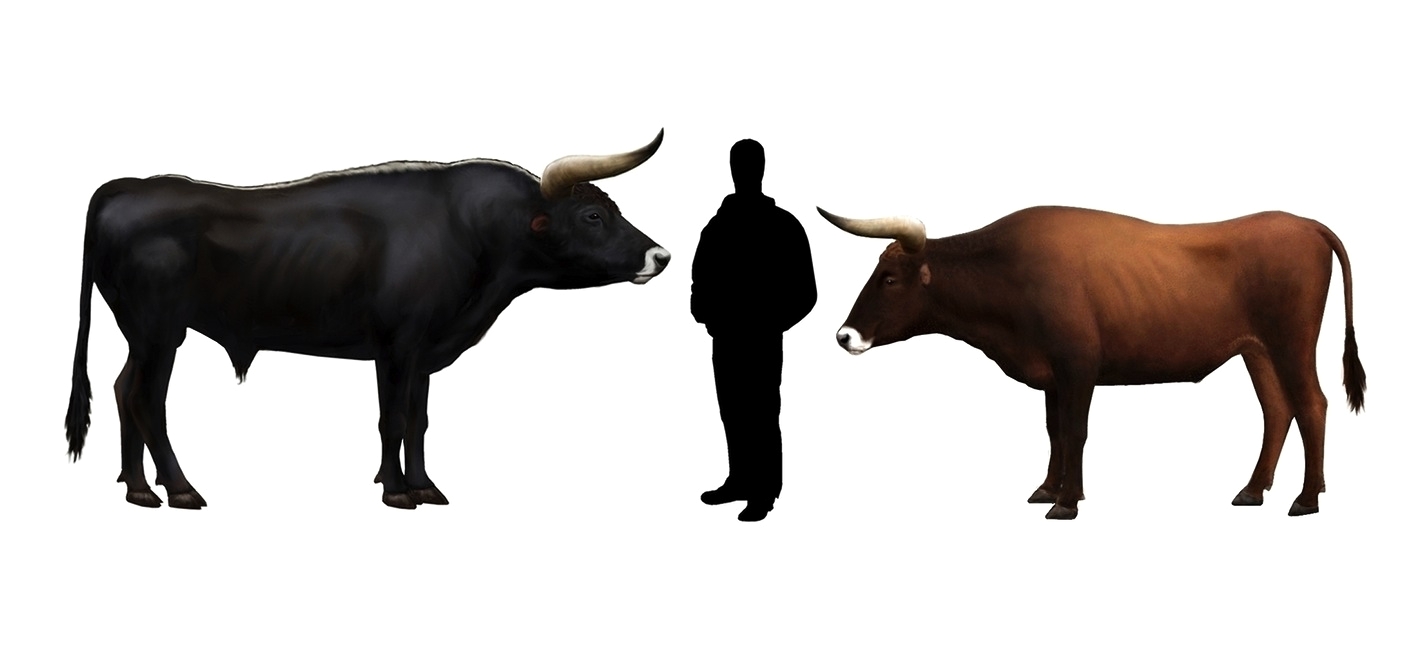
My reconstruction of the Lund bull and the Cambridge cow.
Bull and cow are shown with a shoulder height of 170 and 146 cm, respectively (Human=180 cm).
All rights reserved.
 

This is as far as the skeletal remains go. But the problem is, skeletons often are mounted incorrectly, with their limbs bent too much and/or their shoulder blade in a wrong position, resulting in the skeleton appearing smaller than it really was. I once took a photo of a mounted bull skeleton from Braunschweig, Germany, and corrected its posture on the photo via GIMP. The skeleton in a corrected stance turned out to be 5% taller than the incorrect mount – what would increase a size of, for example, 165 cm to 173.25 cm. This shows that shoulder heights given from mounted skeletons have to be viewed with caution. Furthermore, we should not forget that mounted skeletons lack the connective tissue between the bones and the skin and flesh surrounding them, as well as the hooves. So we can add 5-10 cm to the height data from mounted skeletons to approach the size of the animals in life.
Something that seemingly isn’t considered by most of the authors referring to the aurochs’ size is the fact that most likely not all aurochs remains stem from fully grown individuals. The age of the actual specimen can be indicated by tooth wear, cranial sutures or the epiphysal plate. It is well possible that the smaller bull remains with a reconstructed height of only 145 or 150 cm were subadult individuals, therefore the ontogenetic age of the specimen should also be taken into account.
Numerous references give information on the observed size difference between bull and cow within the respective sample. I am also a bit sceptical on that because only the skull and pelvis give clear information on the sex of the individual. And even the skulls can be ambiguous in some cases. For example, the Vig specimen has not very prominent eye sockets and also the horns are less thick, less inwards-curving and more upright than in usual bulls, yet it is tall overall and has tall neural spines in the shoulder area, and therefore likely was a bull. But again, Cis van Vuure’s estimate (see above) sounds plausible and is comparable to what is displayed by Gaurs and Bantengs.

All in all it seems that the aurochs was indeed variable in size. Pleistocene aurochs probably were larger on average than Holocene populations, but not as significantly as it has been proposed by some authors. The average size of the Holocene aurochs probably was around 170 cm height at the withers in bulls and 150 cm in cows, with northern aurochs populations being on the larger end of the bell curve and southern ones (including the subspecies namadicus and africanus) on the smaller end. This accords to the controversial Bergmann’s rule and is found a number of other large mammal species as well. The claim that historic aurochs were only as tall as domestic cattle very likely is an exaggeration, although habitat destruction and hunting perhaps led to another size decrease during the very end of their existence, what are certainly anthropogenic causes.

What does this tell us for breeding-back? Usual “un-improved” Heck cattle (which unfortunately often are promoted as a “rebred” aurochs, what is a blatantly wrong statement) are way too small to fit their ancestor, reaching only 140-145 cm on average. Although domestic cattle were derived from near eastern aurochs, which likely were somewhat smaller than Northern aurochs but still impressive and taller than domestic cattle, there are indeed some modern cattle breeds that exhibit the size of impressive European aurochs. Uncastrated Chianina bulls from Italy can reach up to 180 or more on occasion, and cows about 150 cm. The Maltese ox is a breed that seems to be about the same size. Large Maremmana bulls grow very tall as well, the largest bull I know of reached 182 cm, and the related Podolica and Boskarin are just as big. These tall and slender breeds surely give an impression of what an awesome animal the aurochs was. Some Holstein cattle grow big as well, but this breed is very derived overall.
So, using these very large and more or less primitive breeds, breeding-back can achieve the size of wild aurochs. I think that cattle with a size of 160 cm in bulls in a breeding-back project are satisfying already (and maybe 150 cm for southern Europe), but more size is desirable in any case. 170 cm would be very good and probably authentic; animals even larger than that still can be tolerated or even wanted. In the end, nature will refine the size of a variable cattle population to the amount of space and food that is available.
Most of the Heck cattle breeders do not show great intentions to improve the size of their cattle. But Taurus cattle, which also have a much better overall resemblance to the aurochs than usual Heck cattle, have some bulls ranging between 160-165 already. A further size increase of Taurus cattle (at least in the Lippeaue) is to be expected because of selection and further crossing-in of Chianina and Sayaguesa. Also Tauros Project wants large cattle that appreciate the impressive animal that the aurochs was, using at least Maremmana, Podolica and Boskarin.  

Do you find this topic interesting? Check out my book on Amazon

Literature

[1] van Vuure, Cis: Retracing the Aurochs - History, Morphology and Ecology of an extinct wild Ox. 2005.
[2] Claude Guintard: On the size of the ure-ox or aurochs (Bos primigenius Bojanus 1827)
[3] Frisch, Walter: Der Auerochs – das europäische Rind. 2010.
[4] Albano Beja-Pereira et al. The origin of European cattle: Evidence from modern and ancient DNA. 2006
[5] Rene Kysely: Aurochs and potential crossbreeding with domestic cattle in Central Europe in the Eneolithic period: A metric analysis of bones from the archaeological site of Kutna Hora-Denemark (Czech Republic). 2008.

Sunday, 25 August 2013

5 myths about Heck cattle


There are quite a lot “myths” (common misconceptions or wrong statements) about Heck cattle around that are constantly repeated in media articles and other sources. One of these myths (the S. fighting bull as an ancestral breed of Heck cattle) has already been dismantled in this post. Today I want to list some other examples of common misconceptions about this cattle breed that usually lead to the picture of Heck cattle being the best or only aurochs substitute. It is not my intention to badmouth Heck cattle nor to discredit fanciers of the breed, but simply to bring this subject to a more objective and open level in order to give other aurochs-like breeds a better chance to get involved in breeding back and rewilding.

"Heck cattle is the most aurochs-like cattle and resembles the aurochs to a large extent"

Well, where should I start? As I discussed in this post, Heck cattle is a very heterogeneous population and therefore the authenticity of the animals depends on the herd you are looking at. But as a whole, there are some considerable phenotypic differences between this breed and the aurochs. First of all, Heck cattle in general have a way smaller but longer body than the aurochs, are less athletic and have a domestic body, the head is smaller and shorter and so on. Horn shape and colour are very variable, in some individuals they match up very well with the aurochs, in others not.
There is a large number of “primitive” breeds from Southern Europe and other regions which resemble the aurochs just as well as many Heck herds, or even better. Usually they are more stable, so it’s easier to judge which features are present and which are not. Most of them have a better body shape and better proportions than Heck, but also many of them lack the large horn dimensions (but those aren’t that big in many Heck cattle too). Many primitive breeds have a very aurochs-like colour with minor differences like bulls having a saddle, black cows or lacking eel stripes, but the colour rarely is perfect in Heck cattle as well.
So I would say again that Heck cattle is surely different from the aurochs in appearance, often to a large extent, and it is surely not the most-aurochs like cattle breed of all because there are many breeds that are about as aurochs like. Check this post for some examples.

"Heck cattle itself is a breeding-back project"

While modern Heck cattle obviously is the result of a breeding-back attempt, it is no project on its own. It should be seen as a “normal” cattle breed that is found on farms, in zoos and grazing projects – like some other breeds. However, it is true that many breeders select for certain features to a certain extent, but there is no centralized and coordinated guideline for the breed as a whole in neither country, therefore the quality of an Heck herd as an effigy breed depends on the work of the individual breeder. Some breeders tolerate many undesired features and/or do not care about the size or proportions of the cattle et cetera. That’s the reason why some Heck cattle herds can look quite good but others may bear almost no real resemblance to the aurochs.

"Heck cattle is more resistant to diseases than other cattle"

This is clearly a myth. It is true that Heck cattle is robust and resistant to many diseases found in very-derived dairy breeds, but so are other landraces. After all, Heck cattle is a mix of several landraces, therefore it is not surprising that it is just as robust to diseases as Highland cattle or Hungarian steppe cattle from which it descended. And, more importantly, Heck cattle do get infected by diseases that all cattle have, such as Bovine herpesvirus 1 and Mucosal disease.

"Heck cattle behave wilder than usual cattle"

Cattle that live under natural or semi-natural conditions for a considerable time get less docile and shier and therefore more difficult to handle. This is true of Heck cattle in grazing projects just like of other breeds under such conditions. In a zoo, you will encounter mostly tame and friendly Heck cattle. But of course cows having a calf have a strong protective instinct and will get aggressive when they think their calf is in danger; there are many incidents that show that is true of all cattle breeds. All in all, the behaviour of Heck cattle is like that of any other domestic breed and therefore also dependent of their environment.

"Heck cattle live under wild conditions and have proven to be robust and hardy "

In fact Heck cattle live nowhere truly in the wild. The only environment with barely any human influence is Oostvaardersplassen in the Netherlands. We do not need to discuss that farms and zoos are not natural environments that lead to natural selection or require animals that are exceptionally hardy and robust. Grazing projects, where the animals live on a large area freely all the year round can be called semi-natural, but the cattle always have medical care and supplementary food if the area is not large enough. Actually Heck cattle live under very similar conditions as thousands of cattle in less industrialized regions, f.e. on the Iberian peninsular. The primitive Iberian landraces (and those from other parts of the world) have been living under these conditions for centuries and probably even longer, so the claim that Heck cattle is the only breed dealing with harsh conditions is absolutely baseless (especially when considering feral cattle from around the world). And, not to forget, other robust landraces do just as well in grazing projects (I intended to list them here but the list of cattle living under semi-natural conditions in Germany, Austria, the Netherlands and other European countries is quite long). One should not underestimate the surviving capacities of modern cattle. 

Wednesday, 21 August 2013

The Indian Aurochs: breeding-back with Zebus?


UPDATE: I consider my life reconstruction of the Indian aurochs a bit outdated. For my current opinion, see my 2017 post

When we speak about the aurochs, we mostly refer to the Eurasian subspecies, B. p. primigenius, the wild type of taurine cattle. The two other subspecies, the African and Indian aurochs, are almost forgotten because they died out way earlier, there are no written accounts of them and there is much less skeletal material to work on. The distinct Indian subspecies, Bos primigenius namadicus, is in the focus of this post. This subspecies has a number of living descendants too, the zebuine cattle or zebus, arising from a different domestication event. Zebus usually are avoided, even banned, from effigy breeding because their ancestors separated from those of taurine cattle during the middle or late Pleistocene. Also their phenotype is rather awkward and derived, and they are adapted to very arid habitats and none of them has the same cold-tolerance or thick winter coat as European cattle. So they are considered to serve no good for creating a proxy for the European aurochs. But how about using less-derived Zebus for breeding a suitable stand-in for the Indian aurochs in its native range? Before going further into this idea, we have to see what we do know about Bos primigenius namadicus.

Skeletal remains of the Indian aurochs are scarce, only fragmentary postcranial material and few skulls are known. These tell us that the Indian aurochs probably was smaller than the Eurasian subspecies (I don’t know how much smaller, but 150-160 cm for bulls might be realistic) and had proportionally larger and more wide-ranging horns [1]. There are no unambiguous depictions that show the Indian aurochs, nor are there historic accounts describing them [1]. Therefore, much of its phenotype is actually unknown.
But phylogenetic bracketing which is based on parsimony is a useful tool to infer some traits of its appearance because features present in both zebus and sister clades such as taurine cattle, the banteng, kouprey and gaur must have been present in the Indian aurochs as well. I think it is very likely that the Indian aurochs too had a long-legged and athletic body like the Eurasian aurochs, and also Koupreys had similar proportions. The dorsal spines of the 1st - 13th dorsal vertebrae are elongated in Eurasian Aurochs, Bantengs, Gaurs, Koupreys and Bison (also in primitive cattle such as Lidia), forming the typical “hump” of wild cattle. Therefore it is very likely that the Indian aurochs also had this feature. The colour of the Eurasian aurochs displaying black bulls with an eel stripe and reddish or brownish cows and a mealy mouth in both sexes is also present in some Bantengs (except for the light eel stripe in bulls) and is indicated in some gaurs as well. It is even displayed by some primitive zebu cattle. Therefore the same basic colour must have been present in the wild Indian aurochs as well. The so-called “zebu tipping gene” causes a lightly coloured area between the legs cows and (some) bulls of zebus, and apparently the same gene is present in the Banteng, so the I. aurochs must have had it as well. The hair of the area between the horns is lightly-coloured in many primitive taurine cattle bulls and also in Gaur bulls, therefore some Aurochs populations must have had this feature. Because the same is found in some zebu, I apply it to namadicus as well. The hair between the horns in the Eurasian aurochs were said to be curly and frizzy, but this isn’t the case in any zebu or Gaur/Banteng, so I assume this feature to be absent in the I. subspecies. The pelvis in zebus is oriented more vertically than in taurine cattle, resulting in a more horse-like rear. When taking a closer look at wild cattle, it becomes obvious that actually all of them have the same feature – Bantengs, Gaurs and Bisons. So it must be a plesiomorphy (a “primitive” feature) and must have been present in the Indian aurochs as well.
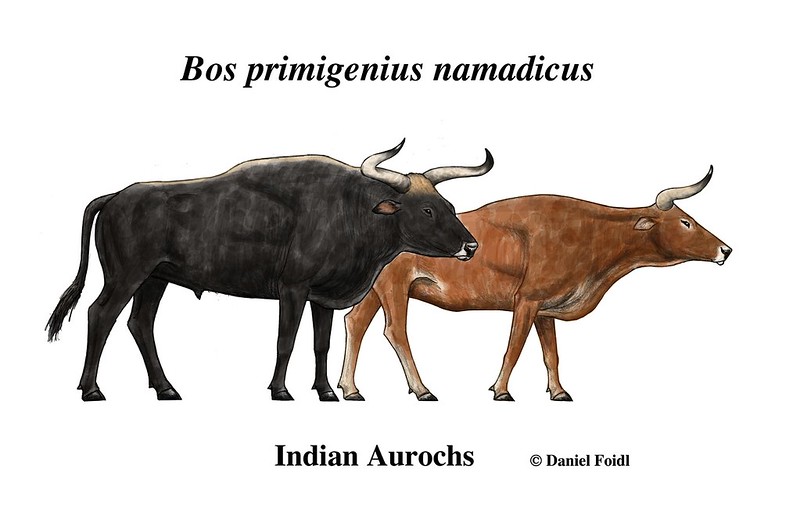
Putting everything together, it turns out that although we actually do not know much about this subspecies’ appearance directly, we can infer a lot of things when approaching it systematically. Based on this, I created this reconstruction:


I also gave my Indian aurochs a slightly longer dewlap, because bovids tend to have long dewlaps for display and cooling in warmer habitats (and hairy appendages like beards in colder ones). There is the possibility that the Indian aurochs also had a kind of hump that is visible in its zebuine descendants, it could have served as an additional tool for cooling down and also for storing fat (the Indian aurochs probably dwelled more arid environments than the Gaur or Eurasian aurochs). But the zebuine hump mainly consists of a hypertrophied rhomboideus muscle that actually serves no visible purpose and has no effect on thermoregulation or food reserve [2]. Unambiguous depictions of the Indian aurochs might help solving that question. I think the zebuine hump is too speculative for me to include it in my drawing and I am not convinced of its presence, but I cannot rule it completely out yet. There is an engraving in the Bhimbetka rock shelters from the Pleistocene which may show the aurochs and has no zebu hump. The depicted animal definitely has an eel stripe, but because this eel stripe is dark it could also show a Banteng, or a Kouprey (the horn tips look a bit bristled).

The phenotype of modern zebuine cattle is very derived and gives them a quite weird appearance. Apart from the fleshy hump and the long dewlap, they have hanging ears, a floppy body and horns of various shapes and sizes. Clearly there is no known zebuine breed that resembles their wild type as much as some southern European taurine breeds resemble their respective wild type. The first depictions of zebu-like cattle were date back 6000 years ago, but it is possible that more-primitive zebuine cattle still were around at that time. I have no likely explanation for why there are no truly primitive zebus left; they were not domesticated significantly earlier than taurine cattle. Perhaps the disappearance of primitive zebus was due to conscious selection or simply coincidence. However, there still are some zebuine breeds that preserve some aurochs-like features.

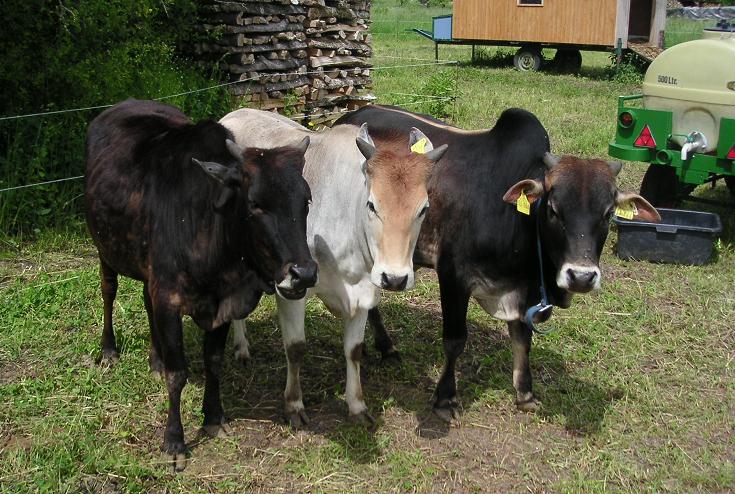
Miniature zebus with aurochs-like coat colours (photo: Markus BĂĽhler) 

Some miniature zebus have a coat colour very reminiscent of the aurochs, even displaying sexual dichromatism. But this breed is quite small, stubby, has tiny horns with a deviant curvature and many of them have taurine introgression.

 
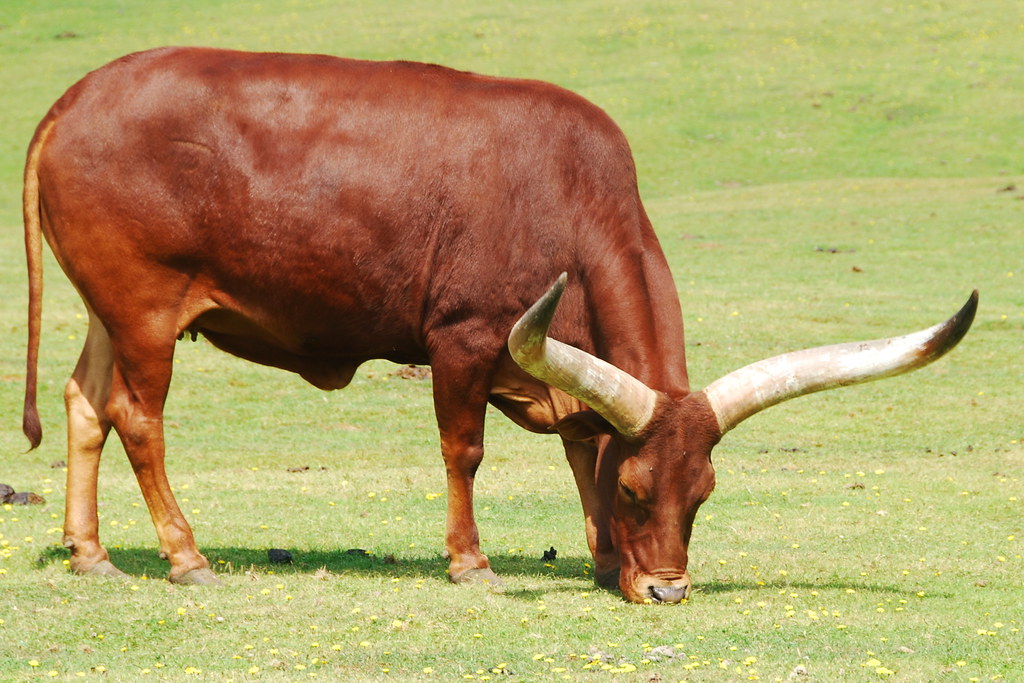
Watussi cow with remotely aurochs-like horns (Photo: Marc Thevenard)
Watussi cattle are taller and slenderer, but do not have the wild colour. Their horns sometimes have an excellent curvature, and their huge dimensions are useful for compensating the small horns of other breeds. Very likely Watussi is no purely zebuine breed as well.

Gudzerat zebu (Photo: Marleen Felius)
Kankrej zebu
The Gudzerat/Kankrej (both breeds are nearly identical) have a grayish wild colour with a reduced sexual dimorphism (much like Steppe cattle). Their horns are very upright, but apart from that, have a useful curvature and also decent dimensions. This breed has no taurine introgression as far as I know.

Although quite satisfying results might be achieved by crossing and selective breeding with breeds like these three, it is clear that the most suitable animals for effigy breeding with zebus are yet to be found. What such a “Wild zebu project” needs before actual breeding starts is: research!
In fact, we don’t know much more about the Indian aurochs and primitive zebus than the Heck brothers knew about the European aurochs and primitive taurine cattle ninety years ago. To ensure that such a project is a success, one has to

1. Collect more material of Bos primigenius namadicus
Be it bone material that tells us more about the morphology, habitat preference and extinction of this subspecies or artistic depictions that could provide clues about its external appearance.

2. Research on zebuine breeds, locating the most primitive breeds
While those three breeds I took as an example may provide some useful features, most zebus outside India are mixed with taurine cattle and looking for good Indian breeds that are hardly known in Europe may uncover not only pure (I am no fan of the purity cult anyway) but also more primitive zebus than those we usually see.

I think that only after such research is done the actual breeding should be started. I am sure that virtually all Indian zebus are hardy, robust and heat-tolerant landraces, but it would be best if such a “Wild zebu project” would also be carried out in India, in order to keep the animals in a semi-feral state in the habitats they are supposed to be living later on.
Although some native Indian zebu breeds may be more primitive and aurochs-like than those breeds usually known in Europe, it may turn out that zebus do not preserve enough phenotypic features to reconstruct the appearance of their wild type completely. I consider that likely because all zebus we know of lack the athletic body that is displayed by at least some taurine cattle, most have very derived horns and almost none of them have a long, aurochs-like skull. Also all zebuine breeds that we know of have a the typical, hypertrophied rhomboideus muscle. However, not all zebus have a really huge hump, actually the hump is quite small in some Indian and south-east Asian zebus. Another idea which is worth considering that some breeds which previously were considered taurine cattle or taurine hybrids in southern Asia might actually represent primitive, humpless zebus. This would need to be genetically tested and would be the third task of the research that yet has to be done.
 
This is what the "wild zebu" could look like
This photographic reconstruction by Jochen Ackermann on Wikipedia illustrates what I think is achievable with selective breeding with zebus. It would be interesting to see how these “Wild zebus” would look like after living several generations in the wild, perhaps even with pressure from predators. They’d certainly get more swift and athletic, their zebu hump might get smaller until it disappears while the neck and shoulder region gets developed stronger and the horn shape would also be refined.

Actually there are Zebu populations living feral, such as in the Kuno Wildlife Sanctionary. These cattle have been reintroduced recently, are a mix of several zebus and serve as “buffer prey” for the big cats until viable populations of genuine large herbivores are available for them, making them the only domestic descendants of the aurochs that are exposed to large felines. Let’s hope they are not short-sightedly removed after that stage because they will develop into a fascinating dedomestication example and one of the few (or even only?) feral zebus to date.
 
Feral zebu in the Kuno wildlife sanctuary 
But what is the point of creating an aurochs-like zebu breed at all? Well, it’s the same reason why authentic proxies for the European aurochs are desirable. The aurochs was a native large herbivore in India and fulfilled a niche that others do not (f.e. it likely inhabited dryer and more open habitats than the Gaur). The Kuno Wildlife Sanctuary, Gir Forest or the Rhanthambore National Park are suited wildlife refuges which might be a good place to reintroduce and dedomesticate the “Wild zebu”.


Literature

[1] Cis van Vuure: Retracing the Aurochs - History, Morphology and Ecology of an extinct wild Ox.
[2] McDowell, McDaniel, Hooven: Relation of the rhomboideus (hump) muscle in zebu and European type cattle. 1958. 

Friday, 16 August 2013

The Liebenthaler horse


Another horse breed, besides the Heck horse, which is actually the result of a breeding-back attempt is the Liebenthaler horse, also from Germany. I haven’t mentioned this breed before yet because I considered it just another dilution of the Konik like the DĂĽlmen Pony (nope, the DĂĽlmen Pony is not a remnant of the wild horse). But seemingly this doesn’t appreciate it enough.

The breed originated in 1960, when JĂĽrgen Zutz wanted to rebreed the European wild horse. For this purpose, he crossed Fjord horses with Koniks and a Heck horse mare. Today there is a herd of more than 100 individuals living freely all year round in a zoo in Liebenthal, Brandenburg.

Apparently the Konik left its strongest mark in the breed. The Liebenthaler is no sensation, it is yet another Tarpan-like breed with the usual appearance, size, behaviour and probably also ecologic capacities. But what I find interesting is the combination Fjord x Konik, because it results in a population of black and bay dun horses (apparently there are also some Sorrel and isabelline horses in the herd). The animals look nice overall, add some Exmoor and perhaps a bit of Przewalski and you get a decently Tarpan-like horse herd.


Tuesday, 13 August 2013

History lesson Pt.II: The founding breeds of Heck cattle


To know what we are dealing with, it’s important to have a look at the breeds that were used to create modern Heck cattle. This post discusses which breeds might have the largest influence on modern-day Heck cattle, and not to be a critical review of the Heck brother’s experiment. For this, you can have a look at Cis van Vuure’s book Retracingthe Aurochs – History, Morphology and Ecology of an extinct wild Ox, 2005.
One problem is that the Hecks did not keep track of their breeding after the early 30s, so that the pedigree of particular Heck cattle individuals was actually unknown until an international breeding book as created in 1980. Therefore, we have to guess which breed left the strongest mark in Heck cattle by looking at the history of the breed and the phenotype displayed by contemporary individuals.

As the Berlin lineage bred by Lutz Heck died out during WWII and probably did not
contribute to the remaining Heck cattle, the breeds used by Heinz Heck are in the focus of our interest, which are:

Angeln cattle* No wild colour, dairy breed, small horns of variable curvature
Black-pied lowland cattle (old lineage of the Frisian) no wild colour, dairy breed, small horns of variable curvature
Braunvieh grayish-brown wild colour with strongly reduced sexual dimorphism, dairy breed but comparably slender, small horns of variable curvature
Murnau-Werdenfelser wild colour with reduced sexual dimorphism, dairy breed, small horns of variable curvature
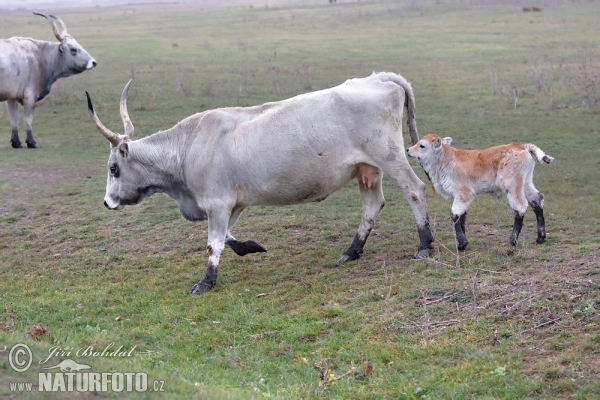
Hungarian/Podolian Steppe cattle** whitish wild colour with greatly reduced dimorphism, usually slender body, large but upright horns
Highland cattle no wild colour, small and stubby body, long horns of variable curvature
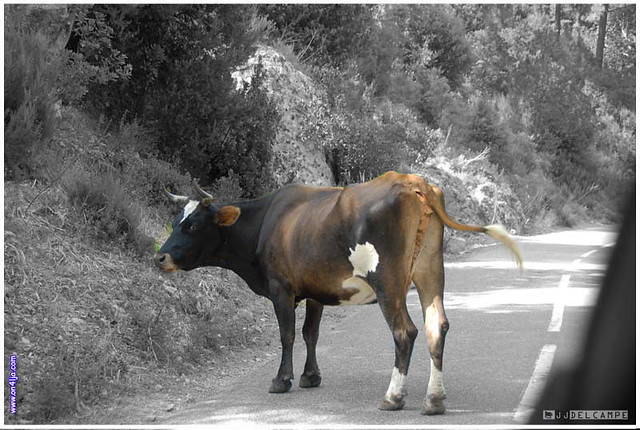
Corsican cattle wild colour, body slender but not athletic, small horns of vaguely aurochs-like curvature

* as an interesting side note, the Angeln cattle were smaller and slenderer back these days: http://www.anglerrind-az.de/img/geschichte-head.jpg
** These are almost identical breeds, therefore I will refer to them only as Steppe cattle

For whatever reason, Heinz Heck relied more on central-European dairy breeds with little resemblance to the aurochs than his brother did, who used southern breeds to a large extent. The “first Heck cattle” was a bull born in 1932, which was an F4 individual that consisted of 75% Corsican cattle and 25% a mix of Steppe cattle, Angeln cattle, Highland and Lowland cattle. After that bull was born, Heinz Heck added Braunvieh and Murnau-Werdenfelser. If he also included English Park cattle and crosses from his brother is dubious, because the documents of the Hecks are unclear about this. Interestingly, H. Heck remarks he learned that using Steppe cattle, Highland cattle, Fighting cattle and Texas longhorn is the fastest combination to gain an aurochs look-alike (although neither he nor his brother used Texas longhorn, by the way).
Although the Hecks themselves did not continue their experiment after WWII, some further crosses took place in other zoos. For example, Hungarian steppe cattle were crossed-in in some herds again. Also a Watussi cow was crossed-in in a German zoo in 1952, resulting in a crossbred cow that left its trace in the Neandertal lineage and their descendants.

That’s how far the history of the breed goes. Now let’s look at the phenotype of modern Heck cattle in order to see the influence of the respective breeds.
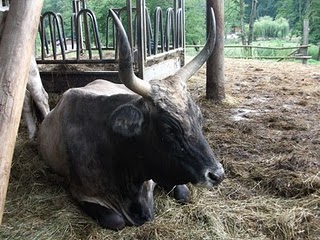
Black-pied lowland cattle and Angeln cattle have little diagnostic features in this selection of breeds, probably you’d only recognize their influence by their colour genes. Angeln cattle lack, as far as I know, the wild type allele (E+) but carry the e mutation instead, resulting in a red coat without any dark pigmentation. This colour pops out in some Heck cattle, but is not very common. Black-pied lowland cattle carry the ED mutation instead, resulting in a uniformly black coat in both sexes and also calves. I am not sure if this occurs in modern Heck cattle. But black-pied cattle also carry alleles for white spotting on the S locus. Unfortunately, Heck cattle with white spots keep showing up in various lineages, therefore the influence of the one black-pied bull is still there. Most Heck cattle have the wild colour gene E+, and display a large degree of variation concerning the expression of this feature. Within this diverse pool, the colours of all the wild type coloured founding breeds show up (Steppe cattle, Murnau-Werdenfelser, Braunvieh, Corsican). Grayish, beige or whitish individuals are common “throwbacks”, indicating a strong presence of Steppe cattle. Although the colours of Highland cattle is rarely seen among Heck cattle (which in fact include the same colour genes as in Angeln and black-pied cattle, or the Simmental dilution gene that results in a lighter coat), other features, such as the body shape (if you imagine it without the long coat) or horn shape of many Heck cattle, can resemble Highlands to a large extent. Some even show a longish coat all the year around. The horn shapes and dimensions among Heck cattle are extremely variable, but the lyre-shaped horns, present both in Highland and Steppe cattle, are common among Heck cows, and the long, straight and upright horns of Steppe cattle bulls are common among bulls as well. Heck cattle display nearly all types of body shapes and proportions among their founding breeds, but many resemble Steppe cattle, Corsican cattle, Murnau-Werdenfelser and Braunvieh. Looking at the overall appearance, some Heck cattle really look like nearly-aurochs-coloured Steppe cattle or Corsican cattle with larger horns. There are not many photos of Corsican cattle in the web (and many of them are influenced by other breeds already), but those that I have seen show a clear resemblance with Heck cattle. The Corsican seems to show almost every colour variation present in Heck cattle (except very lightly coloured ones), and the horn curvature also is very alike. Some Corsican cows are virtually indistinguishable from some Heck cows, except that the latter tends to have longer horns. The Heck cattle’s history also implicates that both Corsican and Steppe cattle left a strong mark in the breed, because the former was used by H. Heck to a large extent and Steppe cattle played an important role in the experiment as well and was crossed in subsequently again. Also Watussi might not have been unimportant, although only one crossbred cow was used. Its influence probably enabled the breed to gain large and well-curved horns that are seen among several German Heck lineages today, although it is likely that not all Heck cattle have that half-Watussi in their ancestry. ThisHeck bull from Germany also resembles Watussi in having a slightly downwards-facing pelvis, giving it a more rounded rear, and also the horns of this individual remind me of Watussi.

All in all, I came to the conclusion that the most important founding breeds of Heck cattle probably are Corsican cattle and Steppe cattle, followed by Highland cattle and Murnau-Werdenfelser/Braunvieh. A cross of 75% Corsican and 25% Steppe cattle probably results in an animal that is very alike some Heck cattle. And single individuals or even herds of that breed, on the other hand, resemble these four breeds to such an extent that it probably would be possible to breed an effigy of these out of the modern Heck population. But, due to inconsequent selection, features of virtually all founding breeds are still recognizable in single within the total of the modern Heck cattle population.
What follows now is a selection of individuals of the founding breeds that show a decent similarity with Heck cattle (I own none of these photos):

Corsican cattle greatly resembling Heck cattle
(nevermind the white spots, these are the result of crossbreeding)

Steppe cattle resembling some Heck cattle
Murnau-Werdenfelser resembling Hecks
Braunvieh cow resembling some Hecks


Literature