There is so
much I want to write about, and so little time for it. This time, I finally
completed my post on one of the most primitive cattle breeds in the world: Toro
de lidia, the Spanish fighting bull. Fighting with bulls, as abominable as it is,
has a long history in Southern Europe. Back in the antiquary, even wild aurochs
bulls were used for arena fights in ancient Rome. It were always the most
aggressive bulls that were chosen for bullfighting, and during the 18th
century, systematic breeding with domestic bulls from various cattle populations
that showed the feistiest behaviour was started in order to breed a cattle
race used virtually exclusively for bullfighting. Today these cattle are known
as Lidia or Toro de Lidia, the Spanish fighting bull. Because Lidia were
selected primarily on their fighting spirit and originate from various cattle
populations, it is a variable breed – variable in appearance, size and
behaviour – and is divided into several lineages: Miura, Casta Navarra, Cabrera,
Galardo and others. These lineages are reproductively isolated from each other,
but taking Lidia as a whole, it is a genetically diverse breed. It is likely
that the breed also has influence from African cattle [1].
What makes
the fighting bull special? First of all, it is the only (non-feral) cattle
breed that was not selected for meat or milk production, but for agility and
feistiness. It is well-known that they range freely all the year round and the
fact that bulls that win fights with other bulls are chosen as breeding bulls –
a kind of man-made natural selection – helped to retain primitive traits that
are not apparent in many other breeds. Fanciers of the breed claim it is the
most aurochs-like cattle around today and also Cis van Vuure, author of themost comprehensive book on the aurochs up-to-date, is very enthusiastic about
Lidia.
 |
| Lidia - the cattle breed with the most aurochs-like, muscular body |
Appearance
Lidia is
remarkable for being the only domestic cattle breed in the world that has
retained a very aurochs-like body conformation. It is true that the proportions
are variable, some bulls are longish while others have a short trunk like in
the aurochs, but nearly all of them have a very muscular body with a large
shoulder hump. This hump (not to be confused with the fleshy hump of zebus or
with the neck crest) is formed by tall processus spinosi at the shoulder area
and large muscles like the M. trapezius attach to it. This is a skeletal trait
and therefore coded genetically and not influenced by how you raise the cattle.
Both bulls and cows have it, and it seems to be as prominent as in the aurochs;
this is unique among most domestic cattle and a big plus for the Lidia breed.
The waist is usually very slender (though not in all individuals), similar to
wild bovines of similar build like Wisents and bison. Most Lidia bulls that we
see are subadult, bulls get continuously more massive after their 6th
year. Nevertheless, Lidia is still the most athletic cattle breed. The legs in
fighting cattle tend to be a little shorter than in the aurochs, but some
examples have just perfect proportions.
 |
| Well-proportioned athletic Lidia bulls |
 |
| Lidia cow with correct coat colour and horn curvature |
Lidia is
one of the few large-headed cattle breeds and many have a really elongated
skull shape. The frontals are long, the nasals are long, and the eye sockets
are prominent. The head profile is either straight or more or less concave.
Also Lidia has prominent curly hair between the horns, giving them the fierce
appearance that is described for the aurochs [2]. If you want to know what a
living aurochs looked like regarding body shape, proportions and head shape,
some Lidia give you a perfectly accurate impression. The horns usually are
medium-sized and nearly always direct forwards. The horn shape does either
roughly or very closely resemble that of the aurochs, depending on the individual.
Unfortunately,
Lidia is very variable concerning the coat colour and has many colour mutations
that are undesirable for breeding-back. Many Lidia have the black allele Ed
instead of the wild-type colour allele E+, resulting in a totally
black colour in bulls, cows and calves (however, this allele is dominant and therefore easy to breed out). Additionally to that, many Lidia also
carry genes for white spotting, resulting in a “Holstein colour”. You also find brindle and roan animals. Nevertheless, there are
still enough wild-coloured Lidia and since wild-type colour is recessive under
black, it should be relatively easy to fix. Then the next task would be to
breed for a more-marked colour dimorphism since many wild type coloured Lidia bulls
show the reddish colour of cows.
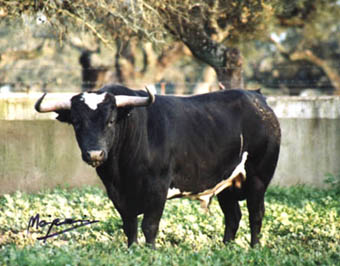
Some
examples of domestic-coloured Lidia…
 |
| Roan coloured bull |
 |
| Holstein coloured Lidia |
 |
| Brindled bull (very good body shape though) |
… and
wild-type coloured Lidia.
 |
| Wildtype coloured Lidia cows |
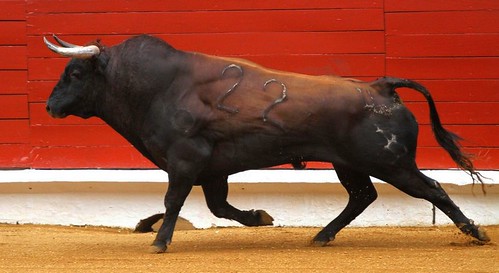 |
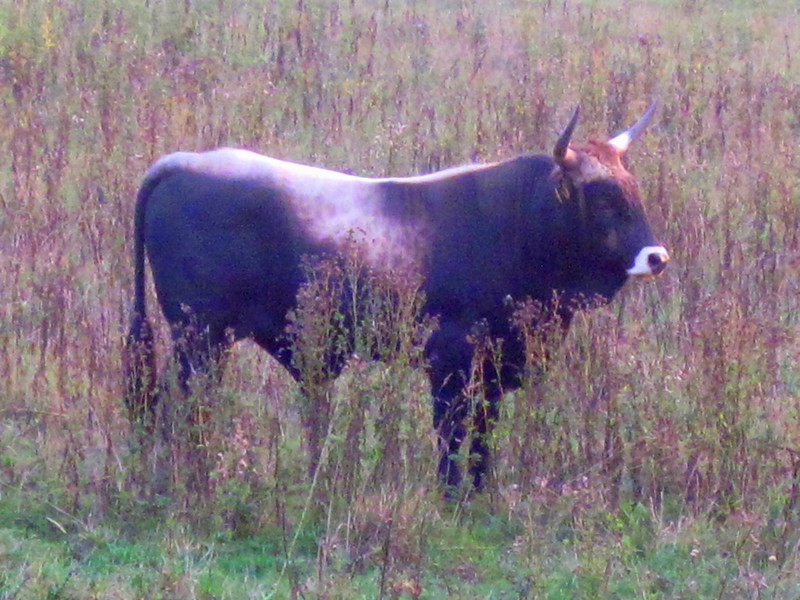
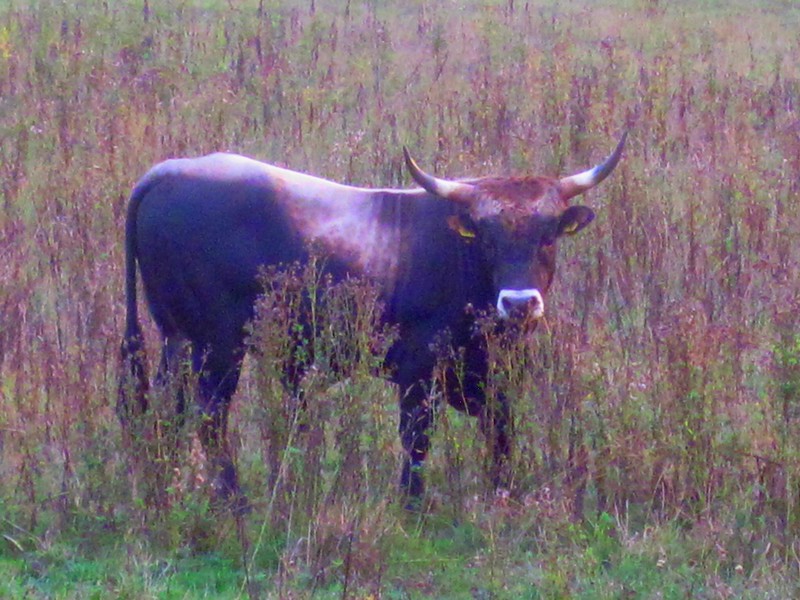
| Wildtype coloured bull (the saddle shouldn't be present in the aurochs) |
Another
“problem” concerning the phenotype of Lidia is their small size. Spanish
fighting bulls are bred for being small so that they are easier to fight with,
and their current shoulder height varies from 110 to 140 cm, depending on the
lineage, which is very small even considering that Southern European aurochs
likely were slightly smaller than those in central and northern Europe. The
relatively large bulls that sometimes do appear in the breed are usually selected
out.
The udder
size is varying, in some cows it is almost invisible from the side, as in wild bovines.
The dewlap is either small or medium-sized.
Behaviour
The
behaviour of Lidia is controversial in breeding-back. While the one side
appreciates their deer-like shyness and agility, the other side criticises
their high aggression when surprised or unable to flee. We know
that it is possible to select on behavioural traits and those are laid down in
the genome to a certain degree [3]. Both cows and bulls of the Lidia breed have been
screened and selected on their fighting spirit for centuries, what certainly augmented their
level of aggression and nervousness. But does that mean we have to exclude them
categorically from breeding-back? In my opinion, not at all. First of all, if
we describe the behaviour of Lidia as “unnatural”, we also have to attribute
that to all gentle and docile breeds, because these are certainly no traits of
wild bovines. Secondly, if you can select for
a trait, you can also select against
it. In fact, there are always Lidia bulls that get culled because they do not
show enough aggressiveness for bullfighting. Certainly, very shy and aggressive
cattle can be very difficult to handle, at least in grazing projects where most
of the breeding-back takes place. Therefore, it is also of practical use to chose
the less-aggressive Lidia for an aurochs project that is centred around this
breed.
Ecology
Of course
it’s time for my standard sentence now: Lidia is a very hardy breed that is
used to poor foliage, lives freely all the year round and is used to all kinds
of weather and so on. Like virtually all primitive Iberian cattle. But what is
interesting is what I have been told by the ABU breeders: the only cattle that
never seized the supplementary food in the Lippeaue during winter were Lidia
cows. Perhaps they are, thanks to their semi-feral history, even more hardy
than Sayaguesa or Heck cattle.
Predation
Lidia is
one of the very, very few domestic cattle that are known to defend themselves successfully from – no, not just wolves – big cats. Fighting bulls defeated even
lions in arena fights of the past [2], which is very impressing.
 |
| Correct colour, athletic body |
In essence,
I think the Spanish fighting bull is a precious breed for breeding-back. Their
athletic body and high shoulder spines (“hump”) in combination with their
aurochs-like proportions makes less-derived Lidia unique among (non-feral)
domestic cattle. Their long snout is certainly very desirable as well. Some
good Lidia individuals are more aurochs-like even than very aurochs-like breeds
like Maronesa or Sayaguesa (or good Hecks), apart from their size. Since the
global Lidia population contains almost all of the desired aurochs features, a
project using only Spanish fighting cattle could bring interesting results. The
idea for such a project was brought up first by Cis van Vuure in an article
from 2003, and proposed by the same author again in 2005 [2]. The high number
of aurochs features in Lidia, as much as their unique breeding history, makes
it unlikely for me that their primitive phenotype is just a by-product of
coincidental crossbreedings, very likely it is truly an ancient breed (I am
looking forward until something on the genetic relationship to other cattle
breeds and the aurochs is published) and therefore worth to play an important
role in another breeding-back attempt. Their behavioural minus point – which is
mainly a practical one because we don’t know the aggression level of the wild
aurochs – probably can be reduced by selection and/or crossing-in of more
docile breeds. Their long history of living nearly feral (ok, this is also true
for other primitive breeds) and their ability to defend against predators also
makes them very suitable for the creation of a new wild bovine.
For such a
project, it would be wise to pick the largest and least-aggressive Lidia with
wild colour, good horns and aurochs-like proportions. In order to gain a
sufficient genetic diversity, not only dozens of individuals but also of
various lineages should be chosen. They should be selected for:
- Well marked
colour dimorphism
- Wild colour
with eel stripe (in bulls) and mealy mouth
- Short
trunk, long legs
- Elongated
skull shape
- Correctly
curved, large-sized horns
- Large body
size
- Less
aggressiveness/nervousness
Perhaps
after few generations already, a Lidia strain that looks and behaves almost
like the aurochs would be established – but these Lidia primitivo (as I
like to call this hypothetic breed, a hint to how Tauros Project calls the
most-primitive Maremmana cattle) would still be much too small (probably about
as small as Heck cattle) and their horn dimensions would probably not be really
satisfying either. Supplementing them with Chianina to add size and leg length and
a breed to add good horn dimensions without ruining the curvature (perhaps very
large-horned Heck cattle or Watussi with useful horns) would insert these
features into the population.
The time
for such a project would be right – bullfighting is getting less popular and
hopefully it will be prohibited in the near future. But the end of bullfighting
also means the end of the fighting bull. Already today many Lidia show clear
signs of intermixing with derived breeds to increase their economic
productivity, resulting in a loss of aurochs-like features. It would be a big
shame if the last primitive Lidia would diminish without being used in
breeding-back, since no other breed contributes such an athletic, aurochs-like
body shape and overall appearance. Lidia definitely has negative aspects as
well (like any breed), but those could be reduced by selection.
A Lidia
project would hopefully be fruitful within few years, it would save the most
precious examples of that breed and unite their aurochs-like traits. It is also
a perspective for animal welfare, because it provides a new future for the
fighting bull: buying and collecting several dozens of fighting cattle (such
numbers are necessary to build up a sufficient gene pool) and giving them a new
and good future living in reserves and dying a natural death must sound
appealing!
Literature
[1] Cortes
et al. 2011: Y chromosome genetic diversity in the Lidia bovine breed: a highly
fragmented population
[3] van Vuure, Cis: Retracing the Aurochs - History, Morphology
and Ecology of an extinct wild Ox.
2005.
[3] Broucek et al. 2008: Genetics of behaviour in cattle.